

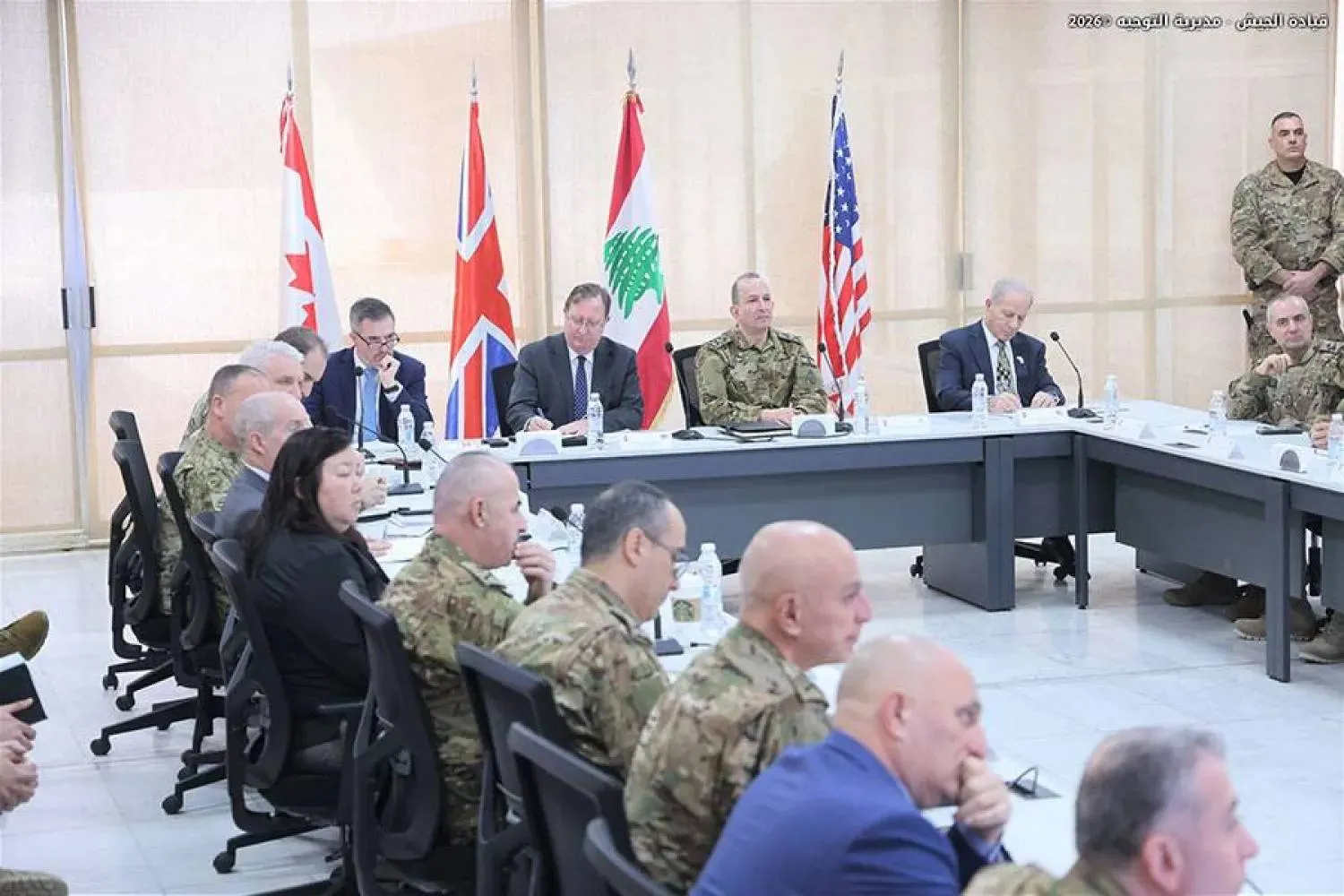

Lebanese Army Affirms Commitment to Protect Borders with Syria

Lebanese Army Commander General Rodolphe Haykal holds a meeting of the High Supervision Committee on the Border Protection Assistance Program in the presence of British, US and Canadian Ambassadors to Lebanon (Lebanese Army Directorate of Orientation) 
TT

Lebanese Army Affirms Commitment to Protect Borders with Syria

Lebanese Army Commander General Rodolphe Haykal holds a meeting of the High Supervision Committee on the Border Protection Assistance Program in the presence of British, US and Canadian Ambassadors to Lebanon (Lebanese Army Directorate of Orientation) 

The Lebanese Army on Wednesday reaffirmed its commitment to protect the border with Syria, stressing that achieving this goal successfully “requires qualitative military support.”

The announcement came in parallel with preparations to hold a fundraising conference in support of the country’s army, scheduled to be held in Paris on March 5.

The Lebanese Army is deployed along its northern and eastern border with Syria, where its forces work on implementing security measures and combat smuggling.

Other tasks include deployment on the southern border with Israel, implementing the Lebanese government’s plan to dismantle all armed militias, as well as protecting internal stability and combating drug smuggling.

In this regard, a meeting of the Higher Supervisory Committee on the Assistance Program for Land Borders Protection was held in Yarzeh, in the presence of Lebanese Army Commander General Rodolphe Haykal, British Ambassador to Lebanon Hamish Cowell, US Ambassador, Michel Issa, Canadian Ambassador Gregory Galligan, and members of the joint working team.

In a statement, the Lebanese Army Command said the meeting highlighted the implemented phases of the program and the necessary steps to support the LAF units tasked with protecting Lebanon’s eastern and northern borders and combat smuggling and illegal activities.

The British embassy said in a statement that the ambassadors underlined the LAF’s pivotal role in maintaining security and stability during a period of significant challenge.

They stressed the need to support the military institutions to further strengthen Lebanon’s security, stability, and territorial integrity.

“The Committee convened to review progress and challenges in securing Lebanon’s eastern and northern borders, and reaffirmed support for the LAF’s (Lebanese Army’s) efforts to reinforce state authority at this critical time,” the British embassy said.

For his part, General Haykal said, “We are committed to protect the borders and we have made many efforts and sacrifices to this end.”

However, he added, “achieving this goal successfully requires qualitative military support, given the size of challenges on the northern and eastern borders.”

Haykal hailed the US, British, and Canadian authorities for their continuous support to the army, which plays a fundamental role in enhancing the capabilities of military units and enabling them to carry out their missions amid the current challenges.



Iran Further Undermines Yemen’s Sovereignty as Houthis Violate the Truce

Smoke rises following airstrikes on Sanaa airport in Sanaa, Yemen, 13 July 2026. (EPA)
TT

Iran Further Undermines Yemen’s Sovereignty as Houthis Violate the Truce

Smoke rises following airstrikes on Sanaa airport in Sanaa, Yemen, 13 July 2026. (EPA)

Yemen's legitimate government said it struck Houthi-controlled Sanaa airport on Monday, its biggest flare-up in years with the militants.

The government said it had wanted to prevent an Iranian plane from landing in the capital, after failing to convince a Houthi delegation that went to Tehran for the late Iranian supreme leader's funeral to board a Yemenia flight instead.

The latest escalation threatens to unravel a truce that has been holding since 2022 despite expiring, and comes at a time of heightened tensions as the United States and Iran trade attacks impacting the Gulf and traffic in the Strait of Hormuz.

Yemen's Defense Ministry accused the Houthis of "allowing an Iranian plane to violate Yemeni territory; consequently, the airport runway was targeted".

Following the strikes, the head of Yemen's Presidential Leadership Council, Dr. Rashad al-Alimi, said he had "ordered that the scope of the confrontation not be expanded".

He held the Houthis “fully accountable for the escalation,” saying they had insisted on welcoming a new Iranian flight despite objections and attempts to contain the crisis and avert more tensions.

The government had run out of political and legal options before the arrival of the flight. He added that the government had offered to operate the flight through the Yemenia airline seeing as it is the national carrier.

The Houthis rejected the proposal and insisted on welcoming the Iranian plane outside official channels, stated al-Alimi, saying this was evidence that the militants “were not serving the people or easing their suffering, but deepening the division and imposing a status quo that serves foreign agendas.”

He ordered the army and security forces “to be on the highest level of alert and take the necessary political, diplomatic, legal and military measures allowed by the constitution and international law to protect Yemen’s airspace and land and sea ports.”

Prime Minister and Foreign Minister Shaya al-Zindani held an extraordinary government meeting in the interim capital Aden to discuss the escalation.

The cabinet tasked the Foreign Ministry with intensifying its contacts with friendly nations and regional and international organizations to urge them against the use of Yemen’s airspace outside official channels.

Smoke rises after reports of an airstrike hitting near the Sanaa International Airport, as seen from Sanaa, Yemen, July 13, 2026. (Reuters)

It held the Houthis “fully responsible for the escalation and its consequences”, accusing them of “undermining peace efforts and exposing Yemen and the region to more dangers”.

It also held the Iranian regime responsible for the escalation given its continued support to the Houthis.

Ahead of the strike, the Defense Ministry had urged citizens to evacuate the airport and its vicinity for their safety.

It vowed that it would “deal with any party or plane that tries to violate Yemen’s airspace or orders issued by relevant authorities.”

Government authorities had for days warned that flights to Sanaa should only take place through state institutions.

Houthi sources later said the plane, which was carrying a Houthi delegation, landed in Hodeidah airport.

Yemeni authorities held the Houthis responsible for the escalation for insisting on imposing their own arrangements away from official regulations.

Monday’s escalation took place after the Houthis insisted on receiving Iranian flights at Sanaa airport amid the government’s refusal to operate flights outside official channels.

The United Nations Special Envoy for Yemen, Hans Grundberg, urged the parties to turn to diplomacy, saying his office has "contacted military representatives from all sides".

Earlier in the day, the Yemeni government accused the Houthis of preventing an International Committee of the Red Cross (ICRC) aircraft from leaving Sanaa airport and holding the pilot and co-pilot "hostage".

"All ICRC staff and the crew of the plane are safe and accounted for," ICRC spokesman for the Middle East Hachem Osseiran told AFP.


Spanish PM to Visit Algeria in Bid to Mend Ties

Spain's Prime Minister Pedro Sanchez talks to media during a visit in the area of a wildfire that killed at least 13 people, at the command post set in Turre, Almeria Province, on July 13, 2026. (AFP)
TT

Spanish PM to Visit Algeria in Bid to Mend Ties

Spain's Prime Minister Pedro Sanchez talks to media during a visit in the area of a wildfire that killed at least 13 people, at the command post set in Turre, Almeria Province, on July 13, 2026. (AFP)

Spanish Prime Minister Pedro Sanchez will travel to Algeria next week for an official visit aimed at ending years of tensions between the two countries over the Western Sahara dispute, his office said on Monday.

The visit on July 20 will be Sanchez's first trip to Algeria since relations deteriorated in 2022 after Madrid shifted its longstanding position of neutrality on Western Sahara and backed Morocco's autonomy plan for the disputed territory.

Spain's move was part of a diplomatic rapprochement with Morocco, ending its decades of ambiguity on the issue but angering Algeria, which supports the pro-independence Polisario Front, which opposes Rabat's claim over the former Spanish colony.

Western Sahara, a mineral-rich desert territory with significant phosphate reserves and fishing resources, was controlled by Spain until 1975.

Morocco now controls most of the territory.

In response to the policy shift in Madrid, Algeria suspended a 2002 friendship treaty with Spain and restricted trade ties between the two countries.

Relations have gradually improved since 2025, with commercial exchanges beginning to recover.


New Round of Lebanon-Israel Talks to Begin on Tuesday

 An Israeli military vehicle covered with netting to protect against FPV drones patrols on the Lebanese side of the border, as seen from an undisclosed location along the border, 13 July 2026. (EPA)
An Israeli military vehicle covered with netting to protect against FPV drones patrols on the Lebanese side of the border, as seen from an undisclosed location along the border, 13 July 2026. (EPA)
TT

New Round of Lebanon-Israel Talks to Begin on Tuesday

 An Israeli military vehicle covered with netting to protect against FPV drones patrols on the Lebanese side of the border, as seen from an undisclosed location along the border, 13 July 2026. (EPA)
An Israeli military vehicle covered with netting to protect against FPV drones patrols on the Lebanese side of the border, as seen from an undisclosed location along the border, 13 July 2026. (EPA)

The sixth round of negotiations between Lebanon and Israel are to begin on Tuesday in Rome, a Lebanese official told AFP on Monday.

The two-day talks will begin at 10.00am (0800 GMT), the official said, requesting anonymity.

An Italian foreign ministry spokesperson had earlier said the talks would be held on July 15 and 16, and Israeli Foreign Minister Gideon Saar had confirmed on July 7 that the negotiations would resume "next week".

The two countries, which have no formal relations, began direct talks in April after Tehran-backed Hezbollah drew Lebanon into the Middle East war by attacking Israel in support of Iran the month prior.

They recently reached a framework agreement that calls for Hezbollah's disarmament and a gradual Israeli withdrawal from occupied Lebanese territory while Lebanon's army deploys into "pilot zones".

But the agreement -- rejected by Hezbollah -- does not set a timetable for Israel's withdrawal, and Israeli officials have also vowed that their forces will remain in a "security zone" 10 kilometers (six miles) deep along the frontier for as long as Hezbollah remains armed.

A US military delegation met with Lebanon's army in Beirut last week to discuss the implementation of Israel's withdrawal from a first pilot zone.