

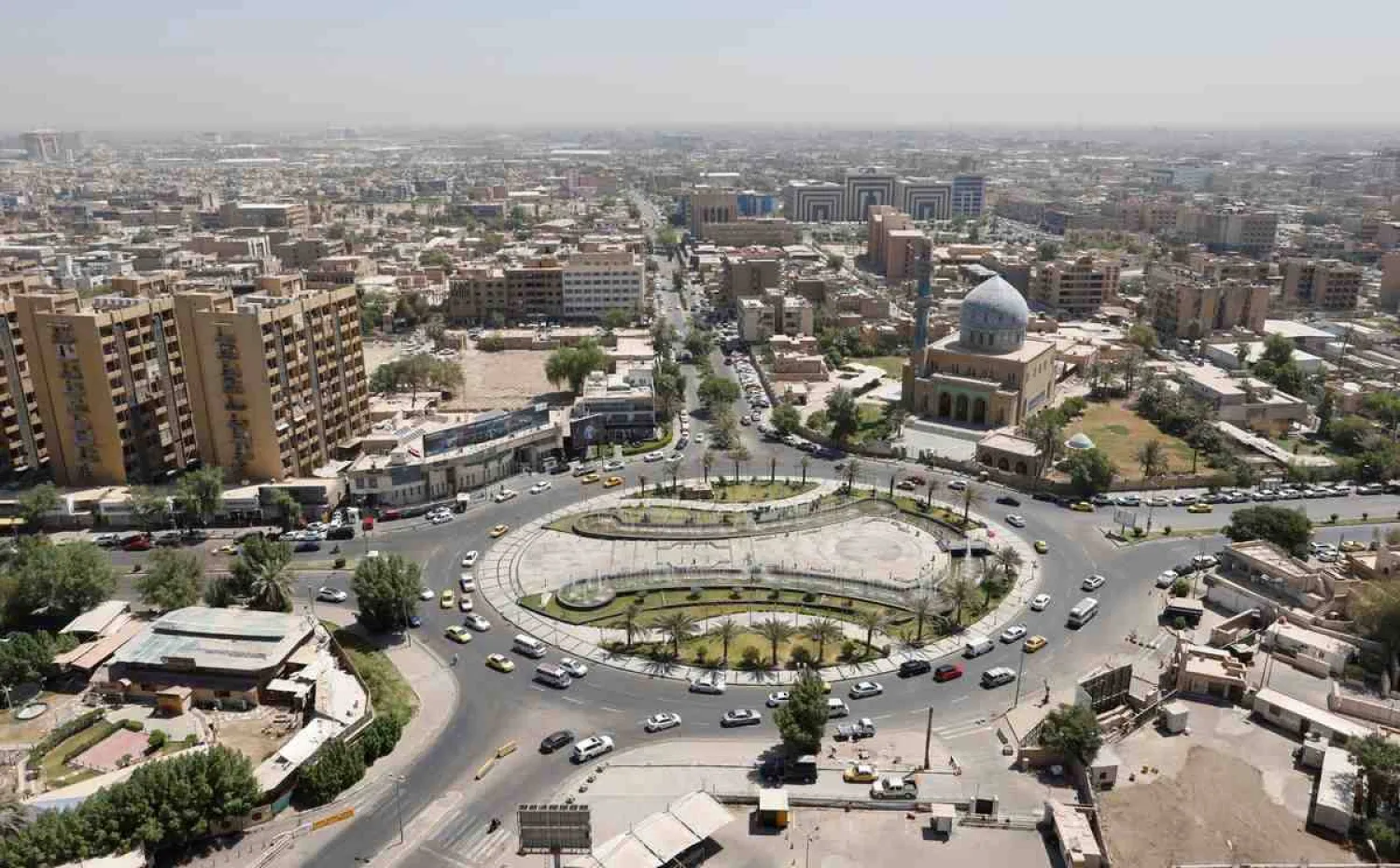

Iraq Majority Bloc Backs Nouri Al-Maliki as Next PM

A general view shows al-Firdous Square in Baghdad, Iraq July 27, 2022. (Reuters)
TT

Iraq Majority Bloc Backs Nouri Al-Maliki as Next PM

A general view shows al-Firdous Square in Baghdad, Iraq July 27, 2022. (Reuters)

Iraq's main Shiite alliance, which holds a parliamentary majority, endorsed on Saturday former prime minister and powerbroker Nouri al-Maliki as the country's next premier.

The nomination effectively guarantees Maliki, 75, the post that he last held more than a decade ago.

The shrewd politician is set to return to power today amid seismic changes in the Middle East, with Tehran's regional influence waning and tensions with Washington rising.

The Coordination Framework, an alliance of Shiite factions with varying links to Iran, said in a statement that it "decided, by majority vote, to nominate" Maliki for the position "as the candidate of the largest parliamentary bloc".

The statement spoke of Maliki's "political and administrative experience and his record in running the state."

After Iraq's November general election, the Coordination Framework, which includes Maliki, formed the majority bloc.

Soon after, it held heated talks to choose the next prime minister, along with other discussions with Sunni and Kurdish parties regarding other posts.

Iraq's parliament chose a speaker last month and should convene next to elect a new president, who will then appoint a prime minister to replace the incumbent Mohammed Shia al-Sudani.

By convention in Iraq, a Shiite holds the powerful post of prime minister, a Sunni is parliament speaker, and the largely ceremonial presidency goes to a Kurd.

Maliki, has long been a central figure in Iraq's politics and its only two-term prime minister (2006-2014) since the US invasion of 2003, which ended decades of rule by President Saddam Hussein.

- Hard task -

Maliki, leader of the State of Law Coalition, has increased his power and influence despite his controversial past, including widespread accusations of stoking sectarian tensions, and failing to stop the ISIS group in 2014.

He has been involved in forming alliances and his name was regularly put forward as a possible candidate for the premiership.

Seen as close to Iran, Maliki also has a record of coordinating with the US on Iraqi politics, particularly during his previous terms.

In a country that has for decades been a proxy battleground between the US and Iran, Maliki will likely face a daunting task as government formation has always been influenced by the two foes.

He will be expected to address Washington's longstanding demand that Baghdad disarm Tehran-backed factions, many of which are designated terrorist groups by the US.

Iraqi officials and diplomats told AFP last month that Washington had demanded that the eventual government exclude Iran-backed armed groups and instead move to dismantle them.

But most of these groups hold seats in parliament and have seen their political and financial clout increase.



Lebanon’s Weapons Monopoly Efforts to Shape International Support for the Army

Lebanese soldiers check the identity of a man in Marjeyoun, southern Lebanon. (Reuters file)
TT

Lebanon’s Weapons Monopoly Efforts to Shape International Support for the Army

Lebanese soldiers check the identity of a man in Marjeyoun, southern Lebanon. (Reuters file)

The understanding between the quintet committee for Lebanon and President Joseph Aoun over the planned conference in support of the army has raised questions on whether the countries friendly to Lebanon have been asking for guarantees related to the launch of the second phase of the state’s plan to impose state monopoly over arms.

The second phase tackles regions north of the Litani River, while the first covered regions south of it and extending to the border with Israel.

The conference on the army is set to take place in Paris on March 5.

Many believe that countries backing Lebanon are testing its seriousness in implementing the monopoly of weapons north of the Litani, particularly as Army Commander General Rodolphe Haykal is expected to present his plan to carry out the task in early February after securing cabinet approval.

Throughout, Hezbollah has firmly rejected cooperation with the government and army over the disarmament plan.

The president had previously said the army needs one billion dollars annually for 10 years, and last week asked security agency chiefs to prepare detailed reports on their needs to present to participants in the Paris conference.

Level of representation and aid

Security sources ruled out that the convening of the army support conference was tied to the implementation of the second phase of the disarmament plan. They argued that setting a fixed date for the meeting and having French President Emmanuel Macron chair it makes it very difficult for international parties to back away from holding it.

Sources told Asharq Al-Awsat that steps taken by the government and the army to monopolize weapons north of the Litani will be reflected in the momentum surrounding the conference, including the number of participating countries, the level of representation, and the amount of aid that can be secured.

If the international community senses concrete steps in this direction, support will be significantly greater, they said.

MP Ghada Ayoub, of the Lebanese Forces bloc, said once a date is set for a conference of this scale, it is rarely postponed unless very exceptional circumstances arise.

Therefore, March 5 should be treated as confirmed until further notice, she told Asharq Al-Awsat.

Ayoub stressed the need to distinguish between holding the conference and the scale of its outcomes.

The conference itself is not tied to a direct condition. Still, the level and type of support could be affected by the nature of the next phase and by the state’s ability to assert its authority, foremost by enabling the army to perform its role across all Lebanese territory.

Ayoub that the primary goal of the conference is to empower the Lebanese army and secure its financial and logistical requirements, as well as to address its needs and demands, because no state can be built and no stability can be protected without a strong, well-equipped military.

Riad Kahwaji, a researcher and writer specializing in security and defense affairs, said support for the army is an external political decision that hinges on its primary mission today which is to disarm Hezbollah.

Army leadership and the government are fully aware of this, he told Asharq Al-Awsat, noting that any potential assistance program will be centered on this task.

Kahwaji said that arming the military will proceed from the premise that confronting ISIS and al-Qaeda remains a task, but is no longer a top priority, as this role is now tied to the Syrian state.

As a result, the army’s primary armament will remain focused on protecting borders, maintaining internal stability, and imposing state monopoly over weapons.


Sisi: Militias, Parallel Entities Responsible for Destruction of Nations

21 January 2026, Switzerland, Davos: Egyptian President Abdel Fattah al-Sisi speaks at the World Economic Forum annual meeting in Davos. (Faruk Pin/World Economic Forum/dpa)
TT

Sisi: Militias, Parallel Entities Responsible for Destruction of Nations

21 January 2026, Switzerland, Davos: Egyptian President Abdel Fattah al-Sisi speaks at the World Economic Forum annual meeting in Davos. (Faruk Pin/World Economic Forum/dpa)

Egyptian President Abdel Fattah al-Sisi said on Saturday that “militias and parallel entities are a reason of the destruction of nations.”

Speaking on the 74th National Police Day, he stressed his country’s categorical rejection of “attempts to divide countries in the region, annex part of them, or establish parallel armies.”

He said the world is grappling with conflicts over land, resources and influence, and witnessing unprecedented ideological and economic clashes.

“The world has room for everyone. Monotheistic religions and human values reject the ugly practices taking place in the world that are threatening to destroy the system of international law and the world order that was formed after World War II,” he remarked.

“Egypt boasts state institutions that will remain factors of stability, security and protection,” he stressed, while warning of the “phenomenon of militias.”

Without giving a specific example, Sisi said that countries that believed militias could play a role in the state later discovered that these groups had a role in their destruction.

Moreover, he declared that Egypt will continue to stand against illegal migration, warning against the forced displacement of Palestinians from Gaza.

Their displacement will cause a new wave of migration towards Europe, which will not be able to withstand it, he added.


Obstacles Cloud Prospects for Safe Exit of Some Hamas Leaders from Gaza

A Palestinian girl sells chocolate bars at a market in Khan Younis, southern Gaza Strip, on Friday. (AP)
TT

Obstacles Cloud Prospects for Safe Exit of Some Hamas Leaders from Gaza

A Palestinian girl sells chocolate bars at a market in Khan Younis, southern Gaza Strip, on Friday. (AP)

Plans to allow a “safe exit” for some Hamas leaders and activists from Gaza are faltering amid strict Israeli conditions and unresolved demands tied to the full implementation of the ceasefire agreement’s second phase, notably disarmament and the handover of control in the enclave to a technocratic committee.

Three Hamas sources told Asharq Al-Awsat days ago that there was concrete movement to prepare lists of prominent leaders and activists, including prisoners freed in the 2011 Gilad Shalit prisoner exchange, in preparation for travel and departure from Gaza under an agreement with mediators and the United States.

A senior Hamas leader later denied those reports, saying the issue had not been formally raised, while another source said he was unaware of such discussions.

Hurdles and conditions

Sources within Hamas told Asharq Al-Awsat that after lists were prepared for figures at various leadership levels, as well as activists and freed prisoners, obstacles began to emerge that could prevent the move from succeeding.

They said Israel is conditioning the departure of any Hamas leader on the complete disarmament and dismantling of the movement.

According to the sources, a delegation from Hamas leadership inside Gaza had been expected to travel to Cairo to discuss issues related to the group’s weapons and security apparatus.

The trip was later canceled, and the information will instead be passed to Hamas leaders abroad to relay to the mediators.

The sources said the Gaza delegation was expected to hold in-depth and detailed talks on unresolved issues related to the second phase, as well as the fate of the last Israeli hostage’s body in the enclave.

Despite this, some sources said that several prisoners freed in the Shalit exchange are in fact preparing for the possibility of traveling in the coming period from Gaza to Egypt and then immediately to a third country.

Expected meeting

The dispute over this issue comes as a plan proposed by US envoy Jared Kushner on Gaza indicated that some Hamas activists could receive pardons, be reintegrated into a new police force following strict security screening by Israel or the United States, or be allowed safe passage out of the territory.

Israel’s i24NEWS reported that a draft comprehensive agreement on the second phase would soon be discussed between US envoy Steve Witkoff and Hamas leader in Gaza Khalil al-Hayya.

The talks would address the group’s weapons by distinguishing between heavy and light arms, and would grant amnesty to fighters who surrender their guns. At the same time, Hamas would hand over maps of its tunnel network and weapons production sites.

Senior Hamas leaders and activists would then begin leaving the Gaza Strip.

Hamas sources told Asharq Al-Awsat that, as of Saturday, there is no confirmed plan to hold such a meeting. They said the issue of weapons and the requirements of the second phase remain under discussion between Hamas leadership and the mediators, including the United States.