


Obstacles Cloud Prospects for Safe Exit of Some Hamas Leaders from Gaza

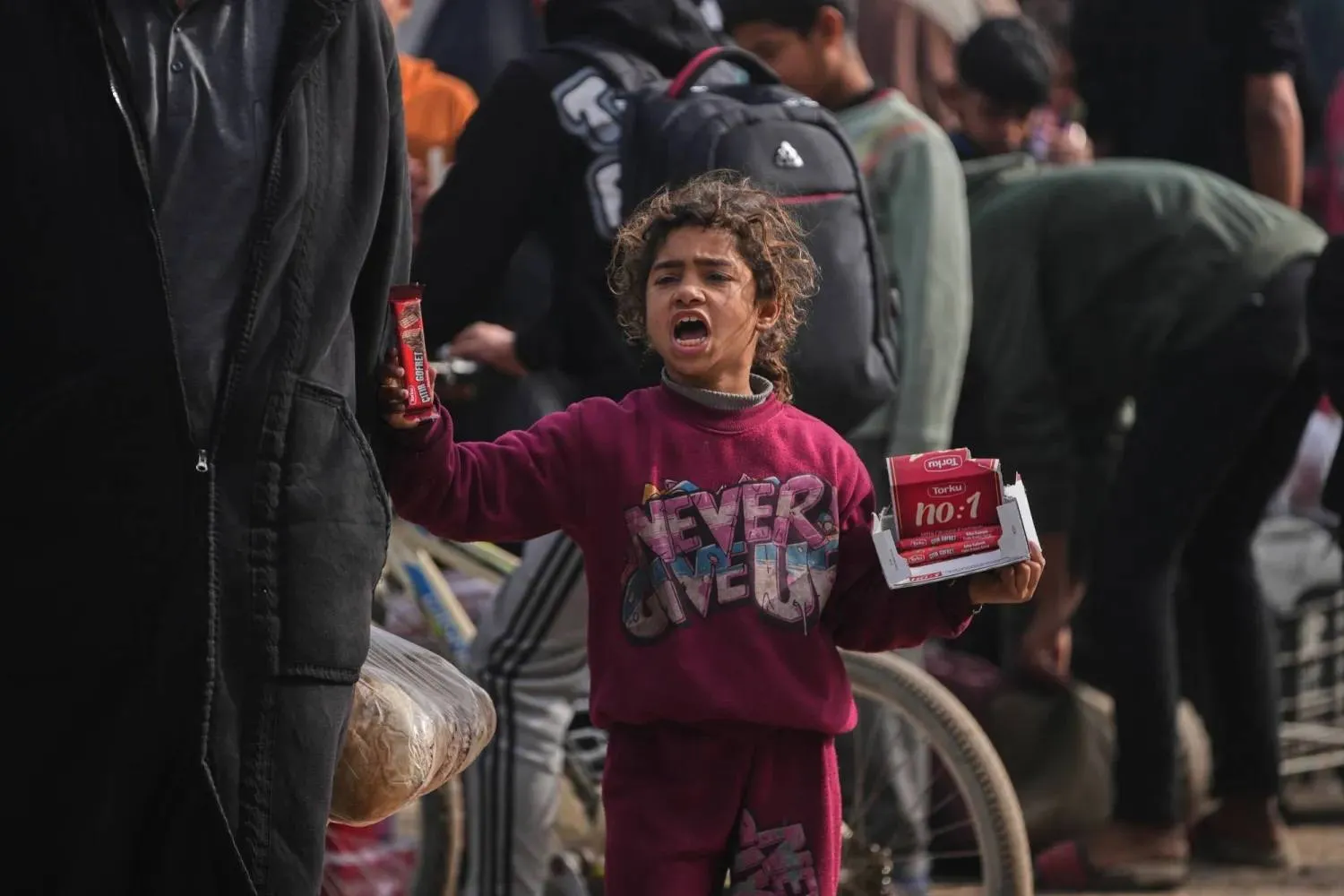
A Palestinian girl sells chocolate bars at a market in Khan Younis, southern Gaza Strip, on Friday. (AP)
TT

Obstacles Cloud Prospects for Safe Exit of Some Hamas Leaders from Gaza

A Palestinian girl sells chocolate bars at a market in Khan Younis, southern Gaza Strip, on Friday. (AP)

Plans to allow a “safe exit” for some Hamas leaders and activists from Gaza are faltering amid strict Israeli conditions and unresolved demands tied to the full implementation of the ceasefire agreement’s second phase, notably disarmament and the handover of control in the enclave to a technocratic committee.

Three Hamas sources told Asharq Al-Awsat days ago that there was concrete movement to prepare lists of prominent leaders and activists, including prisoners freed in the 2011 Gilad Shalit prisoner exchange, in preparation for travel and departure from Gaza under an agreement with mediators and the United States.

A senior Hamas leader later denied those reports, saying the issue had not been formally raised, while another source said he was unaware of such discussions.

Hurdles and conditions

Sources within Hamas told Asharq Al-Awsat that after lists were prepared for figures at various leadership levels, as well as activists and freed prisoners, obstacles began to emerge that could prevent the move from succeeding.

They said Israel is conditioning the departure of any Hamas leader on the complete disarmament and dismantling of the movement.

According to the sources, a delegation from Hamas leadership inside Gaza had been expected to travel to Cairo to discuss issues related to the group’s weapons and security apparatus.

The trip was later canceled, and the information will instead be passed to Hamas leaders abroad to relay to the mediators.

The sources said the Gaza delegation was expected to hold in-depth and detailed talks on unresolved issues related to the second phase, as well as the fate of the last Israeli hostage’s body in the enclave.

Despite this, some sources said that several prisoners freed in the Shalit exchange are in fact preparing for the possibility of traveling in the coming period from Gaza to Egypt and then immediately to a third country.

Expected meeting

The dispute over this issue comes as a plan proposed by US envoy Jared Kushner on Gaza indicated that some Hamas activists could receive pardons, be reintegrated into a new police force following strict security screening by Israel or the United States, or be allowed safe passage out of the territory.

Israel’s i24NEWS reported that a draft comprehensive agreement on the second phase would soon be discussed between US envoy Steve Witkoff and Hamas leader in Gaza Khalil al-Hayya.

The talks would address the group’s weapons by distinguishing between heavy and light arms, and would grant amnesty to fighters who surrender their guns. At the same time, Hamas would hand over maps of its tunnel network and weapons production sites.

Senior Hamas leaders and activists would then begin leaving the Gaza Strip.

Hamas sources told Asharq Al-Awsat that, as of Saturday, there is no confirmed plan to hold such a meeting. They said the issue of weapons and the requirements of the second phase remain under discussion between Hamas leadership and the mediators, including the United States.



Report: Netanyahu Refused Washington’s Request for Israeli President to Attend Board of Peace Launch

President Donald Trump, center, holds up a signed Board of Peace charter during the Annual Meeting of the World Economic Forum in Davos, Switzerland, Thursday, Jan. 22, 2026. (AP)
TT

Report: Netanyahu Refused Washington’s Request for Israeli President to Attend Board of Peace Launch

President Donald Trump, center, holds up a signed Board of Peace charter during the Annual Meeting of the World Economic Forum in Davos, Switzerland, Thursday, Jan. 22, 2026. (AP)

Israeli Prime Minister Benjamin Netanyahu rejected a request by the White House to allow President Isaac Herzog to attend the launch ceremony of President Trump's Gaza Board of Peace on Thursday in Davos, Axios reported on Saturday, citing two sources familiar with the details.

According to diplomatic sources, US officials approached the Prime Minister’s Office on Tuesday and Wednesday, proposing that Herzog represent Israel, sit on stage with the other leaders, and sign the Board of Peace charter.

Netanyahu refused and effectively vetoed Herzog’s participation, according to Axios. The PM argued that Trump had addressed the invitation to him personally, not to president.

Israel’s absence, the sources said, created the impression that Jerusalem was not fully aligned with the Trump peace plan.

Ultimately, the White House chose not to escalate the dispute, the sources said.

Trump advisers Jared Kushner and Steve Witkoff preferred to focus their pressure on Netanyahu regarding the opening of the Rafah crossing between Egypt and Gaza rather than Herzog’s attendance.

Witkoff and Kushner arrived in Israel on Saturday evening for a meeting with Netanyahu expected to center on the Rafah border crossing.

Netanyahu did not travel to Davos due to the International Criminal Court arrest warrant issued against him, but Herzog was present at the forum.


Iraq Urges International Community to Help it Shoulder ISIS Burden

Members of the Iraqi border forces patrol along a concrete wall on the Iraqi-Syrian border, in the town of al-Baghuz in the Al-Qaim district of western Iraq, on January 21, 2026. (AFP)
TT

Iraq Urges International Community to Help it Shoulder ISIS Burden

Members of the Iraqi border forces patrol along a concrete wall on the Iraqi-Syrian border, in the town of al-Baghuz in the Al-Qaim district of western Iraq, on January 21, 2026. (AFP)

The transfer of ISIS detainees from northeastern Syria could saddle Iraq with annual costs of up to $25 million, an Iraqi government source said on Saturday.

The source said the number of detainees stands at around 7,000 members and that the cost of feeding them is estimated at roughly 33 billion Iraqi dinars a year, or about $25 million, according to Shafaq News.

The comments came as Foreign Minister Fuad Hussein said Iraq should not shoulder alone the security and financial burdens resulting from the transfer of ISIS prisoners from Syria to Iraq.

In a statement, the Foreign Ministry said Hussein made the remarks during a phone call with the European Union’s High Representative for Foreign Affairs and Security Policy, Kaja Kallas, during which they discussed developments in Syria and the issue of prisons holding ISIS members.

The statement said the officials discussed security risks arising from the escape of several ISIS members from some prisons outside the control of the Syrian Democratic Forces, as well as the security situation in Syria’s Hasakah province.

They also stressed the importance of resolving disputes peacefully.

Hussein was quoted as saying that responsibility for dealing with the ISIS detainee file “must be borne by all concerned countries and should not fall on Iraq alone.”

Earlier this week, the US military’s US Central Command said its forces had transferred 150 ISIS detainees from a detention facility in Syria’s Hasakah to Iraq, adding that the move was intended to prevent their escape.

Reuters quoted a US official as saying Washington expects the transfer of up to 7,000 detainees from prisons in Syria to Iraq to be completed in the coming days, noting that hundreds of detainees could be moved daily across the border.

Political debate

Falih al-Fayyad, head of Iraq’s pro-Iran Popular Mobilization Forces, said Iraq had received the first batch of detainees, adding that the government would begin talks with the international coalition to shoulder the costs associated with transferring the rest.

Fayyad said most of the detainees are wanted by the Iraqi judiciary and will stand trial under Iraqi law, adding that their transfer to prisons inside Iraq “serves security interests” compared with keeping them in unstable detention facilities outside the country.

The transfer of the detainees has sparked political and media debate in Iraq, amid concerns over the financial and security burdens involved. At the same time, the government says the issue is being handled as a national security matter in coordination with the international coalition.

Separately, Iraqi Prime Minister Mohammed Shia al-Sudani discussed with US Central Command commander Brad Cooper the timeline for the transfer, stressing the importance of security coordination to prevent any potential threats to Iraq and the region.

Sabah al-Numan, spokesman for the commander-in-chief of the armed forces, said the government had ordered the completion of a concrete wall along the Syrian border, which is 80% complete.

Numan said the transferred detainees are wanted on terrorism charges and will be held in fortified prisons, adding that the transfer “will be carried out under a tightly coordinated plan prepared by the Joint Operations Command and the relevant security agencies, in coordination with the Ministry of Justice, which has prepared an integrated plan to accommodate them inside Iraqi prisons.”


Lebanon’s Weapons Monopoly Efforts to Shape International Support for the Army

Lebanese soldiers check the identity of a man in Marjeyoun, southern Lebanon. (Reuters file)
TT

Lebanon’s Weapons Monopoly Efforts to Shape International Support for the Army

Lebanese soldiers check the identity of a man in Marjeyoun, southern Lebanon. (Reuters file)

The understanding between the quintet committee for Lebanon and President Joseph Aoun over the planned conference in support of the army has raised questions on whether the countries friendly to Lebanon have been asking for guarantees related to the launch of the second phase of the state’s plan to impose state monopoly over arms.

The second phase tackles regions north of the Litani River, while the first covered regions south of it and extending to the border with Israel.

The conference on the army is set to take place in Paris on March 5.

Many believe that countries backing Lebanon are testing its seriousness in implementing the monopoly of weapons north of the Litani, particularly as Army Commander General Rodolphe Haykal is expected to present his plan to carry out the task in early February after securing cabinet approval.

Throughout, Hezbollah has firmly rejected cooperation with the government and army over the disarmament plan.

The president had previously said the army needs one billion dollars annually for 10 years, and last week asked security agency chiefs to prepare detailed reports on their needs to present to participants in the Paris conference.

Level of representation and aid

Security sources ruled out that the convening of the army support conference was tied to the implementation of the second phase of the disarmament plan. They argued that setting a fixed date for the meeting and having French President Emmanuel Macron chair it makes it very difficult for international parties to back away from holding it.

Sources told Asharq Al-Awsat that steps taken by the government and the army to monopolize weapons north of the Litani will be reflected in the momentum surrounding the conference, including the number of participating countries, the level of representation, and the amount of aid that can be secured.

If the international community senses concrete steps in this direction, support will be significantly greater, they said.

MP Ghada Ayoub, of the Lebanese Forces bloc, said once a date is set for a conference of this scale, it is rarely postponed unless very exceptional circumstances arise.

Therefore, March 5 should be treated as confirmed until further notice, she told Asharq Al-Awsat.

Ayoub stressed the need to distinguish between holding the conference and the scale of its outcomes.

The conference itself is not tied to a direct condition. Still, the level and type of support could be affected by the nature of the next phase and by the state’s ability to assert its authority, foremost by enabling the army to perform its role across all Lebanese territory.

Ayoub that the primary goal of the conference is to empower the Lebanese army and secure its financial and logistical requirements, as well as to address its needs and demands, because no state can be built and no stability can be protected without a strong, well-equipped military.

Riad Kahwaji, a researcher and writer specializing in security and defense affairs, said support for the army is an external political decision that hinges on its primary mission today which is to disarm Hezbollah.

Army leadership and the government are fully aware of this, he told Asharq Al-Awsat, noting that any potential assistance program will be centered on this task.

Kahwaji said that arming the military will proceed from the premise that confronting ISIS and al-Qaeda remains a task, but is no longer a top priority, as this role is now tied to the Syrian state.

As a result, the army’s primary armament will remain focused on protecting borders, maintaining internal stability, and imposing state monopoly over weapons.