


Israel Agrees to Reopen Rafah Crossing Only for Gaza Pedestrians

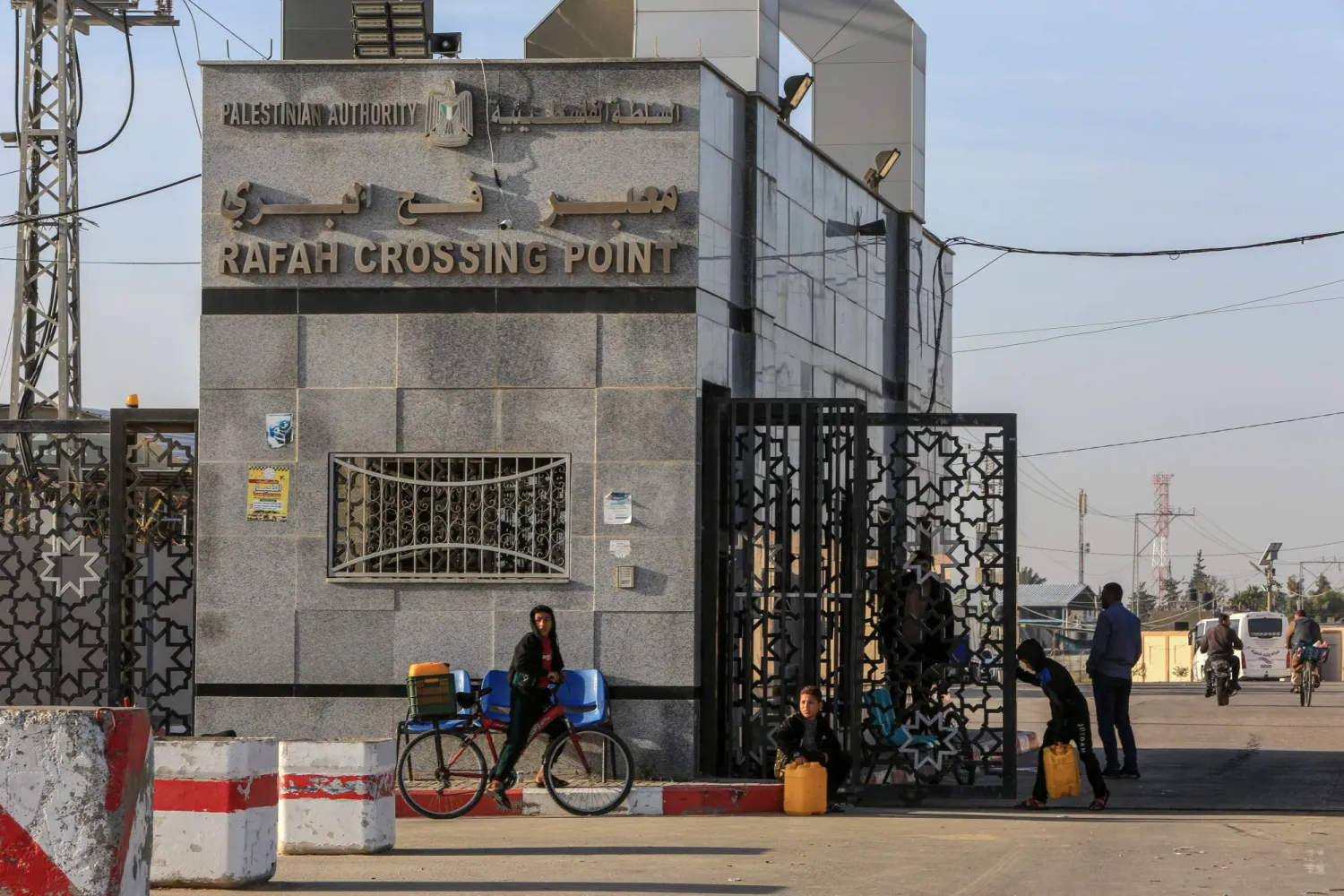
24 November 2023, Palestinian Territories, Rafah: A view of the Rafah border crossing. (dpa)
TT

Israel Agrees to Reopen Rafah Crossing Only for Gaza Pedestrians

24 November 2023, Palestinian Territories, Rafah: A view of the Rafah border crossing. (dpa)

Israel said Monday it would only allow pedestrians to travel through the Rafah crossing between Gaza and Egypt as part of its "limited reopening" once it has recovered the remains of the last hostage in the Palestinian territory.

Reopening Rafah, a vital entry point for aid into Gaza, forms part of a truce framework announced by US President Donald Trump in October, but the crossing has remained closed since Israeli forces took control of it during the war in the Palestinian territory.

Visiting US envoys had reportedly pressed Israeli officials to reopen the crossing during talks in Jerusalem over the weekend.

World leaders and aid agencies have repeatedly pushed for more humanitarian convoys to be able to access Gaza, which has been left devastated by more than two years of war and depends on the inflow of essential medical equipment, food and other supplies.

Prime Minister Benjamin Netanyahu's office said on Monday that Israel had agreed to a reopening "for pedestrian passage only, subject to a full Israeli inspection mechanism".

The move would depend on "the return of all living hostages and a 100 percent effort by Hamas to locate and return all deceased hostages", it said on X.

It remained unclear whether the reopening would allow medical patients to leave Gaza for treatment in Egypt or other countries.

The Israeli military said it was searching a cemetery in the Gaza Strip on Sunday for the remains of the last hostage, Ran Gvili.

"Upon completion of this operation, and in accordance with what has been agreed upon with the US, Israel will open the Rafah Crossing," said Netanyahu's office.

The announcement came after Gaza's newly appointed administrator, Ali Shaath, said the crossing would open "in both directions" this week.

"For Palestinians in Gaza, Rafah is more than a gate, it is a lifeline and a symbol of opportunity," Shaath said at the World Economic Forum in Davos on Thursday.

Several Gazans told AFP that it was depressing to hear Israel had only agreed to a limited reopening of the crossing.

"After two and a half years of war, doesn't the world realize that the entire population of Gaza is ill, and that people have the right to choose whether to stay or leave, even if only temporarily?" said Mohammed Ala, 49, who has not seen his wife since she travelled to Egypt for medical treatment before the war began.

Maha Youssef, 37, who was displaced to eastern Gaza City during the war, said "travel is a dream of returning to life" for Gazans.

"Even if it is financially difficult and likely unstable, my children would be able to see what a normal life looks like and live it, at least they would be able to go to school," she said.

Israeli media had also reported that US envoys Steve Witkoff and Jared Kushner had urged Netanyahu to reopen Rafah during their Jerusalem talks.

Before the war erupted in October 2023, Rafah had been the only gateway connecting Gazans to the outside world and enabling international humanitarian aid to enter the territory, home to 2.2 million people living under Israeli blockade.

- Last hostage -

A spokesman for Hamas's Ezzedine Al-Qassam Brigades, Abu Obeida, said on Sunday that the group had "provided mediators with all the details and information in our possession regarding the location of the captive's body", referring to Gvili.

Obeida added that "the enemy (Israel) is currently searching one of the sites based on information transmitted by the Al-Qassam Brigades".

Except for Gvili, all of the 251 people taken hostage during Hamas's October 7, 2023 attack on Israel have since been returned, whether living or dead.

A non-commissioned officer in the Israeli police's elite Yassam unit, Gvili was killed in action on the day of the attack and his body was taken to Gaza.

The first phase of the US-backed ceasefire deal had stipulated that Hamas hand over all the hostages in Gaza.

Gvili's family has expressed strong opposition to launching the second phase of the plan, which includes reopening Rafah, before they have received his remains.

"First and foremost, Ran must be brought home," his family said in a statement on Sunday.
The Gaza war was sparked by Hamas's attack on Israel, which resulted in the deaths of 1,221 people, according to an AFP tally based on official Israeli figures.

The Israeli retaliation flattened much of Gaza, a territory that was already suffering severely from previous rounds of fighting and from an Israeli blockade imposed since 2007.

The two-year war between Israel and Hamas has left at least 71,660 people dead in Gaza, according to the territory's health ministry, figures considered reliable by the United Nations.



Salam: Washington Did Not Request France’s Ouster from Mechanism Negotiations

A photograph released by the Lebanese Government Press Office on December 26, 2025, show Prime Minister Nawaf Salam speaking during a press conference after a cabinet session in Beirut on December 26, 2025. (Photo by Handout / Lebanese Government Press Office / AFP)
TT

Salam: Washington Did Not Request France’s Ouster from Mechanism Negotiations

A photograph released by the Lebanese Government Press Office on December 26, 2025, show Prime Minister Nawaf Salam speaking during a press conference after a cabinet session in Beirut on December 26, 2025. (Photo by Handout / Lebanese Government Press Office / AFP)

Lebanese Prime Minister Nawaf Salam assured on Monday that Lebanon does not want any confrontation with the United States, pointing out that Washington has not demanded France’s exit from the “Mechanism negotiations”.

An-Nahar newspaper quoted Salam as assuring that both Beirut and Paris have affirmed that a conference in support of the country’s army will be held in France in March as scheduled.

Salam also said that Beirut expects the arrival of Qatari minister, Mohammed Al-Khulaifi, on Tuesday ahead of a February preparatory meeting before the Paris conference. The February meeting "could be held in a Gulf country, probably Qatar", he told the daily.

The PM ruled out the possibility that the dispute between US President Donald Trump and French President Emmanuel Macron could impact the latter’s role in Lebanon.

“There are more important problems than the matter of Lebanon’s Mechanism. Honestly, the small country of Lebanon is not the center of the world”, he said.

Following his meeting with Macron on Saturday, Salam said that the French President has affirmed adherence to the committee overseeing the ceasefire agreement (Mechanism).

Media reports in Lebanon hinted at a US rejection of any French participation in the Mechanism meetings. But Salam stressed that the US is a “strategic partner for Lebanon. We are not in a confrontation because it is a key partner in the ceasefire monitoring committee”.


Damascus Acting with US Support to Control Sweida

This handout picture released by the official Syrian Arab News Agency (SANA) shows Syrian army and security forces deploying in Sweida in southern Syria on July 14, 2025 (Photo by SANA / AFP) 
TT

Damascus Acting with US Support to Control Sweida

This handout picture released by the official Syrian Arab News Agency (SANA) shows Syrian army and security forces deploying in Sweida in southern Syria on July 14, 2025 (Photo by SANA / AFP) 

Damascus is acting in coordination with the United States to take control over Jabal al-Arab, which houses the majority of the Druze population in southern Syria, Israeli broadcaster KAN News said quoting a Syrian official.

Although the official said the American support is conditional on not harming Israel's national security, Tel Aviv does not feel comfortable with it.

According to the Israeli TV report, the Syrian official, who is interested in military affairs, said the Syrian government has been acting under the impression that the US coordinates and supports Syrian President Ahmed al-Sharaa’s actions to take control over the province.

The official noted that Syria's government has yet to decide on re-entering Sweida, explaining that “it will happen sooner or later, hopefully through dialogue and understanding.”

Late on Saturday, Kan 11 said that during negotiations with Syria, Israel had made it clear that security understandings must include a mechanism allowing Tel Aviv to open a humanitarian corridor to Syria's southern province of Sweida.

The American officials took this request into consideration when they said Washington’s support is conditional both on Sharaa’s actions not harming Israel's national security and that there be no further massacres of the Druze currently living in the area, such as in the case of Sweida in October 2025.

Members of the community in Sweida told The Jerusalem Post they are concerned about the re-entry of Syrian army forces into the southern province, recalling that in October, 2,500 people were murdered by state-backed factions.

Kan 11 had quoted an Israeli security source as saying that Israel is ready to expand its military strikes in Syria, if attacks against the Druze community continue, stressing that “escalation will be met with escalation.”

The comment, diffused via KAN, came while the province of Sweida has experienced, for several weeks, a state of relative calm.

Last July, Israeli Prime Minister Benjamin Netanyahu said he had committed to keeping the southwest region of Syria as a demilitarized zone within Israel. “We will not allow the creation of a second Lebanon [in southern] Syria,” he said.

Meanwhile, Syrian and Israeli officials are expected to meet soon under US mediation, perhaps in Paris, to finalize a security agreement between Damascus and Jerusalem, a source close to Syrian President Ahmed al-Sharaa told i24NEWS on Saturday.

According to the Syrian source, the talks will also focus on various potential joint strategic and economic projects in the buffer zones between the two countries.

Previous rounds of US-mediated talks between Syrian and Israeli officials have failed to produce a security agreement aimed at stabilizing the border area, according to Reuters.


'Risk of Mass Violence against Civilians' in S.Sudan, Say UN Experts

Former child soldiers stand in line waiting in Yambio, South Sudan, Feb 7, 2018. Sam Mednick, AP
TT

'Risk of Mass Violence against Civilians' in S.Sudan, Say UN Experts

Former child soldiers stand in line waiting in Yambio, South Sudan, Feb 7, 2018. Sam Mednick, AP

The situation in South Sudan is heightening "the risk of mass violence against civilians", independent UN experts warned on Sunday as fresh conflict and violent rhetoric grips the country.

The UN Commission on Human Rights in South Sudan in a statement expressed "grave alarm" at fighting in Jonglei state north of the capital Juba, where witnesses have described civilians fleeing into swamps, reported AFP.

South Sudan People's Defense Forces (SSPDF) spokesperson Lul Ruai Koang later on Sunday told Jonglei residents to "immediately evacuate" areas controlled by the Sudan People's Liberation Army in Opposition (SPLA-IO) and move to "government controlled areas as soon as possible".

Civilians "would be considered as legitimate military targets", the spokesperson added.

The world's youngest country has been beset by war, poverty and massive corruption since it was formed in 2011, with violence once again on the rise between rival factions.

A power-sharing agreement between the two main sides is all but dead after President Salva Kiir moved against his vice-president and long-time rival, Riek Machar, who was arrested last March and is now on trial for "crimes against humanity".

Their forces have fought several times over the past year, but the most sustained clashes began in late December in Jonglei.

Public statements by commanders encouraging violence against civilians, along with troop mobilization, "represent a dangerous escalation at a moment when the political foundations of the peace process are already severely weakened", the UN commission said.

Army chief Paul Nang Majok on Wednesday ordered troops deployed in the region to "crush the rebellion" within seven days.

Local media have also quoted a senior army official as saying "no one should be spared, not even the elderly".

The UN mission in South Sudan (UNMISS) said it was "gravely concerned" about the public declarations.

"Inflammatory rhetoric calling for violence against civilians, including the most vulnerable, is utterly abhorrent and must stop now," said UNMISS head Graham Maitland.

Renewed fighting in South Sudan has displaced more than 180,000 people, according to the country's authorities.

Kiir and Machar fought a five-year war shortly after independence that claimed 400,000 lives. A 2018 power-sharing deal kept the peace for some years but plans to hold elections and merge their armies did not materialize.