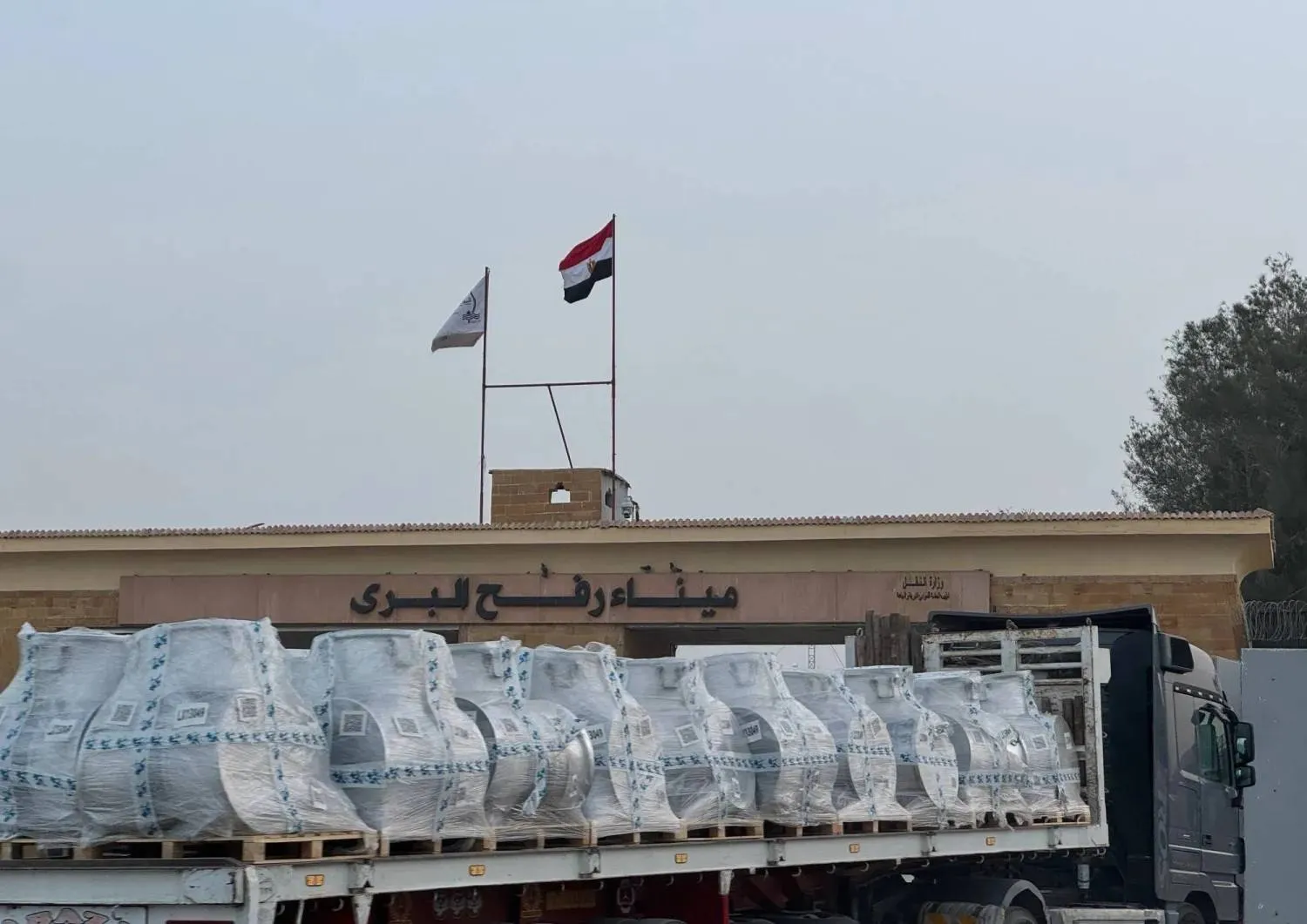

Gaza residents are waiting for the arrival of a technocratic committee tasked with administering the territory, after Israel announced a partial reopening of the Rafah land crossing with Egypt on Sunday, allowing limited daily movement of travelers in and out of Gaza.
The 15-member National Committee for the Administration of Gaza (NCAG) is a team of Palestinian technocrats created as part of the US-sponsored ceasefire agreement which came into effect on October 10.
The head of the committee, Ali Shaath, said in a post on X that once logistical arrangements among the relevant parties are finalized, the reopening of Rafah would be officially announced starting Monday.
He said Sunday would be used as a trial day to test operational procedures at the crossing.
Sources told Asharq Al-Awsat that members of the committee are expected to enter Gaza on Sunday or Monday, provided Israel grants approval, adding that Israeli foot-dragging on the issue continues.
COGAT, the Israeli military body in charge of coordinating aid to Gaza, said on Friday that the Rafah crossing would reopen starting Sunday, under strict restrictions on passenger movement, particularly for those permitted to return to Gaza.
In a statement, the office said the crossing would operate in both directions, but with limited passenger numbers.
Travel would take place in coordination with Egypt, subject to prior Israeli security approval and under the supervision of a European Union mission, following the same mechanism activated in January 2025.
It said returning from Egypt to Gaza would be permitted only for residents who left the territory during the war, and only after obtaining prior Israeli security clearance. After an initial screening at Rafah by the EU mission, travelers would undergo a second identification check at an Israeli army checkpoint.
Israel’s Channel 12 reported that only 150 travelers per day would be allowed to enter Gaza from the Egyptian side, adding that Israeli efforts to impose a direct military presence at the crossing had failed.
Israeli army radio said the country’s security system would monitor the crossing remotely using sensors, metal detectors, cameras, and facial recognition technology to identify approved departures and arrivals.
Any attempt to smuggle an individual using a forged identity would result in denial of entry or exit and detention, without clarifying the mechanism or the responsible authority.
Israeli Prime Minister Benjamin Netanyahu said on Tuesday that Israel would maintain security control over the Rafah crossing.
Yedioth Ahronoth reported that Israel would allow lower-ranking Palestinian fighters, but not senior officials, wounded during the war, to leave Gaza via Rafah if they wished, noting that, in principle, all those who depart would be allowed to return.
On the Palestinian side, sources told Asharq Al-Awsat that preparations to compile lists of patients initially approved to travel through Rafah began on Sunday.
The sources said members of the Palestinian technocratic committee are expected to arrive in Gaza on Sunday or Monday, if Israel permits, noting continued Israeli stalling on the issue.
If the committee members arrive, they will hold meetings with Hamas-run government bodies in Gaza to agree on mechanisms for transferring authority in the territory.
Additional meetings are planned with Palestinian factions, civil society activists, and others to coordinate efforts related to Gaza’s current situation and future governance.