
Kurdistan Region Seeks Retroactive Compensation for Crimes Committed Under Saddam Hussein

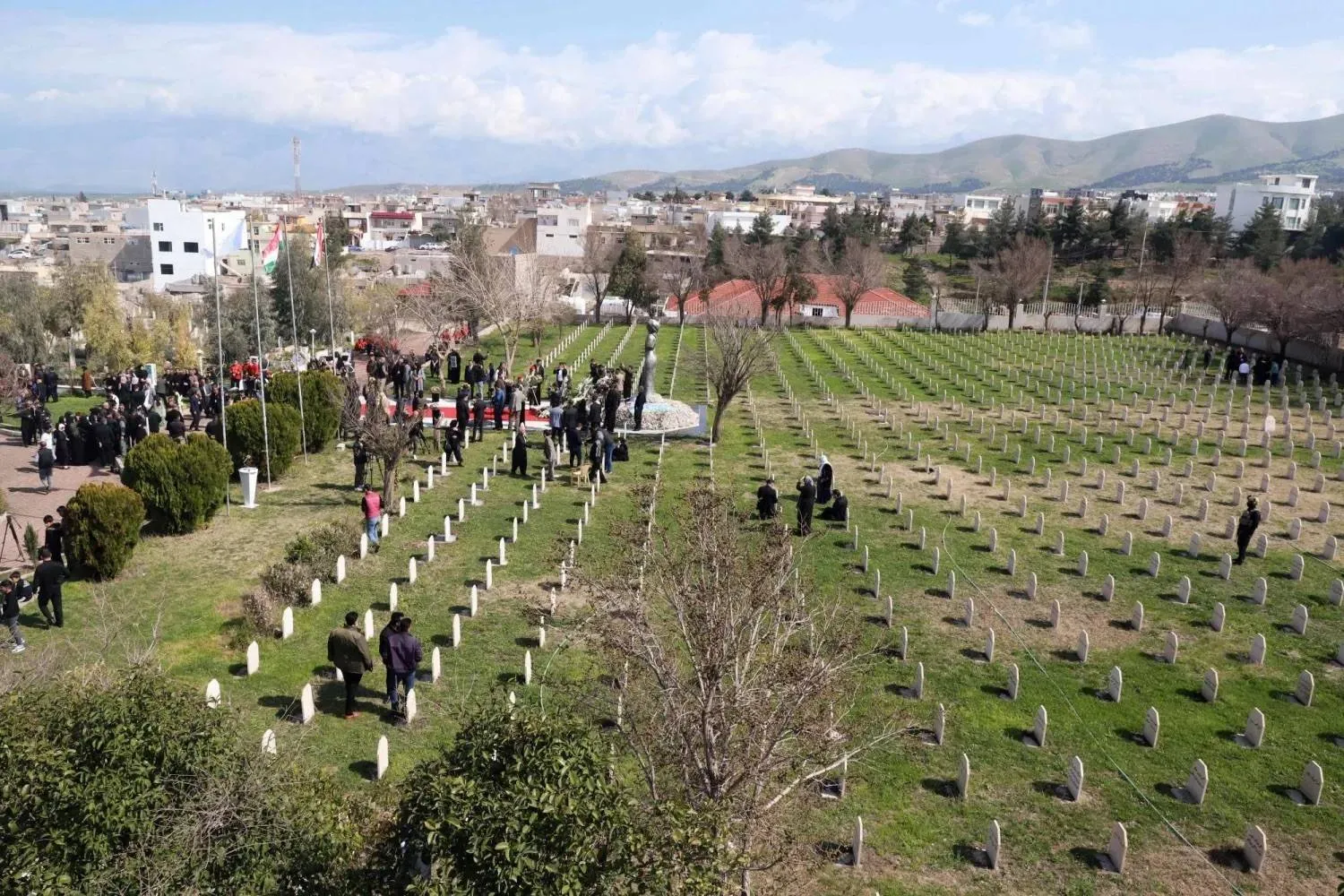
Kurdish families at a cemetery for victims of the chemical bombardment of the city of Halabja (AFP). 
TT

Kurdistan Region Seeks Retroactive Compensation for Crimes Committed Under Saddam Hussein

Kurdish families at a cemetery for victims of the chemical bombardment of the city of Halabja (AFP). 

The Kurdistan Regional Government (KRG) has renewed a retroactive demand for compensation from Iraq’s federal government for crimes committed by the regime of the late president Saddam Hussein against the Kurds.

The move is widely seen as a calculated bid for leverage as calls grow to scrutinize the region’s revenues and governance.

In a statement issued on Thursday, the KRG said it is seeking $384.6 billion in compensation for the people of the Kurdistan Region for damages resulting from “crimes committed by the Iraqi regime between 1963 and 2003”, the period of Baath Party rule from its coup against the government of Abdul Karim Qasim until the US-led invasion that toppled it.

The claim is not unprecedented. Erbil made the same demand in 2013, according to a statement issued at the time by the KRG’s Ministry of Martyrs and Anfal Affairs.

Why now?

Explaining the timing, Jotiar Adil, head of the KRG’s Department of Media and Information, told Asharq Al-Awsat that “Erbil did not choose the timing; it was imposed by the painful paradox in Baghdad’s dealings with the region.”

Constitutional rights, he said, “do not lapse with time,” adding that reopening the compensation file is meant to remind partners in Baghdad that the people of Kurdistan are owed billions of dollars for widespread destruction and genocide.

Adil argued that subjecting the region to “microscopic scrutiny” over oil and non-oil revenues while ignoring the destruction of 4,500 villages—wiped out during the 1988 military campaign internationally recognized as genocide—was illogical.

“The timing carries a message,” he said. “Before you cut our people’s livelihoods today, remember your historical debts to them.” He rejected suggestions that the move was political maneuvering, describing it instead as “a legal rights case aimed at justice, not at paralyzing Baghdad.”

A dispute over resources

Baghdad has insisted on implementing agreements governing oil revenues and border crossings before releasing the region’s financial entitlements. Technical disputes are often entangled with political negotiations over forming federal governments.

Iraq’s constitution provides for joint management of oil and gas, equitable revenue distribution based on population, and temporary allocations for areas damaged by past conflicts.

For years, the Kurdistan Region exported oil via Türkiye’s Ceyhan port without Baghdad’s approval. Exports were halted in 2023 following an international arbitration ruling requiring sales to be conducted through the state oil marketer, SOMO, exacerbating tensions.

Although an agreement was reached in 2025 on handing over the region’s oil, it has yet to be implemented. Baghdad later cut public-sector salaries in the Kurdistan Region as leverage, a move Erbil condemned as a violation of citizens’ rights.

Adil said the compensation figure was based on international standards similar to those used by the UN Compensation Commission in assessing damages to Kuwait after Iraq’s 1990 invasion, factoring in cumulative harm and present value.

He noted that post-2003 governments honored Saddam-era obligations abroad — paying compensation to Kuwait and settling Paris Club debts — while rejecting comparable responsibility toward victims at home.


Israel Launches ‘Large-scale Wave of Strikes against Iran Infrastructure,’ Hits Lebanon

Smoke rises following an Israeli airstrike in Dahiyeh, Beirut's southern suburbs, Lebanon, Thursday, March 5, 2026. (AP Photo/Hassan Ammar)
TT

Israel Launches ‘Large-scale Wave of Strikes against Iran Infrastructure,’ Hits Lebanon

Smoke rises following an Israeli airstrike in Dahiyeh, Beirut's southern suburbs, Lebanon, Thursday, March 5, 2026. (AP Photo/Hassan Ammar)

The Israeli military said it launched a wave of strikes on the Iranian capital Tehran on Thursday.

The army “has just begun a large-scale wave of strikes against infrastructure of the Iranian terror regime across Tehran," a military statement said.

Meanwhile, the Israeli military said it began new strikes against Hezbollah in Lebanon.

An overnight Israeli drone strike targeted a vehicle on a coastal highway in southern Lebanon, killing three people, Lebanon’s state news agency said.

The highway connects the city of Tyre to Naqoura, a border town near Israel.

On Wednesday, the Israeli military warned residents to move north of the Litani River, which serves as a key buffer line with villages south of it lying closest to the Israeli border.

The number of people killed in Israeli strikes in Lebanon in the four days since the conflict between Israel and Hezbollah reignited has risen to more than 70, with over 430 people wounded, Lebanon’s Health Ministry said Wednesday.

It is not clear how many of those killed in Lebanon were civilians, but the Health Ministry said Tuesday that they included seven children.


Lebanese State Media Says Israeli Strike Kills Hamas Official

Smoke rises from the city of Khiam after an Israeli bombing targeted one of its neighborhoods, coinciding with the incursion of tanks (AFP)
TT

Lebanese State Media Says Israeli Strike Kills Hamas Official

Smoke rises from the city of Khiam after an Israeli bombing targeted one of its neighborhoods, coinciding with the incursion of tanks (AFP)

Lebanese state media said an Israeli strike killed a Hamas official on Thursday, the first reported targeted killing of a member of the Palestinian militant group since US-Israeli strikes on Iran triggered regional war.

Wassim Atallah al-Ali and his wife were killed when an "enemy drone targeted their home" in Beddawi, a Palestinian refugee camp near Tripoli, in a pre-dawn strike, the National News Agency (NNA) reported, describing the man as a senior Hamas official.

The strike hit the area without prior warning and marked the northernmost strike so far in Lebanon.

Located about 85 kilometers (53 miles) north of Beirut and more than 180 kilometers (112 miles) from the Lebanese-Israeli border, Beddawi was targeted during the 2024 war between Israel and Hezbollah.
Despite a ceasefire reached in November 2024, the Israeli military said in July it struck a Hamas figure in the camp.


Lebanon’s Displaced Face Housing Crunch, Surging Rents, Municipal Curbs

A woman sits on the ground beside her belongings on Beirut’s seaside corniche (EPA)
TT

Lebanon’s Displaced Face Housing Crunch, Surging Rents, Municipal Curbs

A woman sits on the ground beside her belongings on Beirut’s seaside corniche (EPA)

As war erupted in Lebanon, scenes of displacement quickly returned to the streets. Roads filled with cars packed with families fleeing bombardment, while some displaced people spread out along the seaside corniche in Sidon and Beirut, waiting for shelter.

But the search for a roof has become an ordeal. Rental prices have surged to unprecedented levels, and available apartments are scarce, deepening a housing crisis that has forced many families to remain in their cars or on roadsides while they search for somewhere to stay.

In some areas, residents have refused to receive displaced families amid fears they could be targeted and anger at Hezbollah for engaging in the war again.

“As time passes, the chances of moving to safe housing are shrinking. There are not many options,” said Hassan Daoud.

“What is available does not suit us, or it is beyond our financial means,” he added, noting that some homes are too small for his family while others are far too expensive.

Daoud, a man in his thirties who fled on Monday from a village in the Bint Jbeil district, is still staying with his family of nine along the seaside corniche, living in their cars until they can secure suitable housing.

He said a woman asked for $2,000 to rent a semi-furnished apartment in the Barouk area of Mount Lebanon.

“Who knows how long we will stay there,” he said. “What we fear is that the war will drag on and we will be unable to pay rent for more than one month.”

Displaced families must now pay for many essentials they were unable to take with them when they fled. At the same time, their jobs and businesses have stopped, and their sources of income have dried up.

“We cannot afford such amounts,” Daoud said.

Multiple pressures

Like Daoud, thousands of displaced people have yet to find housing. For many, the immediate goal is simple: a roof to shelter their families.

But displacement carries heavy consequences, particularly as many people have yet to recover from the previous war.

Another form of hardship is faced by Haj Mustafa, who fled his village in Kafra in the Bint Jbeil district.

“It seems there is a municipal decision banning people from renting us homes simply because we are from the Shiite sect,” he told Asharq Al-Awsat, referring to measures taken by municipalities amid fears Hezbollah members could blend in among displaced families.

Mustafa described a long and exhausting journey.

“It lasted more than 25 hours. I felt dizzy many times and was extremely exhausted. I am 80 years old and can no longer endure such displacement. It is extremely bad.”

Speaking in a low voice, he added: “Perhaps what happened to us could have been avoided, I do not know. But we are not well. That is all I know.”

Several Lebanese municipalities have issued circulars requiring residents, property owners, investors and tenants to notify local authorities in writing before signing any rental contract or occupying residential apartments.

Officials say the measures aim to ensure administrative order and proper application of the law.

Rising rents

Crisis profiteers are also exploiting the growing demand for shelter, either by sharply raising rents or imposing strict conditions such as annual contracts or six months’ payment in advance.

Mona, displaced from the city of Tyre, said: “I thought $800 would provide suitable housing for my family of four. But we were surprised that this amount is not enough for a small two-room apartment without furniture.”

“Why are they doing this to us?” she told Asharq Al-Awsat.

“Being forced into the war has already exhausted us.”

“We are losing, and we expect many more losses in lives and livelihoods. On top of that, we face rejection from fellow Lebanese of other sects. Of course we cannot generalize, but we are treated harshly and judged simply for belonging to a Shiite environment. They want to punish us for what the party did.”

Some landlords demand full payment for a year or six months upfront, such as $7,800 in advance for six months instead of $1,300 monthly. The conditions effectively limit available homes to wealthier displaced families.

At the same time, many Lebanese who experienced previous displacement and have the financial means kept their rented homes as a precaution and moved into them as soon as the war began.

Shelter centers

Meanwhile, many families are still waiting for rooms in official shelter centers. Some facilities have yet to open, leaving large numbers sleeping on the ground outside schools while they wait.

Dozens of people forced open the doors of some schools on Tuesday evening and entered them.

Lebanese authorities have published a list of shelter centers for displaced people, but the delay in opening some facilities has drawn criticism.

Sources at the Ministry of Education told Asharq Al-Awsat that shelter centers are opened gradually based on need, adding that the ministry responds immediately to requests from the Ministry of Social Affairs to open new centers.

According to official figures from the Disaster Risk Management Unit, the total number of shelter centers reached 171 on Monday. The number of displaced people stood at 29,347, while 52 people had been killed and 154 injured.

Mohammad Shamseddine, a researcher at the International Information organization, said the Bekaa region has seen fewer displaced people this time.

“The numbers are lower than during the same period in the previous war, when they reached 420,000,” he said. “Residents of frontline villages have still not returned since then because they lost their homes and livelihoods and the conditions for return and life there have not been restored.”

The United Nations said Tuesday that at least 31,000 people have been displaced in Lebanon due to Israeli bombardment and air strikes across several areas, particularly in the south and Beirut’s southern suburbs.

UNHCR spokesperson Babar Baloch told a news conference in Geneva that large-scale displacement has been reported after Israel issued evacuation warnings to residents of more than 53 Lebanese villages and carried out intensive air strikes there.