


Besieged by Gang Violence, Palestinian Citizens in Israel Demand More Security

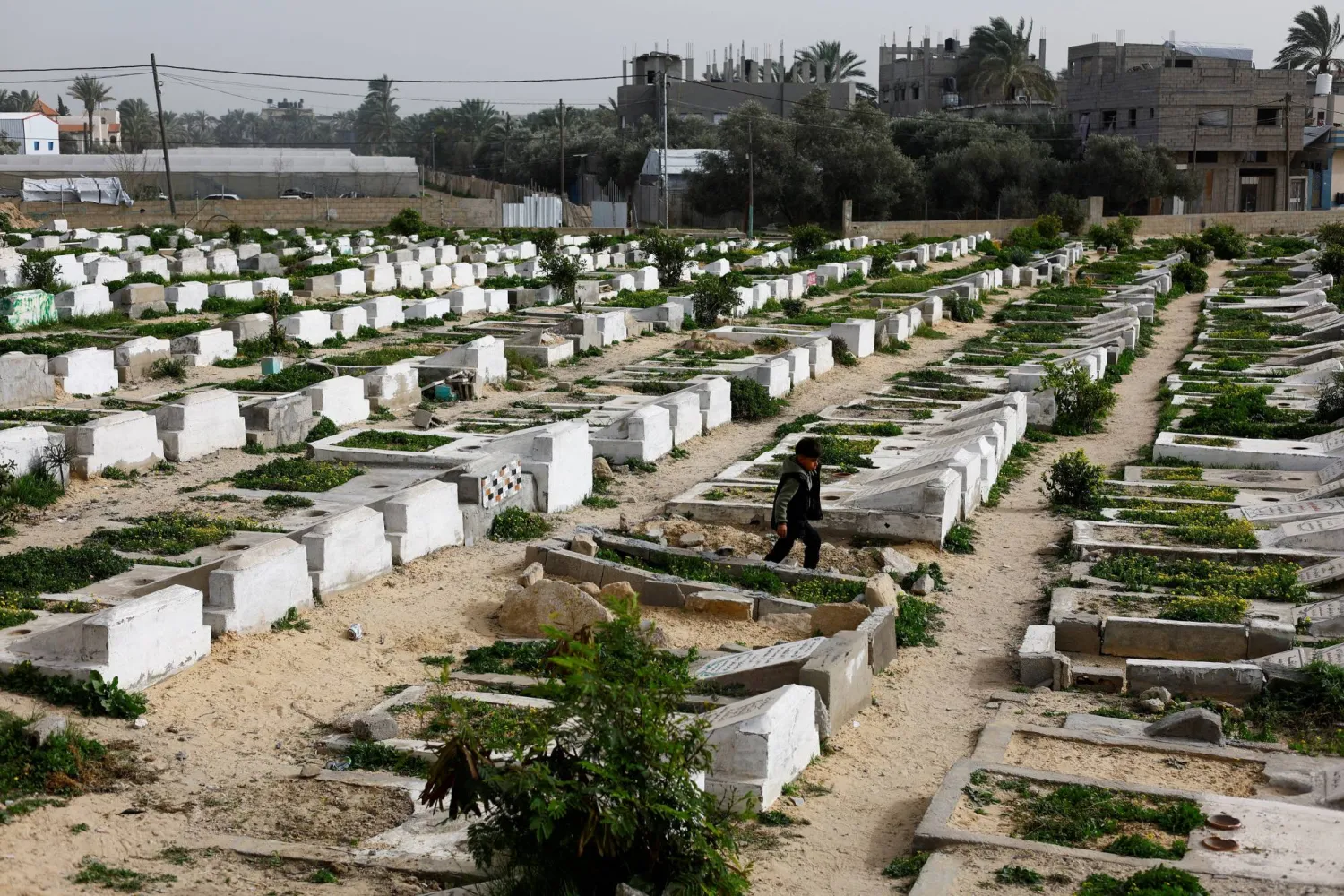
A Palestinian child walks through the cemetery with graves of some of those killed during the war, in Deir al-Balah, central Gaza Strip, January 30, 2026. REUTERS/Mahmoud Issa
TT

Besieged by Gang Violence, Palestinian Citizens in Israel Demand More Security

A Palestinian child walks through the cemetery with graves of some of those killed during the war, in Deir al-Balah, central Gaza Strip, January 30, 2026. REUTERS/Mahmoud Issa

Nabil Safiya had taken a break from studying for a biology exam to meet a cousin at a pizza parlor when a gunman on a motorcycle rode past and fired, killing the 15-year-old as he sat in a black Renault.

The shooting — which police later said was a case of mistaken identity — stunned his hometown of Kafr Yasif, long besieged, like many Palestinian towns in Israel, by a wave of gang violence and family feuds.

“There is no set time for the gunfire anymore,” said Nabil’s father, Ashraf Safiya. “They can kill you in school, they can kill you in the street, they can kill you in the football stadium.”

The violence plaguing Israel’s Arab minority has become an inescapable part of daily life. Activists have long accused authorities of failing to address the issue and say that sense has deepened under Israel's current far-right government, The Associated Press said.

One out of every five citizens in Israel is Palestinian. The rate of crime-related killings among them is more than 22 times higher than that for Jewish Israelis, while arrest and indictment rates for those crimes are far lower. Critics cite the disparities as evidence of entrenched discrimination and neglect.

A growing number of demonstrations are sweeping Israel. Thousands marched in Tel Aviv late Saturday to demand action, while Arab communities have gone on strike, closing shops and schools.

In November, after Nabil was gunned down, residents marched through the streets, students boycotted their classes and the Safiya family turned their home into a shrine with pictures and posters of Nabil.

The outrage had as much to do with what happened as with how often it keeps happening.

“There’s a law for the Jewish society and a different law for Palestinian society,” Ghassan Munayyer, a political activist from Lod, a mixed city with a large Palestinian population, said at a recent protest.

An epidemic of violence

Some Palestinian citizens have reached the highest echelons of business and politics in Israel. Yet many feel forsaken by authorities, with their communities marked by underinvestment and high unemployment that fuels frustration and distrust toward the state.

Nabil was one of a record 252 Palestinian citizens to be killed in Israel last year, according to data from Abraham Initiatives, an Israeli nongovernmental organization that promotes coexistence and safer communities. The toll continues to climb, with at least 26 additional crime-related killings in January.

Walid Haddad, a criminologist who teaches at Ono Academic College and who previously worked in Israel’s national security ministry, said that organized crime thrives off weapons trafficking and loan‑sharking in places where people lack access to credit. Gangs also extort residents and business owners for “protection,” he said.

Based on interviews with gang members in prisons and courts, he said they can earn anywhere from thousands to hundreds of thousands of dollars, depending on whether the job is torching cars, shooting at buildings or assassinating rival leaders.

"If they fire at homes or people once or twice a month, they can buy cars, go on trips. It’s easy money,” Haddad said, noting a widespread sense of impunity.

The violence has stifled the rhythm of life in many Palestinian communities. In Kafr Yasif, a northern Israel town of 10,000, streets empty by nightfall, and it’s not uncommon for those trying to sleep to hear gunshots ringing through their neighborhoods.

Prosecutions lag

Last year, only 8% of killings of Palestinian citizens led to charges filed against suspects, compared with 55% in Jewish communities, according to Abraham Initiatives.

Lama Yassin, the Abraham Initiatives’ director of shared cities and regions, said strained relations with police long discouraged Palestinian citizens from calling for new police stations or more police officers in their communities.

Not anymore.

“In recent years, because people are so depressed and feel like they’re not able to practice day-to-day life ... Arabs are saying, ‘Do whatever it takes, even if it means more police in our towns,’” Yassin said.

The killings have become a rallying cry for Palestinian-led political parties after successive governments pledged to curb the bloodshed with little results. Politicians and activists see the spate of violence as a reflection of selective enforcement and police apathy.

"We’ve been talking about this for 10 years," said Knesset member Aida Touma-Suleiman.

She labeled policing in Palestinian communities “collective punishment,” noting that when Jews are victims of violence, police often set up roadblocks in neighboring Palestinian towns, flood areas with officers and arrest suspects en masse.

“The only side that can be able to smash a mafia is the state and the state is doing nothing except letting (organized crime) understand that they are free to do whatever they want,” Touma-Suleiman said.

Many communities feel impunity has gotten worse, she added, under National Security Minister Itamar Ben-Gvir, who with authority over the police has launched aggressive and visible campaigns against other crimes, targeting protests and pushing for tougher operations in east Jerusalem and the occupied West Bank.

Israeli police reject allegations of skewed priorities, saying that killings in these communities are a top priority. Police also have said investigations are challenging because witnesses don’t always cooperate.

“Investigative decisions are guided by evidence, operational considerations, and due process, not by indifference or lack of prioritization,” police said in a statement.

Unanswered demands

In Kafr Yasif, Ashraf Safiya vowed his son wouldn’t become just another statistic.

He had just gotten home from his work as a dentist and off the phone with Nabil when he learned about the shooting. He raced to the scene to find the car window shattered as Nabil was being rushed to the hospital. Doctors there pronounced him dead.

“The idea was that the blood of this boy would not be wasted,” Safiya said of protests he helped organize. “If people stop caring about these cases, we’re going to just have another case and another case.”

Authorities said last month they were preparing to file an indictment against a 23-year-old arrested in a neighboring town in connection with the shooting. They said the intended target was a relative, referring to the cousin with Nabil that night.

And they described Nabil as a victim of what they called "blood feuds within Arab society.”

At a late January demonstration in Kafr Yasif, marchers carried portraits of Nabil and Nidal Mosaedah, another local boy killed in the violence. Police broke up the protest, saying it lasted longer than authorized, and arrested its leaders, including the former head of the town council.

The show of force, residents said, may have quashed one protest, but did nothing to halt the killings.



UN: Drone Attack Hits Sudan Aid Truck

Shops operate beneath a war-damaged building in Omdurman, on the outskirts of Khartoum, Sudan, Thursday, April 23, 2026. (AP Photo/Bernat Armangue)
TT

UN: Drone Attack Hits Sudan Aid Truck

Shops operate beneath a war-damaged building in Omdurman, on the outskirts of Khartoum, Sudan, Thursday, April 23, 2026. (AP Photo/Bernat Armangue)

A drone attack hit an aid truck in Sudan's North Darfur state, destroying all the supplies on board, the UN refugee agency said on Sunday, without identifying who was responsible.

Drone strikes by both the Sudanese army and the Rapid Support Forces (RSF), who have been locked in a brutal war since April 2023, have escalated in recent months, often killing dozens at a time.

The UNHCR-operated vehicle "came under drone attack" on Friday while transporting emergency shelter kits to Tawila, home to more than 700,000 displaced people who fled fighting elsewhere in the western Darfur region, AFP quoted the agency as saying.

The driver escaped unhurt, but all supplies were destroyed in the resulting fire, it added.

UNHCR condemned the attack, warning that it would "leave 1,314 families living in desperate conditions in Tawila without shelter" at a time when humanitarian needs are already overwhelming.

More than 127,000 people fled El-Fasher, North Darfur's capital and the army's last stronghold in the region, after it fell to paramilitary forces in October, with reports of mass killings, sexual violence, looting and rape following the takeover.

Fighting has since spread to neighboring Kordofan, now the main theatre of the war, and the southeastern Blue Nile state, raising fears of a longer and increasingly fragmented conflict.

According to the UN, nearly 700 civilians have been killed in drone strikes by both sides since January alone.

UNHCR voiced "deep concern" over the rising use of drones, calling repeated attacks on humanitarian operations "particularly abhorrent".

According to an assessment by the UN's Food and Agriculture Organization, 28.9 million people, around 62 percent of Sudan's population, are facing acute food insecurity.

That includes 10.2 million who face severe food insecurity, in particular in the wider Darfur region and South Kordofan state.

Famine was declared last year in El-Fasher and Kadugli, the capital of South Kordofan, with 20 other areas at risk in Darfur and Kordofan, a UN-backed assessment found.

The conflict has already killed tens of thousands, uprooted over 11 million and created the world's largest displacement and hunger crises.


Palestinian Leader's Loyalists Win Local Elections, including Some in Gaza

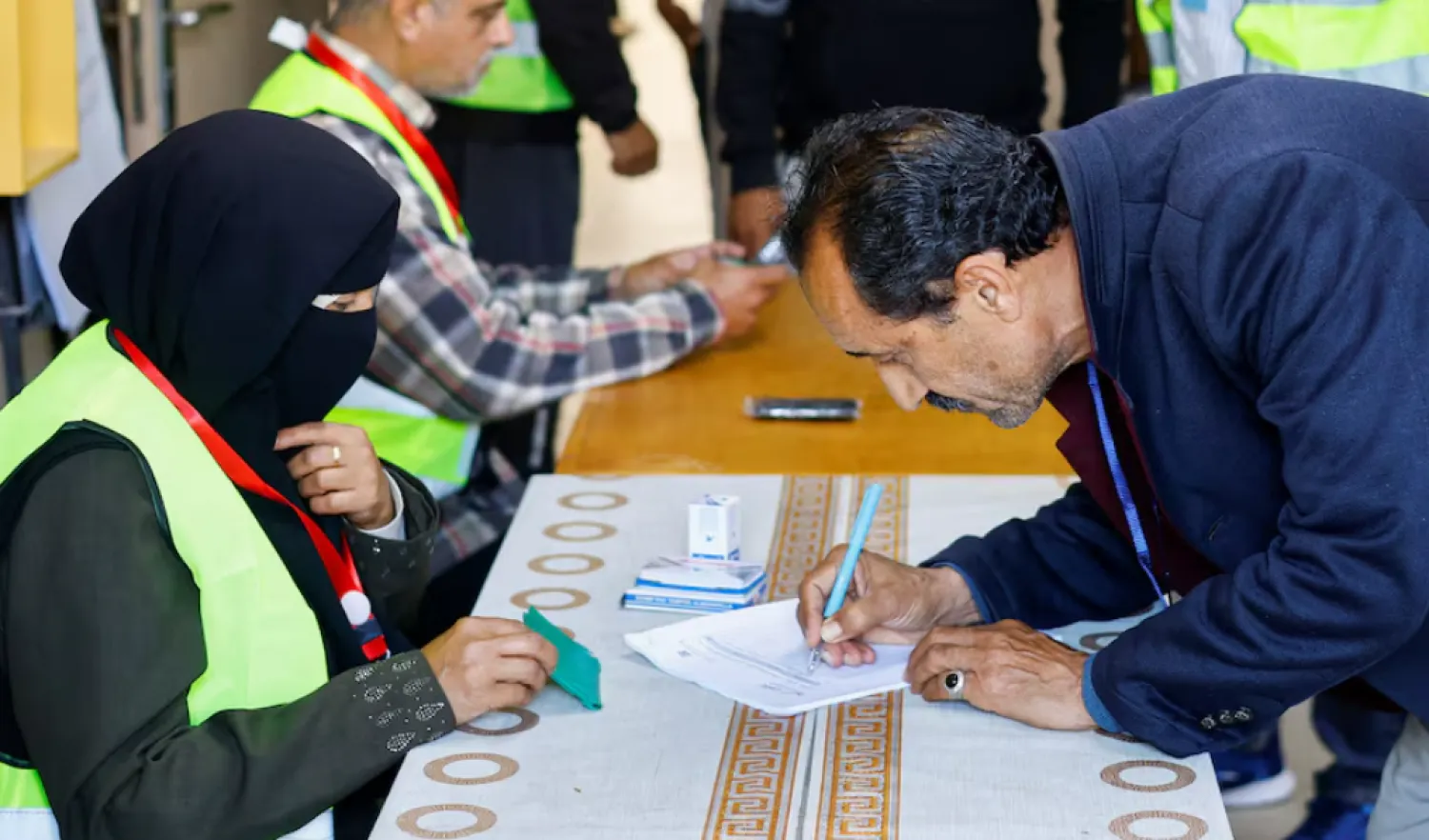
A Palestinian man votes during the municipal election at a polling station in Deir al-Balah, central Gaza Strip April 25, 2026. REUTERS/Mahmoud Issa
TT

Palestinian Leader's Loyalists Win Local Elections, including Some in Gaza

A Palestinian man votes during the municipal election at a polling station in Deir al-Balah, central Gaza Strip April 25, 2026. REUTERS/Mahmoud Issa

Loyalists of President Mahmoud Abbas won most races in Palestinian municipal elections, election officials said on Sunday, in a vote that for the first time in nearly two decades included a city in the Gaza Strip run by rival Hamas.

Saturday’s ballot marked the first elections of any kind in Gaza since 2006 and the first Palestinian polls since the Gaza war began more than two years ago with Hamas' cross-border attack on southern Israel.

Abbas' West Bank–based Palestinian Authority (PA) said the inclusion of the Gaza city Deir al-Balah, which suffered less damage than other areas of the coastal territory during the war, was intended to show that Gaza was an inseparable part of a future Palestinian state.

The elections, in which voter turnout was low, had been held "at a highly sensitive moment amid complex challenges and exceptional circumstances", Palestinian Prime Minister Mohammad Mustafa said as results were announced on Sunday.

But they represented "an important first step in a broader national process aimed at strengthening democratic life ... and ultimately achieving the unity of the land", he said.

POSSIBLE INDICATOR OF HAMAS SUPPORT

Hamas, which ousted the PA from Gaza in 2007, did not formally nominate candidates in Gaza and boycotted the race in the Israeli-occupied West Bank, where Fatah's victory was widely expected.

But some candidates on one of the Deir al-Balah lists were widely seen by residents and analysts as aligned with the movement, making the vote a potential indicator of support for the Islamist group.

Preliminary results showed that the list, known as Deir al-Balah Brings Us Together, won only two of the 15 seats contested in Gaza.

The Nahdat Deir al-Balah list, backed by Abbas' Fatah party and the Western-backed PA, secured six seats. The remaining seats were won by two other Gaza-based groups, Future of Deir al-Balah and Peace and Building, not affiliated with either faction.

Abbas loyalists swept the election in the West Bank, running unchallenged in many seats.

"By electing figures linked to Fatah, voters appear to be seeking unrestricted international support for municipal governance and a gradual political shift that could extend beyond the local level," said Palestinian political analyst Reham Ouda.

The recent war has left much of Gaza reduced to rubble, with many residents displaced and focused on survival. Israel has continued conducting strikes despite an October ceasefire.

In Gaza voter turnout reached just 23%, while in the West Bank it was 56%, according to Chairman of the Central Elections Commission Rami al-Hamdallah.

Al-Hamdallah said some of the ballot boxes and voting equipment did not make it into the enclave because of Israeli security restrictions, though those challenges were overcome.

Hamas' Gaza spokesperson, Hazem Qassem, downplayed the significance of the election results, saying that they had no impact on wider national issues.


Arab Parliament Condemns Attack Targeting Two Border Posts in Kuwait

Arab Parliament logo
TT

Arab Parliament Condemns Attack Targeting Two Border Posts in Kuwait

Arab Parliament logo

Arab Parliament Speaker Mohammed Al-Yamahi has condemned the blatant attack that targeted two sites at the northern land border posts of Kuwait using two explosive-laden drones coming from Iraq, SPA reported.

In a statement, Al-Yamahi stressed the Arab Parliament’s condemnation and categorical rejection of any infringement on the sovereignty of Kuwait or any attempt to undermine its security and stability.

He stressed the Arab Parliament’s full solidarity and support for Kuwait in confronting such attacks, reiterating its backing for all measures taken to protect its security and noting that the security of Kuwait is an integral part of Arab national security.