


Hezbollah Slams the 'Mechanism' Committee and Lebanese President's Envoy

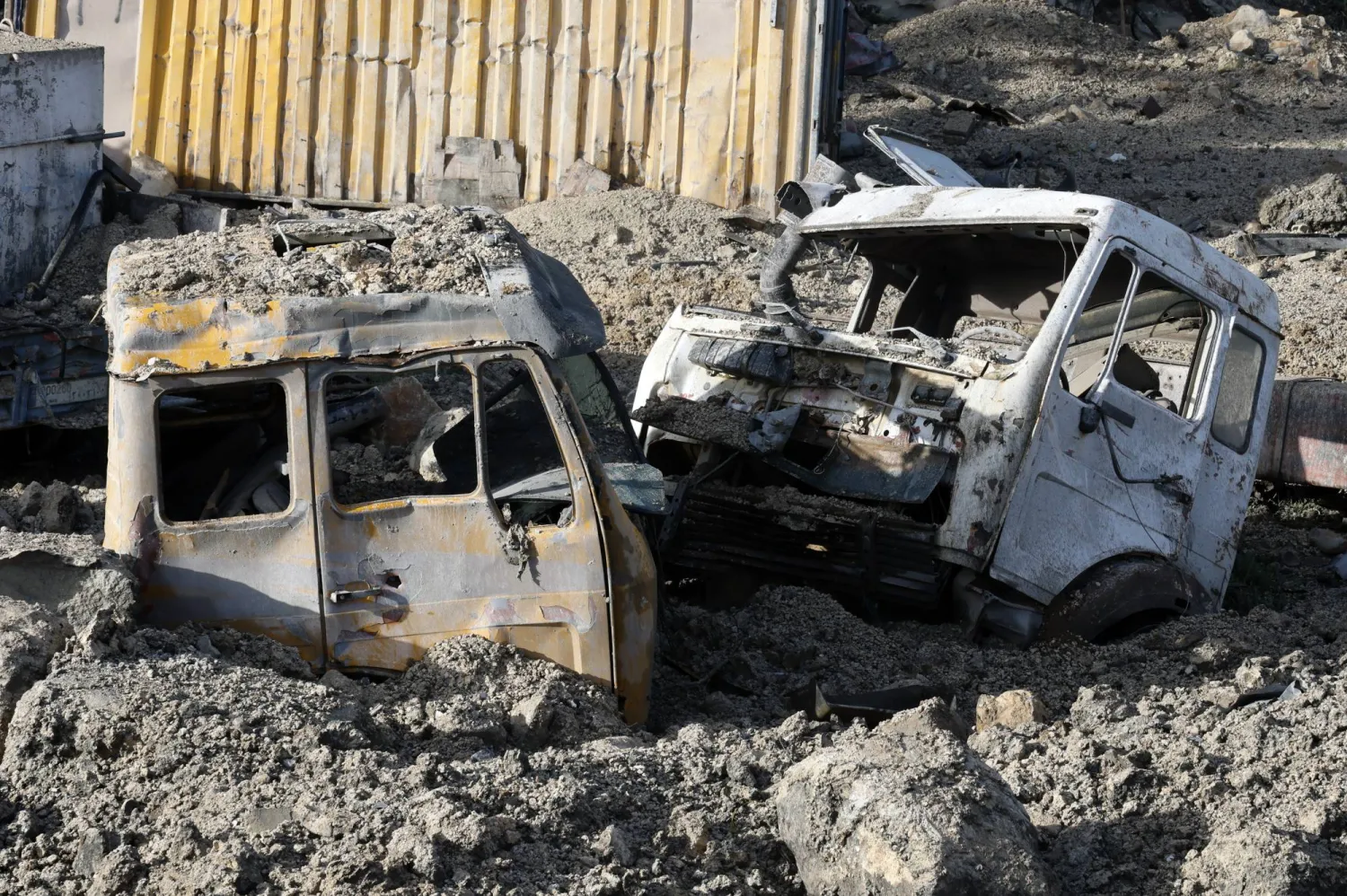
A view of the damage on the site a day after a series of Israeli airstrikes struck a large piece of industrial machinery in the southern Lebanese village of Al-Marwanieh, Lebanon, on 31 January 2026. (EPA)
TT

Hezbollah Slams the 'Mechanism' Committee and Lebanese President's Envoy

A view of the damage on the site a day after a series of Israeli airstrikes struck a large piece of industrial machinery in the southern Lebanese village of Al-Marwanieh, Lebanon, on 31 January 2026. (EPA)

Hezbollah slammed the "mechanism" committee and head of Lebanon's delegation Ambassador Simon Karam, deeming his recent statements a violation of the committee's duties and a precursor to Israel intervening in Lebanon beyond the November 2024 ceasefire agreement.

Hezbollah accused Karam of violating the "technical role" of the committee and of making political statements that "undermine Lebanon's sovereignty and the rights of the Lebanese people and resistors."

The accusations are the latest in a campaign the Iran-backed party has been waging since the beginning the year over efforts to hand over its weapons north of the Litani River. The disarmament is part of a government decision to impose state monopoly over weapons across the country.

The first phase of the plan covered regions south of the Litani and focus has now shifted to areas north of it.

Hezbollah has refused to lay down its weapons in defiance of the state, notably President Joseph Aoun whose recent statements confirming that authorities are forging ahead with the plan have put him at odds with the party and made him a target of its attacks.

A Hezbollah statement on Sunday said the "mechanism" has a purely technical role that is limited to south of the Litani.

"Any improvised proposals only allow the Israeli enemy to meddle in issues not covered in the ceasefire," it added.

The party said appointing a diplomat - Karam - as head of the Lebanese delegation in the mechanism was "a second sin no less significant than the sin of" imposing state monopoly over arms, "especially amid the Zionist occupation of Lebanese territories and continued daily violations against the people and nation."

Hezbollah expressed its "categorical rejection" of attempts to expand the authority of the committee under various diplomatic or political excuses.

The statement also slammed remarks by Karam who cast doubt over Hezbollah's cooperation with the army's disarmament efforts south of the Litani.

Karam's remarks contradict Aoun and other official statements that asserted that the party had indeed cooperated with the military in line with the ceasefire, added Hezbollah.

Ministerial sources told Asharq Al-Awsat, however, that the party was not cooperative with the army, but chose to simply not stand in its way as it implemented the disarmament plan.

The army itself was discovering Hezbollah tunnels and weapons caches, while the party never offered to give it the locations of these sites, they stressed.

Residents of the South were actually notably cooperative with the army, who often pointed them in the direction of caches, they revealed.

The sources rejected Hezbollah's accusations against Karam, dismissing them as an attempt to rally support among its own supporters.

Moreover, they stressed that the authorities will continue with the disarmament plan north of the Litani, noting however the delicate task demands a balanced political and security approach, which officials, led by the president, are working on.



Iraqi Kataeb Hezbollah Say Commander Killed in Strike in Southern Iraq

Members of the Iraqi armed group Kataeb Hezbollah attend the funeral of their members, who were killed in an airstrike that targeted a Hashd al‑Shaabi headquarters near the western al‑Qaim district on the Syrian border, amid the US-Israel conflict with Iran, in Baghdad, Iraq, March 2, 2026. REUTERS/Thaier Al-Suda
TT

Iraqi Kataeb Hezbollah Say Commander Killed in Strike in Southern Iraq

Members of the Iraqi armed group Kataeb Hezbollah attend the funeral of their members, who were killed in an airstrike that targeted a Hashd al‑Shaabi headquarters near the western al‑Qaim district on the Syrian border, amid the US-Israel conflict with Iran, in Baghdad, Iraq, March 2, 2026. REUTERS/Thaier Al-Suda

The Iran-backed Kataeb Hezbollah in Iraq said on Thursday that one of its leaders was killed in a strike on southern Iraq a day earlier.

The Secretary-General of the group, Al-Hajj Abu Hussein al-Hamidawi, mourned in a statement “the great leader, brother, Ali Hassan al-Furayji," who carried out "his duties... for more than two decades."

Two sources from the armed faction told Agence France-Presse on Wednesday that a strike targeted a car near the Jurf al-Nasr base, where the faction is deployed in southern Iraq, resulting in the death of two members.

The death toll rose to three after the death of the leader was confirmed.

One of the sources described the attack as a "Zionist-American strike."

The Jurf al-Nasr base, also known as Jurf al-Sakhar, in southern Iraq, was the first Iraqi target of strikes attributed to Israel and the United States, which later extended to other areas.


Iraq Says it is Directly Affected by the War: ‘We are Under Attack from Both Sides’

Smoke and flames rise near Erbil International Airport in Iraq’s Kurdistan Region following explosions caused by intensive interception operations carried out by air defense systems (dpa)
TT

Iraq Says it is Directly Affected by the War: ‘We are Under Attack from Both Sides’

Smoke and flames rise near Erbil International Airport in Iraq’s Kurdistan Region following explosions caused by intensive interception operations carried out by air defense systems (dpa)

Military escalation across Iraq continues following the outbreak of the Israeli-US war on Iran, as the country is now facing a series of reciprocal attacks by multiple actors on its territory, along with mounting economic damage caused by disruptions to its oil exports.

“Iraq has become one of the countries directly affected by the ongoing conflict,” Iraqi Foreign Minister Fuad Hussein said, noting that the country was “being subjected to attacks from both sides of the conflict.”

Iraqi military and security bases, as well as positions belonging to factions affiliated with the Popular Mobilization Forces (PMF), have been targeted by Israeli and US airstrikes. At the same time, Iran and pro-Iranian factions have targeted American interests and military bases in the Kurdistan Region and other parts of the country.

Hussein made the remarks during a phone call with Russian Foreign Minister Sergei Lavrov, during which the two discussed rapidly evolving military developments in the region and their political and economic repercussions, according to a statement from the Iraqi Foreign Ministry.

Hussein ruled out an immediate ceasefire, saying the widening scope of the confrontation and the intensification of attacks have become daily features of the conflict.

He also warned that the closure of the Strait of Hormuz and ongoing military operations “have disrupted maritime navigation in the region.”

“Iraq is facing increasing difficulties in exporting its oil,” he underlined, a situation shared by several countries in the region and one that could have serious consequences for global energy markets.

He cautioned that the war will lead to a crisis in the energy market and rising prices, which will negatively affect the economies of the region and the world.

New Attacks

Iran and allied factions targeted Erbil International Airport and the nearby Harir Air Base with dozens of rockets and drones on Wednesday. Groups calling themselves the “Islamic Resistance factions” announced that they had carried out more than 28 attacks against US and local targets inside Iraq.

Meanwhile, Camp Victoria, near Baghdad International Airport, was also targeted by rocket attacks launched by armed factions, though Iraqi security forces said they thwarted the strikes.

Kurdistan

On Wednesday, an Iranian Kurdish fighter was reportedly killed in a missile strike targeting a headquarters of the Kurdistan Freedom Party (PAK) in Iraq’s Kurdistan Region, according to a source within the party cited by AFP.

The autonomous Kurdistan Region hosts camps operated by Iranian Kurdish opposition groups.

A party spokesperson, Khalil Kani Sanani, accused “the Iranian regime” of launching three missiles at a camp housing the families of party members, killing one camp guard and wounding three others. The camp lies east of Erbil, the capital of the Kurdistan Region.

On Tuesday, a camp housing Iranian Kurdish fighters and their families in Kurdistan was struck by a drone attack that left one person injured, according to Mohammad Nazif Qader, a member of the opposition Kurdistan Democratic Party of Iran (KDPI).

Iran classifies these Kurdish parties as “terrorist organizations” and accuses them of serving “Western or Israeli interests.”


Sudan Drone Strike Kills 18 People

File photo: A view shows a large plume of smoke and fire rising from fuel depot in Port Sudan, Sudan, May 6, 2025. (Reuters)
TT

Sudan Drone Strike Kills 18 People

File photo: A view shows a large plume of smoke and fire rising from fuel depot in Port Sudan, Sudan, May 6, 2025. (Reuters)

A drone strike on a Sudanese city under paramilitary control killed 18 people, a medic working in the area told AFP on Thursday, while blaming the army for the attack.

Both sides in Sudan's war have resorted to drone warfare, sparking frequent and strong condemnation from the UN, AFP said.

The strike on Al-Mojlad on Wednesday killed 18 people and wounded 25 others, according to a medic working at the city hospital who added that he blamed the military for the attack.

The paramilitary RSF have been fighting the army for nearly three years, and had accused the military of conducting a drone strike on a market in Al-Mojlad.