


Morocco Evacuates 50,000 as Flooding Threatens City After Weeks of Heavy Rain

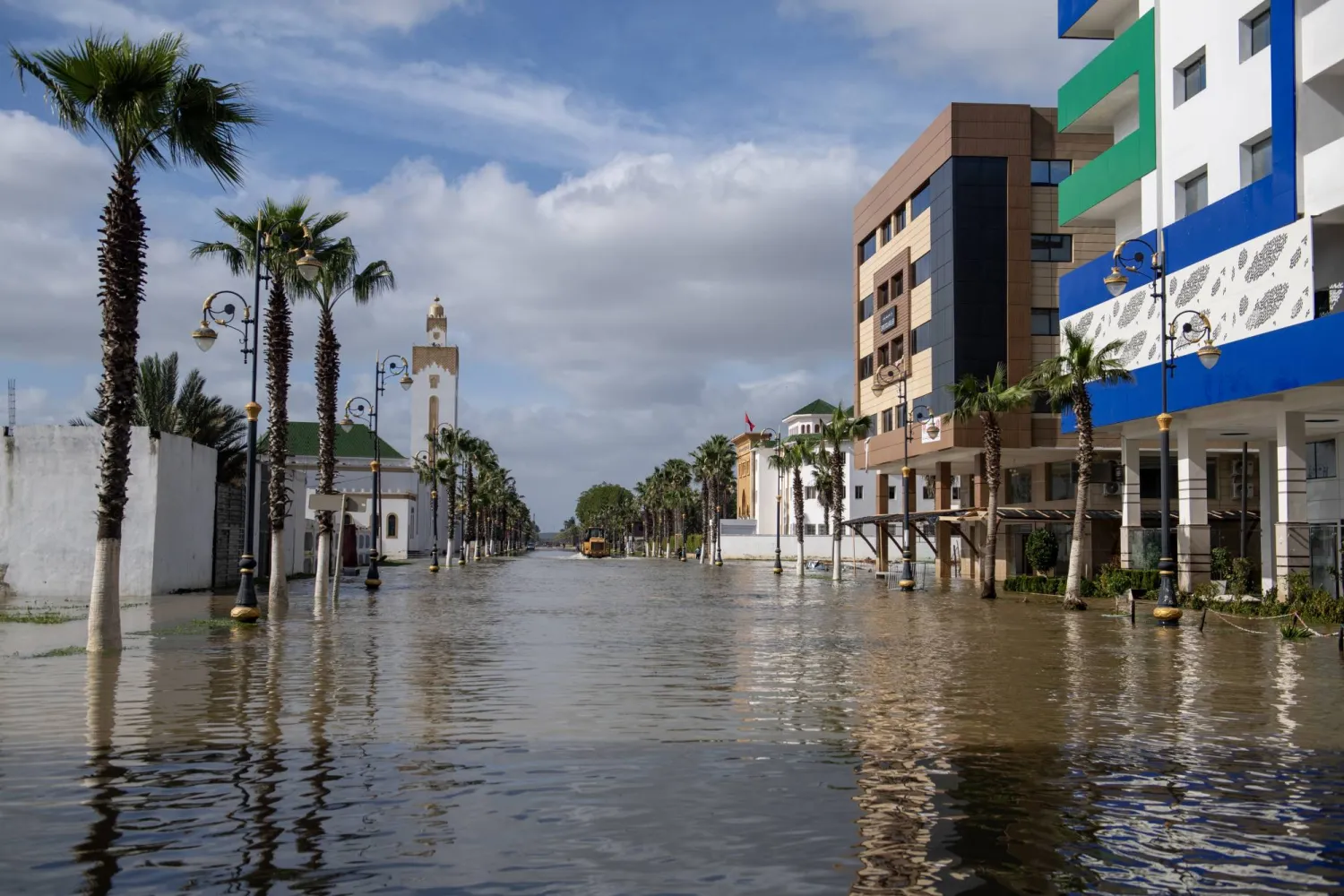
Flooding in Ksar el-Kebir, Morocco, 01 February 2026, amid ongoing heavy rainfall and rising water levels in the Loukkos River. (EPA)
TT

Morocco Evacuates 50,000 as Flooding Threatens City After Weeks of Heavy Rain

Flooding in Ksar el-Kebir, Morocco, 01 February 2026, amid ongoing heavy rainfall and rising water levels in the Loukkos River. (EPA)

Morocco has evacuated more than 50,000 people, nearly half the population of the northwestern city of Ksar el-Kebir, as flooding driven by weeks of heavy rain threatened to inundate the city, state media said on Monday.

"The city has become a ghost town," local resident Hicham Ajttou told Reuters by phone. "All markets and shops are closed and most residents have either left voluntarily or been evacuated."

Authorities set up shelters and temporary camps and ‌barred entry into ‌Ksar el-Kebir as rising water ‌levels ⁠in the ‌Loukkos River spread across several neighborhoods. Only departures from the city were permitted, while electricity was cut in parts of it and schools were ordered to remain closed until Saturday.

Officials said the floods were partly triggered by water released from the nearby Oued Makhazine dam, which ⁠had reached full capacity. Ksar el-Kebir lies about 190 km (120 miles) ‌north of Rabat.

Ajttou said he moved his ‍family to Tangier last ‍week and returned to Ksar el-Kebir to volunteer ‍in relief efforts.

"The question that worries us is what comes next. The dam is full and we don't know how long this situation will last," he said.

The army has deployed rescue units, trucks, equipment and medics to support evacuation and rescue operations and buses evacuated ⁠people from the city.

State TV Al Oula showed a helicopter rescuing four people trapped by rising waters in Oued Ouargha in the nearby province of Ouezzane.

Further south, rising levels of the Sebou River prompted authorities to evacuate several villagers in Sidi Kacem and reinforce riverbanks with sandbags and barriers.

The heavy rainfall has brought an end to a seven-year drought that pushed Morocco to invest heavily in desalination plants. The national dam-filling rate ‌is now close to 62%, with several major reservoirs reaching full capacity, according to official data.



Iraq Reaffirms Ongoing Hunt for Those Behind Attacks on Saudi Arabia

Civilians and security personnel on the Iraqi side of the Shalamja border crossing. (AFP)
TT

Iraq Reaffirms Ongoing Hunt for Those Behind Attacks on Saudi Arabia

Civilians and security personnel on the Iraqi side of the Shalamja border crossing. (AFP)

Iraqi security authorities on Tuesday reiterated that they would continue pursuing those who launched explosive-laden drones against neighboring countries, saying investigations were ongoing to identify those behind attacks on Saudi territory.

Lt. Gen. Saad Maan, head of Iraq’s Security Media Cell, said an intelligence committee had located the launch site inside Iraq.

“The investigation is ongoing, with the use of intelligence and technical capabilities, forensic evidence, fingerprints and other details needed to complete the investigation and identify those who committed this act,” Maan told the state news agency.

Prime Minister Ali al-Zaidi had relieved the commander of operations in the southern province of Maysan of his duties and dismissed the provincial police chief and other security officials after it was established that the attacks targeting Saudi Arabia had been launched from a site in the province.

Maan said the priority was to identify the perpetrators, stressing that Iraq would not allow attacks on countries in the region. He said Baghdad had contacted Saudi authorities to explain the measures taken by the government.

Iran later formally asked Iraq to participate in the investigation, a request Zaidi approved, according to the government’s military spokesman.

Talabani-Araghchi Talks

Separately, Patriotic Union of Kurdistan President Bafel Talabani held a series of meetings with Iranian leaders during a visit to Tehran on Tuesday, beginning with Foreign Minister Abbas Araghchi.

Iranian Foreign Ministry spokesman Esmaeil Baghaei said the visit, made at Araghchi’s invitation, was part of Iran’s continuing consultations with the Iraqi government and the Kurdistan Regional Government to expand bilateral relations and strengthen regional peace and stability, economic cooperation and border security.

Talabani’s visit came a day after several areas of Sulaymaniyah, the PUK’s stronghold, were hit by five missiles believed to be Iranian, leading sources and observers to suggest that the visit would focus on security.

A PUK statement said Talabani and Araghchi discussed the latest developments in the region.

A senior Kurdish source said Talabani was expected to raise a broad range of security, political and economic issues.

The source said security remained a priority because of repeated attacks by Iran and its allied factions in Iraq on the Kurdistan Region, ostensibly over the presence of Iranian Kurdish parties there.

At least six Iranian Kurdish opposition parties operate in Iraqi Kurdistan, including the Kurdistan Democratic Party of Iran, the Party for a Free Life in Kurdistan (PJAK) and Komala. They agreed earlier this year to coordinate under the Coalition of Political Forces of Iranian Kurdistan.

The source said Talabani could ask Tehran to press its factions and allies in Iraq to reduce pressure and attacks on the region.

Baghdad and Tehran signed a security agreement in 2023 aimed at securing their shared border and neutralizing Iranian opposition groups in Iraqi Kurdistan, including by closing and relocating their bases about 50 kilometers from the Iranian border. Those measures, however, have not prevented continued Iranian attacks on the Kurdistan Region.


8 Dead, Dozens Missing as Gaza Apartment Block Collapses

Ambulance crews transport injured Palestinians to Nasser Hospital in Khan Yunis, southern Gaza Strip, 15 September 2026. EPA/HAITHAM IMAD
TT

8 Dead, Dozens Missing as Gaza Apartment Block Collapses

Ambulance crews transport injured Palestinians to Nasser Hospital in Khan Yunis, southern Gaza Strip, 15 September 2026. EPA/HAITHAM IMAD

Rescuers searched on Wednesday for dozens of people missing after an apartment block in Gaza collapsed, killing eight people including children, authorities in the war-torn enclave said.

Gaza's civil defense agency said the six-story building in the Tal al-Hawa area was home to people displaced by the war with Israel, and collapsed onto residential and nearby tents.

Agency spokesman Mahmoud Basal told AFP the building had sustained structural damage from Israeli strikes.

"The bodies of eight martyrs including children and 15 injured individuals have been recovered from the rubble," Basal said.

He said more than 60 people were missing.


Al-Zaidi: Iraq Eyes Europe as It Seeks to Diversify Oil Exports

 German Chancellor Friedrich Merz, right, and Iraqi Prime Minister Ali al-Zaidi attend a press conference in Berlin, Germany, Tuesday, Sept. 15, 2026. (AP)
German Chancellor Friedrich Merz, right, and Iraqi Prime Minister Ali al-Zaidi attend a press conference in Berlin, Germany, Tuesday, Sept. 15, 2026. (AP)
TT

Al-Zaidi: Iraq Eyes Europe as It Seeks to Diversify Oil Exports

 German Chancellor Friedrich Merz, right, and Iraqi Prime Minister Ali al-Zaidi attend a press conference in Berlin, Germany, Tuesday, Sept. 15, 2026. (AP)
German Chancellor Friedrich Merz, right, and Iraqi Prime Minister Ali al-Zaidi attend a press conference in Berlin, Germany, Tuesday, Sept. 15, 2026. (AP)

Iraqi Prime Minister Ali al-Zaidi said on Tuesday that he discussed selling oil to Europe during visits to France and Germany, as Baghdad seeks to diversify its export routes and reduce its reliance on the Strait of Hormuz.

During a press conference with German Chancellor Friedrich Merz in Berlin, al-Zaidi said: "We want to expand and diversify our export routes".

He added that "Iraq cannot remain hostage to a single corridor" as recent events have demonstrated, referring to the Strait of Hormuz, which has been blockaded by Iran during the Middle East war.

Al-Zaidi said that he had discussed oil exports to Europe with Merz and French President Emmanuel Macron, whom he met in Paris on Monday.

Crude oil sales account for nearly 90 percent of Iraq's revenue but its exports have been hurt by the outbreak of the Middle East war between Iran and the United States.

Before the war began in February, Iraq produced around four million barrels per day, and exported an average of 3.4 million bpd, mostly via Hormuz.

Most of its oil exports go to East Asia, with China and India its largest buyers.

Due to the disruption, Iraq began exporting crude using tanker trucks through Syria, as well as through a pipeline to the Turkish port of Ceyhan, although these routes can handle only a fraction of its usual sea-bound trade.

Al-Zaidi said that Baghdad could "double its oil exports through the Mediterranean" to supply markets in Europe and the United States.

Al-Zaidi, who hopes to increase Iraq's oil production to 10 million barrels per day, said that "a large share, or nearly half, can go to European countries and the West".

He said that Iraq and Germany were expected to reach "an understanding on the export of crude oil" while Baghdad would purchase German technology and equipment.

Merz said that the main focus for Iraqi-German cooperation is the economy.

"Many German companies are now active in Iraq. They are developing new solutions, for example for energy supply," he said, adding that "the best example is an agreement on Iraq's electricity supply, which we will sign today".

Merz also expressed his concerns after Yemen's Houthis cemented their control over the Bab al-Mandeb waterway at the entrance to the Red Sea.

"This further exacerbates the situation on the energy markets, and also affects Germany," he said.