


Syria Govt Forces Enter Qamishli Under Agreement with Kurds

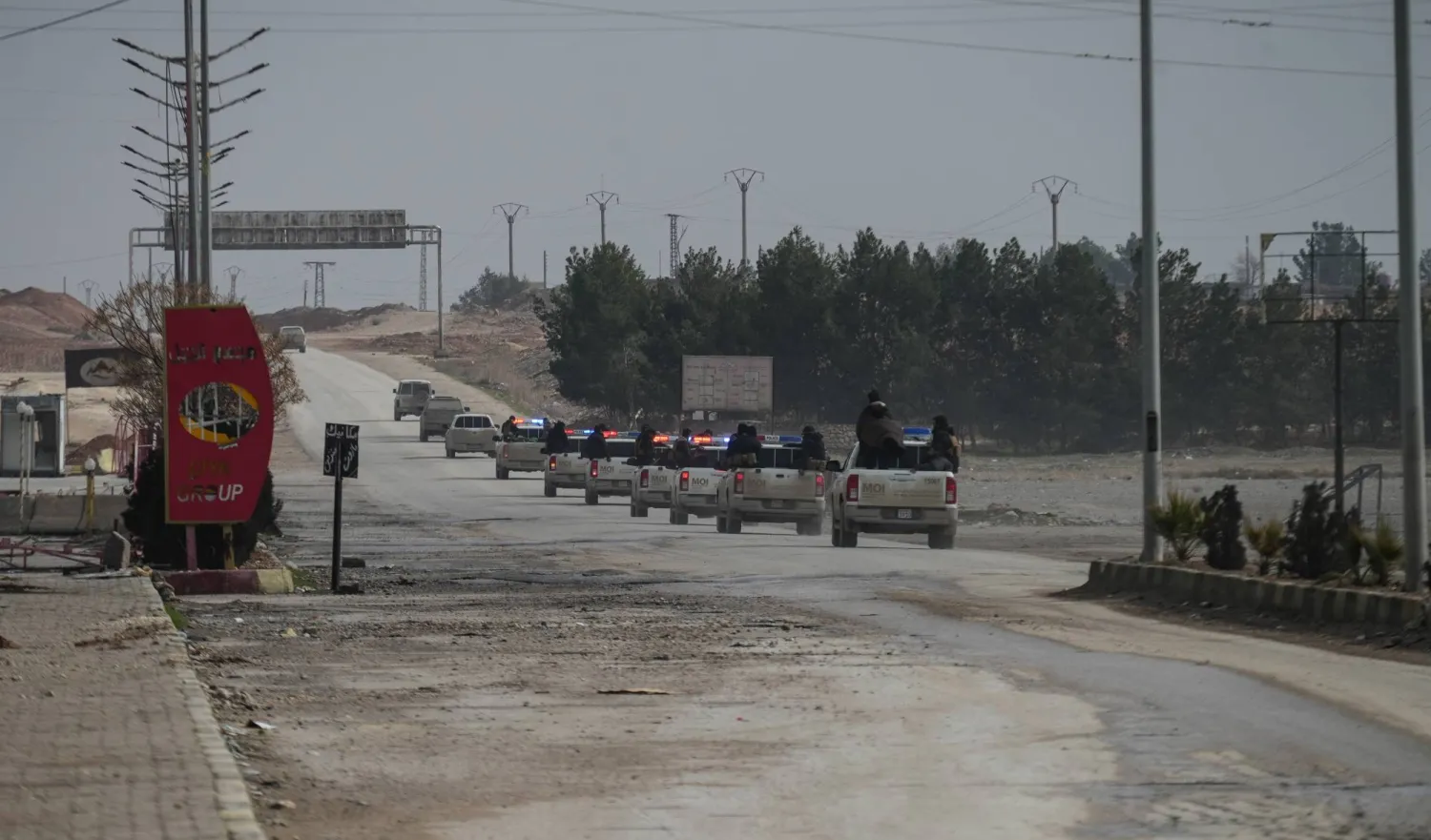
02 February 2026, Syria, Saran: Syrian internal security forces are preparing near the village of Saran to enter the Kobane region northeast of Aleppo, following an agreement between the SDF and the Syrian government stipulating the entry of a number of Syrian security forces into the cities of Hasakeh, Qamishli, and Kobane to take over government institutions. (dpa)
TT

Syria Govt Forces Enter Qamishli Under Agreement with Kurds

02 February 2026, Syria, Saran: Syrian internal security forces are preparing near the village of Saran to enter the Kobane region northeast of Aleppo, following an agreement between the SDF and the Syrian government stipulating the entry of a number of Syrian security forces into the cities of Hasakeh, Qamishli, and Kobane to take over government institutions. (dpa)

Syrian government forces entered the Kurdish-majority city of Qamishli on Tuesday as part of a deal agreed last week to gradually integrate the Kurds' forces and institutions into the state. 

The arrival came after government security personnel entered the mixed Kurdish-Arab city of Hasakeh and the countryside around the Kurdish town of Kobane the day before. 

Kurdish forces have ceded swathes of territory to advancing government troops in recent weeks following months of tension and sporadic clashes as Syria's new authorities have sought to impose their authority across the country. 

"A convoy of internal security forces began entering the city of Qamishli," the official SANA news agency said. 

An AFP correspondent saw a convoy of vehicles, including armored personnel, carriers enter the city, which has been the main stronghold of the Kurds' de facto autonomous administration, while forces set up checkpoints at its entrances. 

Another correspondent reported few people on the streets inside the city amid a curfew in place until Wednesday morning, with Kurdish security forces also lightly deployed and Kurdish flags and banners raised. 

At the city's entrance, interior ministry spokesman Noureddine al-Baba said work would be undertaken to integrate the Kurds' domestic security forces, known as the Asayish, "into the ranks and payroll" of the ministry. 

He welcomed Syria's diversity and "all Syrian national personnel" wishing to serve the country. 

State television reported that Baba and Marwan al-Ali, the new head of internal security in Hasakeh province, inspected the Asayish security headquarters in Qamishli ahead of its handover. 

- 'Gradual integration' - 

Friday's deal "seeks to unify Syrian territory", including Kurdish areas, while also maintaining an ongoing ceasefire and introducing the "gradual integration" of Kurdish forces and administrative institutions, according to the text of the agreement. 

It was a blow to the Kurds, who had sought to preserve the de facto autonomy they exercised after seizing vast areas of north and northeast Syria in battles against the IS extremist group during the civil war. 

Mazloum Abdi, head of the Kurdish-led Syrian Democratic Forces (SDF), had previously said the deal would be implemented on the ground from Monday, with both sides to pull forces back from frontline positions in parts of the northeast, and from Kobane in the north. 

He added that a "limited internal security force" would enter parts of Hasakeh and Qamishli, but that "no military forces will enter any Kurdish city or town". 

On Monday, government security personnel also deployed to the countryside around Kobane, more than 200 kilometers (125 miles) from Hasakeh. 

Hemmed in by the Turkish border and Syrian government forces, the town has long been seen as a symbol of Kurdish fighters' victory against ISIS. 

The United States, which leads a military coalition that had backed the Kurds' campaign against ISIS, has drawn close to Syria's new authorities and recently said the purpose of its alliance with the Kurdish forces was largely over. 


Lebanese Army Says Soldier Wounded by Gunfire from Syria

Vehicles line up at Jdeidat Yabous border crossing with Lebanon, amid an increased cross-border movement in Jdeidat Yabous, 45 kilometers west of Damascus, Syria, 03 March 2026. (EPA)
TT

Lebanese Army Says Soldier Wounded by Gunfire from Syria

Vehicles line up at Jdeidat Yabous border crossing with Lebanon, amid an increased cross-border movement in Jdeidat Yabous, 45 kilometers west of Damascus, Syria, 03 March 2026. (EPA)

Lebanon's military said on Saturday that a soldier was moderately wounded by gunfire coming from Syria a day prior in the country's northeast.

"A Lebanese soldier sustained moderate injuries as a result of gunfire from the Syrian side targeting a Lebanese army post in the Qasr-Hermel area," the military said, adding that "soldiers at the post returned fire".

"An investigation is underway to determine the circumstances of the incident in coordination with the relevant Syrian authorities."

On Friday, Lebanese Prime Minister Nawaf Salam said Syria's President Ahmed al-Sharaa informed him that Syrian troop building along the border with Lebanon was "solely aimed at strengthening border control and maintaining internal Syrian security", and that similar measures were taken on the border with Iraq.


Israel Defense Minister Warns Lebanon to Disarm Hezbollah or Face ‘Heavy Price’

A man inspects the debris of destroyed buildings at the site of an Israeli airstrike that targeted Haret Hreik neighborhood in Beirut's southern suburbs, on March 7, 2026. (AFP)
TT

Israel Defense Minister Warns Lebanon to Disarm Hezbollah or Face ‘Heavy Price’

A man inspects the debris of destroyed buildings at the site of an Israeli airstrike that targeted Haret Hreik neighborhood in Beirut's southern suburbs, on March 7, 2026. (AFP)

Israel's Defense Minister Israel Katz warned the Lebanese government on Saturday to disarm Hezbollah or "pay ‌a very ‌heavy price." 

"We (ISRAEL) ‌have ⁠no territorial claims ⁠against Lebanon, but we will not accept a situation ⁠where what ‌existed ‌for many ‌years — firing ‌from Lebanese territory toward the State of ‌Israel — is renewed," Katz said in ⁠a ⁠statement.  

"Therefore, we are turning and warning: act and take action before we act even more." 

The United Nations special coordinator for Lebanon on Saturday urged Lebanon and Israel to enter talks to negotiate an end hostilities after the outbreak of a renewed Israel-Hezbollah war.  

"As bad as things are today, they are set to get even worse," Jeanine Hennis-Plasschaert said.  

"Talks between Lebanon and Israel can be the game changer needed to save future generations from going, time and again, through the same nightmare".  

In December, Lebanese and Israeli civilian representatives engaged in their first direct talks in decades as part of a meeting of a committee monitoring the November 2024 ceasefire between Israel and Hezbollah.  

Lebanon was engulfed by the expanding Middle East war on Monday, after Hezbollah fired missiles at Israel to avenge the death of Iranian supreme leader Ali Khamenei in US-Israeli attacks on Iran. 


Hezbollah’s Rejection of ‘Surrender’ Stalls Macron Initiative to Halt War

Lebanese President Joseph Aoun receiving former prime ministers Fouad Siniora, Tammam Salam, and Najib Mikati (Lebanese Presidency). 
TT

Hezbollah’s Rejection of ‘Surrender’ Stalls Macron Initiative to Halt War

Lebanese President Joseph Aoun receiving former prime ministers Fouad Siniora, Tammam Salam, and Najib Mikati (Lebanese Presidency). 

French President Emmanuel Macron’s initiative has failed to break the political stalemate surrounding the ongoing war in Lebanon, as Hezbollah rejects what it describes as “surrender” and insists on pressing ahead with the confrontation.

Lebanese and international observers view Hezbollah's fighting as support for Iran in its conflict with Israel and the United States. At the same time, Washington’s continued silence regarding the renewed hostilities in Lebanon has drawn notice.

Lebanese sources familiar with the ongoing contacts said Hezbollah has declined to engage in negotiations after Parliament Speaker Nabih Berri conveyed a call to return to the ceasefire agreement reached in November 2024, which ended the previous round of fighting.

Activists involved in the communications channel quoted senior Hezbollah officials as saying that it was “too early to speak of negotiations.”

Lebanese ministerial sources said President Joseph Aoun informed Macron that any initiative should be presented to Berri, who oversees negotiations on behalf of Hezbollah.

However, visitors to Berri told Asharq Al-Awsat that Macron had only informed him of his intention to send vehicles and equipment to the Lebanese Armed Forces.

Deputy Speaker of Parliament Elias Bou Saab, speaking after meeting the president, referred to “ongoing diplomatic efforts.”

“There are contacts with many parties,” he said. “The media has reported on them, whether French or, in particular, American. But so far we have not reached a breakthrough that we can speak about. The effort is still ongoing, and I believe the contacts made yesterday by the president, as well as the call between the Speaker of Parliament and President Macron, helped reduce attacks that had been planned against Lebanon, including areas that were ultimately not targeted.”

He added: “I can say the diplomatic effort has achieved a measure of success. We must meet these efforts internally with solidarity. Those concerned in Lebanon must also cooperate with the president, the prime minister, and the speaker of parliament so that we can emerge from the current crisis.”

Meanwhile, former prime ministers Najib Mikati, Fouad Siniora, and Tammam Salam visited the president and issued a statement condemning what they described as “the continuing Israeli aggression and crimes against Lebanon and the Lebanese people.”

They voiced support for government decisions affirming that the authority to decide on war and peace must rest exclusively with the state and for enforcing the principle that weapons should be held solely by the Lebanese state across all Lebanese territory. They also called for broad national support for these measures.

Prime Minister Nawaf Salam, for his part, told Arab and foreign ambassadors during a meeting that decisions on war and peace must remain in the hands of the state. He noted that the government is continuing to work with various international partners to halt Israeli attacks.

Salam reiterated Lebanon’s willingness to negotiate and stressed the need to spare facilities and property from damage amid the ongoing escalation. He emphasized that Lebanon “did not choose this war.”

As diplomatic activity intensified, Foreign Minister Youssef Raji held a phone call with Oman’s Foreign Minister Badr Albusaidi, asking Muscat to use its diplomatic influence with the relevant parties to prevent the conflict from being drawn onto Lebanese territory.

Raji also received calls from several European foreign ministers, including Germany’s Johann Wadephul, Ireland’s Helen McEntee, Spain’s José Manuel Albares, Belgium’s Maxime Prévot, and Montenegro’s Ervin Ibrahimović.

The ministers collectively expressed solidarity with Lebanon while welcoming the Lebanese government’s decision to ban Hezbollah’s military and security activities and require the group to surrender its weapons. They also affirmed their readiness to provide the necessary humanitarian assistance.

In turn, Raji expressed deep appreciation for the supportive positions of his counterparts and urged them to mobilize their international contacts to press for an end to the attacks and to spare civilian infrastructure from being targeted.
