



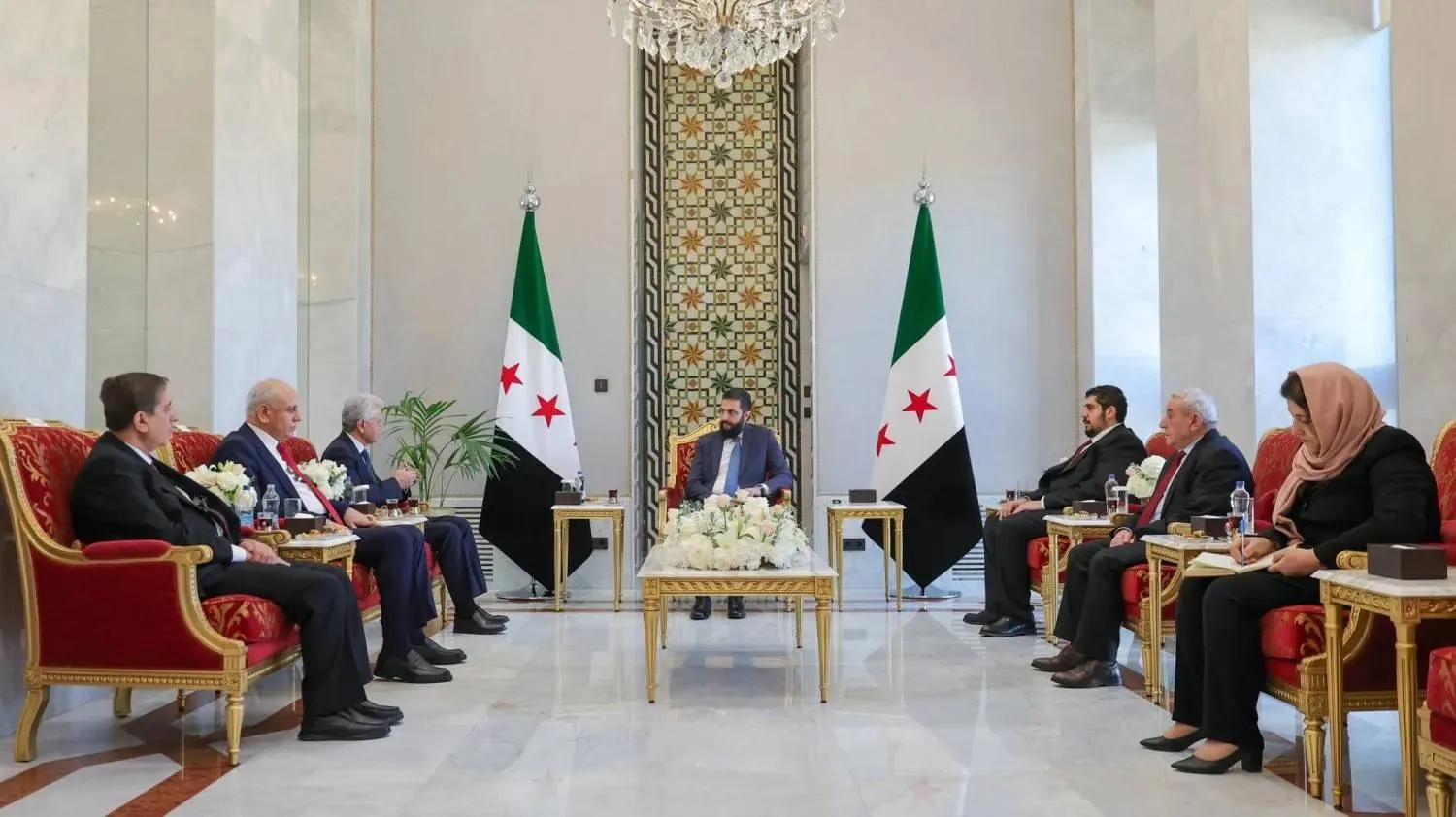

Syrian President Ahmed al-Sharaa on Tuesday received a delegation from the Kurdish National Council, reaffirming the state’s commitment to guaranteeing the rights of Kurds within the framework of the constitution, according to a statement issued by the presidency.
The meeting follows the issuance of Decree No. 13 on December 16, which affirmed that Syrian Kurds are an integral and authentic part of the Syrian people, and that their cultural and linguistic identity constitutes an inseparable part of Syria’s diverse and unified national identity.
Founded in October 2011, the Kurdish National Council is a Syrian political coalition representing a broad spectrum of Kurdish parties and political forces.
The delegation welcomed Decree No. 13, describing it as an important step toward strengthening rights and safeguarding Kurdish cultural and social identity.
Speaking to Asharq Al-Awsat, Shalal Kaddo, head of the Kurdish Centrist Party in Syria and a member of the Council’s general secretariat, said the visit came in response to an official invitation from the Syrian Foreign Ministry.
He explained that the talks aim to hold bilateral meetings with senior Syrian officials, foremost among them al-Sharaa.
Kaddo said the Council has repeatedly emphasized that Decree No. 13 represents a positive step that can be built upon and developed, ultimately to be incorporated into Syria’s permanent constitution in a way that guarantees the national, political, and cultural rights of Syrian Kurds within a unified and democratic Syria.
He added that recent meetings reflected the Council’s growing political presence and its central role in representing the Kurdish cause on the national stage.
Discussions also stressed the need for constitutional recognition of the Kurdish people as genuine partners in Syria, as well as opening a serious political dialogue that places the Kurdish issue in its proper context as a just national cause that cannot be ignored in any future political settlement.
Separately, Abdulaziz Tamo, head of the Association of Independent Syrian Kurds, expressed disappointment that his organization was not invited to meetings in Damascus, despite what he described as its prominent role within the Syrian opposition and revolutionary movement.
He said the Association had been the only Kurdish political body to participate fully in the revolutionary and opposition forces and to openly support recent military operations that led to the liberation of Syrian cities, from Aleppo to Damascus.


