


UN Experts Slam Israeli 'Terrorist' Death Penalty Bill

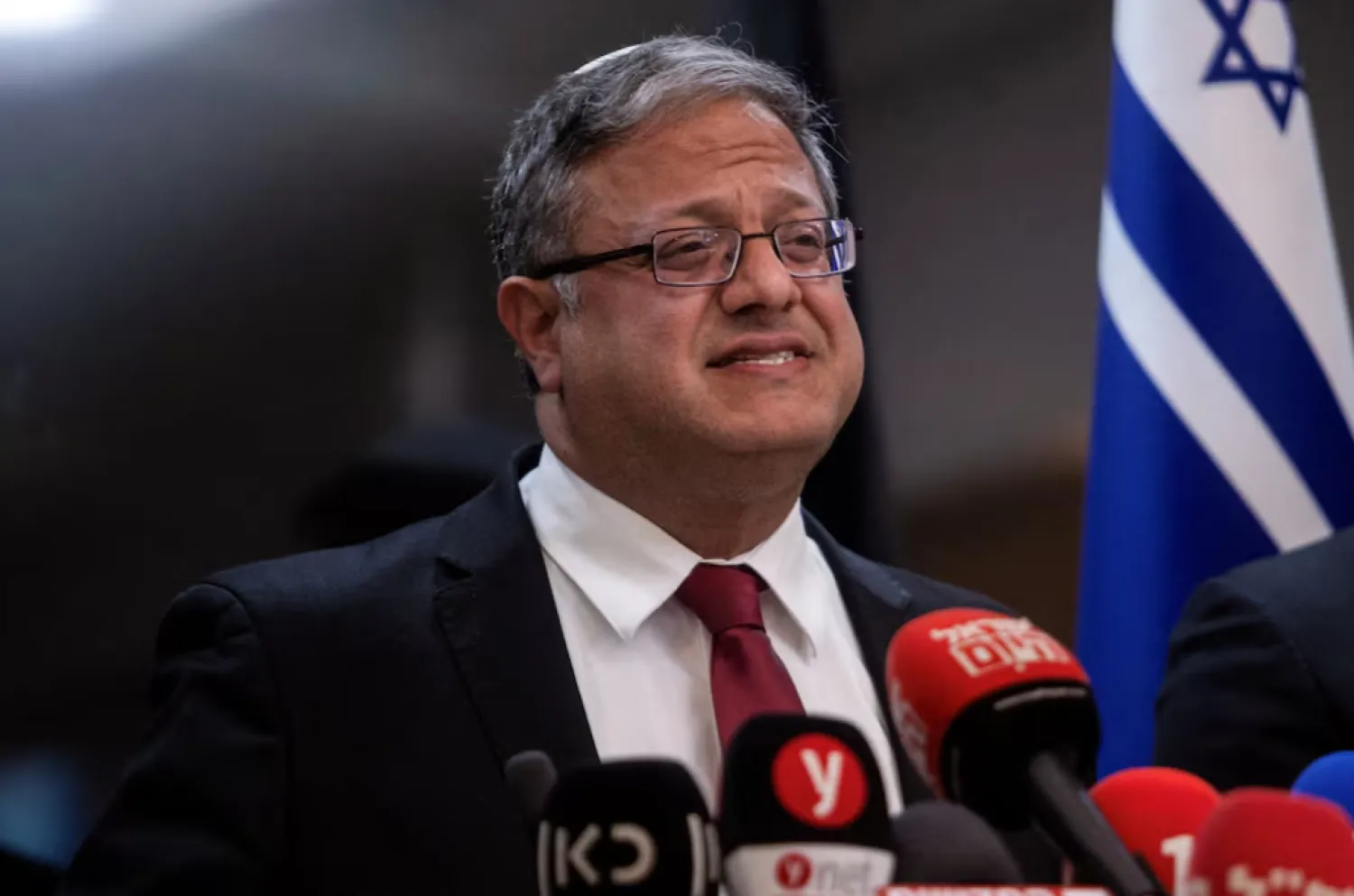
Israeli National Security Minister and head of Jewish Power party Itamar Ben-Gvir gives a statement to members of the press, ahead of a possible ceasefire between Israel and Hamas, in Jerusalem, January 16, 2025. REUTERS/Oren Ben Hakoon/File Photo
TT

UN Experts Slam Israeli 'Terrorist' Death Penalty Bill

Israeli National Security Minister and head of Jewish Power party Itamar Ben-Gvir gives a statement to members of the press, ahead of a possible ceasefire between Israel and Hamas, in Jerusalem, January 16, 2025. REUTERS/Oren Ben Hakoon/File Photo

United Nations experts on Wednesday called on Israel to withdraw a bill proposing the mandatory death penalty for terrorist acts, warning it would violate the right to life and discriminate against Palestinians.

Israel's parliament last November passed a first reading of a draft amendment to the country's penal code, demanded by far-right National Security Minister Itamar Ben Gvir, AFP reported.

"Mandatory death sentences are contrary to the right to life," a dozen independent UN rights experts warned in a statement.

"By removing judicial and prosecutorial discretion, they prevent a court from considering the individual circumstances, including mitigating factors, and from imposing a proportionate sentence that fits the crime," they said.

While the death penalty exists for a small number of crimes in Israel, it has become a de facto abolitionist country: the last person to be executed was the Nazi Holocaust perpetrator Adolf Eichmann in 1962.

But the amendment, which must pass a second and third reading before becoming law, would change that and would introduce two tracks for the death penalty in Israel, a dozen independent UN rights experts warned in a statement.

In the occupied West Bank, the statement said "the death penalty would be imposed by military courts under military law for terrorist acts causing the death of a person, even if not intended".

In Israel and occupied East Jerusalem, meanwhile, capital punishment would continue to be applied only under Israeli criminal law and only for the "intentional killing of Israeli citizens or residents".

- 'Vague and overbroad' -

The experts' statement warned that under both tracks, "vague and overbroad definitions of terrorist offences under Israeli law would apply, which can include conduct that is not genuinely terrorist, and the death penalty would be mandatory".

The experts, including Francesca Albanese, the special rapporteur for the rights situation in the occupied Palestinian territories, stressed that unintentional killings were not considered among the "most serious" crimes to which the death penalty can be applied under international law.

"Since Israeli military trials of civilians typically do not meet fair trial standards under international human rights law and humanitarian law, any resulting death sentence would further violate the right to life," said the experts, who also included the special rapporteurs for protecting rights while countering terrorism and for extrajudicial, summary or arbitrary executions.

"Denial of a fair trial is also a war crime," they stressed.

The independent experts, who are mandated by the UN Human Rights Council but who do not speak on behalf of the United Nations, also warned that "the bill makes matters worse by allowing death sentences to be imposed by a simple majority vote of military judges".

Hamas said in November that the proposed law "embodies the ugly fascist face of the rogue Zionist occupation and represents a blatant violation of international law".

The Ramallah-based Palestinian foreign ministry called it a "new form of escalating Israeli extremism and criminality against the Palestinian people".


Red Cross ‘Outraged’ as On-Duty Paramedic Killed in Gaza

 Rubble from destroyed buildings lies in the north of Gaza, as seen from the Israeli side of the Israel-Gaza border in Israel, February 4, 2026. (Reuters)
Rubble from destroyed buildings lies in the north of Gaza, as seen from the Israeli side of the Israel-Gaza border in Israel, February 4, 2026. (Reuters)
TT

Red Cross ‘Outraged’ as On-Duty Paramedic Killed in Gaza

 Rubble from destroyed buildings lies in the north of Gaza, as seen from the Israeli side of the Israel-Gaza border in Israel, February 4, 2026. (Reuters)
Rubble from destroyed buildings lies in the north of Gaza, as seen from the Israeli side of the Israel-Gaza border in Israel, February 4, 2026. (Reuters)

The International Federation of Red Cross and Red Crescent Societies said it was "outraged" by the killing of an on-duty colleague on Wednesday in Gaza, where Israel is battling Hamas.

The IFRC said Hussein Hassan Hussein Al-Samiri, "a dedicated paramedic" with the Palestine Red Crescent Society, "was killed while performing life-saving humanitarian duties in Khan Younis during an attack in the Al-Mawasi area".

"This tragedy brings the number of PRCS staff and volunteers killed in the line of duty to 30 in Gaza and two in the West Bank since the beginning of the conflict in October 2023," the IFRC said in a statement.


Syrian President Meets Kurdish National Council Delegation, Reaffirms Commitment to Kurdish Rights

Syrian President Ahmed al-Sharaa meets with a delegation from the Kurdish National Council on Tuesday (Syrian Presidency)
TT

Syrian President Meets Kurdish National Council Delegation, Reaffirms Commitment to Kurdish Rights

Syrian President Ahmed al-Sharaa meets with a delegation from the Kurdish National Council on Tuesday (Syrian Presidency)

Syrian President Ahmed al-Sharaa on Tuesday received a delegation from the Kurdish National Council, reaffirming the state’s commitment to guaranteeing the rights of Kurds within the framework of the constitution, according to a statement issued by the presidency.

The meeting follows the issuance of Decree No. 13 on December 16, which affirmed that Syrian Kurds are an integral and authentic part of the Syrian people, and that their cultural and linguistic identity constitutes an inseparable part of Syria’s diverse and unified national identity.

Founded in October 2011, the Kurdish National Council is a Syrian political coalition representing a broad spectrum of Kurdish parties and political forces.

The delegation welcomed Decree No. 13, describing it as an important step toward strengthening rights and safeguarding Kurdish cultural and social identity.

Speaking to Asharq Al-Awsat, Shalal Kaddo, head of the Kurdish Centrist Party in Syria and a member of the Council’s general secretariat, said the visit came in response to an official invitation from the Syrian Foreign Ministry.

He explained that the talks aim to hold bilateral meetings with senior Syrian officials, foremost among them al-Sharaa.

Kaddo said the Council has repeatedly emphasized that Decree No. 13 represents a positive step that can be built upon and developed, ultimately to be incorporated into Syria’s permanent constitution in a way that guarantees the national, political, and cultural rights of Syrian Kurds within a unified and democratic Syria.

He added that recent meetings reflected the Council’s growing political presence and its central role in representing the Kurdish cause on the national stage.

Discussions also stressed the need for constitutional recognition of the Kurdish people as genuine partners in Syria, as well as opening a serious political dialogue that places the Kurdish issue in its proper context as a just national cause that cannot be ignored in any future political settlement.

Separately, Abdulaziz Tamo, head of the Association of Independent Syrian Kurds, expressed disappointment that his organization was not invited to meetings in Damascus, despite what he described as its prominent role within the Syrian opposition and revolutionary movement.

He said the Association had been the only Kurdish political body to participate fully in the revolutionary and opposition forces and to openly support recent military operations that led to the liberation of Syrian cities, from Aleppo to Damascus.


Aoun Calls for Rationally Implementing Lebanon's Commitments as Hezbollah Eases Rhetoric

Lebanese President Joseph Aoun meets with members of the Sovereignty Front. (Lebanese Presidency)
TT

Aoun Calls for Rationally Implementing Lebanon's Commitments as Hezbollah Eases Rhetoric

Lebanese President Joseph Aoun meets with members of the Sovereignty Front. (Lebanese Presidency)

Hezbollah has softened its confrontational tone toward Lebanon’s president and government, without showing clear flexibility on the issue of the state's decision to impose monopoly over arms.

Hezbollah Secretary-General Sheikh Naim Qassem said the party is ready “to discuss how to confront the enemy [Israel] with those who believe in resistance,” while reaffirming its ability to “inflict pain on the enemy” in any potential future confrontation.

His made his remarks as Lebanese President Joseph Aoun reiterated that there will be “no turning back from extending the authority of the law and implementing monopoly over weapons,” stressing that the process would be carried out “with rationality, realism, and responsibility.”

This marks Hezbollah’s first adjustment in tone since it launched a political campaign against the government’s decision to move forward with enforcing the state’s monopoly on arms, including the second phase of the plan that covers regions north of the Litani River.

The Iran-backed party had in recent weeks intensified its criticism of Aoun and the government over the disarmament plan even as Lebanese authorities were working to mobilize international support for the army ahead of a donor conference hosted by Paris on March 5.

Meanwhile, Lebanese Army Commander General Rodolphe Haykal was in the United States where he held talks at the Pentagon with senior military officials, including Chairman of the US Joint Chiefs of Staff General Dan Caine, and Acting Assistant Secretary of Defense for International Security Affairs and Acting Director of the Defense Security Cooperation Agency Daniel Zimmerman.

The discussions focus on military assistance programs and logistical support for the Lebanese army.

Commitment to pledges

On Tuesday, Aoun reiterated his insistence on implementing the weapons monopoly plan, telling a delegation from the Sovereignty Front that the process is being carried out with realism and restraint.

He said the return of international confidence in Lebanon and renewed foreign support are a natural result of efforts to rebuild the state on firm foundations, particularly by enforcing the rule of law and restricting arms to the state.

“These are two matters from which there can be no retreat, regardless of considerations,” Aoun stated, adding that he remains committed to the pledges made in his inaugural address, which received broad domestic and international backing and placed a heavy responsibility on him to remain faithful to them.

Aoun also stressed that he continues to work with all parties to prevent Lebanon from being dragged into a new war.

The Lebanese people, he said, can no longer endure further conflicts, while international conditions require a realistic approach to safeguarding the country and its citizens. He warned that any major danger would affect all Lebanese, not just one group.

Qassem

Despite Lebanon’s insistence on enforcing monopoly over weapons, Hezbollah appeared to step back from its earlier escalation.

Qassem said Lebanon is no longer required to take any further steps under the ceasefire agreement signed in November 2024, calling on the five-member monitoring committee to pressure Israel, rather than Lebanon, to implement the deal.

In a televised address on Tuesday, he said: “We are defending our land, our rights, and our existence against an enemy that wants to eliminate us.”

“When the enemy cannot target fighters, it targets civilians, homes, and municipalities. We must say ‘no’ to the enemy and refuse to surrender.”

Turning to the Lebanese authorities, he said: "Explain to delegations that you cannot pressure the people because they have offered countless martyrs and wounded for the nation."

Qassem said that demands have been made of Hezbollah, "while nothing has been demanded of Israel."

"To those threatening us that the enemy can hurt us, we say we too can harm the enemy, but everything will happen in its own time," he warned.
