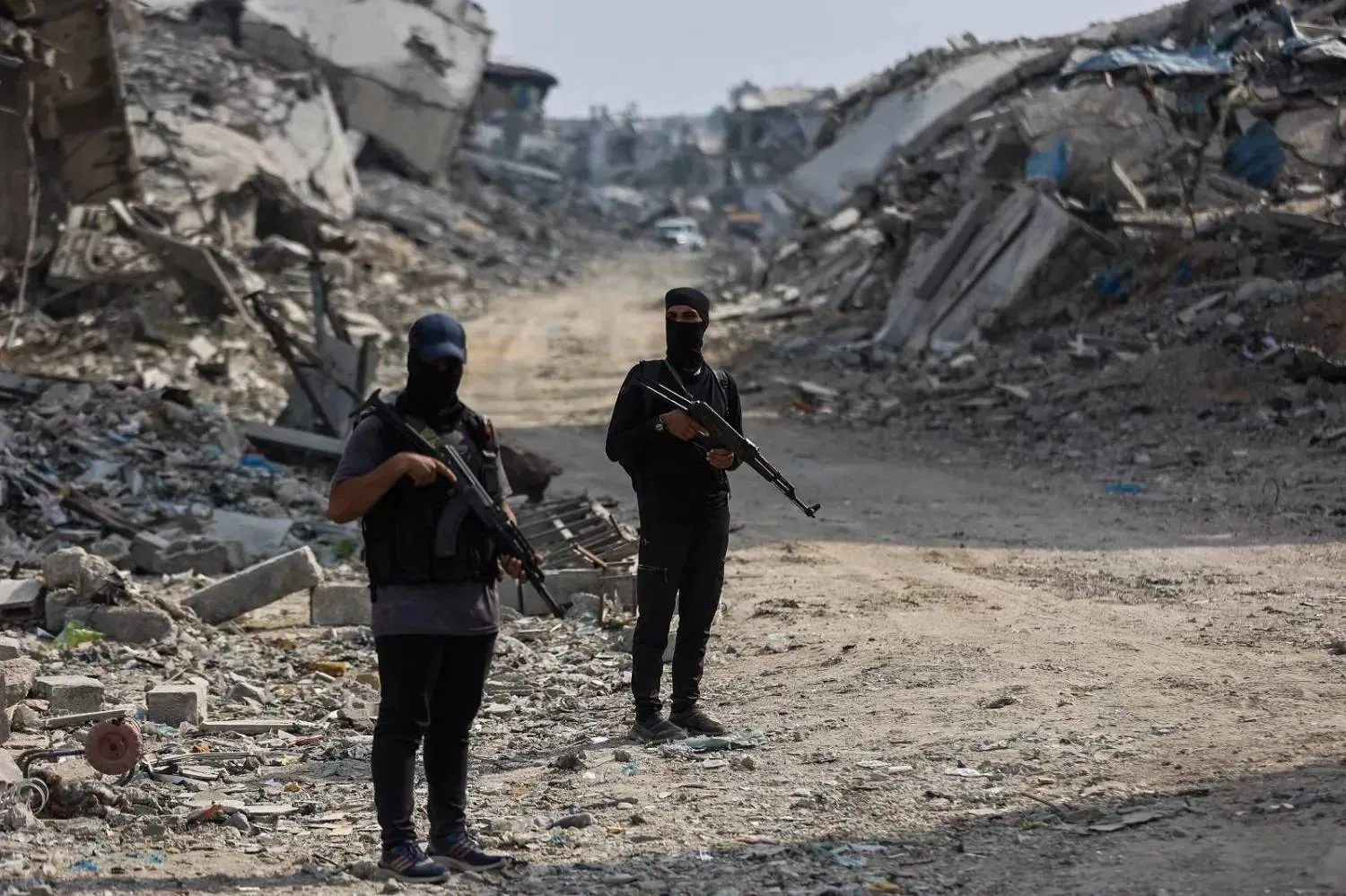

Israel’s demand for the disarmament of Hamas has become the top priority since the second phase of the Gaza agreement began 10 days ago.
It exposed deep uncertainty over how such a step could be enforced amid firm resistance from the movement, which says it will not relinquish its weapons unless progress is made toward establishing a Palestinian state.
Analysts speaking to Asharq Al-Awsat said the issue has left mediators with minimal options, ranging from complete disarmament to freezing weapons, either by persuading Hamas or applying pressure.
The demand has become a political pressure tool that Israeli Prime Minister Benjamin Netanyahu and others in Israel are likely to use increasingly in the run-up to elections, they added.
Israeli opposition figure Benny Gantz, who is preparing for elections, called on Thursday in a post on X for the “disarmament of Hamas.”
Israeli Defense Minister Israel Katz said on Wednesday that Israel will dismantle Hamas if it does not agree to lay down its arms.
Netanyahu, following a meeting on Tuesday with US envoy Steve Witkoff, said he was insisting on the non-negotiable demand to disarm Hamas before any step toward rebuilding Gaza.
Military and strategic analyst Brig. Gen. Samir Ragheb said mediators have few options other than reaching understandings or exerting pressure, noting that the demand to disarm Hamas has been echoed by Israel, Washington, the EU, and donors, and has become an obstacle to ending the war and launching reconstruction.
He said Netanyahu and others would use the issue electorally and as a pretext to collapse the agreement at any time, adding that the second phase is filled with “landmines,” particularly those related to the Israeli withdrawal, which Netanyahu does not want to address.
Strategic and military expert Maj. Gen. Samir Farag said available options are now limited, suggesting that freezing weapons may be more likely than complete disarmament, mainly since Hamas’ arsenal does not consist of missiles or drones and could be handed over.
He said there is US and Israeli insistence on implementing the weapons clause, but that it must coincide with an Israeli withdrawal and guarantees to prevent a new war.
By contrast, sources in Hamas told Reuters on Wednesday that the group had agreed to discuss disarmament with other Palestinian factions, but that neither Washington nor regional mediators had presented it with any detailed or concrete proposal on disarmament.
Israel’s Channel 13 reported in late January that the US was preparing a document granting Hamas several weeks to hand over its weapons to multinational forces within a set timeframe. Failure to comply would give Israel the green light to “act as it sees fit,” the channel said.
Farag stressed that Hamas’ room for maneuver is extremely limited and that it must quickly reach understandings with mediators, particularly Egypt, Qatar, and Türkiye, to resolve what he described as the most significant obstacle currently being created by Israel.
Ragheb said Hamas has no option but to implement US President Donald Trump’s Gaza plan and the disarmament clause, warning against delaying or circumventing it, as “every day lost poses a threat to the ceasefire agreement.”
He added that police forces in the enclave would be deployed within days or weeks, along with a possible stabilization force, leaving little space for further maneuvering.