
UN Force to Withdraw Most Troops from Lebanon by Mid-2027

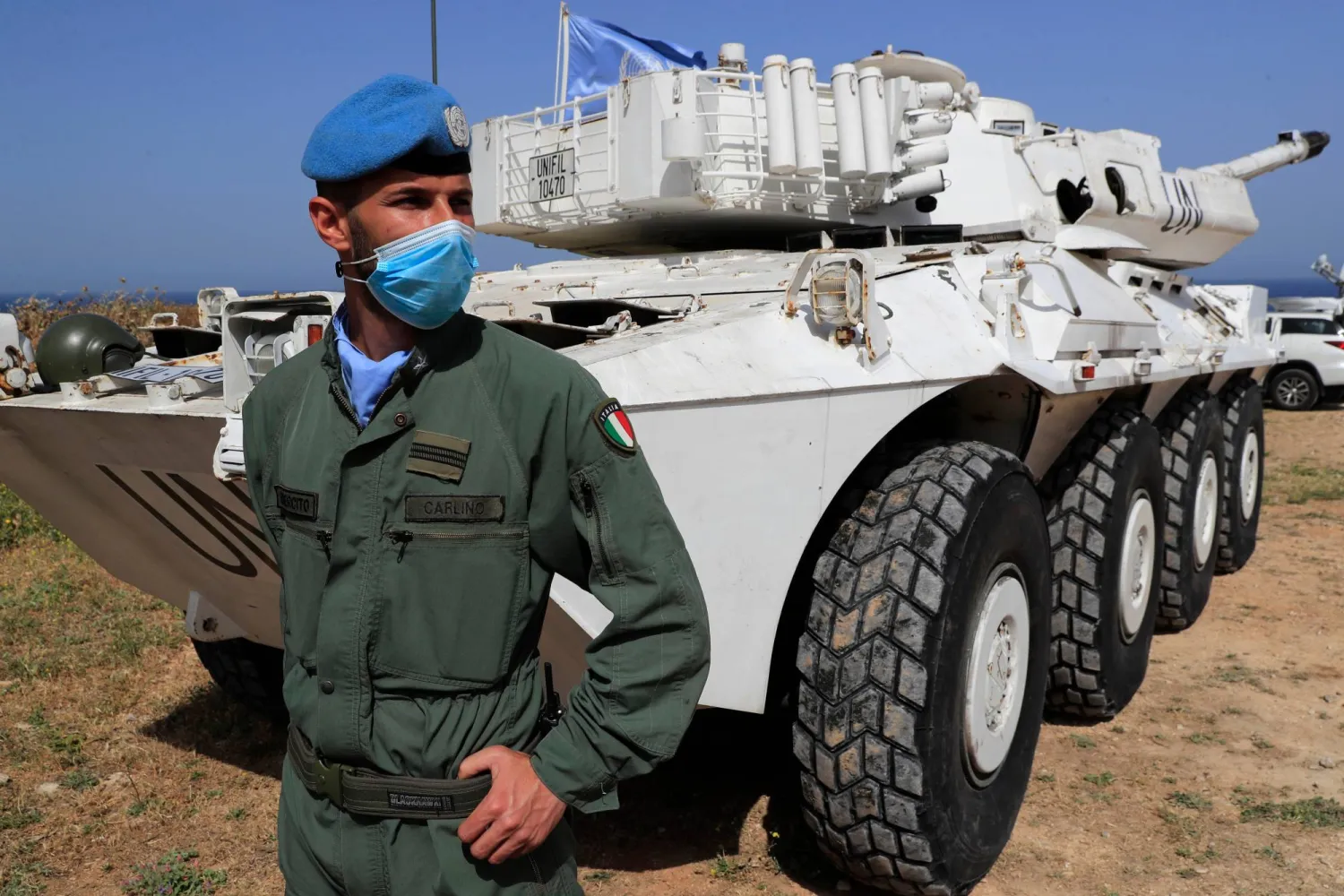
An Italian UN peacekeeper soldier stands guard at a road that links to a United Nations Interim Force In Lebanon (UNIFIL) base, in Naqoura town, Lebanon, on May 4, 2021. (AP)
TT

UN Force to Withdraw Most Troops from Lebanon by Mid-2027

An Italian UN peacekeeper soldier stands guard at a road that links to a United Nations Interim Force In Lebanon (UNIFIL) base, in Naqoura town, Lebanon, on May 4, 2021. (AP)

The United Nations Interim Force in Lebanon plans to withdraw most of its troops by mid 2027, its spokesperson told AFP on Tuesday, after the peacekeepers' mandate expires this year.

UNIFIL has acted as a buffer between Israel and Lebanon for decades and has been assisting the Lebanese army as it dismantles Hezbollah infrastructure near the Israeli border after a recent war between Israel and the Iran-backed group.

Under pressure from the United States and Israel, the UN Security Council voted last year to end the force's mandate on December 31, 2026, with an "orderly and safe drawdown and withdrawal" within one year.

Spokesperson Kandice Ardiel, said that "UNIFIL is planning to draw down and withdraw all, or substantially all, uniformed personnel by mid-year 2027", completing the pullout by year end.

After UNIFIL operations cease on December 31 this year, she said that "we begin the process of sending UNIFIL personnel and equipment home and transferring our UN positions to the Lebanese authorities".

During the withdrawal, the force will only be authorized to perform limited tasks such as protecting UN personnel and bases and overseeing a safe departure.

Despite a November 2024 ceasefire that sought to end more than a year of hostilities with Hezbollah, Israel has kept up regular strikes on Lebanon, mainly saying it is targeting Hezbollah, and has maintained troops in five border areas.

UNIFIL patrols near the border and monitors violations of a UN resolution that ended a 2006 war between Israel and Hezbollah and which forms the basis of the current ceasefire.

It has repeatedly reported Israeli fire at or near its personnel since the truce.

Ardiel said UNIFIL had reduced the number of peacekeepers in south Lebanon by almost 2,000 in recent months, "with a couple hundred more set to leave by May".

The force now counts some 7,500 peacekeepers from 48 countries.

She said the reduction was "a direct result" of a UN-wide financial crisis "and the cost-saving measures all missions have been forced to implement", and unrelated to the end of the force's mandate.

Lebanese authorities want a continued international troop presence in the south after UNIFIL's exit, even if its numbers are limited, and have been urging European countries to stay.

French Foreign Minister Jean-Noel Barrot said in Beirut this month that Lebanon's army should replace the force when the peacekeepers withdraw.

Italy has said it intends to keep a military presence in Lebanon after UNIFIL leaves.


Indonesia Lays to Rest Peacekeepers Killed in Lebanon

The coffin containing the body of Indonesian soldier Farizal Rhomadhon is carried by soldiers at his home in Kulon Progo, Yogyakarta, on April 4, 2026, after being killed while serving with the United Nations Interim Force in Lebanon (UNIFIL) in southern Lebanon. (AFP)
TT

Indonesia Lays to Rest Peacekeepers Killed in Lebanon

The coffin containing the body of Indonesian soldier Farizal Rhomadhon is carried by soldiers at his home in Kulon Progo, Yogyakarta, on April 4, 2026, after being killed while serving with the United Nations Interim Force in Lebanon (UNIFIL) in southern Lebanon. (AFP)

Three Indonesian peacekeepers killed in two separate explosions in southern Lebanon last week were laid to rest in their hometowns on Sunday.

Peacekeeper Farizal Rhomadhon, 28, died when a projectile exploded on March 29 in southern Lebanon, where Israel and Hezbollah have been fighting since Lebanon was drawn into the Middle East war.

Two other blue helmets, Zulmi Aditya Iskandar, 33, and Muhammad Nur Ichwan, 26, died a day later when an explosion struck a logistics convoy of the UN Interim Force in Lebanon (UNIFIL), also in southern Lebanon.

The deadly incidents sparked calls from Indonesian authorities for an investigation and security guarantees for peacekeeping forces.

The soldiers were buried on Sunday in coffins draped in the Indonesian flag during military funerals with gun salutes.

Weeping family members scattered flower petals on their graves.

Zulmi was buried in a military cemetery in his hometown in Bandung, West Java, while Ichwan and Farizal were laid to rest in their respective hometowns in Central Java and Yogyakarta.

"I'm letting him go proudly. I accept it sincerely, even though it is not what I had hoped as a parent," Zulmi's father Iskandarudin told reporters after the funeral.

"I am certain that he's waiting for me in heaven."

Agus Subiyanto, the commander of the Indonesian National Armed Forces, told reporters that every fallen soldier will receive compensation in recognition of their service.

"We have prepared all the rights and entitlements that must be given to the fallen soldiers. Among these is compensation from the United Nations," Agus said after attending Zulmi's funeral.

The bodies of the three peacekeepers arrived in Jakarta on Saturday, received with honors in a ceremony attended by President Prabowo Subianto.

Prabowo said on Instagram that Indonesians "strongly condemn every heinous act that undermines peace and causes the deaths of our nation's soldiers".

Less than a week after the explosions that killed the three peacekeepers, another blast took place at a UN facility near Adeisseh on Friday, injuring three more Indonesian blue helmets.

Indonesia's Foreign Ministry called the attacks "unacceptable" and urged the UN Security Council "to immediately convene a meeting of troop-contributing countries to UNIFIL to conduct a review and take measures to enhance the protection of personnel serving with UNIFIL".

Foreign Minister Sugiono, who like many Indonesians only has one name, told reporters on Saturday that Indonesia wanted a thorough UN investigation, and demanded better security guarantees for peacekeeping soldiers.


Israel Says Will Strike Lebanon-Syria Border Crossing

Vehicles are seen at Masnaa border crossing between Lebanon and Syria, Lebanon November 1, 2018. (Reuters)
TT

Israel Says Will Strike Lebanon-Syria Border Crossing

Vehicles are seen at Masnaa border crossing between Lebanon and Syria, Lebanon November 1, 2018. (Reuters)

The Israeli military said on Saturday it would strike an area near the main crossing between Syria and Lebanon, urging residents to evacuate immediately as it continued its attacks across Lebanon.

Israel has carried out strikes across Lebanon and launched a ground invasion in the south since March 2, when Hezbollah entered the war in the Middle East on the side of its backer Iran.

"Due to Hezbollah's use of the Masnaa crossing for military purposes and smuggling of combat equipment, the (Israeli army) intends to carry out strikes on the crossing in the near future," said the military's Arabic-language spokesman, Avichay Adraee, urging people to leave the area.

A Lebanese security source at the Masnaa border crossing told AFP they were "currently evacuating the crossing following the Israeli threat".

In Syria, the General Authority for Borders and Customs public relations director, Mazen Aloush, said the crossing, known as Jdeidet Yabous on the Syrian side, was "exclusively for civilian use and is not used for any military purposes".

Aloush added that "in light of the circulating warnings and out of concern for the safety of travelers, traffic through the crossing will be temporarily suspended until any potential risks subside".

An AFP journalist on the Syrian side of the crossing said early Sunday it was empty, with only a few guards remaining.

Masnaa is the main crossing between Lebanon and Syria, making it a vital trade route for both countries and a key land gateway for Lebanon to the rest of the region.

Israel struck the crossing in October 2024, during its previous war with Hezbollah.

The crossing remained closed until Lebanese and Syrian authorities began repair works after a ceasefire the following month.


French Boats Set Sail to Join Gaza Aid Flotilla

Activists gather in l'Estaque, part of Marseille's harbor, southern France, on April 4, 2026, during a rally in support of a flotilla carrying activists from “Thousand Madleens to Gaza” movement as they prepare to set sail. (AFP)
TT

French Boats Set Sail to Join Gaza Aid Flotilla

Activists gather in l'Estaque, part of Marseille's harbor, southern France, on April 4, 2026, during a rally in support of a flotilla carrying activists from “Thousand Madleens to Gaza” movement as they prepare to set sail. (AFP)

Some 20 French boats set sail from Marseille on Saturday to join up with an international flotilla making a renewed effort to break an Israeli blockade and deliver aid to Gaza, AFP reporters saw.

"Gaza, Marseille is with you" shouted around a thousand people who had come to the docks to support the initiative.

The ships, mostly sailboats, set off to a round of applause and songs shortly after 5:00 pm (1500 GMT) to join the "Global Sumud Flotilla", named after a Gazan fisherman.

The international flotilla of some 100 boats, mostly setting sail from Barcelona on April 12, will head towards Gaza around April 20, according to the organizers. A week-long stopover is planned in southern Italy for "non-violence training."

"The goal is to give Palestine more visibility. We're not talking about it much right now, because of the international context," said Manon, a crew member who declined to give her full name.

In late 2025, an initial flotilla of about 50 boats, composed of political figures and activists such as Sweden's Greta Thunberg, was boarded by the Israeli navy -- illegally according to the organizers and Amnesty International.

The crew members were arrested and expelled by Israel.

The Gaza Strip, governed by Hamas, has been under an Israeli blockade since 2007. Israel and the Palestinian movement accuse each other of violating a ceasefire that came into effect on October 10, 2025, after two years of war.