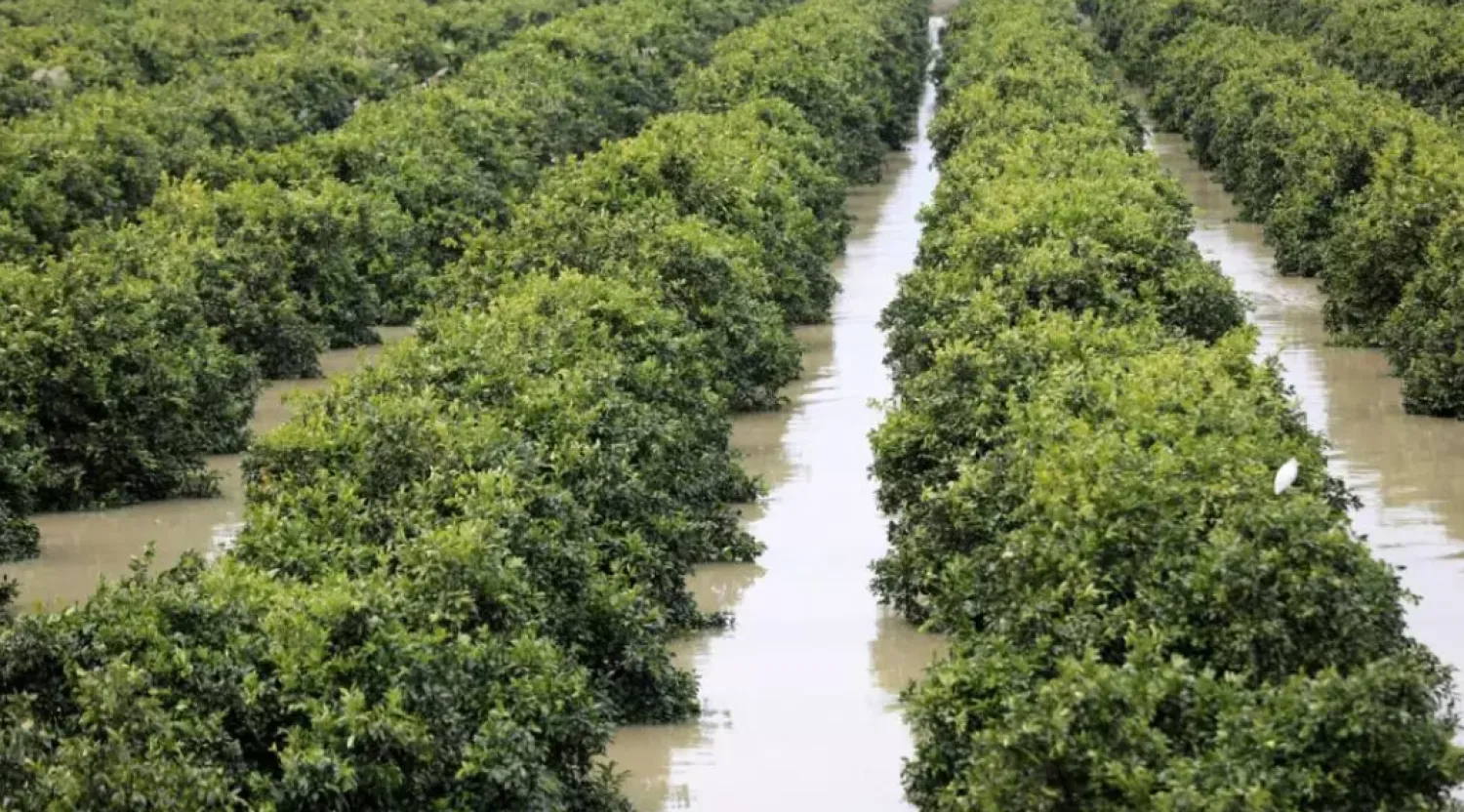

Floods Wreak Havoc in Morocco Farmlands after Severe Drought

Farmers in the North African kingdom have for the past few years endured severe drought © - / AFP
TT

Floods Wreak Havoc in Morocco Farmlands after Severe Drought

Farmers in the North African kingdom have for the past few years endured severe drought © - / AFP

In the Moroccan village of Ouled Salama, 63-year-old farmer Mohamed Reouani waded through his crops, now submerged by floodwaters after days of heavy downpours.

Farmers in the North African kingdom have for the past few years endured severe drought.

But floods have now swamped more than 100,000 hectares of land, wiping out key crops and forcing farmers in the country's northwest to flee with their livestock, AFP reported.

"I have about four or five hectares" of crops, Reouani said. "All of it is gone now."

"Still, praise be to God for this blessing," he added while looking around at the water.

Morocco, where agriculture employs about a third of the working-age population, has seen seven consecutive years of drought.

As of December, its dams were only around 30 percent full on average, and farmers have largely relied on rainwater for irrigation.

Now their average filling rate stands at nearly 70 percent after they received about 8.8 billion cubic metres of water in the last month -- compared to just 9 billion over the previous two years combined.

- 'Took everything' -

Many like Reouani had at first rejoiced at the downpours.

But the rain eventually swelled into a heavy storm that displaced over 180,000 people as of Wednesday and killed four so far.

In his village, the water level climbed nearly two metres, Reouani said. Some homes still stand isolated by floodwater.

Elsewhere, residents were seen stranded on rooftops before being rescued in small boats.

Others were taken away by helicopter as roads were cut off by flooding.

Authorities have set up camps of small tents, including near the city of Kenitra, to shelter evacuees and their livestock.

"We have no grain left" to feed the animals, one evacuee, Ibrahim Bernous, 32, told AFP at a camp. "The water took everything."

Bernous, like many, now depends on animal feed distributed by the authorities, according to Mustapha Ait Bella, an official at the agriculture ministry.

At the camps, displaced families make do with little while waiting to return home.

"The problem is what happens after we return," said Chergui al-Alja, 42. "We have no grain left to feed our livestock, and they are our main source of income."

- Five percent growth -

On Thursday, the government announced a relief plan of some $330 million to provide aid to the hardest-hit regions.

A tenth of that sum was earmarked for farmers and livestock breeders.

Rachid Benali, head of the Moroccan Confederation of Agriculture and Rural Development, told AFP farming was "among the sectors most affected by the floods".

But he said "a more accurate damage assessment was pending once waters recede".

Benali added that sugar beet, citrus and vegetable farms had also been devastated by flooding.

Agriculture accounts for about 12 percent of Morocco's overall economy.

The International Monetary Fund anticipates that the massive rainfall will help the economy grow by nearly five percent.

Authorities are betting on expanded irrigation and seawater desalination to help the sector withstand increasingly volatile climate swings.

While Morocco is no stranger to extreme weather events, scientists say climate change driven by human activity has made phenomena like droughts and floods more frequent and intense.

Last December, flash floods killed 37 people in Safi, in Morocco's deadliest weather-related disaster in the past decade.

Neighbouring Algeria and Tunisia have also experienced severe weather and deadly flooding in recent weeks.

Further north, Portugal and Spain have faced fresh storms and torrential rain.


Israel Military Says Soldier Killed in Gaza 

A drone view shows the destruction in a residential neighborhood, after the withdrawal of the Israeli forces from the area, amid a ceasefire between Israel and Hamas in Gaza, in Gaza City, October 21, 2025. (Reuters)
TT

Israel Military Says Soldier Killed in Gaza 

A drone view shows the destruction in a residential neighborhood, after the withdrawal of the Israeli forces from the area, amid a ceasefire between Israel and Hamas in Gaza, in Gaza City, October 21, 2025. (Reuters)

The Israeli military announced that one of its soldiers had been killed in combat in southern Gaza on Wednesday, but a security source said the death appeared to have been caused by "friendly fire".

"Staff Sergeant Ofri Yafe, aged 21, from HaYogev, a soldier in the Paratroopers Reconnaissance Unit, fell during combat in the southern Gaza Strip," the military said in a statement.

A security source, however, told AFP that the soldier appeared to have been "killed by friendly fire", without providing further details.

"The incident is still under investigation," the source added.

The death brings to five the number of Israeli soldiers killed in Gaza since a ceasefire took effect on October 10.


Syria: SDF’s Mazloum Abdi Says Implementation of Integration Deal May Take Time

People sit outdoors surrounded by nature, with the Tigris river flowing in the background, following a long atmospheric depression, near the Syrian-Turkish border in Derik, Syria, February 16, 2026 REUTERS/Orhan Qereman
TT

Syria: SDF’s Mazloum Abdi Says Implementation of Integration Deal May Take Time

People sit outdoors surrounded by nature, with the Tigris river flowing in the background, following a long atmospheric depression, near the Syrian-Turkish border in Derik, Syria, February 16, 2026 REUTERS/Orhan Qereman

Mazloum Abdi, commander of the Syrian Democratic Forces, said the process of merging the SDF with Syrian government forces “may take some time,” despite expressing confidence in the eventual success of the agreement.

His remarks came after earlier comments in which he acknowledged differences with Damascus over the concept of “decentralization.”

Speaking at a tribal conference in the northeastern city of Hasakah on Tuesday, Abdi said the issue of integration would not be resolved quickly, but stressed that the agreement remains on track.

He said the deal reached last month stipulates that three Syrian army brigades will be created out of the SDF.

Abdi added that all SDF military units have withdrawn to their barracks in an effort to preserve stability and continue implementing the announced integration agreement with the Syrian state.

He also emphasized the need for armed forces to withdraw from the vicinity of the city of Ayn al-Arab (Kobani), to be replaced by security forces tasked with maintaining order.


Israeli Far-Right Minister to Push for ‘Migration’ of West Bank, Gaza Palestinians 

A Palestinian man checks leather belts as people prepare for Ramadan, in the old city of Hebron in the Israeli-occupied West Bank, February 17,2026. (Reuters)
TT

Israeli Far-Right Minister to Push for ‘Migration’ of West Bank, Gaza Palestinians 

A Palestinian man checks leather belts as people prepare for Ramadan, in the old city of Hebron in the Israeli-occupied West Bank, February 17,2026. (Reuters)

Israel's far-right Finance Minister Bezalel Smotrich said he would pursue a policy of "encouraging the migration" of Palestinians from the occupied West Bank and Gaza Strip, Israeli media reported Wednesday.

"We will eliminate the idea of an Arab terror state," said Smotrich, speaking at an event organized by his Religious Zionism Party late on Tuesday.

"We will finally, formally, and in practical terms nullify the cursed Oslo Accords and embark on a path toward sovereignty, while encouraging emigration from both Gaza and Judea and Samaria.

"There is no other long-term solution," added Smotrich, who himself lives in a settlement in the West Bank.

Since last week, Israel has approved a series of measures backed by far-right ministers to tighten control over the West Bank, including in areas administered by the Palestinian Authority under the Oslo Accords, in place since the 1990s.

The measures include a process to register land in the West Bank as "state property" and facilitate direct purchases of land by Jewish Israelis.

The measures have triggered widespread international outrage.

On Tuesday, the UN missions of 85 countries condemned the measures, which critics say amount to de facto annexation of the Palestinian territory.

"We strongly condemn unilateral Israeli decisions and measures aimed at expanding Israel's unlawful presence in the West Bank," they said in a statement.

"Such decisions are contrary to Israel's obligations under international law and must be immediately reversed.

"We underline in this regard our strong opposition to any form of annexation."

UN Secretary-General Antonio Guterres on Monday called on Israel to reverse its land registration policy, calling it "destabilizing" and "unlawful".

The West Bank would form the largest part of any future Palestinian state. Many on Israel's religious right view it as Israeli land.

Israeli NGOs have also raised the alarm over a settlement plan signed by the government which they say would mark the first expansion of Jerusalem's borders into the occupied West Bank since 1967.

The planned development, announced by Israel's Ministry of Construction and Housing, is formally a westward expansion of the Geva Binyamin, or Adam, settlement situated northeast of Jerusalem in the West Bank.

The current Israeli government has fast-tracked settlement expansion, approving a record 52 settlements in 2025.

Excluding Israeli-annexed east Jerusalem, more than 500,000 Israelis live in West Bank settlements and outposts, which are illegal under international law.