

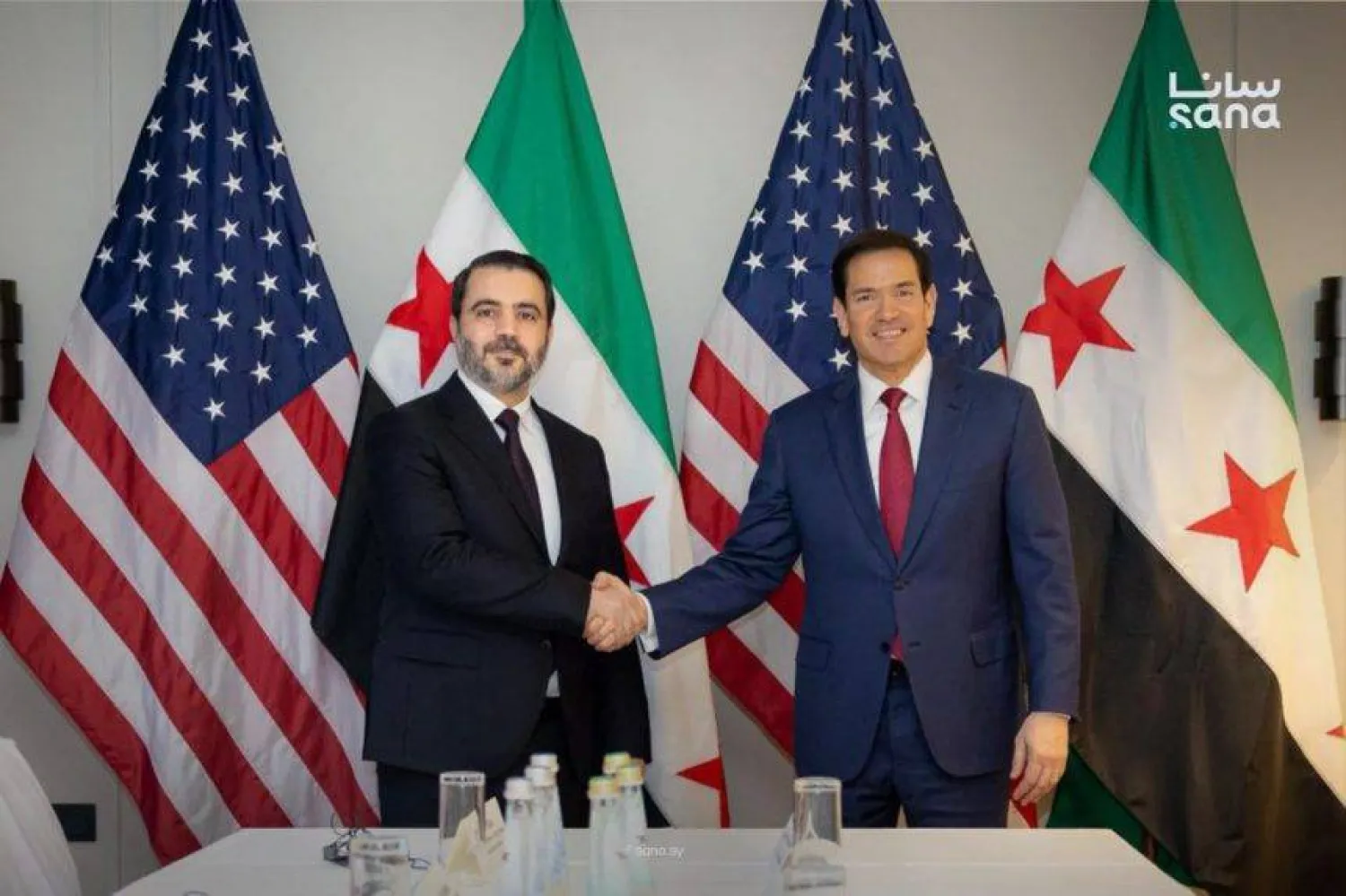

Rubio Meets with Shaibani, Abdi in Munich to Consolidate Damascus-SDF Ties

Syrian Foreign Minister Asaad al-Shaibani and US Secretary of State Marco Rubio. SANA
TT

Rubio Meets with Shaibani, Abdi in Munich to Consolidate Damascus-SDF Ties

Syrian Foreign Minister Asaad al-Shaibani and US Secretary of State Marco Rubio. SANA

US Secretary of State Marco Rubio met with Syrian Foreign Minister Asaad al-Shaibani and Commander-in-Chief of Syrian Democratic Forces (SDF) Mazloum Abdi at the Munich Security Conference, the State Department announced on Saturday.

Rubio “emphasized the importance of implementing the permanent ceasefire and integration agreement in northeast Syria, and ensuring full respect and safety for the rights of all Syrians,” the State Department said in a statement.

He also “welcomed the Syrian government’s commitment to fully cooperate with the United States and the Global Coalition to Defeat ISIS,” it added.

The appearance of al-Shaibani and Abdi, along with co-chair of the Foreign Relations Committee of the Autonomous Administration Elham Ahmed at the Munich Conference was seen as a remarkable development in the course of relations and the implementation of the January 30 agreement to gradually integrate the Kurds' military and civilian institutions into the state.

Wael Alwan, Executive Director of the Jusoor Center for Studies, who is close to the Syrian government, told Asharq Al-Awsat that Abdi and Elham Ahmed were invited to the Conference following coordination between the US Special Envoy to Syria, Tom Barrack, and al-Shaibani, to hold meetings and discussing several issues, including assigning Abdi a position in the Ministry of Foreign Affairs, most likely as Assistant Minister.

Alwan also noted that the issue of integration remains “complex” and faces many obstacles.

Coordinator of the Independent Kurdistan Movement in Syria, Zaid Safouk also spoke to Asharq Al-Awsat, saying “what appears in the media is one thing, and reality is another.”

“The Foreign Minister attended the Munich Conference alone as a representative of the Ministry of Foreign Affairs, while both Abdi and Elham Ahmed attended separately... each representing his or her institution,” he said.

He pointed out that the United States, “by bringing them together at the same table, tried to present the three as a single delegation and to show that it alone controls the situation.”

“But the reality is different,” Safouk added.

Meeting with Members of Congress

According to SANA, al-Shaibani held talks on Saturday with a number of US Congressmen, headed by Senator Jeanne Shaheen. Abdi and Elham Ahmed took part in the meeting.

The discussions focused on the latest developments in Syria and the region, with both sides “stressing the importance of preserving Syria’s unity, sovereignty and territorial integrity, in addition to supporting the political process in a way that achieves security and stability,” SANA said.

The SDF stated that the meeting focused on discussing the integration agreement, ways to ensure a ceasefire, and enhancing stability.



Tunisia President Sacks Energy Minister Ahead of Renewable Energy Projects Vote

Tunisian ‌President Kais Saied. (AFP)
TT

Tunisia President Sacks Energy Minister Ahead of Renewable Energy Projects Vote

Tunisian ‌President Kais Saied. (AFP)

Tunisia’s ‌President Kais Saied dismissed Energy Minister Fatma Thabet on Tuesday, amid growing controversy over renewable energy projects set to be voted on in parliament.

Saied said he had appointed Housing and Infrastructure Minister Salah Eddine ‌Zouari to ‌temporarily oversee the ministry. ‌No ⁠detailed explanation was ⁠provided for the decision.

The move comes as Saied's government seeks to pass draft laws on renewable energy, which ⁠will be put to ‌a ‌vote in parliament later on Tuesday.

The ‌projects have a planned ‌capacity of 600 megawatts, with 500 million euros ($585 million) as total investment.

The projects are ‌part of Tunisia’s efforts to expand clean energy ⁠production. ⁠Some lawmakers and political parties oppose the projects, describing them as a form of "energy colonization."

They have criticized the exclusion of the state electricity company (STEG) from the contracts, which they say were awarded exclusively to foreign firms.


Israeli Strikes on Gaza Kill Five, Including 9-Year-Old Boy, Medics Say

 Mourners react during the funeral of Palestinian child Adel Al-Najjar, who was killed today in an Israeli strike, according to medics, at Nasser Hospital in Khan Younis, in the southern Gaza Strip, April 28, 2026. (Reuters)
Mourners react during the funeral of Palestinian child Adel Al-Najjar, who was killed today in an Israeli strike, according to medics, at Nasser Hospital in Khan Younis, in the southern Gaza Strip, April 28, 2026. (Reuters)
TT

Israeli Strikes on Gaza Kill Five, Including 9-Year-Old Boy, Medics Say

 Mourners react during the funeral of Palestinian child Adel Al-Najjar, who was killed today in an Israeli strike, according to medics, at Nasser Hospital in Khan Younis, in the southern Gaza Strip, April 28, 2026. (Reuters)
Mourners react during the funeral of Palestinian child Adel Al-Najjar, who was killed today in an Israeli strike, according to medics, at Nasser Hospital in Khan Younis, in the southern Gaza Strip, April 28, 2026. (Reuters)

Israeli strikes killed five Palestinians, including a 9-year-old boy, in the Gaza Strip on Tuesday, health officials said.

Medics said an Israeli drone killed the child, Adel Al-Najjar, in eastern Khan Younis in the south of the enclave, while an Israeli airstrike targeted a vehicle in Gaza City, killing four people.

The Israeli military did not ‌immediately comment on ‌either incident.

At Nasser Hospital’s morgue, relatives arrived ‌to ⁠bid farewell to Najjar's ⁠small, white-shrouded body.

Women cried next to the body, which lay on a medical stretcher on the floor, and men held a special prayer before carrying him to the cemetery for burial.

The boy was collecting cardboard that the family uses for cooking, relatives said. There has been no electricity in ⁠Gaza since the war began in October 2023, ‌and Palestinians have complained of Israeli ‌restrictions on the entry of cooking gas.

"We don't have gas. ‌We collect cardboard to bake, they want to eat; they ‌want to drink," said one of the boy's relatives, Sabreen Al-Najjar.

Violence in Gaza has persisted despite an October 2025 ceasefire, with Israel conducting almost daily attacks on Palestinians.

At least 800 Palestinians have been ‌killed since the ceasefire took effect, according to local medics, while Israel says gunmen attacks have ⁠killed four ⁠of its soldiers over the same period.

“Isn’t it shameful what is happening to us? Isn’t it shameful that we bury our children every day, right in front of us? Isn’t it shameful? I swear to God, our hearts are breaking for these children,” another relative, Suhaib Al-Najjar, said at the morgue.

Israel and Hamas have blamed each other for ceasefire violations.

More than 72,500 Palestinians have been killed since the Gaza war began in October 2023, according to Gaza health authorities.

Hamas’ October 7, 2023, attacks on Israel killed 1,200 people, according to Israeli tallies.


Israel Says Has ‘No Territorial Ambitions’ in Lebanon, Despite Evacuations

 Smoke rises following an explosion in southern Lebanon, near the Israel-Lebanon border, as seen from northern Israel, April 28, 2026. (Reuters)
Smoke rises following an explosion in southern Lebanon, near the Israel-Lebanon border, as seen from northern Israel, April 28, 2026. (Reuters)
TT

Israel Says Has ‘No Territorial Ambitions’ in Lebanon, Despite Evacuations

 Smoke rises following an explosion in southern Lebanon, near the Israel-Lebanon border, as seen from northern Israel, April 28, 2026. (Reuters)
Smoke rises following an explosion in southern Lebanon, near the Israel-Lebanon border, as seen from northern Israel, April 28, 2026. (Reuters)

Israel on Tuesday said it was not seeking to take territory in Lebanon, as its military issued a wave of new evacuation warnings for towns and villages in the battle-scarred south. 

"Israel has no territorial ambitions in Lebanon. Our presence... serves one purpose: protecting our citizens," Foreign Minister Gideon Saar told a news conference. 

"No country would be willing to live in such a way with a gun pointed to its head," he said as the military pressed its operations in Lebanon against Iran-backed Hezbollah. 

Shortly after a ceasefire with Hezbollah came into effect on April 17, Israel declared a so-called "Yellow Line" -- a strip of Lebanese territory around 10 kilometers (six miles) deep along the border within which Israeli troops are operating. 

"In a reality where Hezbollah and other terror organizations -- including Palestinian terror groups -- are dismantled, Israel will have no need to maintain its presence in these areas," he added. 

Despite the ceasefire, Israel and Hezbollah have both engaged in fighting, trading blame over violations of the fragile truce. 

Tuesday's evacuation warning was aimed at residents in more than a dozen villages and towns, urging them to immediately head northwards. 

"Out of concern for your safety, you are required to evacuate your homes immediately and move... towards the Sidon District," the military's Arabic-language spokesman Avichay Adraee wrote on X. 

Shortly afterwards, Lebanon's state media reported that Israel carried out airstrikes across the south, hitting targets including the named areas. 

It also said at least one Israeli demolition operation was taking place in the south. 

All the areas listed for evacuation appear to be outside or on the border of the "Yellow Line". 

In two incidents earlier on Tuesday, the military said it intercepted "a suspicious aerial target" in an area where troops were operating. 

It also said a soldier had been severely injured and another lightly hurt a day earlier "as a result of an explosive drone impact", branding it a new ceasefire violation by Hezbollah. 

Israeli Prime Minister Benjamin Netanyahu said Monday that Hezbollah's rockets and drones remained a key threat requiring ongoing military action. 

Hezbollah drew Lebanon into the Middle East war on March 2 by firing rockets towards Israel to avenge the killing of Iranian supreme leader Ali Khamenei.