


Morocco Residents Begin Returning to Northwest as Flood Waters Recede

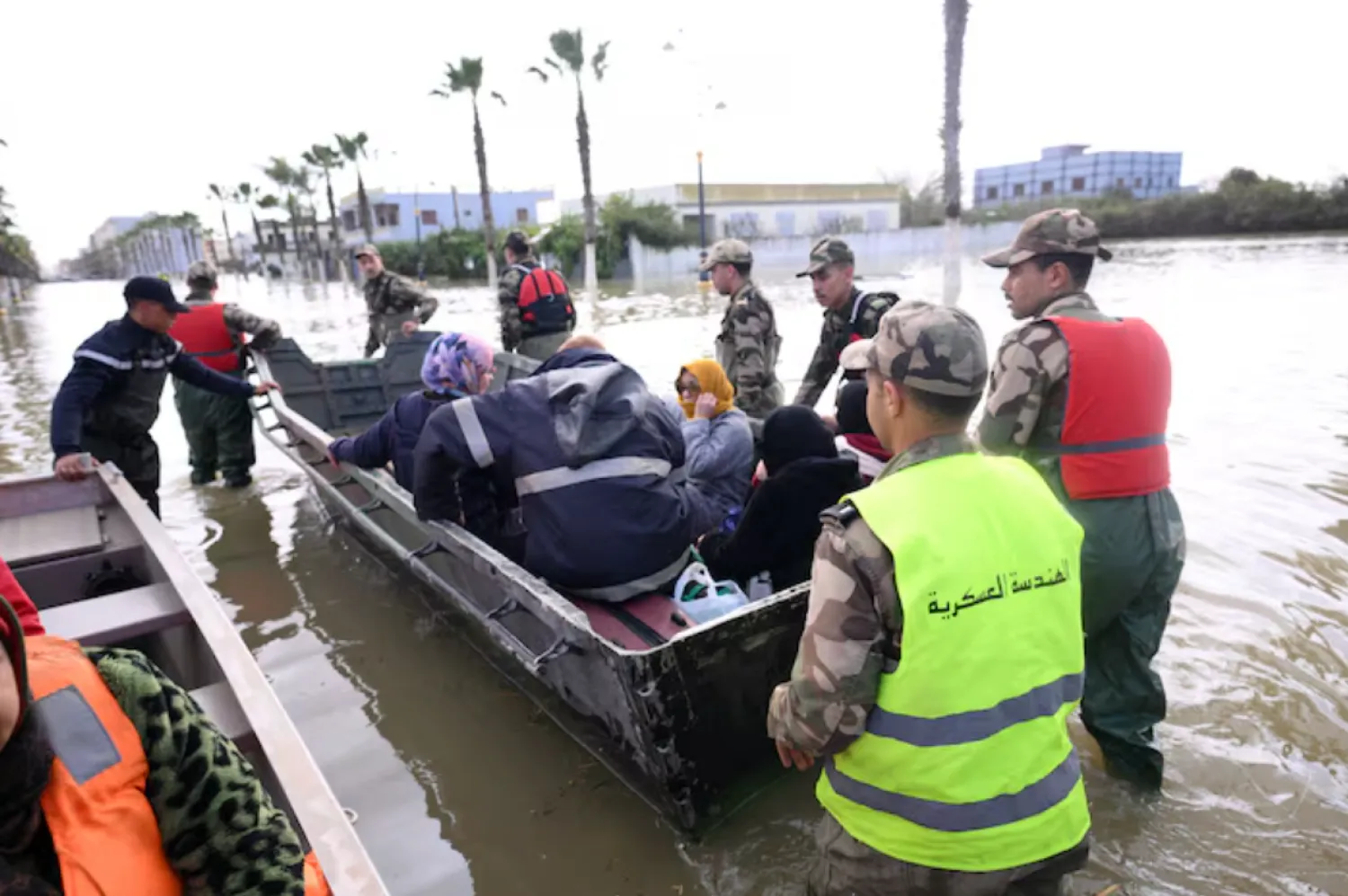
Royal Armed Forces and civil authorities work together to address flooding risks amid rising waters in the Loukkos River, in Ksar El Kebir, Morocco February 2, 2026. Moroccan authorities/Handout via REUTERS
TT

Morocco Residents Begin Returning to Northwest as Flood Waters Recede

Royal Armed Forces and civil authorities work together to address flooding risks amid rising waters in the Loukkos River, in Ksar El Kebir, Morocco February 2, 2026. Moroccan authorities/Handout via REUTERS

Moroccan authorities began organizing the gradual return of residents to the city of Ksar El Kebir and other flood-hit northwestern areas as weather conditions improved, state media showed on Monday.

Authorities backed by the army had helped evacuate 188,000 people since early February, to protect them from overflowing river waters that swept across 110,000 hectares in the northwest.

Most residents of Ksar El Kebir, 213 km north of Rabat, are now allowed to return home, except for those living in a few neighbourhoods, the interior ministry said on Monday.

Train and bus rides were offered free of charge to help transport residents who had sought shelter with relatives in other cities, or in centers and camps provided by authorities, state TV showed. Morocco plans to spend 3 billion dirhams ($330 million) to upgrade infrastructure and support flood-affected residents, farmers and shop-owners in the inundated areas, the prime minister's office said last week, declaring the hardest-hit municipalities disaster areas, Reuters reported.

The Oued Makhazine dam, which had reached 160% of capacity, was forced to gradually release water downstream after exceptional inflows, leading to rising water levels in the Loukous river which inundated Ksar El Kebir and surrounding plains.

Rainfall this winter was 35% above the average recorded since the 1990s and three times higher than last year, official data showed.

Morocco's national dam-filling rate rose to nearly 70% from 27% a year earlier, with several large dams being partially emptied to absorb new inflows.

The exceptional rainfall ended a seven-year drought that had pushed the country to ramp up investments in desalination.



Lebanese Army Says Soldier Killed in Israeli Attack in Southern Lebanon

A Lebanese army soldier inspects the site of an Israeli airstrike that targeted their checkpoint in Aamriyeh, south of the coastal city of Tyre, on March 30, 2026. (Photo by KAWNAT HAJU / AFP)
TT

Lebanese Army Says Soldier Killed in Israeli Attack in Southern Lebanon

A Lebanese army soldier inspects the site of an Israeli airstrike that targeted their checkpoint in Aamriyeh, south of the coastal city of Tyre, on March 30, 2026. (Photo by KAWNAT HAJU / AFP)

The Lebanese army said on Sunday that a soldier had been killed in an Israeli strike on southern Lebanon.

Meanwhile, an Israeli strike hit south Beirut on Sunday, Lebanese state media reported, with a medical source telling AFP it made impact about 100 metres away from a public hospital.

The strike hit Beirut's Jnah neighborhood near Rafik Hariri University Hospital, the largest public medical facility in the country.

Israel's military earlier warned it was carrying out strikes on Beirut.


Israeli Fire Kills Four Palestinians in Gaza, Medics Say

Palestinians inspect a vehicle targeted by an Israeli strike in Maghazi camp for Palestinian refugees in the central Gaza Strip on April 4, 2026. (AFP)
TT

Israeli Fire Kills Four Palestinians in Gaza, Medics Say

Palestinians inspect a vehicle targeted by an Israeli strike in Maghazi camp for Palestinian refugees in the central Gaza Strip on April 4, 2026. (AFP)

An Israeli airstrike ‌killed four Palestinians in the northern Gaza Strip on Sunday, local health authorities said, in the latest violence to overshadow a fragile ceasefire amid a new push by mediators to bolster the agreement.

Medics said the airstrike targeted a group of people in Jaffa Street, near the Darraj neighborhood in Gaza City, killing four people and wounding others.

The Israeli military did not immediately comment on ‌the incident.

Palestinian ‌group Hamas and Israel have ‌traded blame ⁠for violations of ⁠the ceasefire agreed last October, which halted two years of full-blown war.

The Gaza health ministry says Israeli fire has killed at least 700 people since the ceasefire began. Israel says four soldiers have been killed by gunmen in Gaza ⁠over the same period.

A Hamas delegation met ‌Egyptian, Qatari and ‌Turkish mediators in Cairo last week to give its initial ‌response to a disarmament proposal presented to the ‌group last month, two Egyptian sources and a Palestinian official said.

The group has told mediators it will not discuss giving up arms without guarantees that Israel ‌will fully quit Gaza as laid out in a disarmament plan from ⁠US President ⁠Donald Trump's "Board of Peace", three sources told Reuters on Thursday.

Hamas' disarmament is a sticking point in talks to implement Trump's plan for the Palestinian enclave and cement the ceasefire.

Hamas' October 7, 2023, attacks on Israel killed 1,200 people, according to Israeli tallies.

Israel's ensuing two-year campaign killed more than 72,000 Palestinians, most of them civilians, according to Gazan health authorities, and has spread famine, demolished most buildings, and displaced most of the territory's population, in many cases numerous times.


Easter in Jerusalem Disrupted by War and Restrictions at Holy Sepulchre

 Members of the clergy make their way to the Church of the Holy Sepulchre for prayers on Palm Sunday, following restrictions on gatherings in large groups, amid the US-Israel conflict with Iran, in Jerusalem's Old City April 5, 2026. (Reuters)
Members of the clergy make their way to the Church of the Holy Sepulchre for prayers on Palm Sunday, following restrictions on gatherings in large groups, amid the US-Israel conflict with Iran, in Jerusalem's Old City April 5, 2026. (Reuters)
TT

Easter in Jerusalem Disrupted by War and Restrictions at Holy Sepulchre

 Members of the clergy make their way to the Church of the Holy Sepulchre for prayers on Palm Sunday, following restrictions on gatherings in large groups, amid the US-Israel conflict with Iran, in Jerusalem's Old City April 5, 2026. (Reuters)
Members of the clergy make their way to the Church of the Holy Sepulchre for prayers on Palm Sunday, following restrictions on gatherings in large groups, amid the US-Israel conflict with Iran, in Jerusalem's Old City April 5, 2026. (Reuters)

In the usually lively alleyways of Jerusalem's Old City, silence reigned on Easter Sunday, with the holiday overshadowed by war and restrictions on access to the Holy Sepulchre, where the faithful commemorate Christ's crucifixion and resurrection.

On routes approaching the church, police at checkpoints screened a small number of worshippers allowed near the site.

All shops in the area were closed, heightening the sense of emptiness.

"Happy Easter," said the Latin Patriarch of Jerusalem, Cardinal Pierbattista Pizzaballa, shortly after dawn as he entered the church surrounded by a modest group of clergy, according to AFP journalists at the site.

Outside, a few Catholics and Orthodox Christians tried to reach the church but were kept at a distance by security forces.

"How can you tell me I cannot go to church, it is unacceptable," said one Catholic from Tel Aviv who had attended Easter worship at the site in previous years.

Security has been stepped up in the Old City, located in annexed east Jerusalem and home to sites sacred to Jews, Christians and Muslims.

Israel has also imposed restrictions on large gatherings as a security precaution due to the constant threat of strikes during the ongoing Middle East war.

On Palm Sunday, Cardinal Pizzaballa was prevented by Israeli police from entering the Holy Sepulchre for mass, provoking outrage, before Prime Minister Benjamin Netanyahu ordered he be allowed in.

Since the start of the war on February 28, debris from Iranian missiles or interceptors has fallen in the Old City, including near the Holy Sepulchre, Al-Aqsa Mosque, and in the Jewish Quarter.

Most Palestinian Christians belong to the Orthodox faith, which celebrates Easter on April 12.

But for many other Christians, the curbs on worship have stripped the Easter celebrations of substance.

"It's very hard for all of us because it's our holiday... It's really hard to want to pray but to come here and find nothing. Everything is closed," said Christina Toderas, 44, from Romania.

Like many other worshippers, she had resigned herself to watching the mass at the Holy Sepulchre on television.

Father Bernard Poggi, who was preparing to attend mass in another church near the holy site, said he understood the security measures but added that "it seems to be more and more that there's an unevenness in how the laws are put into practice".

Inside the Holy Sepulchre, the celebrations were being held behind closed doors in front of a very small congregation, far removed from the crowds that usually gather.

Around the Old City, where hymns and processions usually dominate at Easter, only whispers could be heard among the faithful moving discreetly through its passages.