

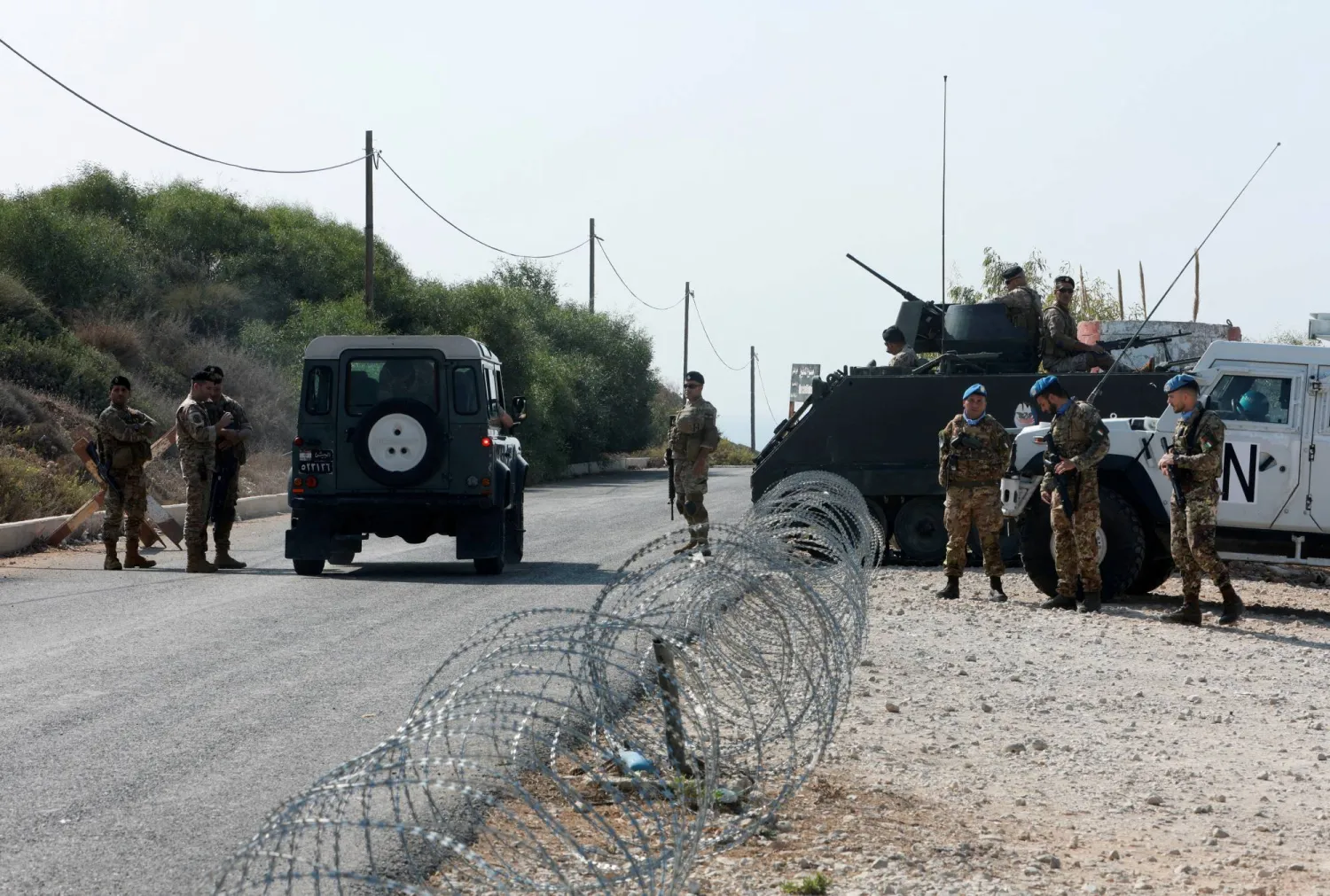

Israel Seeking Direct Military Coordination with Lebanon 

Lebanese soldiers and UNIFIL forces on patrol in Naqoura southern Lebanon. (Reuters file)
TT

Israel Seeking Direct Military Coordination with Lebanon 

Lebanese soldiers and UNIFIL forces on patrol in Naqoura southern Lebanon. (Reuters file)

Israel is seeking to alter the post-ceasefire coordination mechanism along the Lebanese border by establishing direct contact with the Lebanese army, bypassing the United Nations peacekeeping force deployed in the south, said Israeli media.

The proposal has reignited debate in Beirut over the future of UN Security Council Resolution 1701 and the role of international oversight in southern Lebanon, with Lebanese officials insisting that any modification must remain strictly within the United Nations framework.

Reports attributed to Israel’s security establishment say the United Nations Interim Force in Lebanon (UNIFIL) has recently adopted what Israeli officials describe as a “confrontational stance” toward the Israeli military.

Israeli media quoted officials as telling American counterparts that direct coordination between the Israeli military and the Lebanese army would be preferable to the current arrangement, which operates through UNIFIL. Some officials reportedly argued that the peacekeeping force now causes “more harm than benefit.”

The Israeli Public Broadcasting Corporation said Israel’s security establishment believes UNIFIL has grown increasingly “hostile” in recent weeks.

The force’s mandate in southern Lebanon is due to expire at the end of this year.

Lebanese officials have responded by underscoring that the country’s position remains anchored in international legality and UN authority.

Fadi Alame, head of the Foreign Affairs and Immigrants Committee in Lebanon’s parliament, said Israeli media discussions “do not bind Lebanon,” stressing that “Lebanon’s sole reference remains the international resolutions issued by the United Nations.”

Speaking to Asharq Al-Awsat, Alame reiterated Lebanon’s commitment to Resolution 1701 and expressed support for UNIFIL.

He said the force monitors implementation of the resolution and safeguards Lebanon’s rights and sovereignty within the UN framework.

“As long as there is a UN resolution in force, any amendment or termination must occur through the United Nations itself,” he stated. “International law requires an international monitoring body as long as the resolution remains in effect.”

Addressing speculation about replacing UNIFIL or shifting to direct coordination with the Lebanese army, Alame said Beirut’s official stance remains unchanged.

“Lebanon is committed to Resolution 1701 under a clear government decision,” he underlined. “For us, Resolution 1701 and other UN resolutions remain the foundation.”

He added that Lebanon is awaiting a report from the UN secretary-general in June that is expected to outline potential options. These could range from maintaining the current international force to introducing a European-led presence or increasing the number of international observers.

Any proposal, he stressed, would remain subject to UN approval.

Meanwhile, a Lebanese ministerial source told Asharq Al-Awsat that Israel’s proposal for direct coordination without UNIFIL “raises questions,” noting that the peacekeeping force is already embedded in the existing tripartite coordination mechanism.

Communication with Israel is conducted through UNIFIL under an established framework, the source explained, adding that Lebanon insists on maintaining an international sponsor and monitoring body as long as Resolution 1701 has not been fully implemented.

European proposals remain under discussion, including the possibility of a European-led force under French supervision or a mission focused on training and equipping the Lebanese army to assume expanded responsibilities. However, these ideas have yet to crystallize and remain tied to future political and security developments.

The debate follows a UN Security Council decision in August 2025 to extend UNIFIL’s mandate until December 31, 2026, with a coordinated drawdown planned to begin the following year.

UNIFIL has been deployed in southern Lebanon since 1978. It serves as a monitoring and buffer force, overseeing implementation of Resolution 1701 and supporting the Lebanese army’s deployment south of the Litani River.



Israeli Strikes Damage Hospital in Lebanon

File photo: Destroyed houses that were hit in an Israeli airstrike in Saksakiyeh village, south Lebanon, Friday, April 3, 2026. (AP Photo/Hussein Malla)
TT

Israeli Strikes Damage Hospital in Lebanon

File photo: Destroyed houses that were hit in an Israeli airstrike in Saksakiyeh village, south Lebanon, Friday, April 3, 2026. (AP Photo/Hussein Malla)

A hospital in the coastal Lebanese city of Tyre was damaged by Israeli airstrikes on nearby buildings that wounded 11 people, the health ministry said on Saturday.

The director of the Lebanese Italian Hospital told the state-run National News Agency (NNA) that it would "remain open to provide the necessary medical care" despite the damage.

Strikes destroyed two buildings nearby, an AFP correspondent saw, shattering windows and causing suspended ceilings to collapse in the hospital, the facility's management said.

A series of attacks hit the Tyre region on Saturday, including one on its port that struck a small boat and damaged others moored nearby, the AFP correspondent said.

Israel has been carrying out strikes across Lebanon and launched a ground invasion in the south after Hezbollah entered the war in the Middle East on the side of its backer Iran on March 2.

Tens of thousands of people have left Tyre, but around 20,000 remain, including 15,000 displaced from surrounding villages, despite Israeli evacuation warnings covering most of the city and a broad swathe of southern Lebanon.

The NNA also reported that Israeli forces abducted a man in Shebaa, near the Israeli border in the east, at around 3:00 am on Saturday.


Indonesia Slams 'Unacceptable' Peacekeeper Casualties in Lebanon

FILE PHOTO: UNIFIL vehicles drive on a main road in Qlayaa, amid escalating hostilities between Israel and Hezbollah, as the US-Israel conflict with Iran continues, in Qlayaa, southern Lebanon, March 27, 2026. REUTERS/Karamallah Daher/File Photo
TT

Indonesia Slams 'Unacceptable' Peacekeeper Casualties in Lebanon

FILE PHOTO: UNIFIL vehicles drive on a main road in Qlayaa, amid escalating hostilities between Israel and Hezbollah, as the US-Israel conflict with Iran continues, in Qlayaa, southern Lebanon, March 27, 2026. REUTERS/Karamallah Daher/File Photo

The Indonesian government on Saturday slammed as "unacceptable" an explosion that injured three of its peacekeepers in Lebanon within days of three other blue helmets from the Southeast Asian nation being killed.

The United Nations Interim Force in Lebanon (UNIFIL) said three peacekeepers were wounded in a blast that occurred inside a UN facility near Adaisseh on Friday afternoon, and rushed to hospital.

Two were seriously wounded.

The UN Information Center in Jakarta said the "origin of the explosion" was unknown but identified the injured soldiers as Indonesian.

"Repeated attacks or incidents of this kind are unacceptable," the Indonesian foreign ministry said in a statement.

"Regardless of their cause, these events underscore the urgent need to strengthen protection for UN peacekeeping forces amid an increasingly dangerous conflict situation."

The government urged the UN Security Council to investigate the events and "to immediately convene a meeting of troop-contributing countries to UNIFIL to conduct a review and take measures to enhance the protection of personnel serving with UNIFIL".

Friday's incident came just days after an Indonesian peacekeeper died when a projectile exploded on March 29 in southern Lebanon, where Israel and Hezbollah have been fighting since Lebanon was drawn into the Middle East war.

A UN security source told AFP on condition of anonymity Tuesday that fire from an Israeli tank was responsible for that attack.

A day later, two more Indonesian peacekeepers died after an explosion struck a UNIFIL logistics convoy, also in southern Lebanon.

The father of one of the two fallen soldiers, 33-year-old Zulmi Aditya Iskandar, said this week he was shocked that peacekeepers were losing their lives in the conflict.

"We were really sad and regretful, because this is a UN troop, a peacekeeping troop, not deployed for war," 60-year-old Iskandarudin told reporters at his house in West Java province.

The bodies of the three peacekeepers are scheduled to arrive in Jakarta on Saturday evening, according to the military.

The Indonesian National Armed Forces has said it will deploy more than 750 personnel to Lebanon next month as part of the scheduled UNIFIL peacekeeping troop rotation.


Strike Kills One Iraqi Fighter near Syria Border

Mourners attend the funeral of members of Iraq's Hashed al-Shaabi, who were killed in an airstrike in the town of al‑Qaim near the Syrian border, amid heightened regional tensions due to the US-Israel conflict with Iran, in Baghdad, Iraq, March 12, 2026. REUTERS/Stringer
TT

Strike Kills One Iraqi Fighter near Syria Border

Mourners attend the funeral of members of Iraq's Hashed al-Shaabi, who were killed in an airstrike in the town of al‑Qaim near the Syrian border, amid heightened regional tensions due to the US-Israel conflict with Iran, in Baghdad, Iraq, March 12, 2026. REUTERS/Stringer

An attack killed one fighter from the former paramilitary coalition Hashed al-Shaabi on Saturday, the alliance said, blaming the US and Israel.

Iraq has been dragged into the war between the United States, Israel and Iran, with strikes targeting both US interests and pro-Iran groups in the country, reported AFP.

"This treacherous attack resulted in the martyrdom of one PMF fighter and the wounding of four others, as well as a member of the ministry of defense," said a short statement from the group, which is also known as the Popular Mobilization Forces (PMF), adding it was a "Zionist-American attack".

The PMF is a coalition of armed groups -- formed in 2014 to fight extremists-- that is now part of Iraq's regular army, but also contains pro-Iran factions who have a reputation for acting independently.

PMF positions have been repeatedly targeted since the outbreak of war, with the group consistently blaming the attacks on the US and Israel.

According to the group's statement, the latest attack targeted a position in western Anbar province of the 45th Brigade, which belongs to the US-blacklisted, pro-Iran Kataeb Hezbollah group.

Kataeb Hezbollah is part of the umbrella movement known as the Islamic Resistance in Iraq, which has been claiming daily attacks since the start of the war on US interests in Iraq and the region.

The Pentagon has said helicopters have carried out strikes against pro-Iran armed groups in Iraq during the war.

Washington has strongly denied claims it has targeted Iraqi security forces.