


Lebanon Fears Israeli Strikes if Iran Situation Escalates

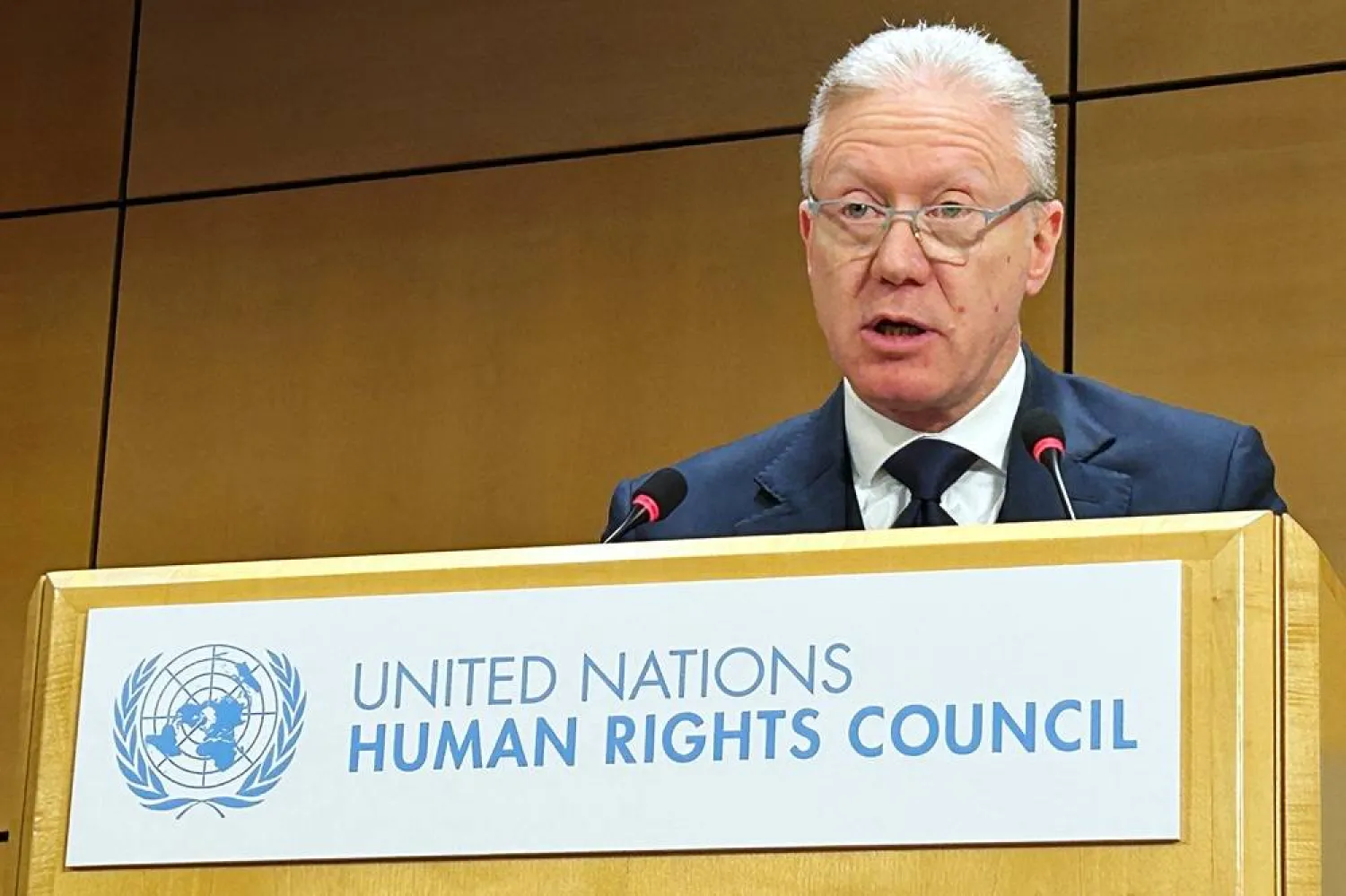
 Lebanese Foreign Minister Youssef Raggi addresses the Human Rights Council in Geneva, Switzerland, Tuesday, Feb. 24, 2026. (AP)
Lebanese Foreign Minister Youssef Raggi addresses the Human Rights Council in Geneva, Switzerland, Tuesday, Feb. 24, 2026. (AP)
TT

Lebanon Fears Israeli Strikes if Iran Situation Escalates

 Lebanese Foreign Minister Youssef Raggi addresses the Human Rights Council in Geneva, Switzerland, Tuesday, Feb. 24, 2026. (AP)
Lebanese Foreign Minister Youssef Raggi addresses the Human Rights Council in Geneva, Switzerland, Tuesday, Feb. 24, 2026. (AP)

Lebanon's foreign minister said Tuesday his country feared its infrastructure could be hit by Israeli strikes if the situation with Iran escalates, as Israel has intensified its attacks on Tehran-backed Hezbollah.

Also on Tuesday, Lebanon's army accused the Israeli military of firing near a position it was setting up in the country's south, saying it had instructed troops to return fire.

"There are signs that the Israelis could strike very hard in the event of an escalation, potentially including strategic infrastructure such as the airport," foreign minister Youssef Raggi told reporters in Geneva.

His comments came amid a massive US military buildup in the Middle East that suggested Washington was prepared to wage a potentially sustained campaign against Iran.

Iran vowed on Monday to retaliate "ferociously" against any attack from the United States, and repeated its warning of a regional conflagration in response to President Donald Trump's latest threat of strikes.

"We are currently conducting diplomatic efforts to request that, even in the event of retaliation, Lebanese civilian infrastructure not be targeted," Raggi said.

He stressed that his country's leadership had been very clear: "This war does not concern us."

A Lebanese official who requested anonymity said "what the Lebanese fear is a chain reaction: an American strike against Iran, a Hezbollah retaliatory strike against Israel, followed by a massive Israeli response."

- Israeli strikes -

Israel has kept up regular strikes on Lebanon despite a November 2024 ceasefire that sought to halt more than a year of hostilities with Iran-backed Hezbollah, usually saying it was targeting the group.

Last Friday, Israel carried out deadly strikes on what it called Hezbollah positions in eastern Lebanon and targets linked to the Palestinian group Hamas in the south.

Hezbollah said Saturday that eight of its fighters had been killed, and vowed "resistance".

Its leader Sheikh Naim Qassem stated last month that any attack on Tehran would also be an attack on Hezbollah.

On Monday, Washington ordered non-emergency personnel to leave its embassy in Lebanon's capital Beirut as anticipation rose of a possible conflict with Iran.

On Tuesday, Lebanon's army said it was "establishing a new observation post on the southern border" when "the area surrounding the post was subjected to gunfire from the Israeli side".

"The army command issued orders to reinforce the post, remain there, and return fire."

On the same day in Cairo, a preparatory meeting was held ahead of a conference in Paris next month to back Lebanon's army, which is facing heavy pressure from Washington and Israel to disarm Hezbollah.

Egyptian Foreign Minister Badr Abdelatty said that Tuesday's meeting aimed "to enable the Lebanese state to ensure that all weapons are held exclusively by the state".

Lebanon's government last year committed to disarming Hezbollah, which was badly weakened in a recent war with Israel, and tasked the army with drawing up a plan to do so.

The army, which has limited capabilities, declared in January the completion of the first phase of its plan near the border with Israel.

It said last week it would need at least four months to complete the second phase.

Israel, which accuses Hezbollah of rearming, has criticized the army's progress as insufficient.



Israeli Military Warns of Imminent Strikes on South Lebanon

 Smoke billows from southern Lebanon following an Israeli strike, as seen from Marjeyoun, Lebanon, June 12, 2026. (Reuters)
Smoke billows from southern Lebanon following an Israeli strike, as seen from Marjeyoun, Lebanon, June 12, 2026. (Reuters)
TT

Israeli Military Warns of Imminent Strikes on South Lebanon

 Smoke billows from southern Lebanon following an Israeli strike, as seen from Marjeyoun, Lebanon, June 12, 2026. (Reuters)
Smoke billows from southern Lebanon following an Israeli strike, as seen from Marjeyoun, Lebanon, June 12, 2026. (Reuters)

The Israeli military on Saturday warned of imminent strikes on south Lebanon, telling residents of 20 towns and villages including many near Nabatieh city to evacuate despite a ceasefire in its war with Lebanese militant group Hezbollah, according to AFP.

"For your safety, you should evacuate your homes immediately and move to the north of the Zahrani River," the military's Arabic-language spokesman Avichay Adraee said in a post on X.

"Anyone who is in the vicinity of Hezbollah installations or means of warfare is endangering their lives," he added, accusing the movement of violating the truce.


Sharaa: Syria Seeks to Stop Lebanon War, Not Join It

Syrian President Ahmed al-Sharaa (SANA)
TT

Sharaa: Syria Seeks to Stop Lebanon War, Not Join It

Syrian President Ahmed al-Sharaa (SANA)

Syrian President Ahmed al-Sharaa has moved to quell renewed speculation that Syria could become involved in the war in Lebanon, saying reports that Damascus intends to intervene militarily are “mere rumors.”

Sharaa said Syria’s position at this stage was based on “seeking to stop the war in Lebanon, not becoming involved in it.”

His remarks came during a meeting with a delegation from the Damascus countryside. He said demarcating the Syrian-Lebanese border was “not currently a priority” given more urgent files, foremost among them the case of about 1.4 million displaced Syrians in Lebanon and efforts to find a suitable mechanism to ensure their return.

US President Donald Trump had recently reaffirmed Washington’s goal of delivering a strong blow to Hezbollah. According to him, Israel has done what is necessary in the south, but there is still much left to eliminate Hezbollah. He then hinted at possibly having to ask Syria’s involvement.

Trump’s remarks prompted a wave of interpretations, amid reports of a possible visit by Sharaa to Washington. The Syrian presidency denied those reports.

Sources in Damascus told Asharq Al-Awsat that the US remarks were “a form of reshuffling the cards” and fell within “the framework of negotiating statements and sending messages to Iran.”

The sources said, “So far, there has been no official US request to Damascus related to any form of Syrian military intervention in Lebanon.” They said Tom Barrack, Trump’s envoy to Syria and Iraq and Washington’s ambassador in Ankara, had previously asked Damascus “to take a clear, explicit and serious position against Hezbollah.”

The sources said Damascus believes it already has such a position, reflected in border control, cutting smuggling routes and high-level coordination with the Lebanese government.

They added that “entering the quagmire of war and sending military forces unilaterally is completely ruled out,” and that it was “very, very early” to discuss the possibility of Syrian forces entering Lebanon in support of the Lebanese army.

Brigadier General Hassan Abdul Ghani, commander of the Border Guard Forces in the Syrian Arab Army, met last Thursday with a Lebanese army delegation headed by liaison official Brigadier General Michel Boutros, in the presence of several officers.

The talks focused on issues of mutual concern, mainly “enhancing cooperation and coordination between the two sides in border control and combating smuggling activities, in a way that contributes to strengthening border security between the two countries.”

At the same time, Syria’s Interior Ministry said “Lebanon is a sovereign state and not a backyard, as the former regime viewed it,” stressing that “coordination with Lebanon is the basic pillar for any assistance Syria provides to Lebanon.”

Sharaa had expressed Syria’s readiness to provide Lebanon with whatever support and assistance it can, within available capabilities and circumstances, when he received former Lebanese Prime Minister Najib Mikati in Damascus on the ninth of this month.

Media reports said Sharaa told Mikati that “Lebanon’s stability and security constitute a direct Syrian interest,” and that Damascus was keen to build the best relations with the Lebanese state on the basis of mutual respect, good neighborliness and non-interference in internal affairs.

The meeting between Sharaa and Mikati, which lasted for hours, discussed the state of bilateral relations between Damascus and Beirut and prospects for developing them in the next stage, along with several economic and investment files of mutual interest, in light of the transformations taking place in the region.


Palestinian, Israeli Civil Society Groups Meet in France as Two-State Hopes Dim

European Union foreign policy chief Kaja Kallas speaks during a conference with Palestinian and Israeli civil society groups supporting a two-state solution in Paris, France, 12 June 2026. (EPA)
TT

Palestinian, Israeli Civil Society Groups Meet in France as Two-State Hopes Dim

European Union foreign policy chief Kaja Kallas speaks during a conference with Palestinian and Israeli civil society groups supporting a two-state solution in Paris, France, 12 June 2026. (EPA)

Palestinian and Israeli civil society groups delivered an appeal in France on Friday to urge the international community not to abandon a two-state solution, as Paris seeks to keep the issue alive amid the Middle East war.

The meeting brought together foreign ministers and senior officials from dozens of countries alongside civil society groups. It marks one year since the UN-backed New York Declaration, which set out a roadmap toward Palestinian statehood and prompted around a dozen countries, including France, Britain and Canada, to recognize ‌a Palestinian state.

"We ‌could find every reason in the world to give up. ‌But ⁠you are here! Your ⁠testimonies alone are grounds for hope and action," France's Foreign Minister Jean-Noel Barrot told 250 civil society representatives from both sides.

"France refuses to let the side of war prevail over the side of peace."

The gathering ended with an eight-point “Call for Action” urging a permanent ceasefire, a halt to settlements, Gaza reconstruction, governance reforms and stronger international backing for civil society.

It will be delivered to the G7 leaders who meet in the French Alps from Monday.

"The region continues to fracture. Gaza is devastated, Israel remains ⁠under threat. Settler terrorism, settlement expansion, and de facto annexation and ‌threats to the Palestinian Authority continue to undermine the viability ‌of a future Palestinian state," according to the action plan.

"Israelis and Palestinians alike remain trapped in fear, insecurity, ‌and trauma. We return because, as the G7 convenes in Evian, this conflict risks once ‌again being set aside. The window for a solution remains open; but it is narrowing."

ANGER IN WEST OVER SETTLER VIOLENCE

The conference comes amid escalating violence by Israeli settlers in the occupied West Bank and underscores anger in many Western countries toward Israeli Prime Minister Benjamin Netanyahu’s government, which has expanded settlements.

Diplomats say ‌that expansion is aimed at undermining prospects for a Palestinian state.

A key concern is Israel’s plan to build a settlement east of Jerusalem, ⁠known as the E1 ⁠project, which would bisect the West Bank and cut it off from East Jerusalem, fragmenting territory Palestinians seek for an independent state.

"The two-state solution remains the only viable path to bringing lasting peace to the Middle East," European Union foreign policy chief Kaja Kallas said. "The situation in the West Bank is equally alarming. Illegal Israeli settlements continue to expand at an unprecedented pace, and settler violence is increasing without sufficient accountability."

Britain, Canada, France and Norway announced new coordinated sanctions on Tuesday against Israeli networks involved in financing, enabling and carrying out violence in the Israeli-occupied West Bank.

Israel and the United States declined to attend the meeting in Paris.

"The ambassador was invited but will not attend the conference, as it has nothing to do with promoting peace," the Israeli embassy said in a statement.

"France cannot act as a mediator between Israel and the Palestinians. Regarding the two-state solution, the ambassador recalls that the Palestinians have rejected proposals to establish a Palestinian state on five occasions."