
Lebanon Fears Being Dragged to War as US-Iran Tensions Spike

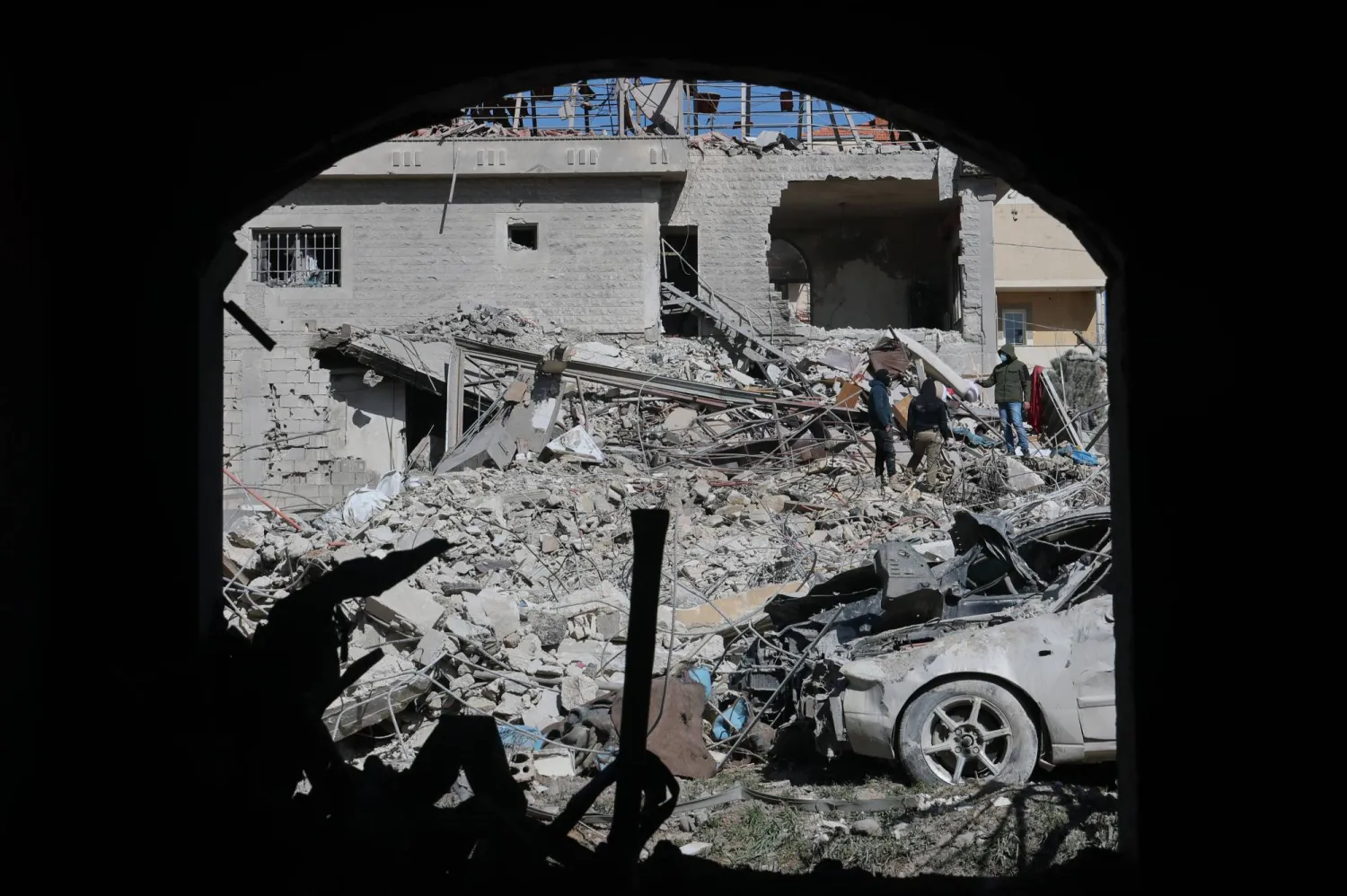
People gather near a building damaged in an Israeli strike in the village of Bednayel in eastern Lebanon, 21 February 2026. (EPA)
TT

Lebanon Fears Being Dragged to War as US-Iran Tensions Spike

People gather near a building damaged in an Israeli strike in the village of Bednayel in eastern Lebanon, 21 February 2026. (EPA)

Concern is mounting in Lebanon as tensions between the United States and Iran intensify, stoking fears that any direct military clash could spill onto Lebanese soil.

The evacuation of non-essential staff from the US embassy in Beirut has deepened unease, especially as it coincided with official Lebanese statements citing “indications” that Israel could launch powerful strikes in the event of escalation, potentially targeting strategic infrastructure, including the airport.

Warnings

Speaking from Geneva on the sidelines of a session of the United Nations Human Rights Council, Lebanese Foreign Minister Youssef Raggi said: “There are signs that the Israelis could strike very hard in the event of an escalation, potentially including strategic infrastructure such as the airport.”

“We are currently conducting diplomatic efforts to request that, even in the event of retaliation, Lebanese civilian infrastructure not be targeted,” he added.

In the same vein, Reuters quoted two senior Lebanese officials as saying Israel had sent an indirect message that it would hit Lebanon hard and target civilian infrastructure, including the airport, if Hezbollah joined any US-Iran war.

Presidency: No warnings received

As Lebanese officials work to prevent Hezbollah from dragging the country into a new “support war”, ministerial sources close to the presidency said “no warnings have reached the Lebanese presidency in this regard.”

The sources said assurances were conveyed through Parliament Speaker Nabih Berri that Hezbollah would not intervene in the war.

On the US embassy’s evacuation decision, the sources said Lebanese officials contacted the embassy in Beirut and were told the move was temporary and precautionary, linked to the regional security situation and talk of an imminent Iranian strike and a possible Hezbollah response from Lebanon.

US measures included closing the consular section and canceling all visa appointments, they added.

Lebanese authorities have not been informed of any similar steps by European embassies, the sources revealed.

Possible arena for confrontation

Dr. Sami Nader, director of the Levant Institute for Strategic Affairs, said Lebanon could become a potential arena for confrontation based on political and military realities, but described the US embassy’s steps as standard precautionary measures taken in similar circumstances.

“Hezbollah, through its Secretary-General Naim Qassem, said it will not remain neutral. Hezbollah has not been fully disarmed, and the plan to confine weapons to the state has not been completed,” Nader told Asharq Al-Awsat.

“Fears have therefore grown that Lebanon could become a parallel arena to what may happen in Iran, especially with the rising likelihood of a military strike on Tehran.”

While the scale of any military fallout in Lebanon from a regional war cannot be predicted, Nader said Israeli escalation in the Bekaa and the south last week aimed to preempt Hezbollah from launching a strike on Israel.

“The elements of a parallel arena in Lebanon are almost complete. That is why the Americans judged the risk level to be high in Lebanon and took this decision, unlike in other countries not exposed to becoming an arena of confrontation,” he explained.

Washington orders departures

The US State Department said in an updated travel advisory that on Feb. 23 it ordered non-essential embassy staff and their family members to leave Lebanon due to the security situation in Beirut.

Washington renewed its Level 4 advisory against travel to Lebanon, citing risks of crime, terrorism, civil unrest, kidnapping, unexploded landmines and the potential for armed conflict, particularly near the border.

It said US embassy personnel in Beirut face strict restrictions on personal travel, with further limits possible without prior notice amid growing security threats.

Kataeb warns against new war

Amid the tensions, the Kataeb party warned against dragging Lebanon into another war.

The party voiced concern over “statements by Hezbollah officials about their readiness to support Tehran if it comes under military strike,” alongside reports of field movements by officers from Iran’s Revolutionary Guard and elements linked to Palestinian groups in areas under Hezbollah’s control, as well as the widening of Israeli airstrikes inside Lebanon.

It renewed its call for the legitimate armed forces to act swiftly and decisively to dismantle Hezbollah’s security and military apparatus across all Lebanese territory without exception.

It warned that failure to extend state authority across Lebanon undermines the integrity of the parliamentary elections, the freedom of candidacy and voting, and the protection of the democratic process from pressure or intimidation.

It added that any tangible change in political life and governance remains conditional on the state’s monopoly over arms and control of decisions of war and peace.

The elections are set for May.


Australia Tells Families of Diplomats to Leave Israel, Lebanon

A billboard on the road to Beirut International Airport promoting tourism in Lebanon (AP).
TT

Australia Tells Families of Diplomats to Leave Israel, Lebanon

A billboard on the road to Beirut International Airport promoting tourism in Lebanon (AP).

The Australian government has told dependants of Australian diplomats in Israel and Lebanon to leave the two Middle East countries, citing a deteriorating security situation in the region, the foreign ministry said on Wednesday.

The government has also offered voluntary departures to Australian diplomats' dependants in the United Arab Emirates, Jordan and Qatar, it said on an official ministry X account, Reuters reported.

US President Donald Trump laid out his case for a possible attack on Iran in his State of the Union speech to Congress on Tuesday, saying he would not allow the world's biggest sponsor of terrorism to have a nuclear weapon.

Iran and the United States resumed negotiations earlier this month as Washington builds up military capability in the Middle East. Iran has threatened to strike US bases in the region if it is attacked, but Tehran's top diplomat said on Tuesday that a deal with the US was "within reach" if diplomacy is prioritised.

The Australian government continues to advise citizens in Israel and Lebanon to consider leaving while commercial options are still available, the foreign ministry said.

The announcements were made in a series of posts on the foreign ministry's Smartraveller X account.


Security Council Sanctions 4 RSF Commanders over Atrocities in Sudan’s El-Fasher

Security Council Sanctions 4 RSF Commanders over Atrocities in Sudan’s El-Fasher
TT

Security Council Sanctions 4 RSF Commanders over Atrocities in Sudan’s El-Fasher

Security Council Sanctions 4 RSF Commanders over Atrocities in Sudan’s El-Fasher

The UN Security Council has announced sanctions on four commanders from the Rapid Support Forces for atrocities committed in the October takeover of the Darfur city of El-Fasher.

The four are high-ranking members of the RSF, which a UN probe last week determined had committed acts of genocide in their 18-month siege and eventual capture of El-Fasher.

They are RSF deputy commanders Abdelrahim Hamdan Daglo and Gedo Hamdan Ahmed, Brigadier General Al-Fateh Abdullah Idris and field commander Tijani Ibrahim.

Since April 2023, Sudan has been gripped by what the UN has called a "war of atrocities" between the RSF and Sudan's regular army, killing tens of thousands and creating the world's largest hunger and displacement crises.

For a year and a half, the RSF besieged North Darfur state capital El-Fasher -- the region's last major city to evade their control -- before storming the city on October 26.

The campaign, which the UN fact-finding mission described as "three days of horror", was marked by summary executions, systematic sexual violence and mass detention -- primarily targeting the city's ethnic Zaghawa population.

Abdelrahim, brother of RSF chief Mohamed Hamdan Daglo, appears in footage "giving direct orders to his fighters to not take captives but to kill everyone", according to the sanctions announcement.

He is already sanctioned by the United States, the United Kingdom and the European Union.

Idris, commonly referred to as Abu Lulu, became known as "the Butcher of El-Fasher" for graphic videos he himself posted of the takeover.

"Abu Lulu has filmed himself smiling and killing people while they begged for mercy, as well as videos where he makes ethnically targeted executions," AFP quoted the Security Council as saying.

He, Ahmed and Ibrahim were slapped with US sanctions last week over their roles in the "ethnic killings, torture, starvation and sexual violence" committed in El-Fasher.


Aid Groups Petition Israel’s Top Court to Halt Ban on Gaza, West Bank Operations 

Palestinian Red Crescent workers load medical supplies to be transported to Gaza, at the launch of a joint logistical operation with the European Union and the Red Cross, in the West Bank city of Beitunia, Tuesday, Feb. 24, 2026. (AP)
TT

Aid Groups Petition Israel’s Top Court to Halt Ban on Gaza, West Bank Operations 

Palestinian Red Crescent workers load medical supplies to be transported to Gaza, at the launch of a joint logistical operation with the European Union and the Red Cross, in the West Bank city of Beitunia, Tuesday, Feb. 24, 2026. (AP)

Around 17 international humanitarian organizations have petitioned Israel’s Supreme Court to block an imminent order that would force 37 NGOs to cease operations in Gaza, the West Bank and east Jerusalem, warning of catastrophic consequences for civilians.

Organizations, including Doctors Without Borders (MSF), Oxfam, the Norwegian Refugee Council and CARE, were notified on December 30 that their Israeli registrations had expired and that they had 60 days to renew them by providing lists of their Palestinian staff.

If they fail to do so, they will have to cease operations in Gaza and the occupied West Bank, including east Jerusalem, from March 1.

The petitioners said enforcement has already begun in practice, with supplies blocked and visas denied to foreign staff.

“We haven't been able to get international staff inside Gaza since the beginning of January. Israeli authorities denied any entry to Gaza, but also to the West Bank,” MSF head of mission in the Palestinian territories Filipe Ribeiro told AFP last week.

The petition, described as unprecedented in its scale, seeks an urgent interim injunction from Israel's top court to suspend the closures pending full judicial review.

The 17 petitioners, which include some of the NGOs hit by the ban, argued the Israeli measures are incompatible with an occupying power's obligations under international humanitarian law.

The NGOs said compliance would expose local employees to potential retaliation, undermine the principle of humanitarian neutrality and violate European data protection law.

“Turning humanitarian organizations into an information-gathering arm for a party to the conflict stands in total contradiction to the principle of neutrality,” the petition stated.

The petitioners said they have proposed practical alternatives to handing over staff lists to Israel, including “independent sanctions screening” and “donor-audited vetting systems.”

The organizations noted that they collectively support or implement more than half of all food assistance in Gaza, 60% of field hospital operations and all inpatient treatment for children suffering severe acute malnutrition.