


Israel’s Top Court Allows Aid Groups to Keep Working in Gaza as Israeli Strikes Kill 5 There

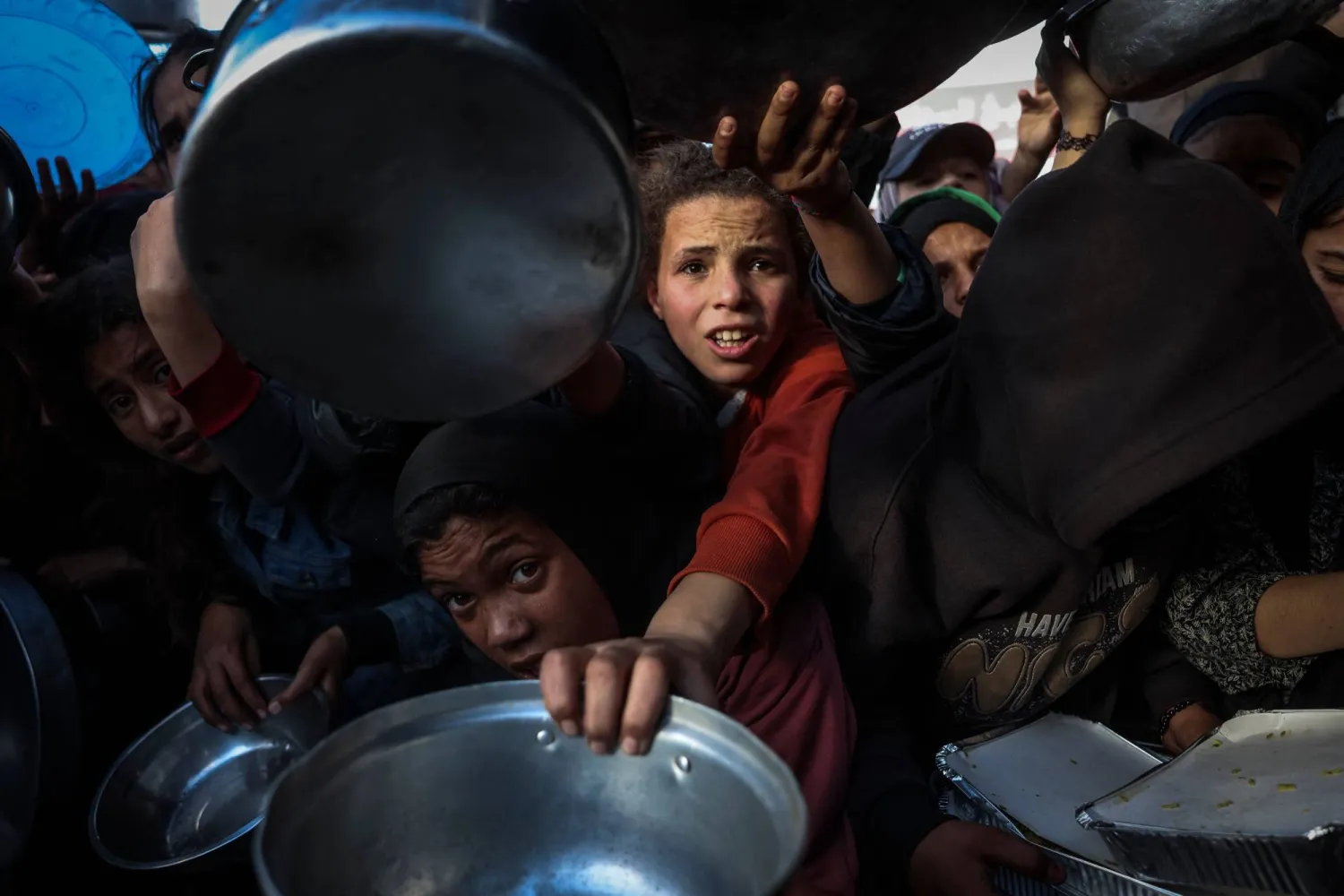
 Palestinians react as they wait to receive food at a soup kitchen in Khan Yunis, in the southern Gaza Strip, on February 26, 2026.  (Photo by BASHAR TALEB / AFP)
Palestinians react as they wait to receive food at a soup kitchen in Khan Yunis, in the southern Gaza Strip, on February 26, 2026. (Photo by BASHAR TALEB / AFP)
TT

Israel’s Top Court Allows Aid Groups to Keep Working in Gaza as Israeli Strikes Kill 5 There

 Palestinians react as they wait to receive food at a soup kitchen in Khan Yunis, in the southern Gaza Strip, on February 26, 2026.  (Photo by BASHAR TALEB / AFP)
Palestinians react as they wait to receive food at a soup kitchen in Khan Yunis, in the southern Gaza Strip, on February 26, 2026. (Photo by BASHAR TALEB / AFP)

Israel's top court on Friday moved to allow international aid groups to keep operating in the Gaza Strip and other Palestinian territories as Israeli strikes killed at least five people across the war-torn enclave. 

The Supreme Court's order, which followed a petition from 17 aid groups, effectively halted an earlier Israeli government decision that barred aid groups for refusing to comply with Israel's new rules. 

Israel had announced it will ban 37 aid groups by March 1 for not abiding by rules introduced last year that require aid groups to register names and contact information of employees, and provide details about their funding and operations. 

The groups view the rules as invasive and arbitrary, and say the ban would hinder critical assistance. Israel says the new measures are necessary to ensure armed groups do not infiltrate humanitarian organizations. 

A US-negotiated ceasefire reached in October has halted major military operations. But the two-year war triggered by Hamas' Oct. 7, 2023 attack on Israel has left much of the territory in ruins and most of Gaza's 2 million Palestinians reliant on international aid. 

Israel has also continued to strike what it says are gunmen, often killing civilians. 

Aid groups express relief Friday's order was a temporary injunction while the court considers the case. There was no timeline for a final decision. 

“This is, however, a step in the right direction — with a long, long way still to go. We will keep fighting to be able to do our jobs, and deliver life saving assistance to Palestinians in need,” said Athena Rayburn, the executive director of AIDA, an umbrella organization representing over 100 groups operating in the Palestinian territories. 

Lawyers representing the aid groups said the decision has given Palestinians in Gaza and the West Bank some “breathing room." 

The petition said the new rules violate international law, and that Israel, as an occupying power, has the obligation to ensure food and medicine reach people. It also says Israel does not have the authority to shutter organizations in areas under the nominal control of the Palestinian Authority. 

COGAT, the Israeli military body overseeing civilian affairs in Gaza, has said that the organizations whose licenses are to be revoked contribute less than 1% of the total aid going into the territory. More than 20 organizations will continue to operate after complying with the new regulations, it said. 

Airstrikes kill at least 5  

Israeli airstrikes overnight killed at least five people, four of them members of the Hamas-run police, officials said Friday. 

Such strikes have repeatedly disrupted the truce since it took effect in October. The escalating Palestinian death toll has left many in Gaza feeling as though the war never ended. 

Three of the five were killed by a strike on a police checkpoint in southern Gaza near Khan Younis, said Dr. Ahmed al-Farra at Nasser Hospital. Another died in a strike on a checkpoint in Bureij refugee camp, according to a statement from the Hamas-run Interior Ministry, which oversees police in Gaza. 

A separate strike in western Khan Younis killed one Palestinian, al-Farra said. 

The Israeli military said it killed several fighters in Rafah, on the border with Egypt. It said the strikes were in response to a violation of the ceasefire. 

The Hamas-run police force has continued to operate in the half the territory under the group's control. The ceasefire agreement calls for Hamas to disarm and hand over power to a committee of Palestinian administrators, and for Israel to withdraw as international forces are deployed. There is no firm timeline for implementing those aspects of the agreement. 

US Embassy provides services in settlement  

Meanwhile, in the occupied West Bank, the US Embassy began offering consular services for the first time Friday in an Israeli settlement. 

The move continues a shift in policy under US President Donald Trump, whose administration has been far friendlier to Israeli settlements in the West Bank than past US leaders. Most of the international community views the settlements as illegal and an obstacle to peace with the Palestinians. 

People lined up in the settlement of Efrat, where some 4,000 US citizens live. “The United States says Efrat is part of Israel, Efrat is going to be forever here,” the city’s mayor, Dovi Sheffler, said. 

More than 500,000 Israelis live in settlements across the West Bank, which is home to around 3 million Palestinians living under military rule, with the Palestinian Authority exercising limited autonomy in population centers. 

The US Embassy has previously provided consular services in Ramallah and other Palestinian cities in the West Bank, which is home to many Palestinian Americans. 

Israel captured the West Bank, Gaza and east Jerusalem in the 1967 Mideast war, territories the Palestinians want for a future state. 


Israel Will Strike Hezbollah Until Group Disarmed, Vows Army Chief

A picture taken along the Israel-Lebanon border shows rockets being fired from southern Lebanon towards Israel on March 3, 2026. (AFP)
TT

Israel Will Strike Hezbollah Until Group Disarmed, Vows Army Chief

A picture taken along the Israel-Lebanon border shows rockets being fired from southern Lebanon towards Israel on March 3, 2026. (AFP)

Israel's military chief on Tuesday said his forces would keep attacking Hezbollah until the Iran-backed Lebanese group was disarmed, as the war in the Middle East raged for a fourth day.

"We are determined to eliminate the threat Hezbollah poses and will not stop until this organization is disarmed," Lieutenant General Eyal Zamir was quoted as saying in a military statement.

The latest round of fighting between Hezbollah and Israel started early Monday when Hezbollah launched rockets towards Israel in retaliation for the killing of Iranian supreme leader Ali Khamenei in US-Israeli attacks on Saturday.


Sources to Asharq Al-Awsat: Iran Contacts with Hamas, Islamic Jihad Cut

Islamic Jihad leader Ziad al-Nakhalah (R) sits beside Hezbollah Secretary-General Naim Qassem and senior Iranian military officials during the funeral of late Hamas leader Ismail Haniyeh in Tehran in August 2024. (Reuters)
TT

Sources to Asharq Al-Awsat: Iran Contacts with Hamas, Islamic Jihad Cut

Islamic Jihad leader Ziad al-Nakhalah (R) sits beside Hezbollah Secretary-General Naim Qassem and senior Iranian military officials during the funeral of late Hamas leader Ismail Haniyeh in Tehran in August 2024. (Reuters)

Israeli-US operations targeting various Iranian military and security leaders have cut off communication between officials handling the Palestinian file in Iran’s Revolutionary Guard Corps (IRGC) and leaders at multiple levels within Palestinian factions, both inside and outside Gaza.

Asharq Al-Awsat has learned from informed Palestinian factional sources that contact with commanders in the IRGC - whether in the Quds Force or in branches directly linked to Palestinian groups, particularly Hamas and Islamic Jihad - has been severed since the first day of the Israeli-US attacks last Saturday.

According to those sources, it remains unclear whether the IRGC commanders in question have been assassinated or are implementing standard security measures, although some had maintained contact and relayed messages through various means during the 12-day war in June.

“Messages are usually transmitted through encrypted channels, either electronically or by other means. Since the start of this war, no messages have been received,” the sources revealed.

Officials overseeing the Palestinian file in the IRGC are primarily responsible for supporting the factions, financially and militarily. They maintain regular, direct communication with top political and military leaders, and at times with second-tier officials, in efforts to develop plans and scenarios for potential or unfolding events.

The same sources said Iran had appointed a successor to Saeed Izadi, known as Hajj Ramadan, who was responsible for the Palestinian file in the Quds Force and was assassinated by Israel last June.

Two deputies were also assigned to the new commander to oversee the file in case he was killed. However, none of them have communicated with officials from Palestinian factions funded by Tehran during this period.

Deep crisis

Palestinian factions, particularly the Islamic Jihad and smaller groups such as the Popular Resistance Committees, the Mujahideen Brigades and some armed groups active in Gaza, have been facing a severe financial crisis for several months due to a sharp decline in Iranian support for more than seven months, Asharq Al-Awsat previously reported.

Before the Israeli-US strikes, leadership sources within those factions voiced concern over the potential impact, expressing fears of “the collapse of the Iranian regime, which would mean an irreversible halt to support.”

While Hamas relies on multiple funding sources, Islamic Jihad and other factions depend solely on Iranian backing. The downturn has affected salary payments to their members, raising fears of significant damage and even the potential collapse of some groups.

In a related development, sources within the Islamic Jihad told Asharq Al-Awsat that Adham al-Othman, commander of the Al-Quds Brigades, the movement’s armed wing in Lebanon, who was assassinated by Israel on Monday in Beirut’s southern suburbs, had been staying in an apartment belonging to Lebanon’s Hezbollah.

The apartment was considered a “safe location” and was secured by the party. He was killed alongside several individuals, some of whom were Hezbollah security personnel.

It remains unclear whether Israel had precise intelligence on Othman’s presence at the site or targeted it on the basis of its affiliation with Hezbollah, particularly as the Israeli military announced his killing only after a significant delay, hours after the Islamic Jihad had issued a statement mourning him.

Islamic Jihad members had taken part in attacks alongside Hezbollah along the border with Israel during what was known as the “support war”, which was launched by the party in October 2023 and ended with a ceasefire in November 2024. Some of those mourned by the group had moved to Beirut from Syria.


Israel Strikes Jamaa Islamiya Group’s HQ in Sidon, South Lebanon

Rescue workers gather in front of the destroyed center of the Jamaa Islamiya group which hit by an Israeli strike, in the southern port city of Sidon, Lebanon, Tuesday, March, 3, 2026. (AP)
TT

Israel Strikes Jamaa Islamiya Group’s HQ in Sidon, South Lebanon

Rescue workers gather in front of the destroyed center of the Jamaa Islamiya group which hit by an Israeli strike, in the southern port city of Sidon, Lebanon, Tuesday, March, 3, 2026. (AP)

Beirut, Lebanon, March 3, 2026 (AFP) - Israel struck a headquarters belonging to the Jamaa Islamiya group, an ally of Hamas and Hezbollah, in the southern Lebanese city of Sidon on Tuesday, state media reported.

"The Israeli enemy carried out an air raid a short while ago, targeting a headquarters of the Jamaa Islamiya" in the coastal city, state media said.

Sidon was largely spared of major Israeli attacks during the last war between Israel and Hezbollah, which a November 2024 ceasefire sought to end.

The strike almost entirely destroyed a seven-storey building, according to an AFP photographer, and ambulances rushed to the scene.

It caused a powerful blast in a densely populated area, as seen on local media.

The Jamaa Islamiya in a statement said no one was killed or wounded in the strike, which it called a "war crime".

The Israeli military then issued an evacuation warning for another building in Sidon, saying it will hit "Hezbollah military infrastructure... in light of its prohibited attempts to rebuild its activities in the area".

The Jamaa Islamiya had previously been the target of Israeli strikes in Lebanon after claiming responsibility for rocket launches towards Israel during the war between Israel and Hezbollah that began in October 2023.

Last month, it accused Israel of seizing one of its officials from a town near the border.

The Israeli military said that it "apprehended a senior terrorist" in the group who was then "transferred for further questioning in Israeli territory".
