


Libyan Court Hands 30-Year Sentence to Human Trafficker

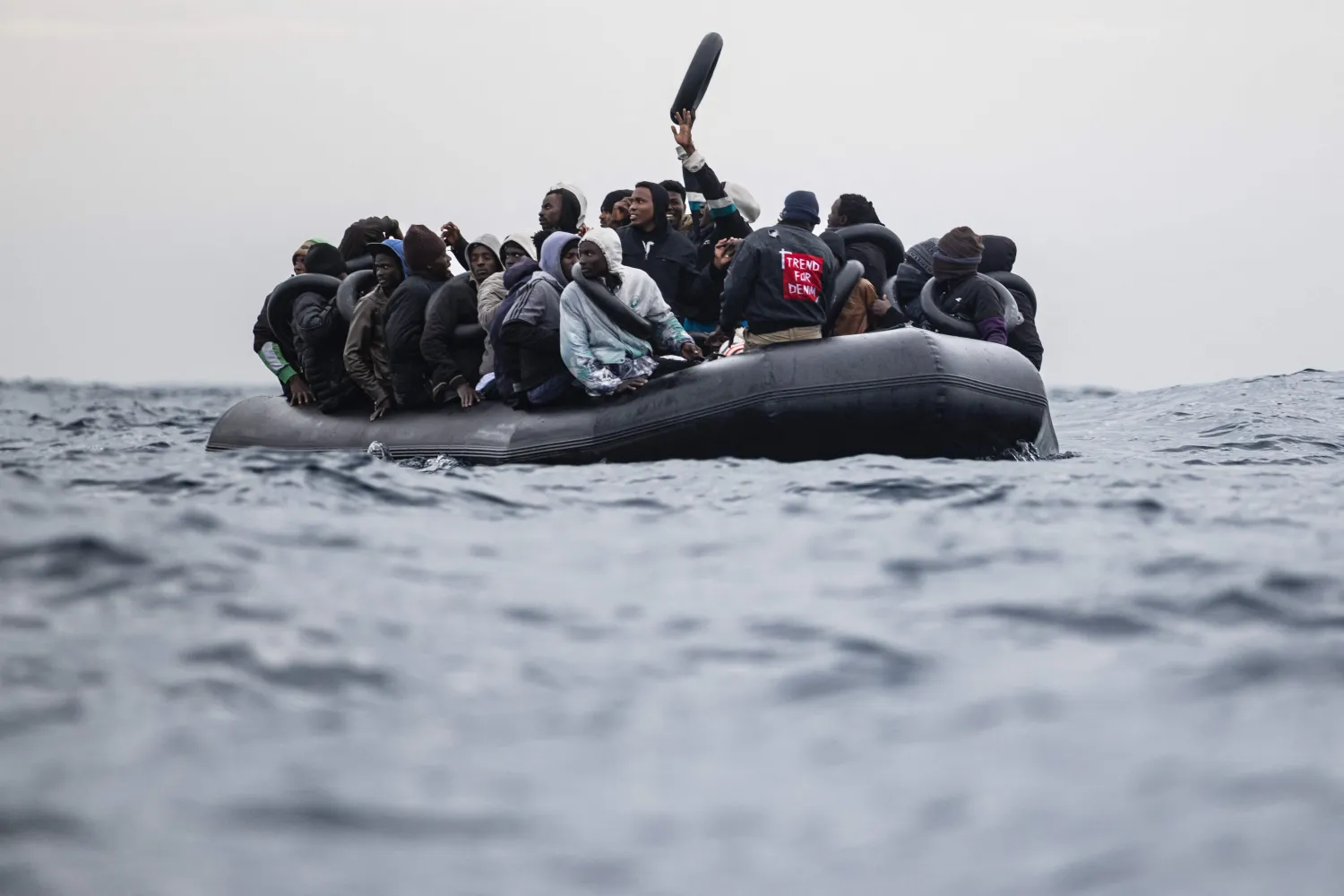
(FILES) Migrants onboard a rubber boat wave and gesture as they wait to be rescued by crew members of the “Ocean Viking” rescue ship in the search-and-rescue zone in the Mediterranean Sea near the Libyan coast, on January 16, 2026. (Photo by Sameer Al-DOUMY / AFP)
TT

Libyan Court Hands 30-Year Sentence to Human Trafficker

(FILES) Migrants onboard a rubber boat wave and gesture as they wait to be rescued by crew members of the “Ocean Viking” rescue ship in the search-and-rescue zone in the Mediterranean Sea near the Libyan coast, on January 16, 2026. (Photo by Sameer Al-DOUMY / AFP)

The Tripoli Criminal Court on Friday sentenced a member of a criminal network to 30 years in prison after convicting him of human trafficking and of organizing the smuggling of migrants by sea.

The Office of the Attorney General said the court initiated criminal charges against an individual actively involved in an organized criminal group engaged in human trafficking and the unlawful facilitation of migrant smuggling operations across the Mediterranean.

The defendant was also fined 90,000 Libyan dinars.

Investigations revealed that members of the network deliberately arranged irregular sea crossings and subjected some migrants to severe abuses and that several victims were deprived of their liberty and held in coercive conditions amounting to practices akin to slavery.

In a related development, the International Organization for Migration said at least 7,667 people died or went missing on migration routes worldwide in 2025.

The figures underscore the continued global scale of the crisis faced by people on the move, the UN agency said, calling for the dismantling of smuggling networks that exploit migrants and put lives at risk.

“The continued loss of life on migration routes is a global failure we cannot accept as normal,” said IOM Director General Amy Pope.

“These deaths are not inevitable. When safe pathways are out of reach, people are forced into dangerous journeys and into the hands of smugglers and traffickers,” Pope noted.

The UN agency said sea crossings remained among the deadliest routes. In 2025, at least 2,185 people died or went missing in the Mediterranean, and at least 1,500 additional people were reported missing at sea but could not be verified due to limited access to search-and-rescue information.

Though evidence on these “invisible shipwrecks” is scarce, IOM said at least 270 human remains washed ashore on Mediterranean coasts in 2025 without being linked to known shipwrecks, and three vessels carrying the remains of 42 people were later found drifting to Brazil and the Caribbean after attempting the Canary Islands crossing.

This concerning trend continues into 2026.

According to the UN agency, the Mediterranean is seeing an unprecedented number of migrant deaths in the first two months of 2026, with 606 recorded as of 24 February.

Over the same timeframe, arrivals in Italy decreased from 6,358 to 2,465 (a 61% decrease).

Yet, it said, there are reports of hundreds more missing at sea that cannot yet be verified. In the last two weeks alone, 23 human remains have been washed up on southern Italian and Libyan coasts.

IOM affirmed that the persistence of these deaths reflects the growing reach of trafficking and migrant smuggling networks that continue to exploit desperation along migration routes, exposing people to violence, abuse, and life-threatening journeys.

It called on governments and partners to urgently scale up coordinated search-and-rescue operations to prevent further loss of life, strengthen international cooperation to dismantle criminal networks, and expand safe and regular migration pathways so people are not forced into the hands of smugglers.

Meanwhile, the Interior Ministry of the Tripoli-based Government of National Unity (GNU) announced on Friday the deportation of a group of illegal Nigerian migrants through Mitiga International Airport, as part of the national program to address illegal migration.

Also, the Anti-Migration Service (Wahat Branch) in Libya said it detained 38 Sudanese migrants for illegal entry and initiated their transfer to the Ajdabiya shelter center, in line with legal and humanitarian procedures.



Lebanon: Disagreements Over Israel Talks Strain Aoun-Berri Ties

Israeli soldiers operate in southern Lebanon, as seen from northern Israel, Wednesday, April 29, 2026. (AP Photo/Ariel Schalit)
TT

Lebanon: Disagreements Over Israel Talks Strain Aoun-Berri Ties

Israeli soldiers operate in southern Lebanon, as seen from northern Israel, Wednesday, April 29, 2026. (AP Photo/Ariel Schalit)

Disagreements between Lebanese President Joseph Aoun and Parliament Speaker Nabih Berri over negotiations with Israel have come to the surface as violence has continued despite a recently extended ceasefire between Israel and Hezbollah.

Aoun said Wednesday that he had coordinated all steps with Berri and Prime Minister Nawaf Salam. But Berri responded sharply, saying the president’s remarks were “inaccurate, if not otherwise.”

Aoun had said Israel must “understand that it must first fully implement the ceasefire before moving on to negotiations,” stressing that every step he had taken regarding talks “was coordinated and consulted on with Speaker Nabih Berri and Prime Minister Nawaf Salam, contrary to what is being reported in the media.”

Berri quickly pushed back in a statement: “With all due respect to the presidency and to what His Excellency the president is saying, the remarks attributed to him ... are inaccurate, if not otherwise - particularly regarding the November 2024 arrangement and the issue of negotiations.”

Aoun also said he was “making every possible effort to reach a solution far from violence and the bloodshed in the South,” adding that such a solution could be achieved through negotiations, “which are war without bloodshed.”

Amid mounting criticism over the decision to pursue direct negotiations with Israel, Aoun reiterated: “In every step I have taken, I was in coordination and consultation with Speaker Nabih Berri and Prime Minister Nawaf Salam, contrary to what is being reported in the media.”

He added: “As for the criticism that Lebanon, through the US statement issued after the trilateral talks in Washington, agreed to grant Israel the freedom to continue its attacks on Lebanon, I say that this wording appeared in a statement issued by the US State Department. It is the same text adopted in November 2024 and approved by all parties. It is a statement, not an agreement, because an agreement comes after negotiations are concluded.”

The Lebanese president stressed that if Israel believes it can achieve security through violations and the destruction of border villages, it is mistaken, noting that it has tried this approach before without success.

“The only thing that can protect the borders is when the Lebanese state, in full strength, is present throughout the entire south, up to the international border,” he underlined.

“Israel must definitively understand that the only path to security is through negotiations, but it must first fully implement the ceasefire before moving to negotiations.”

Aoun acknowledged “many difficulties” facing efforts to reach that goal, saying Lebanon is working to mitigate the consequences of Israeli attacks through intensive diplomatic contacts.

“It is unacceptable for Israeli attacks to continue after the ceasefire has been declared,” he said. “We are now awaiting the United States to set a date to begin negotiations. All European Union countries, along with Arab states, have supported our choice of negotiations. There is also broad consensus among the Lebanese people, especially in the south, on the need to end the war,” he added.

The president highlighted a positive development, saying that the Lebanon file is now on the desk of US President Donald Trump. “He holds a special regard for Lebanon and spoke highly, in a very moving way, about Lebanon and its people during our phone call. This is an opportunity we must seize to guide our country toward safety and peace,” Aoun said.

Hezbollah drew Lebanon into the Middle East war on March 2, and Israeli and Lebanese representatives have since met twice in Washington, the first such meetings in decades, for discussions that Hezbollah has categorically rejected.

After the first talks, Trump announced a 10-day ceasefire that began on April 17, and a three-week extension after the second round.

Israel has repeatedly bombed Lebanon, particularly the south, despite the truce, and has carried out demolitions of border villages inside a "Yellow Line" it established in southern Lebanon.

It said on Wednesday that it struck "approximately 20 command centers and military structures used by Hezbollah.”


Libya: 17 Migrants Perish at Sea, 9 Missing Feared Dead

Migrants rescued after their boat, which departed from Libya's coast towards Europe, sank (AP)
TT

Libya: 17 Migrants Perish at Sea, 9 Missing Feared Dead

Migrants rescued after their boat, which departed from Libya's coast towards Europe, sank (AP)

At least 17 migrants died and nine are missing after their boat broke down and drifted for eight days in the Mediterranean Sea, Libya's Red Crescent and Libyan security sources said on Wednesday.

The Red Crescent said in a statement that the volunteers in cooperation with naval forces and coast guards of the Libyan National Army rescued seven survivors during recovery operations off Tobruk city in eastern Libya, ⁠near the border ⁠with Egypt.

Libya is a transit route for migrants, many of them from sub-Saharan Africa, who risk their lives to flee to Europe across desert and sea in the hope of escaping conflict and poverty. The ⁠security sources said they expected the bodies of the nine missing migrants to wash ashore in the next few days.

Pictures posted on the internet by the Red Crescent showed the volunteers placing the bodies in black plastic bags and loading them into the back of pick-up vehicles, Reuters reported.

On Tuesday, the country's attorney general said Tripoli Criminal Court sentenced four ⁠members ⁠of a "criminal gang" in Zuwara, western Libya, to up to 22 years in jail for human trafficking, abductions for ransom and torture.

In a separate case, the Public Prosecutor's Office ordered on Monday the arrest of another gang that allegedly sent migrants from Tobruk on a dilapidated boat that capsized, resulting in the death of 38 Sudanese, Egyptian, and Ethiopian nationals, according to the attorney general.


US Auditors Find No Evidence Linking Iraq PM-Designate to Iran’s Revolutionary Guards

Iraq’s prime minister-designate Ali al-Zaidi attends a Coordination Framework meeting in Baghdad on April 27 (AP)
TT

US Auditors Find No Evidence Linking Iraq PM-Designate to Iran’s Revolutionary Guards

Iraq’s prime minister-designate Ali al-Zaidi attends a Coordination Framework meeting in Baghdad on April 27 (AP)

A US law firm said an independent investigation it recently conducted found no evidence linking Iraq’s prime minister-designate, Ali al-Zaidi, to financial activities tied to Iran’s Revolutionary Guards, adding that restrictions imposed on him in 2024 were due to reputational risks, not proven involvement in money laundering.

The clarification comes as al-Zaidi’s surprise designation to form a government in Baghdad, succeeding Mohammed Shia al-Sudani, faces political scrutiny over his background, after a bank he owns was included in restrictions by the Central Bank of Iraq on access to US dollars, as part of what was described at the time as a campaign to combat illicit financial flows.

Representatives of K2 Integrity, who asked not to be named because they are not authorized to speak publicly, said an independent probe by the firm found no credible evidence linking al-Zaidi or Al-Janoob Islamic Bank to the Quds Force and did not identify direct financial transfers from the bank to regional entities classified as high risk.

One representative told Asharq Al-Awsat that the restriction recommended by the US Treasury and the New York Federal Reserve on Al-Janoob Islamic Bank was limited to US dollar transactions and was driven by reputational concerns and the bank’s ownership, rather than confirmed violations related to money laundering or financing Iran-linked entities.

Al-Zaidi, a businessman who owns companies with his brother and partners, including Al-Oweis, Al-Janoob, and Dijlah TV, is seen as an opaque figure in Iraq’s political landscape.

His designation came amid public US opposition that led to Nouri al-Maliki’s exclusion from the race, while unannounced objections were also reported to have sidelined al-Sudani.

Restrictions linked to Iran

In February 2024, Iraq imposed restrictions on eight local banks, including Al-Janoob Islamic Bank, preventing them from accessing US dollars through the central bank window. The move was part of Washington’s efforts to curb money transfers to Iran.

A US Treasury spokesperson said at the time the measures aimed to protect Iraq’s financial system from abuse, citing concerns that US currency could be used in illegal activities.

The case highlights the ongoing challenge facing Baghdad in balancing its ties with both the United States and Iran, given its heavy reliance on the US dollar. Iraq receives about $10 billion in cash annually from the Federal Reserve, according to official estimates.

The US Embassy in Baghdad welcomed al-Zaidi’s designation, expressing support for efforts to form a government that reflects the aspirations of the Iraqi people. This follows months of political deadlock and comes amid pressure from the administration of Donald Trump, which had threatened to cut support to Iraq if al-Maliki returned to power.

Al-Zaidi faces a 30-day deadline to form a government, amid sharp divisions within the Coordination Framework and as regional tensions escalate following military strikes on Iran in February 2026 and subsequent attacks by armed groups on US interests in Iraq.