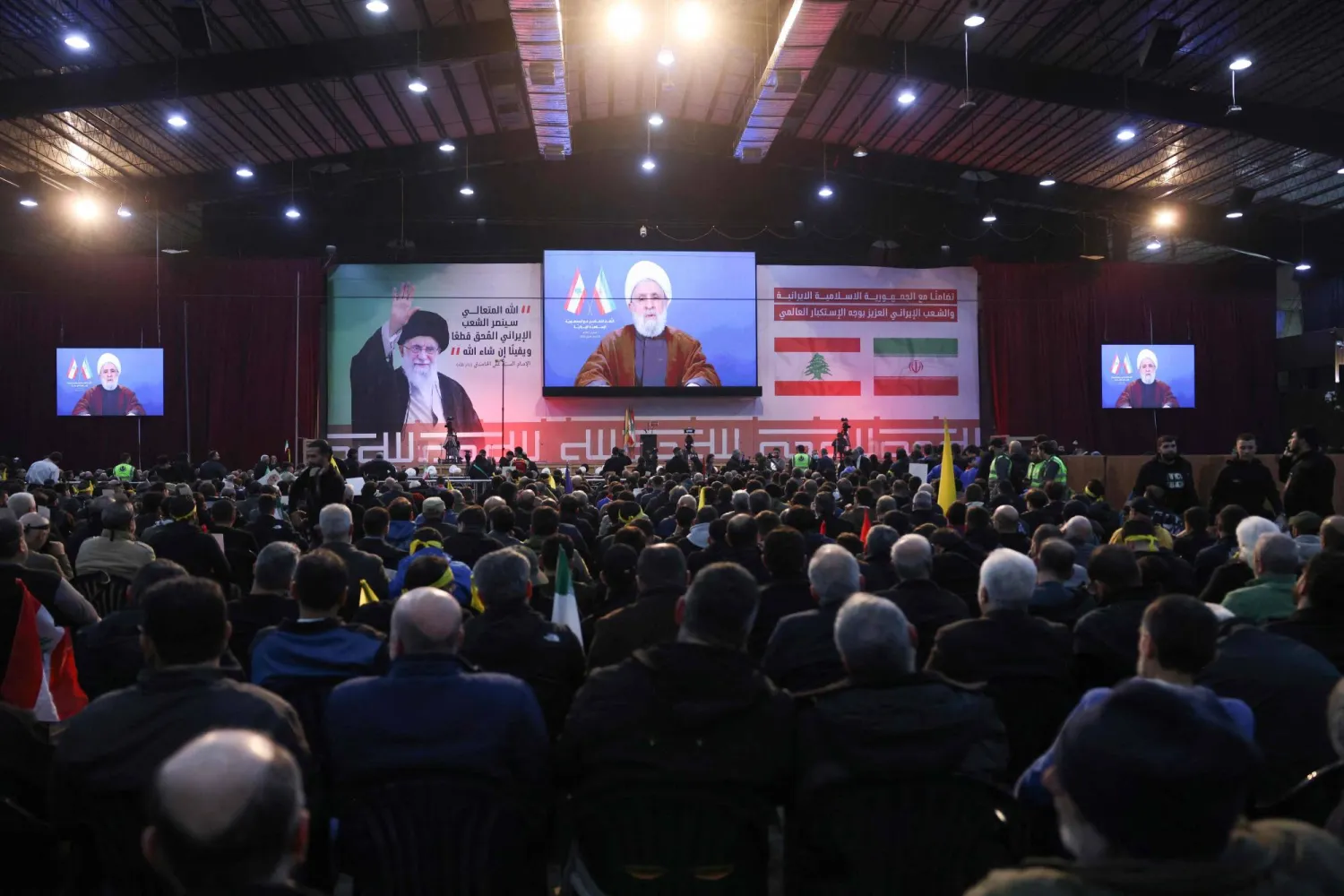
Israeli Defense Minister Says Lebanon's Hezbollah Chief is Now 'Target for Elimination'

Supporters watch a televised speech by Hezbollah chief Naim Qassem during a rally to show their solidarity with Iran, in the southern suburb of Beirut on January 26, 2026. (Photo by Anwar AMRO / AFP)
TT

Israeli Defense Minister Says Lebanon's Hezbollah Chief is Now 'Target for Elimination'

Supporters watch a televised speech by Hezbollah chief Naim Qassem during a rally to show their solidarity with Iran, in the southern suburb of Beirut on January 26, 2026. (Photo by Anwar AMRO / AFP)

Israeli Defense Minister Israel Katz said ‌on ‌Monday that ‌Hezbollah ⁠chief Naim Qassem ⁠was now a "target for ⁠elimination", after ‌the ‌Iran-aligned militant group ‌fired ‌at Israel in ‌retaliation for the killing ⁠of ⁠Iran's Supreme Leader Ali Khamenei.

On Sunday, Qassem said in a statement: “We will undertake our duty of confronting the aggression," adding that his movement would not leave "the field of honor and resistance".

Israeli strikes on Lebanon killed at least 31 people on Monday, authorities said, following rocket fire from Tehran-backed militant group Hezbollah after the killing of Khamenei.

Israel's military vowed to intensify its attacks on the country and make Hezbollah pay a "heavy price" after launching several strikes on Beirut's southern suburbs and south Lebanon, areas where Hezbollah holds sway.

Lebanese authorities, who have been trying to spare the country from any repercussions of the US-Israeli attack on Iran, said Hezbollah's rocket fire gave Israel "excuses" to ramp up its attacks.

Lebanese President Joseph Aoun said attacks from the country's territory risked drawing the country into regional conflict.

Lebanese Prime Minister Nawaf Salam, whose government has pushed for Hezbollah's disarmament, called Monday's rocket fire "irresponsible".

He vowed to "stop the perpetrators and protect the Lebanese people".


What Does Removing Syria from the US List of State Sponsors of Terrorism Mean for Its Economy?

US President Donald Trump holds a bilateral meeting with Syrian President Ahmed al-Sharaa alongside the NATO leaders summit at the Bestepe Presidential Compound in Ankara, Türkiye, July 8, 2026. REUTERS/Jonathan Ernst
TT

What Does Removing Syria from the US List of State Sponsors of Terrorism Mean for Its Economy?

US President Donald Trump holds a bilateral meeting with Syrian President Ahmed al-Sharaa alongside the NATO leaders summit at the Bestepe Presidential Compound in Ankara, Türkiye, July 8, 2026. REUTERS/Jonathan Ernst

The US administration’s decision to begin the process of removing Syria from its list of State Sponsors of Terrorism (SST) - where it has remained since 1979 - marks the country’s most significant political and economic shift in decades.

The designation was more than a political label; it served as the legal cornerstone of the extensive US sanctions architecture imposed on Syria. Its removal could reopen the door to trade, investment, and large-scale reconstruction.

The announcement followed what Washington described as “positive changes” by the Syrian government and formal assurances from Syrian President Ahmed al-Sharaa that Syria would not support acts of international terrorism in the future.

Secretary of State Marco Rubio subsequently notified Congress of President Donald Trump’s intention to rescind the designation after the required 45-day congressional notification period, describing the move as “historic” and saying it offers Syria a genuine opportunity to rebuild and open a new chapter for its people.

Syrian officials welcomed the decision. Finance Minister Mohammad Yosr Barnieh called it “a historic moment” heralding a new era of prosperity, investment, and economic recovery. He said the move would open a new chapter for the Syrian economy, accelerate recovery, encourage investment, and facilitate Syria’s reintegration into the global economy.

Central Bank Governor Safwat Raslan likewise described the decision as “a positive turning point” that would strengthen confidence, attract investment, and help reintegrate Syria into the global financial system. He reaffirmed the central bank’s commitment to reforms, monetary stability, and long-term economic recovery.

Reconnecting to the Global Financial System

In practical terms, the decision paves the way for Syrian banks to gradually reconnect with the global financial system, correspondent banking networks, and the SWIFT international payments system. The terrorism designation had effectively prevented foreign correspondent banks from dealing with Syrian financial institutions for fear of US legal penalties.

Reintegration could improve access to trade finance and sharply reduce the cost of remittances from Syrians abroad. For years, expatriates have relied on costly informal channels to circumvent sanctions. Easier remittance flows would provide a direct boost to household incomes and financial stability.

Removing Barriers to Investment

For years, US secondary sanctions linked to the terrorism designation discouraged foreign companies from participating in reconstruction projects, fearing hefty fines or exclusion from the US market.

Highlighting the policy shift, the US administration quoted Trump as telling Al-Sharaa: “I promised to remove all the barriers preventing you from rebuilding your country, and very soon you will finally be able to do so.” Trump also said US companies are already interested in investing in Syria.

Removing the designation significantly reduces reputational risk and gives multinational companies greater legal and procedural certainty to invest in infrastructure, real estate, telecommunications, and other sectors.

Reviving Trade and the Energy Sector

Foreign trade is also expected to benefit. Previous restrictions limited imports of advanced industrial equipment and technology classified as “dual-use” goods with potential civilian and military applications. Easing those restrictions would allow Syrian manufacturers to import production lines, agricultural equipment, and medical supplies with far fewer regulatory hurdles.

The energy sector, which has suffered years of severe deterioration, could also benefit. International companies would be able to provide spare parts, technical expertise, and technology needed to rehabilitate damaged oil and gas fields and repair aging power plants, helping ease chronic electricity shortages and support industrial production.

Restoring Access to International Financing

Syria’s designation as a State Sponsor of Terrorism also triggered an effective US veto on loans, grants, technical assistance, and other support from international financial institutions, particularly the World Bank and the International Monetary Fund.

With the designation removed, Damascus could theoretically begin negotiations with these institutions to secure development financing, support economic restructuring, and implement monetary and fiscal reforms.

From Blanket Prohibition to Risk-Based Assessment

Legal experts say the decision fundamentally changes how international companies and financial institutions assess Syria.

Previously, US law effectively imposed a blanket prohibition on doing business with Syria, leaving banks and corporations with virtually no room for discretion. Now, the automatic legal barrier is removed. Banks and companies can independently assess the remaining legal and commercial risks and proceed with transactions that comply with other applicable sanctions. This represents a fundamental shift, giving investors and financial institutions flexibility that has not existed since Syria was added to the terrorism list in 1979.

Why the Economic Crisis Will Not End Overnight

Despite the significance of Rubio’s announcement and the June 30, 2025 executive order easing certain restrictions, the economic impact is unlikely to be immediate.

The biggest constraint is that removing Syria from the terrorism list does not dismantle the broader sanctions regime. Numerous US laws and executive orders targeting key economic sectors, entities, and individuals remain in force.

In addition, Syria is likely to face prolonged caution from international banks — a phenomenon known as “over-compliance.” Many financial institutions are expected to spend months, if not years, conducting extensive legal reviews before reopening accounts or facilitating trade with Syria, seeking to avoid penalties under the sanctions that remain in place.

Ultimately, Syria’s economic recovery will depend not only on the easing of US restrictions but also on its ability to implement deep structural and institutional reforms, improve the business environment, and maintain monetary stability.

Removing Syria from the State Sponsors of Terrorism list is a major step toward reducing reputational risk and reopening international markets. But a full recovery remains a long-term process that will require the gradual dismantling of the remaining sanctions, which continue to pose the greatest obstacle to Syria’s reintegration into the global economy.


Iraq’s ‘Oil Network’ Arrests Reach Another Official

Iraqi security personnel patrol a street in Baghdad on June 28. (AFP)
TT

Iraq’s ‘Oil Network’ Arrests Reach Another Official

Iraqi security personnel patrol a street in Baghdad on June 28. (AFP)

An Iraqi security force on Thursday arrested Hussein Talib, director general of the state-run Oil Products Distribution Company, on suspicion of involvement in corruption cases, hours before he was scheduled to take the constitutional oath as a replacement member of parliament, a security source said.

Talib’s detention came as investigations into corruption linked to the oil sector widened. The Central Anti-Corruption Criminal Court announced Thursday that an additional 14 billion Iraqi dinars, or about $10.7 million, had been seized in the case of detained Oil Ministry Undersecretary Adnan al-Jumaili.

Talib, who heads the Oil Ministry-affiliated company, had been named to replace lawmaker Ammar Mousa as a Baghdad representative for the National State Forces Alliance. His arrest prevented him from taking the oath, the source said.

The National Wisdom Movement, led by Ammar al-Hakim and of which Talib is a member, said it supported measures taken by the government, judiciary and Integrity Commission to combat corruption.

Movement spokesman Hossam al-Hassani said it backed legal action aimed at protecting public funds, adding that an official’s compliance with investigative procedures demonstrated respect for constitutional and legal institutions.

He stressed that “the accused is innocent until proven guilty by a final court ruling,” adding that any legal responsibility, if established, was personal and should not extend to any political, social or institutional entity. He urged against prejudging or politically exploiting the case.

Iraqi security forces last week arrested politicians, lawmakers and senior government officials named in al-Jumaili’s confessions. Security and legal sources described the arrests as the beginning of a broader anti-corruption campaign ordered by Prime Minister Ali al-Zaidi.

Al-Zaidi, who took office in May, has pledged to root out corruption, one of Iraq’s most persistent challenges despite repeated accountability promises by successive governments.

An investigating judge said continued inquiries into the waste of public funds in projects led authorities to discover money hidden in a stormwater drainage pit. Investigations were continuing to identify all members of the network.

Parliament also voted Thursday to dismiss National Investment Commission Chairman Haider Makkiya and refer the relevant files to the Integrity Commission after he failed to attend a questioning session.

Al-Zaidi said his government would fight corruption “without exceptions or red lines,” pursue those involved and recover stolen funds.

Local media also reported that Foreign Minister Fuad Hussein discussed in Kuwait efforts to freeze and recover money allegedly deposited in Kuwaiti banks by corruption suspects, as well as cooperation to identify shell companies and return assets to Iraq.


Syrian Authorities Say Captured ISIS-linked Cell Behind Blasts

Syrian security personnel inspect a burned vehicle near the Four Seasons Hotel after two explosions rocked the area earlier in Damascus, Syria, Tuesday, July 7, 2026. (AP Photo/Omar Albam)
TT

Syrian Authorities Say Captured ISIS-linked Cell Behind Blasts

Syrian security personnel inspect a burned vehicle near the Four Seasons Hotel after two explosions rocked the area earlier in Damascus, Syria, Tuesday, July 7, 2026. (AP Photo/Omar Albam)

Syrian officials said late Thursday the country had captured an ISIS-linked cell responsible for two bomb blasts during French President Emmanuel Macron's visit to Damascus earlier this week.

In a joint press conference with his Syrian counterpart, Macron said we must "not let ourselves be destabilized" by such attacks, and the two leaders vowed to boost ties with new ambassadors to be installed in each country.

Syria's Interior Minister Anas Khattab said that "the cell responsible for the terrorist bombings that targeted Damascus two days ago is now in our custody".

"Once the investigations are completed, we will reveal to the public the identities of the cell's members, their roles, and all of their affiliations and connections," he wrote on X.

Ahmad Dalati, head of interior security for the Damascus region, said on Syrian state television that preliminary investigations indicated "the cell was affiliated with the ISIS group".

The interior ministry said in a statement that the cell had been captured following a series of raids "carried out at the same time against the suspects' different locations across Damascus and its countryside".

The statement said the raids occurred in four neighborhoods.

Two blasts hit central Damascus on Tuesday, killing one person and wounding dozens during the French president's first visit to Syria.

The explosives had been planted near the Four Seasons Hotel, where Macron had spent the night, with Syria's interior ministry saying one was placed in a garbage container and the other in a vehicle near the hotel in the heart of the capital.