


‘Tactical Calm’ May Precede Long War in Iraq

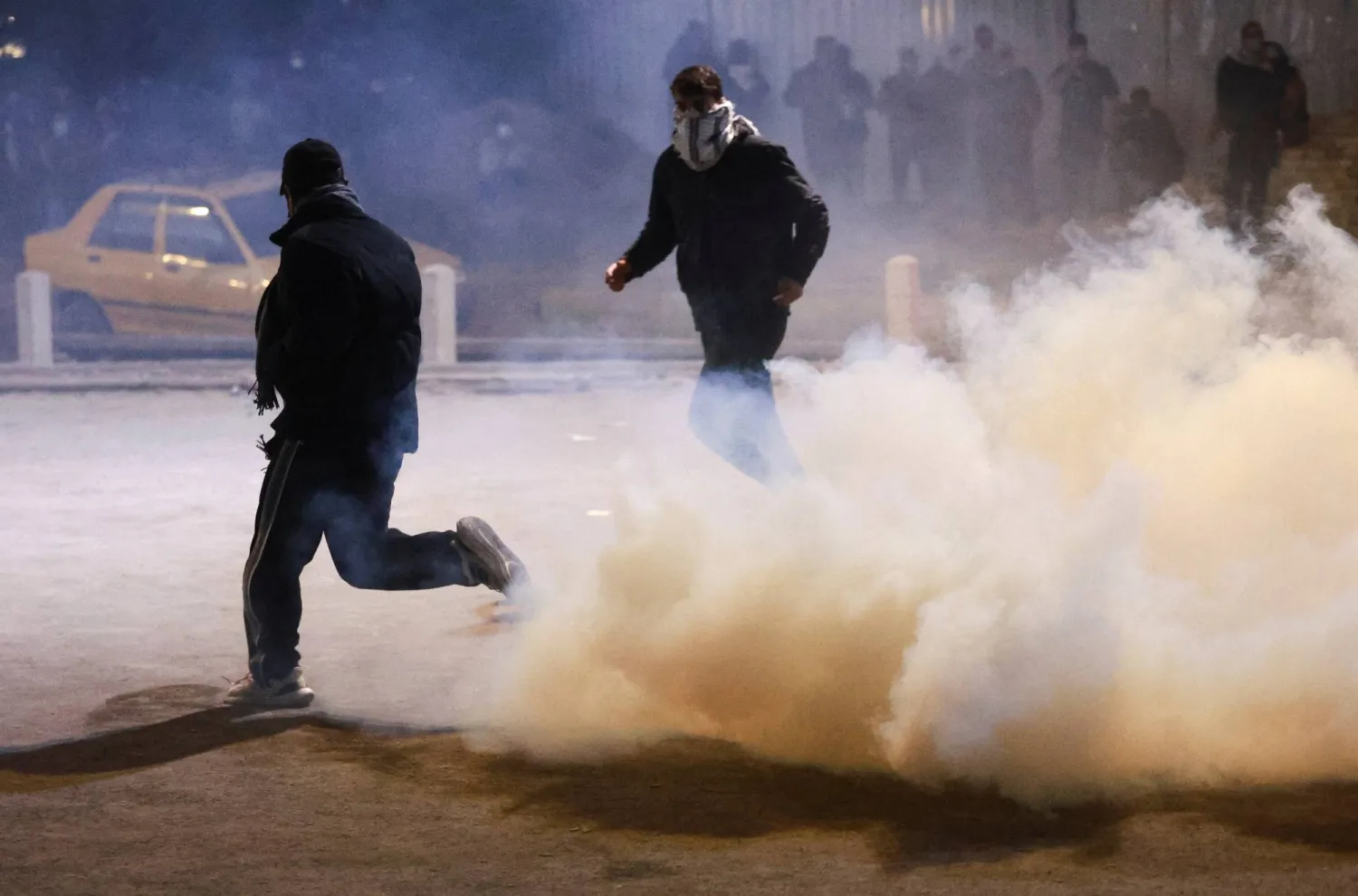
Demonstrators run amid tear gas as supporters of Iraqi Shiite armed groups attempt to move toward the US embassy located in Baghdad's Green Zone following the Israel and US strikes on Iran and the killing of Iran’s Supreme Leader Ali Khamenei, in Baghdad, Iraq, March 1, 2026. (Reuters)
TT

‘Tactical Calm’ May Precede Long War in Iraq

Demonstrators run amid tear gas as supporters of Iraqi Shiite armed groups attempt to move toward the US embassy located in Baghdad's Green Zone following the Israel and US strikes on Iran and the killing of Iran’s Supreme Leader Ali Khamenei, in Baghdad, Iraq, March 1, 2026. (Reuters)

The violent protests that erupted in Iraq among supporters of Iran’s slain Supreme Leader Ali Khamenei against US interests subsided on Monday.

It appears that a decision has been taken for the pro-Iran factions to rein in their reactions to give time for the resumption of communication with the Iranian Revolutionary Guards.

Restoring contacts will help put in place a plan for a possible long war against the US that covers a number of potential targets, some of which may be out of reach.

Influential leaderships ordered the angry protesters to withdraw from Baghdad’s Green Zone where they were trying to inch their way towards the American embassy. “An eerie calm has since been restored with the situation open for any scenario,” observers said.

The protesters had flooded the Green Zone soon after the confirmation of Khamenei’s death on Saturday. Security forces were clearly given an order to prevent them from reaching the US embassy, said an Iraqi official.

Overnight on Sunday, a number of protesters opened live fire at government forces. The Interior Ministry later said a “fifth column” had opened fire at security forces who were there to protect the protesters. Thirteen people were wounded in the unrest.

It did not detail how many were wounded by live fire shot by security forces, according to witnesses.

Various sources confirmed that the government, which is composed of various pro-Iran powers, had issued strict orders to prevent the protesters from breaching the embassy and to arrest any security leader who fails in preventing the launch of rockets and drones.

No leadership

Over the weekend, Iran’s supporters in Iraq acted without clear orders from their central command as the Revolutionary Guards were coming under Israeli and US attacks. What ensued were attacks against any target in Iraq and Kurdistan the factions could come up with.

American reports on Sunday said the Guards no longer have a central base for guiding operations, forcing allied factions to improvise in launching their retaliatory attacks.

Consequently, the factions hit the US Victoria base near Baghdad International Airport. In Basra, they attacked a system of radars; and in Nasiriyah, they fired booby-trapped drones at the Imam Ali base.

The capital of the Iraqi Kurdistan Region, Erbil, “paid the highest price” for Khamenei’s killing, said a Kurdish officer.

“The attacks have been countless. Drones are fired every hour,” he added.

The drone attacks focused on the new US consulate building and Harir military base, revealed American and Kurdish sources.

Calm

By Monday, the strict security measures around the Green Zone remained in place, but the angry factions, mostly Iran-aligned Popular Mobilization Forces, had retreated.

Observers believe Baghdad has entered a phase of “tactical calm” after the shock of Khamenei’s death. The Guards appear to be “catching their breath” and will begin resuming regular communication with their Iraqi agents.

Various sources said the Iraqi factions view Hezbollah’s attack against Israel overnight on Sunday as a sign that contacts had resumed between the Lebanese party and Iran. Tehran had ordered Hezbollah to act, and it did. A similar order will likely be issued to the factions in Iraq.

American estimates believe that the Iranian response to Khamenei’s killing will ease in the coming days due to logistical reasons or because Tehran will be preoccupied with the transition to post-Khamenei rule. Shiite circles in Iraq, however, believe that a long war is in store.

Secretary of Iran’s national security council Ali Larijani said his country has prepared itself for a long war more so than the US.

Target bank

Such a conflict demands a target bank that is not all within reach of the factions seeking to avenge Khamenei’s death, said a leading member of the pro-Iran Shiite Coordination Framework in Iraq.

The targets may include American interests that will harm Washington in the medium-term, such as the consulate and Harir base in Erbil and Victoria base in Baghdad.

In a longer war, the factions may target American investments in gas and oil fields across Iraq. An attack against the US embassy may be saved for a decisive moment in the conflict and will be decided by the Guards, said sources close to the factions.

The factions may also “relish” the idea of carrying out assassinations against the “enemies of Iran,” they added.

The unrest will pose the biggest challenge to Iraqi Prime Minister Mohammed Shia al-Sudani's caretaker government. It will find itself caught in the middle of Shiite factions that want to escalate the conflict against the US and an emerging Arab alliance that has been targeted by Iran’s attacks, said a former government official.


Arab League, Arab Parliament Condemn Closure of Al-Aqsa Mosque

A view of the Aqsa Mosque is pictured in Old City of Jerusalem on March 6, 2026.  (Photo by AHMAD GHARABLI / AFP)
A view of the Aqsa Mosque is pictured in Old City of Jerusalem on March 6, 2026. (Photo by AHMAD GHARABLI / AFP)
TT

Arab League, Arab Parliament Condemn Closure of Al-Aqsa Mosque

A view of the Aqsa Mosque is pictured in Old City of Jerusalem on March 6, 2026.  (Photo by AHMAD GHARABLI / AFP)
A view of the Aqsa Mosque is pictured in Old City of Jerusalem on March 6, 2026. (Photo by AHMAD GHARABLI / AFP)

The General Secretariat of the Arab League expressed deep concern over the continued measures by the Israeli occupation authorities to close Al-Aqsa Mosque to Muslim worshippers, particularly during the holy month of Ramadan, considering this a violation of freedom of worship and an infringement of the historical and legal status quo of the holy sites in the city of Jerusalem.

In a statement issued Thursday, the General Secretariat stressed that Al-Aqsa Mosque holds a special religious and historical status for Muslims around the world, and that any measures restricting access to it or hindering the performance of religious rituals there could lead to an escalation of tensions and undermine efforts to achieve calm and stability, SPA reported.

The Arab League called on the international community and concerned organizations to assume their responsibilities to protect the holy sites and preserve the historical and legal status quo in Jerusalem, stressing that respect for holy sites and freedom of worship are fundamental to maintaining stability and enhancing prospects for peace in the region.

Also, the speaker of the Arab Parliament Mohammed bin Ahmed Al-Yamahi condemned the Israeli occupation's ongoing measures that close the Al-Aqsa Mosque and the Haram Al-Sharif to Muslim worshippers, particularly during Ramadan. He described these actions as violations of the freedom of worship and an infringement on the historical status quo in occupied Jerusalem.

Al-Yamahi stated that restricting access to Al-Aqsa Mosque is a troubling escalation that provokes Muslims globally and reflects efforts to alter the city's Arab and Islamic identity. He emphasized that the Al-Aqsa Mosque, covering 144 dunams, is exclusively for Muslim worship.

He warned that such restrictions would heighten tensions in the region and expressed concern over violations at the Ibrahimi Mosque in Hebron. He called on the international community, including the United Nations, to protect the holy sites in Jerusalem and ensure respect for the historical status of Islamic and Christian sacred sites.


51 Crew Rescued, 1 Dead after Attack on Tankers Off Iraq

An oil tanker burns after being hit by an Iranian strike in the ship-to-ship transfer zone at Khor al-Zubair port near Basra, Iraq, late Wednesday, March 11, 2026. (AP Photo)
TT

51 Crew Rescued, 1 Dead after Attack on Tankers Off Iraq

An oil tanker burns after being hit by an Iranian strike in the ship-to-ship transfer zone at Khor al-Zubair port near Basra, Iraq, late Wednesday, March 11, 2026. (AP Photo)

More than 50 crew members were rescued after an attack on two oil tankers in Iraq's territorial waters, Farhan al-Fartousi of the port authorities told AFP.

Fartousi, from Iraq's General Company for Ports, said "all crew members of the two tankers were rescued," adding that the 51 workers were in good condition.

The attack killed at least one crew member, an Indian national.

Iran's Revolutionary Guards said Thursday they had struck a Marshall Islands-flagged ship, which they claimed was US-owned, in the north of the Gulf.

The vessel, Safesea Vishnu, came under attack March 11 while operating near Basra, India’s embassy said.

The remaining 15 Indian crew members were evacuated and are safe, the embassy added.


Israel Orders Army to Prepare for 'Expanding' Lebanon Operations

A man stands by the rubble of a destroyed building in the aftermath of overnight Israeli airstrikes in the southern Lebanese coastal city of Tyre on March 12, 2026. (Photo by Kawnat HAJU / AFP)
TT

Israel Orders Army to Prepare for 'Expanding' Lebanon Operations

A man stands by the rubble of a destroyed building in the aftermath of overnight Israeli airstrikes in the southern Lebanese coastal city of Tyre on March 12, 2026. (Photo by Kawnat HAJU / AFP)

Israeli Defense Minister Israel Katz said Thursday that he had ordered the military to prepare for expanding operations in Lebanon after Hezbollah fired a heavy barrage of rockets ⁠at Israel overnight.

"The Prime Minister and I have instructed the IDF to prepare for expanding IDF operations in Lebanon and for restoring quiet and security to the northern communities," Katz was quoted as saying in a statement.

"I warned the President of Lebanon that if the Lebanese government does not know how to control the territory and prevent Hezbollah from threatening northern communities and firing toward Israel -- we will take the territory and do it ourselves," Katz said in a situation assessment, according to the statement from his ministry.


A man walks over blood stains, in the aftermath of an Israeli strike in Ramlet al-Bayda at Corniche Beirut, in Beirut, Lebanon, March 12, 2026. REUTERS/Claudia Greco


An Israeli strike hit a car Thursday in Ramlet al-Bayda, a major seaside tourist area of Beirut where dozens of displaced people have been sheltering. Eight people were killed and 31 others were wounded, the Lebanese Health Ministry said.

In Aramoun, a town about 10 kilometers south of Beirut, another three people were killed and a child was wounded in another early Israeli attack.

At least 634 people have been killed in Lebanon since the latest fighting began, the Health Ministry said.

Lebanon was drawn into the Middle East war last week when Hezbollah attacked Israel in response to the killing of Iranian supreme leader Ali Khamenei in US-Israeli strikes.

Hezbollah launched some 200 rockets at Israel’s north and deeper into the country overnight, the Israeli military says.

Many rockets were intercepted and no serious injuries were reported.
