
Failed Israeli Commando Operation to Find Airman Remains Kills 41 in Lebanon

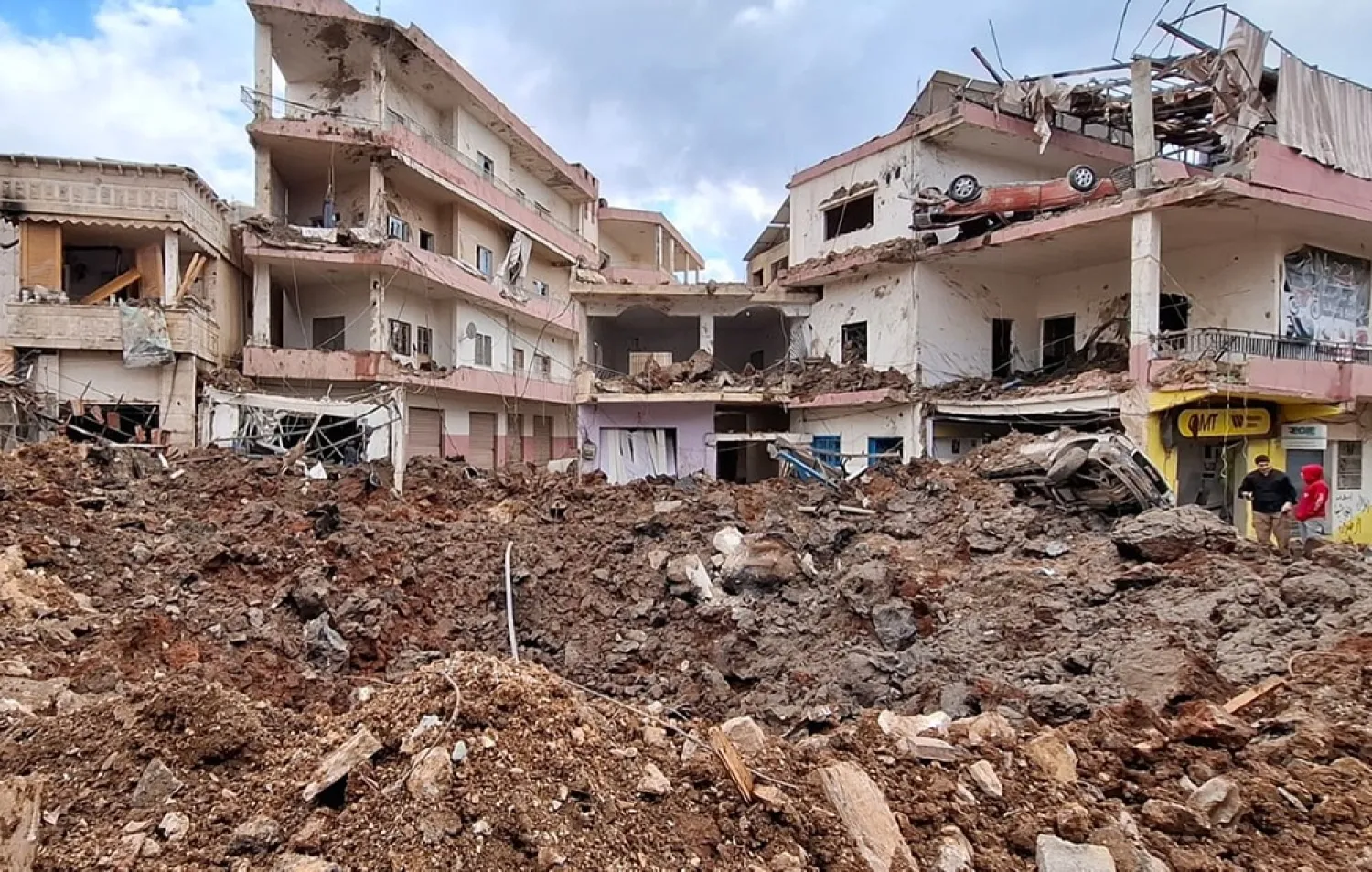
People check the damage left by Israeli airstrikes, Saturday, March 7, 2026, in the village of Nabi Sheet, eastern Lebanon late Friday, where Israeli forces landed overnight and dug a grave in a cemetery searching for Israeli co-pilot Ron Arad who was captured and then went missing after his fighter jet crashed over south Lebanon in 1986. (AP)
TT

Failed Israeli Commando Operation to Find Airman Remains Kills 41 in Lebanon

People check the damage left by Israeli airstrikes, Saturday, March 7, 2026, in the village of Nabi Sheet, eastern Lebanon late Friday, where Israeli forces landed overnight and dug a grave in a cemetery searching for Israeli co-pilot Ron Arad who was captured and then went missing after his fighter jet crashed over south Lebanon in 1986. (AP)

An Israeli special forces operation that failed to find the remains of airman Ron Arad, captured in Lebanon in 1986, killed 41 people and wounded 40 in eastern Lebanon. 

Gutted buildings, torn-off roofs, munitions scattered on the ground surrounded a large crater in Nabi Sheet, the town that witnessed the operation which involved air strikes and clashes. 

"The sounds of the explosions were like something out of a movie," Nabi Sheet resident Mohammed Mussa, 55, told AFP during a media tour organized by the Iran-backed group Hezbollah. 

"We later understood that there was a commando operation underway." 

The operation was met with "resistance" he said, referring to Hezbollah fighters in the area, adding that it had "escalated into clashes and attacks against the Israelis". 

The explosions were powerful enough to send a car onto a building's second floor. 

Another damaged home showed the shredded remains of posters of Hezbollah leaders. 

The strikes on Nabi Sheet and its surroundings killed 41 people and wounded 40, Lebanon's health ministry said. 

The Israeli military had issued evacuation warnings for the area at noon on Friday. 

"With this warning, we prepared and evacuated the children from the town to protect them," Nabi Sheet mayor Hani Moussawi said. 

Israel's military said Saturday it had carried out an operation overnight in Lebanon to find Arad's remains but had failed to uncover any trace of the navigator missing since 1986. 

"No findings related to him were located... No military injuries were reported," the army said. 

Lebanese military chief Rudolphe Haykal said the Israeli soldiers wore military uniforms similar to those of the Lebanese army and used military vehicles and ambulances similar to those of the Hezbollah-linked Islamic Health Authority. 

Haykal added that Israeli attacks targeting Lebanon were hindering the implementation of the army's plan to disarm Hezbollah. 

- 'Infiltration' - 

Hezbollah said earlier Saturday it had confronted Israeli troops that infiltrated an east Lebanon town overnight by helicopter. 

The group said its fighters had "observed the infiltration of four Israeli enemy army helicopters from the Syrian direction". 

After landing and disembarking, the advancing troops "were engaged" by Hezbollah fighters as they reached a cemetery in Nabi Sheet, it added. 

"The clash escalated after the enemy force was exposed," Hezbollah said, adding that Israeli troops launched strikes before evacuating. 

An AFP correspondent in eastern Lebanon, where Hezbollah holds sway, heard warplanes and intense gunfire throughout the night. 

Lebanon's military said it witnessed a commando operation by Israeli forces, adding that "three soldiers and a number of civilians were killed as a result of the violent enemy shelling" that accompanied the attack. 

Arad has been missing since he was captured after he ejected from his combat jet over Lebanon in 1986 as the aircraft went down. 

He is presumed dead, though his remains have never been returned. 

The Israeli army said it "will continue to operate relentlessly, day and night, out of a deep commitment to bringing all of Israel's sons, the fallen and the missing, back home". 

Arad's wife Tami thanked the military but said the lives of soldiers should not be put "at risk" in the hunt for traces of her husband, Israeli media reported. 

- 'Resist' - 

In the town's cemetery, an AFP journalist saw a hole that looked like a dug-up grave, surrounded by other tombstones. 

Earlier on Saturday, a Hezbollah official in the Bekaa region, where Nabi Sheet is located, told AFP that the cemetery the Israelis raided belonged to the Shukr family. 

Last month, Lebanese authorities charged four people with kidnapping Ahmed Shukr -- whose brother Hassan is suspected of involvement in Arad's capture -- on behalf of Israel's Mossad intelligence agency. 

As the Israelis withdrew after the failed operation, mayor Moussawi said "the bombing became indiscriminate and very heavy, resulting in destruction in dozens of locations". 

"It cost a great deal: infrastructure, destruction and the blood of our sons," he added, insisting however that "as long as Israel exists, we will continue to resist it". 

Israel has launched numerous strikes and sent ground troops into Lebanon since Hezbollah fired missiles at Israel to avenge the killing of Iranian supreme leader Ali Khamenei. 

Lebanon's health ministry on Saturday said Israeli attacks on the country had killed nearly 300 people since Monday. 


4 US Service Members Killed in Plane Crash Over Iraq

(FILES) A US Air Force Boeing KC-135 Stratotanker aerial-refuelling aircraft flies over Tel Aviv on March 4, 2026. (Photo by JACK GUEZ / AFP)
TT

4 US Service Members Killed in Plane Crash Over Iraq

(FILES) A US Air Force Boeing KC-135 Stratotanker aerial-refuelling aircraft flies over Tel Aviv on March 4, 2026. (Photo by JACK GUEZ / AFP)

Four of the six crew members aboard a US military aircraft that crashed in western Iraq are confirmed to have been killed, the US military said on Friday, ⁠as rescue efforts ⁠continued for the remaining two.

A US military refueling aircraft crashed in western ⁠Iraq on Thursday, in an incident the military said involved another aircraft but was not the result of hostile or friendly fire.

"The circumstances of the incident are ⁠under ⁠investigation. However, the loss of the aircraft was not due to hostile fire or friendly fire," a statement from US Central Command said.

The plane was taking part in the operation against Iran.

Both President Donald Trump and Defense Secretary Pete Hegseth have warned that the Iran war would likely claim more American lives before it ends.


Iran War Raises Concerns Over Impact on Suez Canal Traffic

A ship transits the Suez Canal last month (Suez Canal Authority). 
TT

Iran War Raises Concerns Over Impact on Suez Canal Traffic

A ship transits the Suez Canal last month (Suez Canal Authority). 

The Iran war has sparked growing concern in Egypt over its potential impact on navigation through the Suez Canal, one of the country’s most important sources of national income. Experts say the conflict has already begun affecting traffic through the strategic waterway as security risks for ships increase.

Recent reports indicate that several major global shipping companies—including Denmark’s Maersk, France’s CMA CGM, and Germany’s Hapag-Lloyd—have suspended the transit of some vessels through the canal.

The head of the Suez Canal Authority, Admiral Osama Rabie, expressed hope that regional stability would return soon, warning that escalating tensions could have serious repercussions for maritime transport and global supply chains.

In a statement issued Thursday, Rabie said the authority has moved to upgrade its maritime and navigational services and introduce new activities designed to meet customer needs in both normal and emergency circumstances. These include ship maintenance and repair services, maritime rescue operations and marine ambulance services, alongside continued modernization of the authority’s fleet of marine units.

Early impact on canal traffic

International transport expert Osama Aqil said the war’s effect on the canal had been evident since the first days of the conflict.

“Current indicators show that canal traffic has declined by about 50 percent since the war began,” Aqil told Asharq Al-Awsat. He attributed the drop to rising security risks and higher insurance premiums imposed on vessels passing through the region.

Aqil warned that the impact could deepen if the conflict drags on. Even after hostilities end, he said, it may take considerable time for shipping traffic to return to normal.

“International shipping groups that divert their vessels to the Cape of Good Hope route will likely sign contracts for the alternative passage,” he said. “Ending those arrangements and redirecting ships back through the canal will take time.”

Before the latest tensions, the Suez Canal had been showing signs of recovery following an earlier setback caused by Houthi attacks on commercial vessels in the Red Sea linked to the war in Gaza.

In January, the Suez Canal Authority said navigation statistics showed a “noticeable improvement” during the first half of the 2025–2026 fiscal year. Rabie said at the time that indicators pointed to improving revenues as some shipping lines resumed using the canal after conditions stabilized in the Red Sea.

Wider threat to global trade

Egyptian President Abdel Fattah el-Sisi has also warned about the impact of regional tensions on shipping in the Red Sea. During a meeting in Cairo earlier this month with Ajay Banga, president of the World Bank Group, Sisi said Egypt had lost roughly $10 billion in Suez Canal revenues due to the Gaza war, according to the Egyptian presidency.

Aqil said the Iran war could affect not only the canal but global trade more broadly, which he said has already shown signs of slowing.

“If the conflict continues, transport costs will rise, which will push up prices for many goods and commodities,” he stated.

Suez Canal revenues dropped sharply in 2024, falling 61 percent to $3.9 billion, compared with about $10.2 billion in 2023.

Security risk management expert Major General Ihab Youssef noted that the continuation of the war poses a threat to global navigation, not only to the Suez Canal.

Egypt secures ships along the canal and up to the limits of its territorial waters, he remarked. However, vessels traveling to and from the waterway must still pass through areas affected by military operations in the Gulf region and the Bab el-Mandeb Strait, prompting many shipping companies to reroute vessels around the Cape of Good Hope.

“Any closure of the Strait of Hormuz would further increase the risks of transit, particularly if the war is prolonged,” Youssef said.


Australia Orders All 'Non-essential' Officials to Leave Lebanon

A plume of smoke billows following reported Israeli strikes in the southern suburbs of Beirut, after an escalation between Hezbollah and Israel, amid the US-Israeli conflict with Iran, Lebanon, March 13, 2026. (Reuters)
TT

Australia Orders All 'Non-essential' Officials to Leave Lebanon

A plume of smoke billows following reported Israeli strikes in the southern suburbs of Beirut, after an escalation between Hezbollah and Israel, amid the US-Israeli conflict with Iran, Lebanon, March 13, 2026. (Reuters)

Australia has ordered all non-essential officials in Lebanon to leave, Canberra's foreign minister said Friday, after issuing the same command to diplomats in Israel and the United Arab Emirates.

In a post on X, top diplomat Penny Wong said they had been ordered to depart due to the "deteriorating security situation", AFP said.

"Essential Australian officials will remain in-country to support Australians who need it," she added.

The warning came hours after Canberra issued the same order to officials in Israel and the United Arab Emirates.

Canberra has said there are about 115,000 Australian nationals across the Middle East, of whom about 2,600 have returned home.

"We urge Australians in the Middle East to leave if you can and if it's safe to do so," Wong said.

"Don't wait until it's too late. It may be the last chance for some time."

The United States and Israel launched strikes on Iran on February 28 that killed its supreme leader, Ali Khamenei, and triggered a war in the Middle East.

Iran has responded with drone and missile strikes targeting Israel as well as Gulf states like the UAE, Bahrain and Qatar.

Officials said 14 people had been killed in Israel since the start of the Iran war.

Inside Iran, its health ministry said this week that more than 1,200 people have been killed.

Hundreds more people have died in Lebanon.

Australia backed the US-Israeli strikes as necessary to prevent Tehran from acquiring nuclear weapons.

And Canberra said this week it would deploy a long-range military reconnaissance plane to the Gulf to protect civilians.