


Hamas Foils Armed Gang Attack in Gaza City

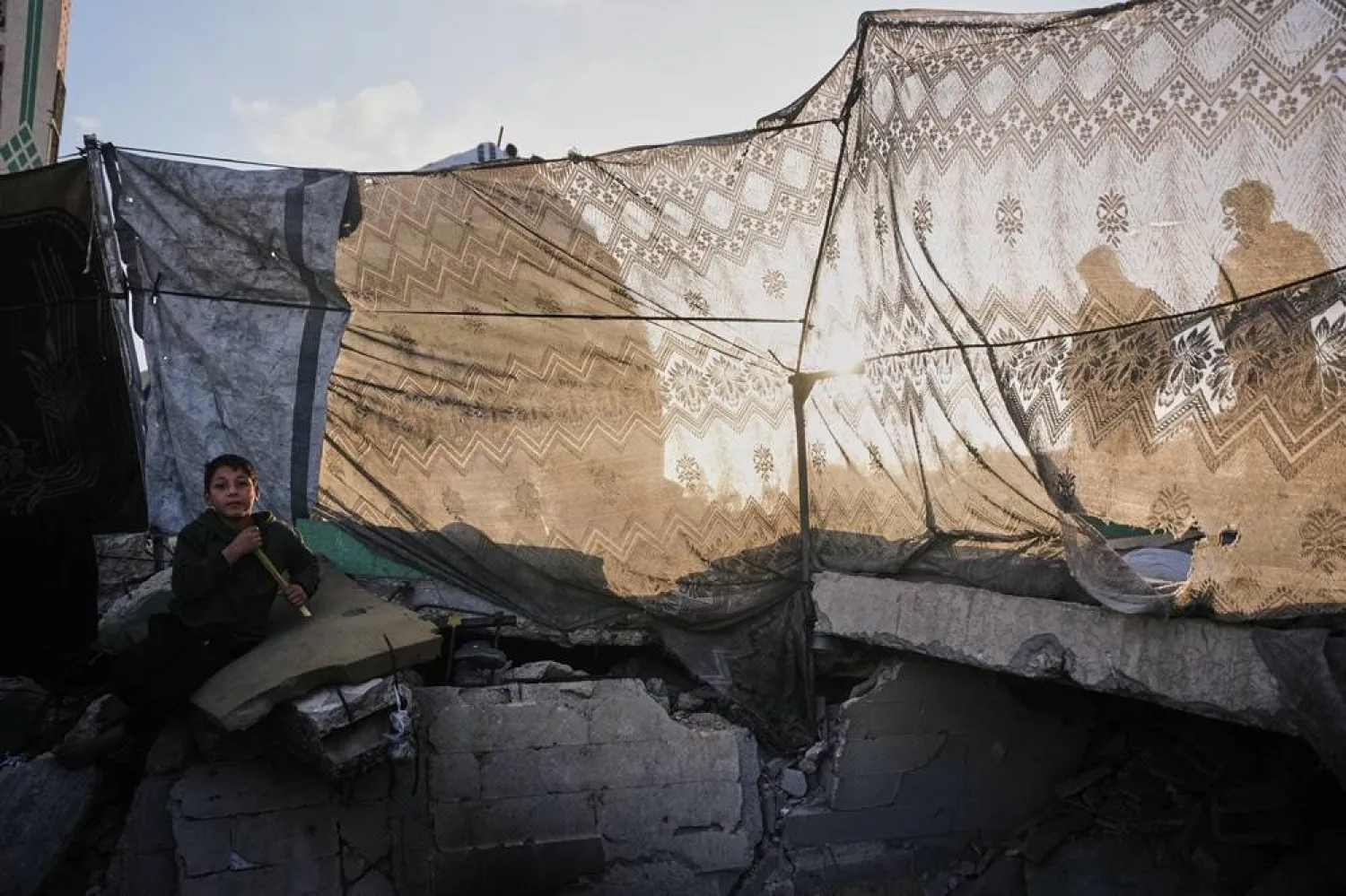
 Obaida Suleiman, 8, sits on the ruins of a mosque where his family is currently taking shelter, after it was destroyed during the war between Israel and Hamas, in Deir al-Balah, Gaza Strip, Friday, March 6, 2026. (AP)
Obaida Suleiman, 8, sits on the ruins of a mosque where his family is currently taking shelter, after it was destroyed during the war between Israel and Hamas, in Deir al-Balah, Gaza Strip, Friday, March 6, 2026. (AP)
TT

Hamas Foils Armed Gang Attack in Gaza City

 Obaida Suleiman, 8, sits on the ruins of a mosque where his family is currently taking shelter, after it was destroyed during the war between Israel and Hamas, in Deir al-Balah, Gaza Strip, Friday, March 6, 2026. (AP)
Obaida Suleiman, 8, sits on the ruins of a mosque where his family is currently taking shelter, after it was destroyed during the war between Israel and Hamas, in Deir al-Balah, Gaza Strip, Friday, March 6, 2026. (AP)

Security sources in Gaza said a plot by an armed gang was foiled in western Gaza City, describing the attempt as bold, given it took place in zones where the Hamas movement maintains full security control.

Sources told Asharq Al-Awsat the incident occurred Thursday evening in the Al-Nasr neighborhood

Large security forces were deployed in the area, and vehicles were searched as part of a manhunt for members of a cell belonging to an armed gang calling itself the “Popular Army.”

The group is led by Ashraf Al-Mansi, a former officer in the Palestinian Authority’s security services, and operates mainly in the northern Gaza areas of Jabalia and Beit Lahia.

Shortly before midnight on Wednesday-Thursday, gunmen opened fire near a Hamas security checkpoint in the area before fleeing. Security investigations later found they had hidden in a nearby part of the neighborhood.

On Thursday evening, the same group tried to open fire on another patrol, but was chased after security forces, already on alert, moved to intercept them. One gunman was arrested after security forces raided a house where members of the gang were staying. Two firearms and ammunition were seized, while the remaining suspects fled toward their areas of influence northwest of Beit Lahia.

Motive

Investigators are questioning the detainee to determine the intended target of the planned attack and whether it was aimed at a Hamas security officer or simply a security post.

The armed gangs had assassinated two senior security officers in the past three months in Khan Younis and Al-Maghazi.

Such groups often exploit the presence of Israeli drones overhead for cover when carrying out attacks. Sources said this was the first time they attempted such an operation, while Israel was more focused on the war with Iran.

Days earlier, four-wheel-drive vehicles mounted with new heavy machine guns known as “Dushka” were seen moving along Salah al-Din Street east of Khan Younis. It later emerged that they belonged to members of an armed gang active in those areas, while Israeli drones were flying overhead.

Hamas has been waging a campaign against these armed gangs, seeking to kill or arrest their members. The movement has also tried to dismantle the groups through local clans, urging their members to surrender in return for the opportunity to “repent.”

Hamas is holding many arrested members of these gangs in secure locations and interrogating them for information about their activities. Some were killed when a site where they were being held was struck by an Israeli attack about a month ago in Gaza.

Israeli attacks continue

On the ground, Israeli attacks across Gaza have continued, killing eight Palestinians near the yellow line designated as the initial withdrawal line under the ceasefire agreement that took effect on October 10.

A Palestinian was killed Friday afternoon in an Israeli strike on the main Salah al-Din Street at the entrance to the Shujaia neighborhood east of Gaza City, about 230 meters from the yellow line.

Four others were wounded in separate incidents in different areas.

Three Palestinians were also killed on Thursday in similar incidents as gunfire and shelling continued across the Gaza Strip.

Since early Friday, areas on both sides of the yellow line have come under heavy gunfire and artillery shelling, while Israeli forces carried out demolition operations in several parts of the enclave.

According to the Gaza Health Ministry, 638 people have been killed since the ceasefire took effect, while the overall death toll since the start of the war on Oct. 7, 2023, has risen to more than 72,120.



Lebanese Army Says Soldier Wounded by Gunfire from Syria

Vehicles line up at Jdeidat Yabous border crossing with Lebanon, amid an increased cross-border movement in Jdeidat Yabous, 45 kilometers west of Damascus, Syria, 03 March 2026. (EPA)
TT

Lebanese Army Says Soldier Wounded by Gunfire from Syria

Vehicles line up at Jdeidat Yabous border crossing with Lebanon, amid an increased cross-border movement in Jdeidat Yabous, 45 kilometers west of Damascus, Syria, 03 March 2026. (EPA)

Lebanon's military said on Saturday that a soldier was moderately wounded by gunfire coming from Syria a day prior in the country's northeast.

"A Lebanese soldier sustained moderate injuries as a result of gunfire from the Syrian side targeting a Lebanese army post in the Qasr-Hermel area," the military said, adding that "soldiers at the post returned fire".

"An investigation is underway to determine the circumstances of the incident in coordination with the relevant Syrian authorities."

On Friday, Lebanese Prime Minister Nawaf Salam said Syria's President Ahmed al-Sharaa informed him that Syrian troop building along the border with Lebanon was "solely aimed at strengthening border control and maintaining internal Syrian security", and that similar measures were taken on the border with Iraq.


Israel Defense Minister Warns Lebanon to Disarm Hezbollah or Face ‘Heavy Price’

A man inspects the debris of destroyed buildings at the site of an Israeli airstrike that targeted Haret Hreik neighborhood in Beirut's southern suburbs, on March 7, 2026. (AFP)
TT

Israel Defense Minister Warns Lebanon to Disarm Hezbollah or Face ‘Heavy Price’

A man inspects the debris of destroyed buildings at the site of an Israeli airstrike that targeted Haret Hreik neighborhood in Beirut's southern suburbs, on March 7, 2026. (AFP)

Israel's Defense Minister Israel Katz warned the Lebanese government on Saturday to disarm Hezbollah or "pay ‌a very ‌heavy price." 

"We (ISRAEL) ‌have ⁠no territorial claims ⁠against Lebanon, but we will not accept a situation ⁠where what ‌existed ‌for many ‌years — firing ‌from Lebanese territory toward the State of ‌Israel — is renewed," Katz said in ⁠a ⁠statement.  

"Therefore, we are turning and warning: act and take action before we act even more." 

The United Nations special coordinator for Lebanon on Saturday urged Lebanon and Israel to enter talks to negotiate an end hostilities after the outbreak of a renewed Israel-Hezbollah war.  

"As bad as things are today, they are set to get even worse," Jeanine Hennis-Plasschaert said.  

"Talks between Lebanon and Israel can be the game changer needed to save future generations from going, time and again, through the same nightmare".  

In December, Lebanese and Israeli civilian representatives engaged in their first direct talks in decades as part of a meeting of a committee monitoring the November 2024 ceasefire between Israel and Hezbollah.  

Lebanon was engulfed by the expanding Middle East war on Monday, after Hezbollah fired missiles at Israel to avenge the death of Iranian supreme leader Ali Khamenei in US-Israeli attacks on Iran. 


Hezbollah’s Rejection of ‘Surrender’ Stalls Macron Initiative to Halt War

Lebanese President Joseph Aoun receiving former prime ministers Fouad Siniora, Tammam Salam, and Najib Mikati (Lebanese Presidency). 
TT

Hezbollah’s Rejection of ‘Surrender’ Stalls Macron Initiative to Halt War

Lebanese President Joseph Aoun receiving former prime ministers Fouad Siniora, Tammam Salam, and Najib Mikati (Lebanese Presidency). 

French President Emmanuel Macron’s initiative has failed to break the political stalemate surrounding the ongoing war in Lebanon, as Hezbollah rejects what it describes as “surrender” and insists on pressing ahead with the confrontation.

Lebanese and international observers view Hezbollah's fighting as support for Iran in its conflict with Israel and the United States. At the same time, Washington’s continued silence regarding the renewed hostilities in Lebanon has drawn notice.

Lebanese sources familiar with the ongoing contacts said Hezbollah has declined to engage in negotiations after Parliament Speaker Nabih Berri conveyed a call to return to the ceasefire agreement reached in November 2024, which ended the previous round of fighting.

Activists involved in the communications channel quoted senior Hezbollah officials as saying that it was “too early to speak of negotiations.”

Lebanese ministerial sources said President Joseph Aoun informed Macron that any initiative should be presented to Berri, who oversees negotiations on behalf of Hezbollah.

However, visitors to Berri told Asharq Al-Awsat that Macron had only informed him of his intention to send vehicles and equipment to the Lebanese Armed Forces.

Deputy Speaker of Parliament Elias Bou Saab, speaking after meeting the president, referred to “ongoing diplomatic efforts.”

“There are contacts with many parties,” he said. “The media has reported on them, whether French or, in particular, American. But so far we have not reached a breakthrough that we can speak about. The effort is still ongoing, and I believe the contacts made yesterday by the president, as well as the call between the Speaker of Parliament and President Macron, helped reduce attacks that had been planned against Lebanon, including areas that were ultimately not targeted.”

He added: “I can say the diplomatic effort has achieved a measure of success. We must meet these efforts internally with solidarity. Those concerned in Lebanon must also cooperate with the president, the prime minister, and the speaker of parliament so that we can emerge from the current crisis.”

Meanwhile, former prime ministers Najib Mikati, Fouad Siniora, and Tammam Salam visited the president and issued a statement condemning what they described as “the continuing Israeli aggression and crimes against Lebanon and the Lebanese people.”

They voiced support for government decisions affirming that the authority to decide on war and peace must rest exclusively with the state and for enforcing the principle that weapons should be held solely by the Lebanese state across all Lebanese territory. They also called for broad national support for these measures.

Prime Minister Nawaf Salam, for his part, told Arab and foreign ambassadors during a meeting that decisions on war and peace must remain in the hands of the state. He noted that the government is continuing to work with various international partners to halt Israeli attacks.

Salam reiterated Lebanon’s willingness to negotiate and stressed the need to spare facilities and property from damage amid the ongoing escalation. He emphasized that Lebanon “did not choose this war.”

As diplomatic activity intensified, Foreign Minister Youssef Raji held a phone call with Oman’s Foreign Minister Badr Albusaidi, asking Muscat to use its diplomatic influence with the relevant parties to prevent the conflict from being drawn onto Lebanese territory.

Raji also received calls from several European foreign ministers, including Germany’s Johann Wadephul, Ireland’s Helen McEntee, Spain’s José Manuel Albares, Belgium’s Maxime Prévot, and Montenegro’s Ervin Ibrahimović.

The ministers collectively expressed solidarity with Lebanon while welcoming the Lebanese government’s decision to ban Hezbollah’s military and security activities and require the group to surrender its weapons. They also affirmed their readiness to provide the necessary humanitarian assistance.

In turn, Raji expressed deep appreciation for the supportive positions of his counterparts and urged them to mobilize their international contacts to press for an end to the attacks and to spare civilian infrastructure from being targeted.