Syrian Leader Announces Support for Lebanese Counterpart to Disarm Hezbollah

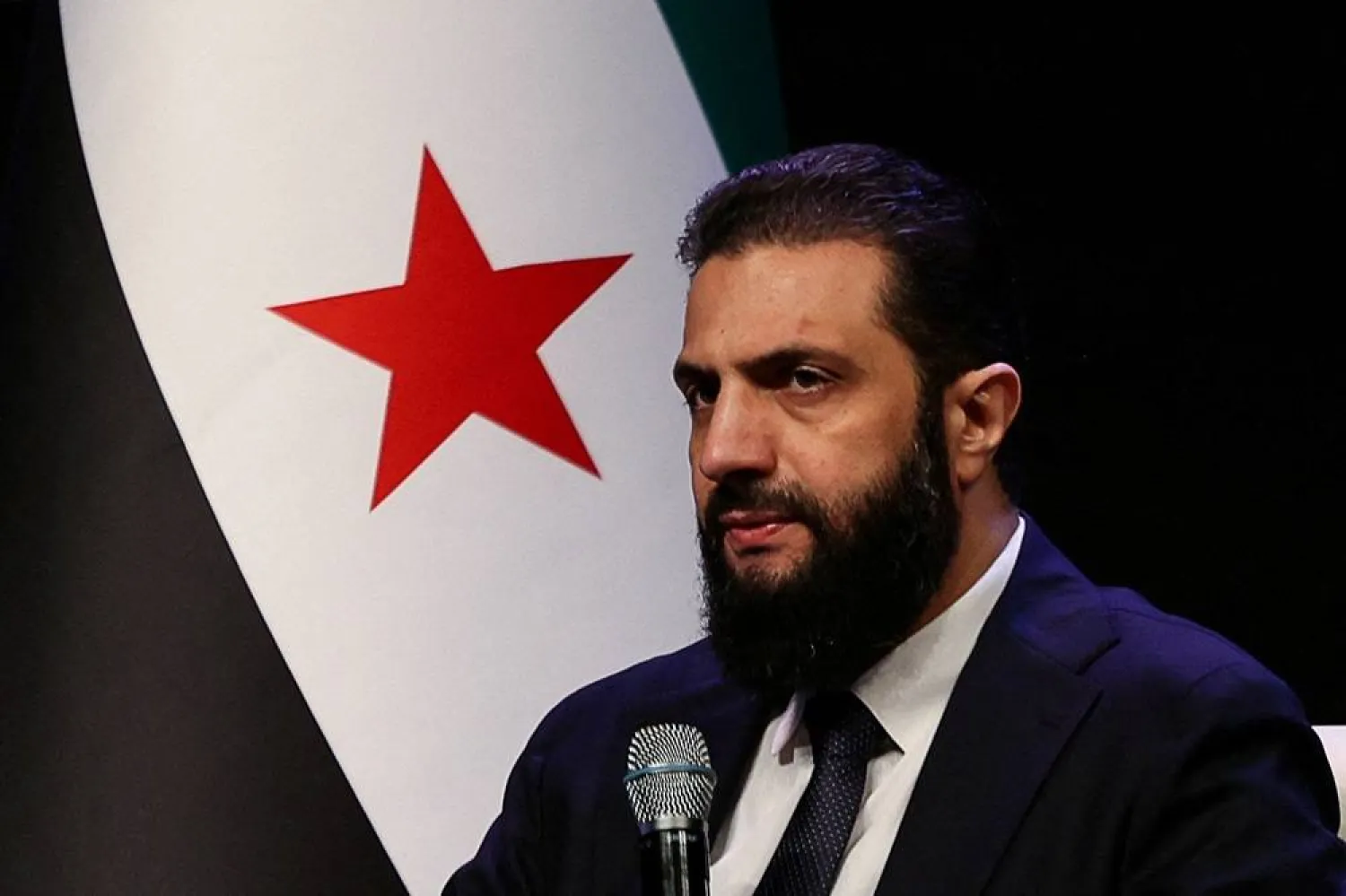
Syrian President Ahmed al-Sharaa attends the Ministry of Awqaf conference titled "Unity of Islamic Discourse" at the Conference Palace in Damascus, Syria, February 16, 2026. (Reuters)
TT

Syrian Leader Announces Support for Lebanese Counterpart to Disarm Hezbollah

Syrian President Ahmed al-Sharaa attends the Ministry of Awqaf conference titled "Unity of Islamic Discourse" at the Conference Palace in Damascus, Syria, February 16, 2026. (Reuters)

Syrian President Ahmed al-Sharaa on Monday declared his support for his Lebanese counterpart Joseph Aoun in the latter's effort to disarm Hezbollah, state media reported.

The Middle East war expanded to Lebanon on March 2, after Tehran-backed Hezbollah fired rockets towards Israel in response to the killing of Iranian supreme leader Ali Khamenei on the first day of US-Israeli attacks on Iran, prompting Israeli retaliation.

Since March 2, Israel has been conducting large-scale air raids on Lebanon and incursions with ground troops, killing at least 486 people according to the Lebanese health ministry.

"We stand alongside Lebanese president Joseph Aoun in disarming Hezbollah," Sharaa said during a video conference with top European officials.

The Syrian army has bolstered its troop deployments on the country's borders with Lebanon and Iraq, a Syrian government source told AFP on Wednesday.

"We have reinforced our defensive forces along the border as a precaution to prevent the repercussions of the conflict from spilling over onto Syrian territory, and to combat cross-border organizations and prevent them from using Syrian soil," Sharaa said.

On Monday, Aoun accused Hezbollah of seeking the "collapse" of the Lebanese state with its decision to launch rockets towards Israel.

Iran-backed Hezbollah was a prominent ally of former Syrian president Bashar al-Assad, sending forces to help him in the civil war.

His brutal rule was brought to an end in December 2024 and he was replaced by new authorities hostile to Hezbollah.


Pilot Zones: Netanyahu Rejects Simultaneous Israeli Withdrawal, Lebanese Army Deployment

An Israeli flag hangs on a damaged building in southern Lebanon as seen from northern Israel, Wednesday, July 1, 2026. (AP Photo/Ariel Schalit)
TT

Pilot Zones: Netanyahu Rejects Simultaneous Israeli Withdrawal, Lebanese Army Deployment

An Israeli flag hangs on a damaged building in southern Lebanon as seen from northern Israel, Wednesday, July 1, 2026. (AP Photo/Ariel Schalit)

Implementation of the “pilot zones” in southern Lebanon under the Framework Agreement remains stalled by Israeli Prime Minister Benjamin Netanyahu’s refusal to allow the Lebanese army to deploy simultaneously with an Israeli troop withdrawal, a move intended to prevent a security vacuum.

The issue has become a top US priority as Washington presses Netanyahu to facilitate the Lebanese army’s deployment ahead of the sixth round of US-mediated Lebanese-Israeli talks, scheduled for July 15-16 in Rome.

The negotiations are expected to discuss the formation of joint committees, including a coordination committee headed by US General Joseph Clearfield, to oversee the Lebanese army’s deployment in the areas covered by the agreement and coordinate field operations to ensure smooth implementation.

The talks are also expected to consider expanding the pilot zones beyond southern towns already under Lebanese state control to include, in phases, towns that remain under Israeli occupation. The proposed committee would intervene immediately to address any operational problems that could disrupt the deployment.

A ministerial source told Asharq Al-Awsat that a recent meeting between the Lebanese army command and the US monitoring team overseeing the deployment ended with an understanding that Lebanese forces should deploy simultaneously with an Israeli withdrawal. The plan would extend beyond areas already under state control to include occupied towns.

According to the source, the main obstacle remains Netanyahu himself, who opposes both the concept of pilot zones and the gradual withdrawal of Israeli forces from occupied Lebanese towns.

The source said US Secretary of State Marco Rubio intervened during the fourth and fifth negotiating rounds to pressure the Israeli delegation into making the pilot zones a main clause because they would pave the way for the Lebanese army’s deployment up to the international border.

The source argued that Netanyahu’s position is shaped by domestic politics as he prepares for parliamentary elections and therefore opposes any explicit commitment in the Framework Agreement requiring an Israeli withdrawal.

Instead, Netanyahu insists that the Lebanese army first deploy only in towns outside the occupied areas to test its ability to establish full control and prevent any armed Hezbollah presence before considering subsequent phases.

Lebanese President Joseph Aoun, however, continues to insist on simultaneous deployment and withdrawal, the source underlined, adding that his position has received backing from the US monitoring team following a meeting with Admiral Brad Cooper, commander of US Central Command (CENTCOM).

The source added that Aoun reiterated the same position during talks with US Ambassador to Lebanon Michel Issa, who expressed understanding for Lebanon’s insistence on simultaneity and did not object to amending certain provisions of the Framework Agreement, describing it as a negotiating roadmap rather than a final accord.

In practical terms, the source said, any amendments would facilitate implementation on the ground with US support. Lebanese and American preparations for the deployment plan are complete, pending Netanyahu’s approval of simultaneous implementation.

Issa is said to view the planned July 21 meeting in Washington between US President Donald Trump and Aoun as an opportunity to gauge whether the US administration is prepared to back Lebanon with concrete action rather than rhetoric.

The source said Washington’s military pressure on Iran serves two objectives: compelling Tehran to honor its commitments under its memorandum of understanding with the US and ending its interference in Lebanon by encouraging Hezbollah to facilitate implementation of the Framework Agreement, now viewed as the only viable path after the military option collapsed.

According to the source, Trump remains committed to supporting Lebanon, while Washington continues to pressure Iran to curb the Revolutionary Guard’s role in Lebanese affairs and remove obstacles to implementing the agreement, seen as the only route toward an Israeli withdrawal.


Top UN Official Accuses Hamas of Gaza Aid Obstruction

Displaced Palestinians collect water from the Ita charitable water station, amid ongoing water shortages and limited access to water sources, in Khan Younis, Gaza Strip, 13 July 2026. EPA/HAITHAM IMAD
TT

Top UN Official Accuses Hamas of Gaza Aid Obstruction

Displaced Palestinians collect water from the Ita charitable water station, amid ongoing water shortages and limited access to water sources, in Khan Younis, Gaza Strip, 13 July 2026. EPA/HAITHAM IMAD

A senior UN official on Monday accused Hamas of interfering with humanitarian deliveries in Gaza and intimidating aid workers, warning that the group's actions were making relief operations increasingly dangerous.

Hamas continues to control parts of Gaza, even after Israeli forces expanded their presence across more than 60 percent of the territory.

In a statement, UN Deputy Special Coordinator for the Middle East Peace Process, Ramiz Alakbarov, said he "strongly" condemns the obstruction of humanitarian operations by Gaza's de facto authorities, referring to Hamas.

Hamas's actions "endangered humanitarian personnel, intimidated workers delivering life-saving food assistance and disrupted life-saving humanitarian operations", AFP quoted him as saying.

Armed men linked to Hamas allegedly on Saturday forced their way into a food distribution point in Jabalia, in the northern Gaza Strip, the UN statement said.

Militants "also entered a WFP (World Food Program) warehouse and reportedly assaulted two truck drivers who were delivering humanitarian supplies", it added.

Alakbarov said "these incidents are not isolated" and "reflect an increasingly dangerous pattern of intimidation, violence and obstruction, including smuggling attempts, targeting and abusing humanitarian operations".

He warned that such actions were hampering the delivery of life-saving assistance at a time when civilians across Gaza faced severe hardships.

A ceasefire was reached in Gaza between Israel and Hamas in October following two years of war, which was sparked by the Palestinian militants' unprecedented attack on Israel on October 7, 2023.

The second phase of the ceasefire, which was to involve Hamas' disarmament and a gradual withdrawal of Israeli forces from Gaza, has been stalled for months.

Israeli forces have expanded their presence in recent months, taking control of more than 60 percent of the territory.

Hamas still exerts control over the remaining area, but last week announced it was dissolving its 15-member body that had governed the strip for nearly two decades.


Jordan Says it Shot Down 4 Missiles Launched by Iran

The Jordanian capital, Amman. Petra file photo
TT

Jordan Says it Shot Down 4 Missiles Launched by Iran

The Jordanian capital, Amman. Petra file photo

The Jordanian military said on Monday it had shot down four Iranian missiles over the country, which Tehran said were intended as retaliation for US strikes.

"At dawn today, air defense systems intercepted and shot down four missiles that had entered Jordanian airspace from Iranian territory," an official source from the Jordanian General Staff said

There were no reports of injuries or damage to property.