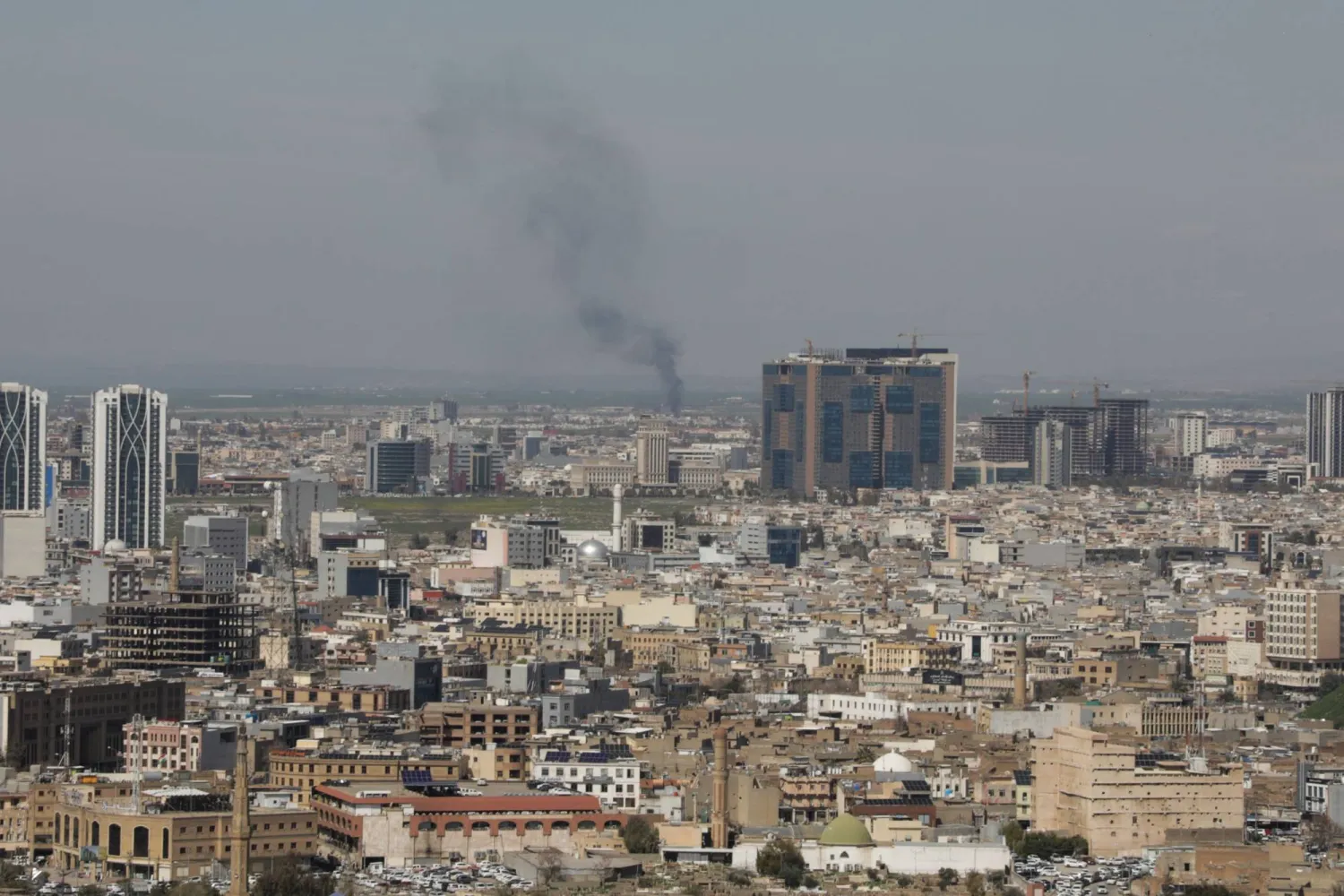
French Soldier Killed in Drone Attack in Iraq

A plume of smoke rises following an interception of a drone in Erbil on March 12, 2026. (Photo by Shvan HARKI / AFP)
TT

French Soldier Killed in Drone Attack in Iraq

A plume of smoke rises following an interception of a drone in Erbil on March 12, 2026. (Photo by Shvan HARKI / AFP)

France’s president said Friday that a French soldier has been killed in a drone attack in Iraq.

The attack targeted Erbil in Iraq’s northern Kurdish region, President Emmanuel Macron said on the social platform X.

Macron identified the soldier as Chief Warrant Officer Arnaud Frion of the 7th Battalion of Chasseurs Alpins from Varces.

“To his family, to his brothers in arms, I want to express all the affection and solidarity of the nation,” Macron said. “Several of our soldiers have been wounded. France stands by their side and with their loved ones.”

France said earlier that six soldiers were hurt in a drone attack in Erbil.

French troops are in Iraq as part of a multinational counterterrorism mission supporting local forces in their fight against ISIS militants.


Lebanese Army Chief’s Remarks Spark Political Row

Lebanese President Joseph Aoun, Army Commander Gen. Rodolphe Haykal and security chiefs inspect a State Security building struck by Israel (File photo: Lebanese Presidency). 
TT

Lebanese Army Chief’s Remarks Spark Political Row

Lebanese President Joseph Aoun, Army Commander Gen. Rodolphe Haykal and security chiefs inspect a State Security building struck by Israel (File photo: Lebanese Presidency). 

Remarks by Lebanese Army Commander Gen. Rodolphe Haykal on the military’s role and national policy have sparked a political dispute over the army’s authority, its relationship with the government and who has the right to define patriotism.

Addressing troops, Haykal declared: “The army’s policy is the national policy, and anyone who does not agree with it is on the other side.”

He added: “Anyone who speaks ill of their country’s army is not suited to Lebanon and has no right to be here.”

The comments drew criticism from lawmakers who accused Haykal of overstepping his authority, while supporters defended the military as a pillar of stability and national unity that should remain above political disputes.

Lawmakers Challenge Army Chief

The controversy comes amid accusations that the army leadership has been slow to implement government decisions to place Hezbollah’s weapons under state control.

Supporters of the military command argue that its cautious approach is intended to preserve civil peace and prevent political divisions from undermining the army’s unity.

MP Waddah Sadek questioned whether Lebanon was now “under military rule” in which the army determined who was patriotic.

“Is the Taif Agreement no longer in force? Has the government’s collective authority to determine national policy been taken away?” he asked, calling the situation “extremely dangerous.”

MP Michel Douaihy stressed that Lebanese citizens had both the right and the duty to scrutinize state institutions, including the army, without anyone monopolizing the definition of patriotism or questioning their national allegiance.

Fellow lawmaker Mark Daou insisted that national policy was determined by the president and government and approved by parliament.

“It is not for you to decide what constitutes national policy or who supports or opposes it,” he told Haykal.

“In a democratic state, your duty is to protect all political viewpoints, remain politically neutral and focus on security, where the results so far have been very limited, if not a failure.”

Supporters Defend Haykal

Free Patriotic Movement MP Jimmy Jabbour described Haykal’s remarks as “self-defense” against a sustained political campaign targeting the military through press reports and leaks.

Jabbour told Asharq Al-Awsat that some politicians sought to exploit state institutions for their own interests and were prepared to push the army into confrontation, even at the risk of civil war.

“Those who have no objection to that will have no problem attacking the commander,” he argued, accusing the army’s critics of undermining the sovereignty they claim to defend and seeking to tie Lebanon to Israel.

Hezbollah and Amal Movement lawmakers also defended Haykal.

Hezbollah MP Hassan Fadlallah described the “resistance and the Lebanese Army” as Lebanon’s two pillars of strength and cohesion, essential to liberating territory and protecting the country.

He accused critics of waging a campaign against both institutions to revive plans for sectarian mini-states, which he portrayed as serving an Israeli project to fragment the region.

Fadlallah warned against undermining civil peace and internal unity, arguing that the army was being targeted precisely because it was carrying out its national duty.

Amal MP Qabalan Qabalan thanked Haykal for steering the national debate “in the right direction,” saying his remarks had reassured Lebanese citizens worried about the country’s future.

“Despite all the difficult circumstances, hope remains in the national army to protect the country and its people, safeguard sovereignty and defend our land and national dignity. The army remains the guarantor,” he maintained.

Legal Expert: Army Must Follow Government Policy

Constitutional expert Dr. Said Malek emphasized that the army commander is appointed by Cabinet decree on the defense minister’s recommendation under Article 19 of Legislative Decree 102/83, Lebanon’s National Defense Law.

As a public official, the commander is subject to the Cabinet’s authority and must abide by government policy, Malek told Asharq Al-Awsat.

“The Cabinet alone has the authority to set general policy in all areas, including political, foreign, domestic, security and military affairs,” he explained.

Any departure from government policy would constitute a violation carrying legal consequences, he warned.

“The army commander cannot establish a separate policy for the military. Its policy must follow that of the government, without independent interpretation.”



Barzani Calls for Talks with PUK to Resolve Kurdistan Political Crisis

New Kurdish parliament speaker Vala Fareed (L) addresses a press conference after the session of Kurdistan's regional parliament, in Erbil on November 4, 2026. (AFP)
TT

Barzani Calls for Talks with PUK to Resolve Kurdistan Political Crisis

New Kurdish parliament speaker Vala Fareed (L) addresses a press conference after the session of Kurdistan's regional parliament, in Erbil on November 4, 2026. (AFP)

Kurdistan Democratic Party (KDP) leader Masoud Barzani on Monday called on the rival Patriotic Union of Kurdistan (PUK), led by Bafel Talabani, to enter talks aimed at resolving their differences and ending the political crisis in Iraq’s Kurdistan Region.

His appeal came five days after the regional parliament convened for its first session in nearly two years, which the PUK boycotted, deepening longstanding divisions between the two parties that dominate Kurdish politics.

“Amid the current political developments and circumstances, all parties must bear in mind that the interests of the people of Kurdistan are greater than, and take precedence over, any other interest or objective,” Barzani declared.

“Based on this principle, I invite our brothers in the Patriotic Union of Kurdistan to sit down at the negotiating table with the Kurdistan Democratic Party to resolve the problems and put an end to the political crisis in the Kurdistan Region.”

He also expressed a “sincere desire” for other political parties to participate in the political process and work together to form a broad-based national government that meets the demands and aspirations of the Kurdish people.

Delicate balance of power

The Kurdistan Region’s parliament reconvened last Wednesday after nearly two years of paralysis caused by disputes between the KDP and PUK.

Lawmakers elected a speaker, deputy speaker and parliamentary secretary, all three aligned with the KDP, prompting strong objections from the PUK.

Although the KDP holds 39 of the legislature’s 100 seats, compared with the PUK’s 23, power-sharing arrangements in the region have traditionally reflected the parties’ territorial influence rather than parliamentary representation alone.

The KDP dominates the Erbil and Duhok provinces, while the PUK exercises extensive influence over Sulaymaniyah, Halabja and other parts of the region.

PUK political bureau member Yousif Goran said the region’s political system could not be governed by parliamentary numbers alone.

“The Kurdistan Region is not merely a handful of parliamentary seats that can be added up mathematically. It is a political experiment founded on balance and a complex partnership,” he explained.

“Any attempt to run its institutions without an understanding between the two main forces opens the door to a deep crisis,” he warned.

‘Coup’

Despite holding several senior positions in Iraq’s federal government, particularly the presidency, as well as ministerial and other high-ranking posts in the Kurdistan Region, the PUK viewed the KDP’s decision to convene parliament as a breach of previous agreements.

A senior PUK official maintained that the two parties had agreed to settle all outstanding disputes over the distribution of positions before holding the parliamentary session.

In response, the PUK announced a series of retaliatory measures, refusing to recognize the session’s legitimacy and denouncing it as “a coup against legitimacy” and a unilateral move.

The party threatened to withdraw from the Kurdistan Regional Government, recall its representatives from the regional presidency and pull out of other joint institutions.

It also raised the possibility of dividing the region by establishing a separate administration in areas under its influence, particularly the Sulaymaniyah province and its surroundings.

The PUK further decided to challenge the parliamentary session before Iraq’s Federal Supreme Court in Baghdad, contesting its legality and legitimacy.

Despite Masoud Barzani’s latest invitation, observers remain skeptical that the two parties can reach a mutually acceptable agreement in the near term, citing their long history of rivalry and conflict.


Yemen on Iran Foreign Ministry Statement: Political and Media Cover for Terrorist Houthis

Yemen's Foreign Minister Afrah al-Zouba speaks during a plenary session of the International Institute for Strategic Studies (IISS) Manama Dialogue 2026 in Manama on October 31, 2026. (AFP)
TT

Yemen on Iran Foreign Ministry Statement: Political and Media Cover for Terrorist Houthis

Yemen's Foreign Minister Afrah al-Zouba speaks during a plenary session of the International Institute for Strategic Studies (IISS) Manama Dialogue 2026 in Manama on October 31, 2026. (AFP)

Yemen’s Ministry of Foreign Affairs and Expatriates strongly condemned on Monday the statement by the Iranian Ministry of Foreign Affairs regarding Yemen, with its “misleading allegations and blatant interference in the internal affairs” of the country.

It deemed it a “transparent attempt to provide political and media cover for the terrorist Houthi militia, and to disclaim the Iranian regime’s responsibility for prolonging the war and deepening the humanitarian tragedy of the Yemeni people.”

The ministry statement came in response to an Iranian statement adopting the Houthi narrative about the shelling of a market in the al-Waziyah district, west of Taiz, an incident the Yemeni government accused the Houthis of orchestrating.

“The Iranian statement lays bare Tehran’s open adoption of the putschist militia’s narrative and its justification of the militia’s practices, in parallel with the findings of Yemeni agencies that Iranian interference has evolved from financing, arming and training into direct participation in the planning and management of operations,” said the Yemeni ministry.

“The ministry regards this pairing of military support on the ground with diplomatic cover in international forums as further evidence of the true nature of the Iranian role in undermining the Yemeni state and threatening the security of the region and its waterways,” it added.

“The ministry rejects the Iranian regime’s exploitation of the blood of the victims of the Souq Al-Hadarah crime in al-Waziyah district, or of any other area, to promote accusations that contradict what the competent Yemeni authorities have announced, including their call for independent investigations into the Houthi militia’s violations of human rights and international law,” it continued.

The ministry recalled the Ministry of Interior’s announcement of the presence of 21 foreign experts working with the Houthi militia, including 14 from the Iranian Revolutionary Guard Corps and seven from Lebanon’s Hezbollah.

“Their tasks span command and control and the management of operations; work on ballistic missiles, drones and electronic warfare; the smuggling of military components; and the coordination of maritime operations, including the selection of commercial vessels for targeting - together constituting a fully-fledged general staff whose role goes beyond training to the supervision, planning and direction of operations, for which Yemenis pay the price with their lives, their security and their livelihoods,” said the ministry.

“By arming the Houthi militia and supplying it with experts, Tehran enables it to pursue its terrorism in Yemen - abducting, killing and terrorizing civilians, shelling cities and civilian facilities, and besieging and starving the population - alongside its repeated attacks on the territory Saudi Arabia, on commercial shipping, and on navigation in the Red Sea and the Bab al-Mandab Strait,” it went on to say.

“This interference embodies a pattern the Iranian regime has long pursued in undermining the security of the region’s states: financing rogue armed groups that contest national governments’ exclusive authority over the use of force and over decisions of war and peace,” it added.

The ministry recalled that the arms embargo imposed under United Nations Security Council Resolution 2216 and expanded under Resolution 2624 to cover the Houthis as an entity, encompasses weapons, equipment, technical assistance, training and financing related to military activities.

The ministry stressed that “Iran’s own interests, its security and the future of its relations in the region require respect for the sovereignty of states, the building of good-neighborly relations founded on shared interests and non-interference in internal affairs, and the abandonment of its policy of arming the subversive groups affiliated with it.”

“The Iranian regime would be far better served devoting its country’s resources and wealth to improving the livelihood of the Iranian people and meeting their needs for development, services and employment, rather than squandering them on arms and smuggling networks and on destabilizing the region,” it said.

Furthermore, the ministry noted that “throughout 12 years of a war ignited by the Houthi militia with its backing, the Iranian regime has offered the Yemeni people nothing but missiles, suicide drones, explosive-laden boats and experts of destruction, while our brothers in Saudi Arabia have provided invaluable relief, humanitarian and development assistance, together with countless facilitations for Yemeni expatriates whose work and remittances keep millions alive.”

“Respect for Yemen’s sovereignty begins with halting the arming of the militias, withdrawing the experts, and ceasing interference in Yemen’s national decision-making - and that Tehran’s professed concern for the lives of Yemenis requires, first of all, that it stop wielding the very tools that prolong their suffering and deepen the destruction,” demanded the ministry.