


Six US Service Members Killed in Plane Crash Over Iraq

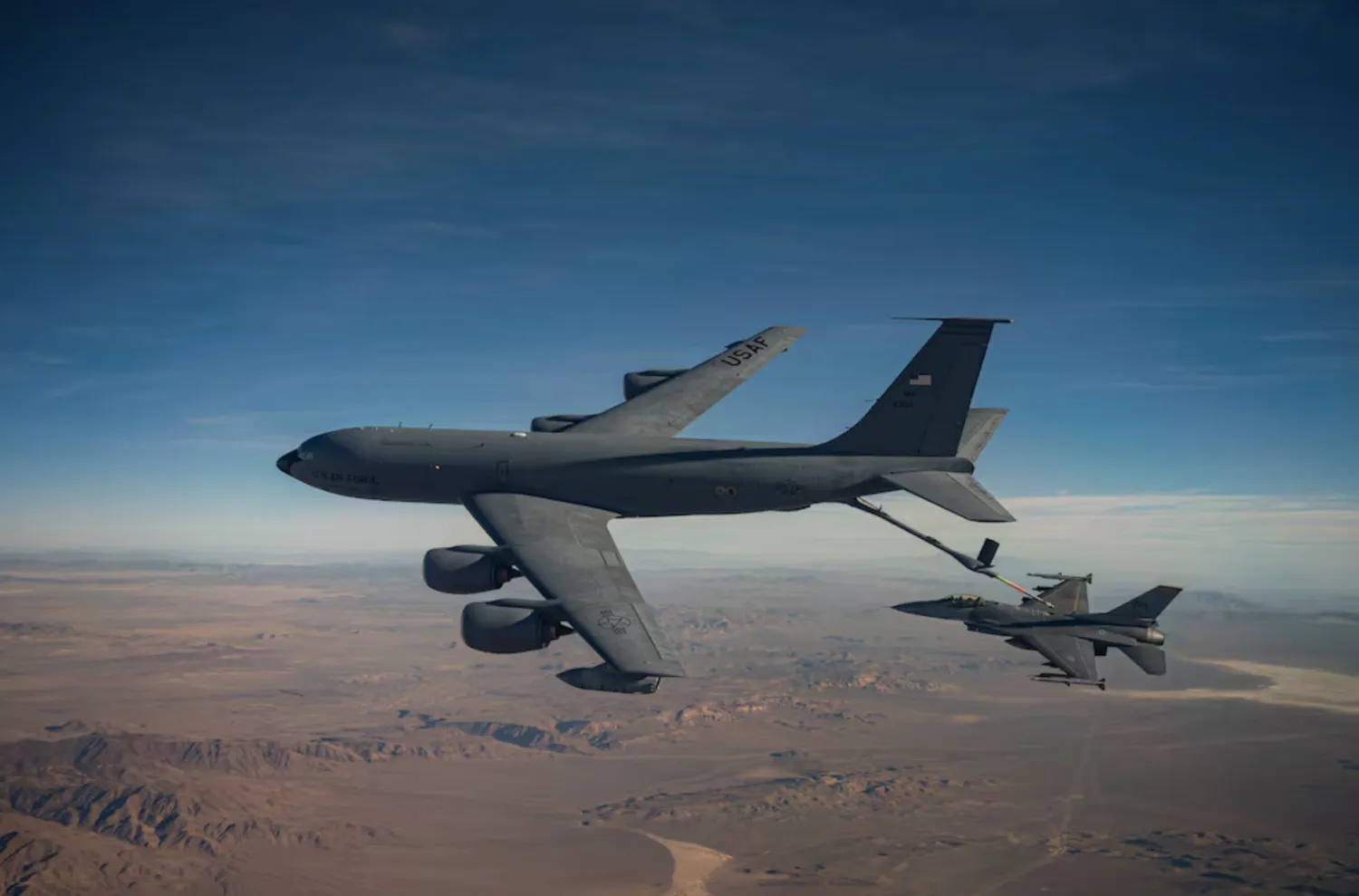
An F-16 fighter jet being refueled in the air by a US Air Force KC-135 Stratotanker (CENTCOM)
TT

Six US Service Members Killed in Plane Crash Over Iraq

An F-16 fighter jet being refueled in the air by a US Air Force KC-135 Stratotanker (CENTCOM)

All six crew members aboard a US military KC-135 refueling aircraft that crashed in western Iraq are confirmed to have been killed, the US military said on Friday. 

The US military refueling aircraft crashed in western Iraq on Thursday, in an incident the military said involved another aircraft but was not the result of hostile or friendly fire. 

The deaths add to the seven US service members who have already been killed as part of US operations against ‌Iran which began on ‌February 28. 

"The circumstances of the incident ‌are ⁠under investigation. However, the ⁠loss of the aircraft was not due to hostile fire or friendly fire," a statement from US Central Command said. 

A US official told Reuters that the second aircraft involved in the crash, which landed safely, was also a military refueling aircraft known as the KC-135. 

The United States has deployed a ⁠large number of aircraft into the Middle East ‌to take part in operations ‌against Iran and the incident highlights the risk of not just operations, ‌but of refueling aircraft in the air. 

The KC-135, built by ‌Boeing in the 1950s and early 1960s, has served as the backbone of the US military's air refueling fleet and is critical to allowing aircraft to carry out missions without having to land. 

The Islamic ‌Resistance in Iraq, an umbrella group of Iran-backed armed factions, claimed responsibility for downing the US ⁠military refueling ⁠aircraft. 

Reuters reported on Tuesday that as many as 150 US troops have been wounded in the US-Israeli war on Iran. News of the crash comes the same day two US sailors were injured after the USS Gerald Ford suffered a non-combat-related fire on board. 

The first seven US troops were killed when a drone slammed into a US military facility in Port Shuaiba, Kuwait. 

President Donald Trump and other senior officials have warned the Iran conflict will result in more US military deaths as Tehran retaliates against US and Israeli strikes. 


US Hails ‘Productive’ Talks Between Lebanon, Israel Military Officials

The border wall separating Israel (R) and Lebanon is pictured from a position along the Upper Galilee region of northern Israel on May 29, 2026. (AFP)
TT

US Hails ‘Productive’ Talks Between Lebanon, Israel Military Officials

The border wall separating Israel (R) and Lebanon is pictured from a position along the Upper Galilee region of northern Israel on May 29, 2026. (AFP)

Military officials from Lebanon and Israel held "productive" talks in Washington on Friday, a US official said, adding that the meeting will complement upcoming diplomatic discussions.

"Today at the Pentagon, I hosted military delegations from Israel and Lebanon for the security track supporting the ongoing peace talks between their two countries," Elbridge Colby, the Pentagon's second-in-command, said on X.

"We held productive military-to-military discussions which will inform the Department of State-led political track next week," he said.

It was the first meeting between Lebanese and Israeli military officials in decades.

"The United States anticipates reconvening soon to continue the security track," Colby said.

He made no mention of the truce to halt fighting between Israel and the Iran-backed Hezbollah group in Lebanon that was supposed to have taken effect on April 17, but has never been observed.

Israeli Prime Minister Benjamin Netanyahu said Friday that his country's forces had pushed deeper into Lebanon and continued heavy bombardment of the country's south.

Israeli strikes on Friday in three areas of Tyre, in southern Lebanon, killed 11 people including a rescuer, the country's health ministry said. Eight people were wounded.

Hezbollah said it had launched a series of attacks targeting soldiers, barracks and a military camp in northern Israel on Friday.

Lebanese President Joseph Aoun stressed to US Secretary of State Marco Rubio "the need to exert all efforts to reach a ceasefire" as an essential first step for progress in negotiations.

The State Department said Rubio "commended President Aoun's courage and vision in pursuing direct negotiations with Israel" despite Hezbollah's opposition, adding the group was "entirely responsible for the ongoing fighting."

The meeting at the Pentagon took place amid ongoing negotiations between the United States and Iran, with Tehran seeking to include the Lebanese front in any agreement aimed at ending the war in the Middle East.


Iraq Awaits Zaidi’s First Move on Disarmament of Factions

Zaidi speaks before presenting his government to parliament in Baghdad on May 14, 2026. (AFP)
TT

Iraq Awaits Zaidi’s First Move on Disarmament of Factions

Zaidi speaks before presenting his government to parliament in Baghdad on May 14, 2026. (AFP)

Iraqi sources said on Friday that the prime minister’s office is preparing intensive consultations after Eid al-Adha as part of a plan to “reorganize the file of armed factions” and confine weapons to the state, as early moves emerge to dismantle the factions and merge them into official institutions.

Sources said Prime Minister Ali al-Zaidi has been in contact and exchanged direct messages in recent days with political forces with armed factions, in an effort to establish gradual mechanisms for the handover of weapons.

Five armed factions have so far declared an initial readiness to hand over their weapons, but have given no clear details or timetable.

The move is being viewed as the first political and security test of efforts to dismantle armed groups outside the state in a country where about 20 of them still operate beyond full official control, according to political estimates.

Weapons handover

The sources said the government plans to hold separate meetings with political leaders and blocs with armed factions, particularly within the ruling pro-Iran Coordination Framework, to agree on handover mechanisms and the reintegration of fighters into the regular forces or civilian state institutions.

In a significant move, influential Shiite cleric Moqtada al-Sadr announced that he was breaking with his armed faction, Saraya al-Salam, and handing its weapons and headquarters to the state.

Observers saw the step as backing the prime minister’s efforts and raising political pressure on other factions to follow suit.

A motorbike drives past a banner depicting influential cleric Moqtada al-Sadr, erected along a street the Iraqi capital Baghdad on May 27, 2026. (AFP)

The sources said the restructuring of Saraya al-Salam involved three main brigades, which include about 9,000 members, and placing them under the command of the commander-in-chief of the armed forces. That could make it easier to integrate them later into state institutions.

Sadr’s return

Other factions remain divided. Some political forces with armed groups have said they do not plan to join the current government, while others voiced conditional support for reform steps, demanding guarantees over the legal status of their members.

The Nujaba faction renewed its refusal to hand over weapons outside what it calls an “ideological path.” Other factions have adopted a more flexible tone, but have not publicly committed to any timetable.

A source within the Coordination Framework said the dismantling of Saraya al-Salam could open the way for a wider political repositioning by the Sadrist movement and give the government more room to maneuver on the armed factions file.

Political researcher Ghalib al-Daami told Asharq Al-Awsat that Sadr’s move “will strengthen the government’s ability to control weapons outside state authority and weaken the justifications of factions that refuse to hand them over.”

Al-Daami said some members of Saraya al-Salam are already part of the pro-Iran Popular Mobilization Forces and receive salaries from it.

He said the faction’s civilian wing is expected to be reintegrated into civilian groups working in the humanitarian field.


Syria: Sharaa Visits Deir Ezzor after Flooding Caused by Rising Euphrates Levels

Syrian President Ahmed al-Sharaa waves as he arrives to visit a flooded area after the Euphrates River overflowed its banks in recent days, in Deir Ezzor, Syria, Friday, May 29, 2026. (AP Photo/Omar Albam)
TT

Syria: Sharaa Visits Deir Ezzor after Flooding Caused by Rising Euphrates Levels

Syrian President Ahmed al-Sharaa waves as he arrives to visit a flooded area after the Euphrates River overflowed its banks in recent days, in Deir Ezzor, Syria, Friday, May 29, 2026. (AP Photo/Omar Albam)

Syrian President Ahmed al-Sharaa visited the province of Deir Ezzor on Friday, accompanied by a ministerial delegation, to assess the situation and humanitarian conditions there amid flooding due to rising water levels in the Euphrates River, state news agency SANA said.

Syrian naval forces deployed several boats and watercraft to Deir Ezzor Friday to assist with evacuation and transportation operations across both banks of the Euphrates following the sharp rise in the river's water level.

The Syrian Ministry of Defense announced the mobilization of its military units and relevant departments, in coordination with the Ministry of Emergency and Disaster Management, to help address the consequences.

On Thursday, Syria's energy ministry warned of rising water levels on the Euphrates River after flooding in the north and east following increased flows from neighboring Türkiye and recent rains.

The ministry said it was monitoring the situation on the Euphrates "in light of the significant and unprecedented increase in water flows from the Turkish side".

It said the increase was due to "the abundance of the current rainy season and the opening of floodgates at dams located along the river in Turkish territory".

A statement said government water authorities in Deir Ezzor, Raqa and Aleppo provinces had announced a "state of emergency" and were taking precautionary measures.

SANA reported flooding in urban and rural areas of Deir Ezzor province on Thursday, where an earthen bridge was submerged.

It had said several bridges in the province were out of service on Wednesday because of flooding which also affected farmland and homes, and had also reported flooding in neighboring Raqa province.

Turkish local media, quoting the regional water authority, reported "controlled water releases" from the Ataturk Dam after a rise in water levels due to heavy rainfall in recent months, with the spillway gates opened for the first time in seven years.

The Ataturk facility is one of Türkiye’s three major dams and was built to generate electricity and irrigate the region along the border with Syria.

The energy ministry in Damascus said that according to authorities managing the country's Euphrates Dam, Syria's dam storage capacities were almost full, "necessitating the continued release of large quantities of water".

Late Wednesday, the ministry posted an image showing the opening of the Euphrates Dam floodgates, saying they had not been used for around 40 years, and warned people to exercise caution.

Separately, Sharaa had previously apologized to the people of Deir Ezzor after remarks by his father, Hussein al-Sharaa, sparked backlash on social media. Critics said the comments, made during a podcast discussion about social divisions between urban and rural communities in Syria, were offensive to Deir Ezzor residents.

Hussein al-Sharaa later said his remarks were taken out of context and were intended to address the impact of past exclusionary policies, not to insult the province's residents.
