


Israel Military Says Its Tank Fire Hit UN Lebanon Base, Regrets Incident

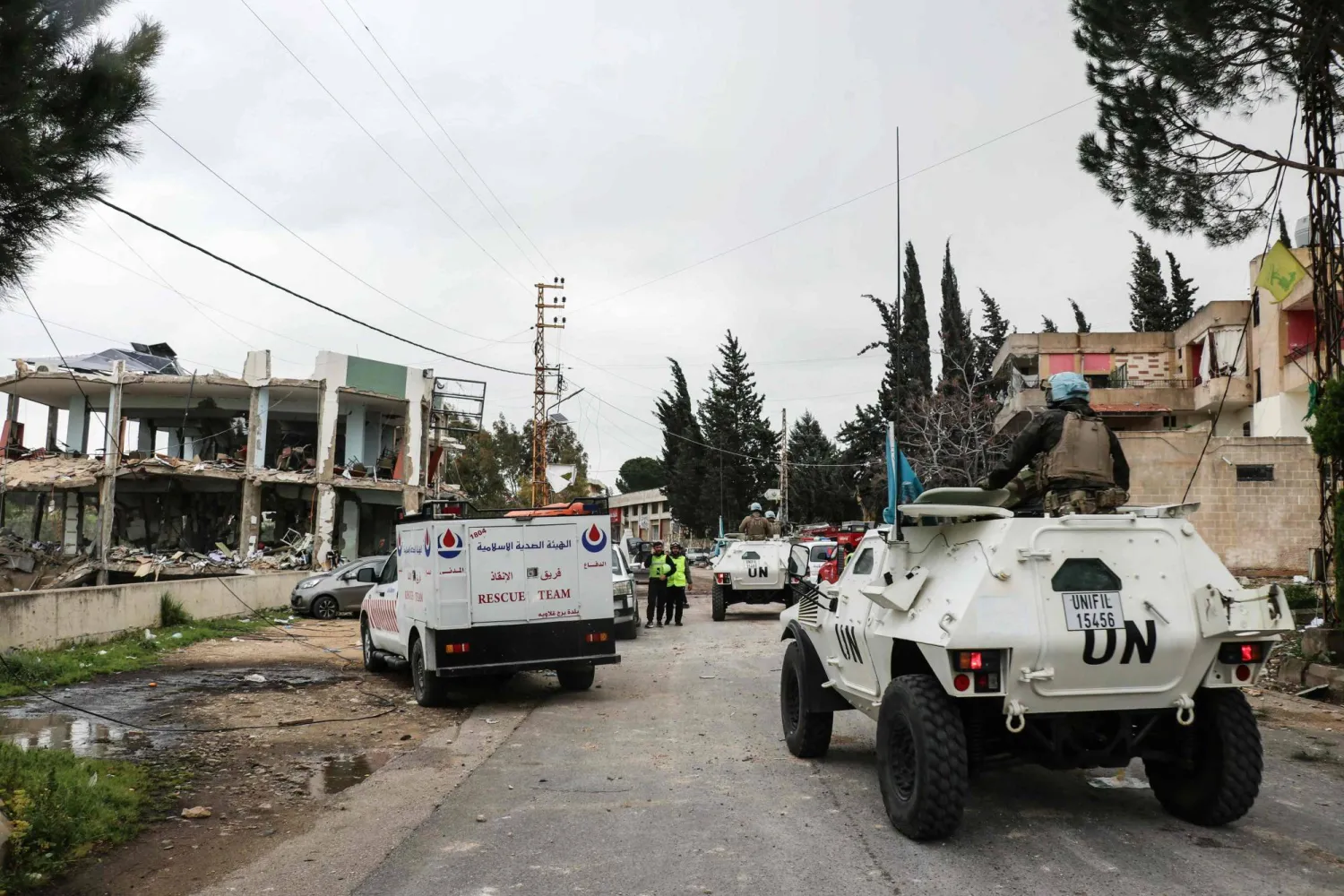
United Nations peacekeepers with the UN Interim Force in Lebanon (UNIFIL) drive past a destroyed healthcare center building in the aftermath of an Israeli strike in the southern Lebanese town of Burj Qalawiya on March 14, 2026. (AFP)
TT

Israel Military Says Its Tank Fire Hit UN Lebanon Base, Regrets Incident

United Nations peacekeepers with the UN Interim Force in Lebanon (UNIFIL) drive past a destroyed healthcare center building in the aftermath of an Israeli strike in the southern Lebanese town of Burj Qalawiya on March 14, 2026. (AFP)

Israel's military on Wednesday acknowledged that its tank fire hit a UN position in southern Lebanon on March 6, wounding Ghanaian peacekeepers, an incident that underscores the growing risks as Israeli operations expand.

Initial findings by an internal UN inquiry had suggested Israel was behind the attack, a Western military source had told Reuters on Tuesday.

The UN peacekeeping mission known as UNIFIL is stationed in southern Lebanon to monitor hostilities along the demarcation line with Israel - an area that is at the heart of clashes between Israeli troops and Iran-backed Hezbollah fighters.

The mission, which will be halted at the end of 2026, has been sporadically caught in the crosshairs of both Israel and Hezbollah over the last couple of years, but with Israel considering a broader ground operation, the risks could be greater in the coming weeks.

In a statement to Reuters, Israel's military acknowledged its troops were behind the incident, but said they had responded to ‌anti-tank missile fire ‌from Hezbollah, which had moderately wounded two of its soldiers.

"A comprehensive investigation concluded in ‌recent ⁠days determined that the ⁠fire that hit the UNIFIL personnel was mistakenly carried out by the Israeli troops that misidentified the UNIFIL troops as the source of the anti-tank fire moments earlier," it said.

"The Israeli army regrets the incident and has conveyed its apologies through the appropriate channels to Ghana and the United Nations. The findings of the investigations have been disseminated within the army to prevent recurrence of similar incidents."

Lebanon was pulled into the war in the Middle East when Hezbollah fired rockets at Israel that ignited a new Israeli offensive against the group.

THREE SHELLS FIRED FROM ISRAELI TANK

According to the Western source, the preliminary conclusions led by UNIFIL’s Force Commander Reserve with support ⁠from explosive ordnance disposal specialists indicated that three strikes at the al-Qawzah base were direct ‌hits from the main gun of an Israeli battle tank.

They were fired using ‌120-mm M339 HE-MP-T shells, the source said.

"Israeli involvement in the attack against UNIFIL is undeniable, given that these munitions are manufactured by Israel ‌Military Industries (IMI)," the source said.

The findings of UNIFIL's probe have not been previously reported. UNIFIL had said on March ‌6 that Ghanaian peacekeepers were wounded amid heavy firing and called the incident "unacceptable," but did not say at the time who was responsible.

"That investigation is not yet complete. Once it is finalized, it will be shared with the parties, per usual practice," said UNIFIL spokesperson Kandice Ardiel.

"Nonetheless, we reiterate the obligation of all actors to ensure the safety and security of peacekeepers and avoid harm to civilians. Any ‌deliberate attack on peacekeepers is a grave violation of international humanitarian law and a violation of resolution 1701."

The Lebanese prime minister's office did not immediately respond to a request ⁠for comment.

Highlighting the concerns surrounding ⁠UN peacekeepers, UNIFIL said on Sunday that another group of peacekeepers were likely fired upon earlier that day on three separate occasions in southern Lebanon, "likely by non-state armed groups." It said no peacekeepers were injured.

UNIFIL ABILITY TO CARRY OUT MISSION TESTED

The M339 HE-MP-T round can be used in anti-personnel, anti-helicopter, anti-materiel, anti-armor and anti-structure roles.

The shots were fired within a five-minute window, indicating repeated fire rather than a single stray round, the source said, adding that the base’s location and coordinates were well known to all parties operating in the area, raising serious concerns over the safety of UN personnel.

Three Ghanaian soldiers were wounded, according to the Ghanaian army.

"This escalation, far from being isolated, is part of a worrying dynamic, severely testing UNIFIL’s ability to carry out its peacekeeping mission," the source said.

The Israeli military occupies five posts within Lebanon and despite a ceasefire last year had frequently carried out airstrikes in the country's south that it says are targeting Iran-backed group Hezbollah.

UN Security Council Resolution 1701, among other provisions, states that no armed forces should be operating in southern Lebanon except the UN peacekeepers and the Lebanese military.

Israel has repeatedly accused Hezbollah of trying to rearm and the Lebanese armed forces of failing to disarm the group.



Israel Ramps up Qassam Killings in Gaza for Fourth Consecutive Day

 Palestinian policemen inspect a vehicle in Khan Younis in the southern Gaza Strip, March 16, 2026. (Reuters)
Palestinian policemen inspect a vehicle in Khan Younis in the southern Gaza Strip, March 16, 2026. (Reuters)
TT

Israel Ramps up Qassam Killings in Gaza for Fourth Consecutive Day

 Palestinian policemen inspect a vehicle in Khan Younis in the southern Gaza Strip, March 16, 2026. (Reuters)
Palestinian policemen inspect a vehicle in Khan Younis in the southern Gaza Strip, March 16, 2026. (Reuters)

Israel has stepped up targeted killings of fighters in Gaza for a fourth day in a row, zeroing in on field commanders in the military wings of Palestinian factions, particularly the Izz ad-Din al-Qassam Brigades, the armed wing of Hamas, across the north and south of the enclave.

On Wednesday, the Israeli military used a suicide drone to strike a tent in the Mawasi area of Khan Younis, killing Mohammed Abu Shahla, a senior field commander in the Khan Younis brigade and its intelligence chief.

A field source told Asharq Al-Awsat that Abu Shahla was “the third-ranking figure in the eastern Khan Younis area” and a key figure within the Qassam Brigades due to his military and security experience.

Several civilians were wounded in the strike.

A day earlier, an Israeli drone hit a vehicle carrying Yahya Abu Labda, a Qassam Brigades field commander responsible for logistics and supply in Khan Younis. He was killed along with two others nearby.

Field sources said Abu Labda had also been active in humanitarian work, overseeing projects to establish camps for displaced people and deliver aid. He had received substantial donations from abroad, “which may have contributed to Israel accelerating his targeting,” the sources said.

On Monday, an Israeli drone strike killed Younis Alyan, a field commander in the northern brigade of the Qassam Brigades, firing a single missile that killed him instantly.

The Israeli military said Alyan was in charge of the brigade’s naval force and had led a series of attacks.

Sources within the Qassam Brigades told Asharq Al-Awsat that Alyan had recently been tasked with reorganizing the group’s structure in western Jabalia and had held several roles during and before the war.

On Sunday, an Israeli strike killed seven Hamas police members in a vehicle in the Zawayda area in central Gaza. It later emerged that one of them, Iyad Abu Youssef, was a Qassam Brigades field commander who also served as a Hamas police officer.

According to an Asharq Al-Awsat tally, at least seven field commanders, including company commanders and deputy battalion commanders, have been killed in the past two weeks, among them Alyan, Abu Labda, and Abu Shahla, along with other fighters.

The escalation in Gaza coincided with Israeli killings of two Hamas operatives in Lebanon. One, Wissam Taha, was killed in Sidon and described by the Israeli military as part of a financial network supporting the group. The other, Walid Deeb, was a Hamas official in Lebanon’s refugee camps.

Armed groups backed by Israel have mirrored the campaign. On Tuesday, gunmen tried to kill a Qassam Brigades operative in the Zeitoun neighborhood of Gaza City.

Two assailants opened fire inside a supermarket using a silenced weapon, seriously wounding him before fleeing toward Israeli-controlled areas.

Sources told Asharq Al-Awsat that members of these groups had received advanced training at Israeli military sites and now possess weapons and drones, and are being trained to use them against Hamas operatives.

The Hamas-run government media office in Gaza said it had recorded 2,073 violations of a ceasefire that took effect on Oct. 10. These included 750 shooting incidents, 87 incursions, 973 bombardments and 263 demolitions of homes and buildings.

The violations have killed more than 677 people, including 305 children and women, wounded 1,813 and led to 50 arrests.


Israel Army Chief Says West Bank Settler Attacks ‘Ethically Unacceptable’

New settlements near Abu Falah village, near Ramallah in the Israeli-occupied West Bank, March 11, 2026. (Reuters)
TT

Israel Army Chief Says West Bank Settler Attacks ‘Ethically Unacceptable’

New settlements near Abu Falah village, near Ramallah in the Israeli-occupied West Bank, March 11, 2026. (Reuters)

Israel's military chief Lieutenant General Eyal Zamir on Wednesday criticized a recent rise in settler attacks in the Israeli-occupied West Bank, calling the violence against troops and civilians "morally and ethically unacceptable".

At least six Palestinians have been killed in attacks by Israeli settlers in the West Bank since the start of March, according to an AFP tally.

"Recently there has been an increase in nationalist crime incidents, some of which are directed against our troops and toward civilian populations," Zamir said, referring to Palestinians living in the territory, as he visited the Central Command.

"It is unacceptable that during a multi-front war the Israeli army is forced to confront a threatening minority from within," he said, adding that the attackers "do not represent the wider population."

"I call on all authorities in the country to act against this phenomenon and stop it before it is too late," he said, in a statement issued by the military.

"Anyone who believes these actions contribute to security is mistaken -- they are morally and ethically unacceptable and cause extraordinary strategic damage to the efforts of the army," he said.

Violence in the West Bank, which Israel has occupied since 1967, has risen sharply since the October 7, 2023 Hamas attack on Israel triggered the Gaza war. It has continued despite the ceasefire and spiked since the start of the war against Iran.

Alongside roughly three million Palestinians, more than 500,000 Israelis live in settlements and outposts in the West Bank, which are illegal under international law.

While most Israeli settlers do not engage in violence, a small but militant fringe has been linked to attacks on Palestinians.

According to an AFP tally based on Palestinian health ministry figures, Israeli troops or settlers have killed at least 1,050 Palestinians -- many of them gunmen, but also scores of civilians -- in the West Bank since the start of the Gaza war.

Official Israeli figures say that 45 Israelis, including soldiers and civilians, have also been killed in Palestinian attacks or during Israeli military operations.

The current Israeli government, considered one of the most right-wing in the country's history, has fast-tracked settlement expansion and recognized some outposts.


Israel Doubles Troops in Hezbollah Fight, Searches Homes in South Lebanon

Israeli soldiers and a bulldozer conduct an operation in a southern Lebanese village along the border, as seen from a position in the Upper Galilee in northern Israel on March 18, 2026. (AFP)
TT

Israel Doubles Troops in Hezbollah Fight, Searches Homes in South Lebanon

Israeli soldiers and a bulldozer conduct an operation in a southern Lebanese village along the border, as seen from a position in the Upper Galilee in northern Israel on March 18, 2026. (AFP)

Israel has more than doubled the number of troops along its border with Lebanon since March 1 and they are searching homes in southern Lebanese villages that the military has ordered evacuated, a senior Israeli commander said on Wednesday.

As Israeli warplanes pound Beirut in operations against Hezbollah that have become the deadliest spillover of the US-Israeli war on Iran, heavy smoke could be seen rising from villages in southern Lebanon as troops fired artillery across the border.

Hundreds of thousands of Lebanese have fled southern Lebanon since Israel ordered people to clear the area south of the Litani River, viewed by Israel as a stronghold of Iran-backed Hezbollah. The group has been firing rockets toward Israel since joining the war in support of Iran on March 2.

'DEFENSIVE POSITIONS' INSIDE LEBANON

"The plan is to make sure that Hezbollah does not have military infrastructure," said the commander, whose name was withheld by the Israeli military on security grounds.

Speaking to Reuters in Eilon, an ‌Israeli town four kilometers ‌from the border, the commander, who is responsible for infantry warfare in Lebanon, declined to ‌say ⁠how many troops Israel ⁠had now deployed in the area.

Describing the military's fortifications inside Lebanon as "defensive positions", he said troops were searching "the villages to see if Hezbollah hid weapons or communications centers".

Asked if that included searching houses that residents had fled following Israeli orders, the commander said: "In some of the cases they hid their weapons in houses. We have no choice but to make sure that house is not a military installation."

Hezbollah has publicly denied using civilian infrastructure to store weapons. It accuses Israel of destroying homes to prevent Lebanese from returning, something Israel denies. Many villages in southern Lebanon have been completely destroyed.

Two Israeli soldiers have been killed since the start of operations ⁠in southern Lebanon, the Israeli military says.

At least 968 people in Lebanon have been ‌killed since the start of Israel's attacks, Lebanese authorities say.

Hezbollah has not provided ‌regular updates on deaths among its fighters. On Monday, a Hezbollah official told Reuters that at least 46 had been killed so far.

LEBANESE ‌VILLAGE OF KHIYAM AN INITIAL TARGET

The Israeli military is advancing slowly through southern Lebanon, aiming to completely clear the ‌town of Khiam as a first step before advancing toward the Litani River, according to a Lebanese security source and a foreign official tracking developments on the ground.

In response to a question on whether Israel intended to establish positions up to the Litani, the commander said it was not his decision. If troops receive orders, he added, they are "prepared to do all kinds of operations".

The Israeli military did not ‌immediately comment on its operations in Khiam, five kilometers inside the Lebanese border from the Israeli town of Metula.

Along the border near Metula, Reuters saw several Israeli military fortifications dug ⁠into hillsides, filled with rows ⁠of tanks, armed personnel carriers, and bulldozers.

Smoke rose from Khiam throughout the day on Wednesday, and many of the buildings on the southern side of the town had been reduced to rubble. A neighboring town remains in ruins from Israel's attacks in 2024.

'EVERY FIVE MINUTES YOU CAN HEAR THE BOMBS'

Israel's northern border area with Lebanon is known as the Upper Galilee, its rolling hills offering vantages into southern Lebanese villages now occupied and bombarded by Israeli troops.

Near Metula, Israeli Apache helicopters and jets were making near-constant sorties on Tuesday and Wednesday, with the sounds of rocket fire from Lebanon interspersed with the booms of Israeli artillery fire.

For residents of Israel's far north, the current war with Hezbollah has seen less rocket fire than during a year of fighting that ended in 2024.

Hezbollah's ability to launch missiles has largely been degraded, but it still retains capacity to strike areas deep inside Israel, Israeli officials say.

Ofer Moskovitz, 60, who works at an avocado farm in the area, and said being so close to the border meant he had little time to run to a bomb shelter when sirens signaled incoming Hezbollah fire.

Near his farm, the military dug out a muddy fortification from where troops fired artillery across the border.

"Every five minutes you can hear the bombs," he said.