

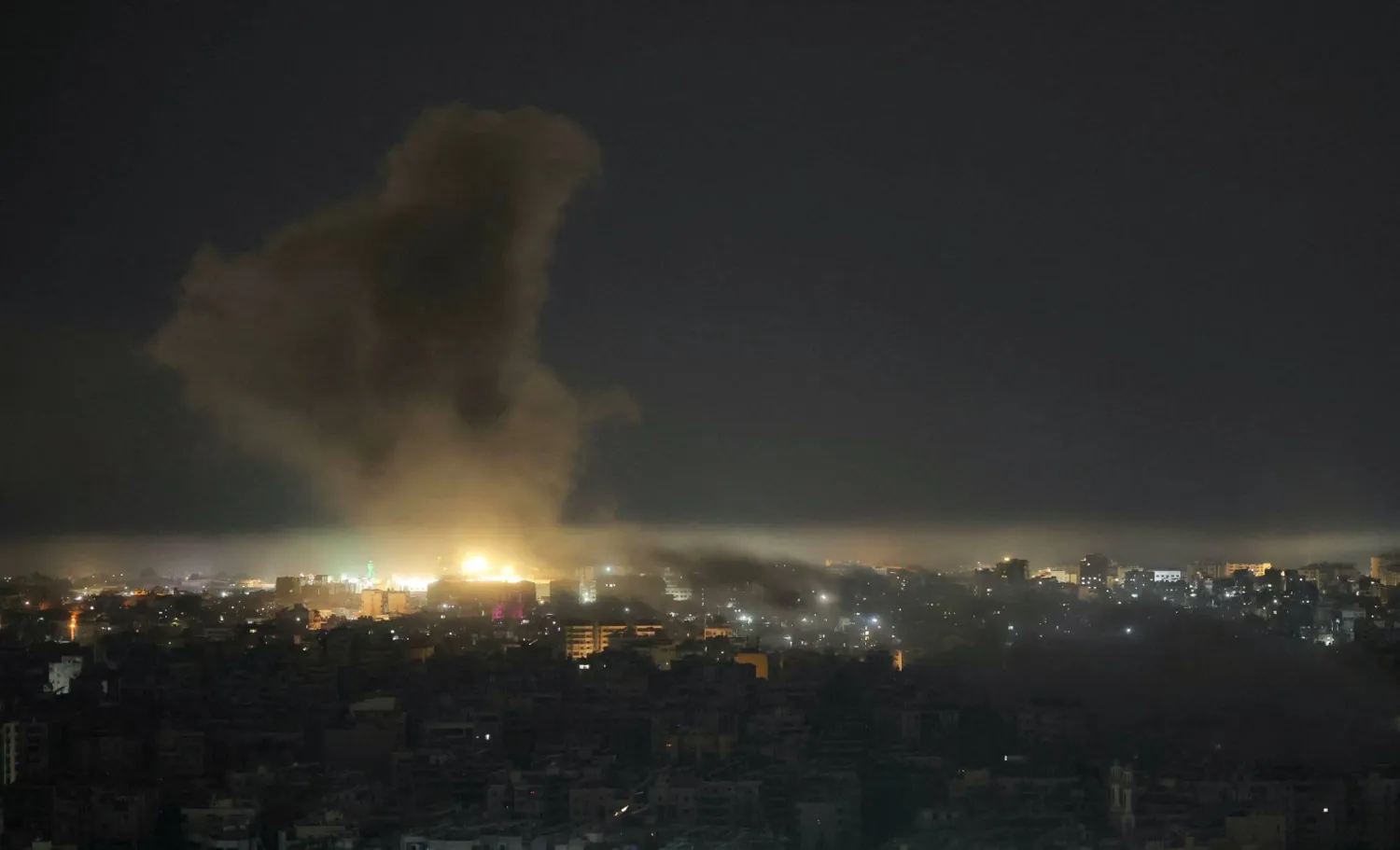

Israeli Strike Near Beirut Kills 2 While Raids Target Southern Suburbs

Smoke rises from the site of an Israeli airstrike that targeted an area in Beirut's southern suburbs on March 24, 2026. (AFP)
TT

Israeli Strike Near Beirut Kills 2 While Raids Target Southern Suburbs

Smoke rises from the site of an Israeli airstrike that targeted an area in Beirut's southern suburbs on March 24, 2026. (AFP)

An Israeli strike on Bshamoun, south of Beirut, killed two people on Tuesday, Lebanon's health ministry said, while strikes on the capital's southern suburbs continued throughout the night.

"The Israeli enemy raid on the town of Bshamoun in the Aley district resulted, in a preliminary toll, in the martyrdom of two citizens and the injury of five others," the ministry said in a statement.

Located in the mountainous, Druze-majority Aley district southeast of Beirut, Bshamoun lies outside of Hezbollah's traditional strongholds.

Lebanon was pulled into the Middle East war when Iran-backed Hezbollah began firing rockets into Israel on March 2 to avenge the killing of Iran's supreme leader Ali Khamenei in a US-Israel attack. 

Israel has since launched strikes across Lebanon, killing at least 1,039 people, and sent ground troops into the country's south. 

Separately, Lebanon's state-run National News Agency reported that Israel's overnight attacks on Beirut's southern suburbs, where Hezbollah holds sway, had targeted seven areas. 

"Enemy warplanes launched seven raids overnight on the southern suburbs, targeting the areas of: Bir al-Abed, Al-Ruwais -- outskirts of Al-Manshiyya, Haret Hreik, Hadi Nasrallah Highway, Saint Therese, Burj al-Barajneh and Al-Kafaat," NNA said on Tuesday. 

The Israeli military on Monday renewed its calls for residents of the southern suburbs to evacuate. 

A spokesperson for the UN secretary-general estimated this week that the ongoing war has displaced about one in five residents of Lebanon. 

Meanwhile, Israel's military said it captured two Hezbollah members in southern Lebanon.

In a statement on Monday, the Israeli army said that "during an activity to locate weapons in southern Lebanon, (Israeli) troops identified several armed Hezbollah Radwan Force terrorists who were planning to fire an anti-tank missile", referring to the group's commando force.

"After being identified, the terrorists surrendered. They were apprehended by the troops and transferred to Israeli territory for further questioning," it added.

The Israeli military told AFP two Hezbollah members were captured.

- 'Only just begun' -

The two Hezbollah members captured in the south were the latest additions to a list of Lebanese who have been held in Israel since the last war between it and the group.

Hezbollah lawmaker Hussein al-Hajj Hassan said in January that Israel was holding "20 Lebanese prisoners", alleging 10 had been abducted "inside Lebanese territory after the ceasefire" that sought to end the previous conflict in 2024.

The next month, Israeli forces seized a member of the Hamas-allied Jamaa Islamiya in southern Lebanon.

The Israeli army's Arabic-language spokesperson Ella Waweya said on Monday "the battle against Hezbollah... has only just begun".

In a video statement, Israeli Prime Minister Benjamin Netanyahu said his country will "continue to strike both in Iran and in Lebanon".

Israel earlier struck a bridge linking areas in southern Lebanon to the Bekaa Valley in the east of the country, a day after a major bridge in the Tyre region was targeted.

Israeli Defense Minister Israel Katz said on Sunday he and Netanyahu had instructed the military to "destroy all the bridges over the Litani River that are used for terrorist activity".



France Urges Israel ‘to Refrain’ from Occupying South Lebanon Zone

France's Foreign Affairs Minister Jean-Noel Barrot attends an interview with AFP journalists at the Quai d'Orsay French Foreign ministry in Paris on March 24, 2026. (AFP)
TT

France Urges Israel ‘to Refrain’ from Occupying South Lebanon Zone

France's Foreign Affairs Minister Jean-Noel Barrot attends an interview with AFP journalists at the Quai d'Orsay French Foreign ministry in Paris on March 24, 2026. (AFP)

Israel should "refrain" from sending in forces to take control of a zone in south Lebanon, France's foreign minister told AFP on Tuesday, warning that such a move would have "major humanitarian consequences".

"We urge the Israeli authorities to refrain from such ground operations, which would have major humanitarian consequences and would exacerbate the country's already dire situation," Jean-Noel Barrot said in an interview with AFP.

His comments came after Israel earlier said its military would take control of south Lebanon up to the Litani River, around 30 kilometers (20 miles) from the border.

Lebanon was pulled into the Middle East war when the Tehran-backed Hezbollah group began firing rockets into Israel on March 2 to avenge the killing of Iran's supreme leader Ali Khamenei.

Israel has since launched strikes across Lebanon, killing at least 1,072 people and displacing more than a million others in more than three weeks of fighting. It has also sent ground troops into the country's south.

Barrot, who visited Lebanon and Israel last week, called on Israel to seize a "historic opportunity" for dialogue with Lebanon's government, saying that Beirut was "turning its words into action" to counter Tehran's interference in the country.

He noted that during his visit to Lebanon on March 19, President Joseph Aoun called for a truce and the opening of negotiations with Israel to stop the war between it and Hezbollah.

"There is a moment to seize, it is historic, and that moment is now," Barrot said, calling for "high-level political dialogue" with the Lebanese government.

Lebanon's government has acted against Iranian interests and withdrew its approval of the Iranian ambassador's accreditation on Tuesday, a decision Barrot hailed as "courageous".

Iranian ambassador Mohammad Reza Sheibani was told to leave Lebanese territory by Sunday.

"I wish to commend the statements and actions of the Lebanese government...which this morning took a courageous decision by expelling the Iranian ambassador," Barrot said.

Hezbollah strongly objected to the move, calling on the government to reverse it.

It was "no small matter" that Lebanon's government had also expelled "a number of representatives of the Revolutionary Guards" in the country, Barrot said, referring to the country's ideological army.

Beirut has accused Iran's Revolutionary Guards of commanding Hezbollah's operations in its war against Israel, having decided on March 5 to ban all activity by the organization in the country.

The government also took the unprecedented step of imposing a ban on Hezbollah military activities and called on the group to hand over its weapons to the state.


Israeli Army Says Strike Killed Lebanese Member of Iran’s Quds Force

A photograph shows the damage after an Israeli strike targeted an apartment in Hazmieh, on the eastern outskirts of Beirut, on March 23, 2026. (AFP)
TT

Israeli Army Says Strike Killed Lebanese Member of Iran’s Quds Force

A photograph shows the damage after an Israeli strike targeted an apartment in Hazmieh, on the eastern outskirts of Beirut, on March 23, 2026. (AFP)

Israel announced on Tuesday that a strike it carried out near Beirut the day before killed a member of Iran's Quds Force, who a Lebanese security source said had survived a previous attack in the same area.

On Monday Israel struck an apartment in Hazmieh, an upscale town overlooking Beirut and near the presidential palace and diplomatic missions.

In a statement Tuesday, the Israeli army said it had killed Mohammed Ali Kurani, "a Quds Force terrorist who was advancing terror attacks directed by Iranian intelligence officials".

The Quds Force is the foreign operations arm of Iran's Revolutionary Guards.

A Lebanese security source told AFP that Kurani hailed from Nabatieh governorate in south Lebanon, and was "known by his military alias Haj Sadeq".

The source said he was a "security officer" in the Iran-backed Lebanese group Hezbollah, and by virtue of his position, would likely have been coordinating with the Quds Force.

Kurani survived an earlier March 4 strike on a hotel, also in Hazmieh, with the source saying "a recording that night documented his leaving the hotel with his wife and son".

The strike hit the room where he and his family had stayed for just two hours, and resulted in injuries to a receptionist who later died of her wounds.

Monday's strike targeted a room in an apartment that had been rented in his wife's name since last October, the source added, noting Lebanese President Joseph Aoun and his sister own two units in the same building.

Lebanon was dragged into the Middle East war on March 2 when Hezbollah fired rockets at Israel in retaliation for US-Israeli attacks that killed Iran's supreme leader.

Following Monday's strike, Hazmieh Mayor Jean Asmar announced the municipality would take new measures with regards to hosting people displaced by the war "so that this incident is not repeated".


Sudan’s RSF Says Captured Strategic Town on Ethiopia Border

RSF commander Gen. Mohammed Hamdan Dagalo, center, greets the crowd during a military-backed tribes' rally in the Nile River State of Sudan, July 13, 2019. (AP)
TT

Sudan’s RSF Says Captured Strategic Town on Ethiopia Border

RSF commander Gen. Mohammed Hamdan Dagalo, center, greets the crowd during a military-backed tribes' rally in the Nile River State of Sudan, July 13, 2019. (AP)

Sudanese paramilitary group the Rapid Support Forces said on Tuesday that it and its allies had seized control of the town of Kurmuk on the border with Ethiopia after "fierce fighting".

"Elite troops from the Rapid Support Forces and the Sudan People's Liberation Movement-North (SPLM-N) have succeeded in fully liberating the strategic town of Kurmuk," the RSF said in a statement.

Its forces also took over two other nearby areas, it said, "following fierce fighting waged since yesterday".

On Tuesday morning, a representative of the army-aligned government in Damazin, the capital of Blue Nile state where Kurmuk is located, said "the situation in Kurmuk is critical and it's very difficult for the forces on the ground to hold their positions".

Fighting began on Sunday around the small border town in the far southeast of Sudan, which the army considers vital because it sits on one of the few roads to Ethiopia.

The faction of the SPLM-N led by Abdelaziz al-Hilu and allied to the RSF maintains a foothold in southern Blue Nile, a narrow strip of land jutting south between Ethiopia and South Sudan.

From there, it reportedly maintains supply lines from both countries, building on decades-old links.

Ethiopia has denied separate allegations that it is harboring RSF camps.

The war in Sudan, which began in 2023, pits the RSF against the regular army and has left tens of thousands dead, displaced around 11 million people and triggered one of the world's worst humanitarian crises.