


G7 Ministers Urge End to Attacks Against Civilians in Middle East War

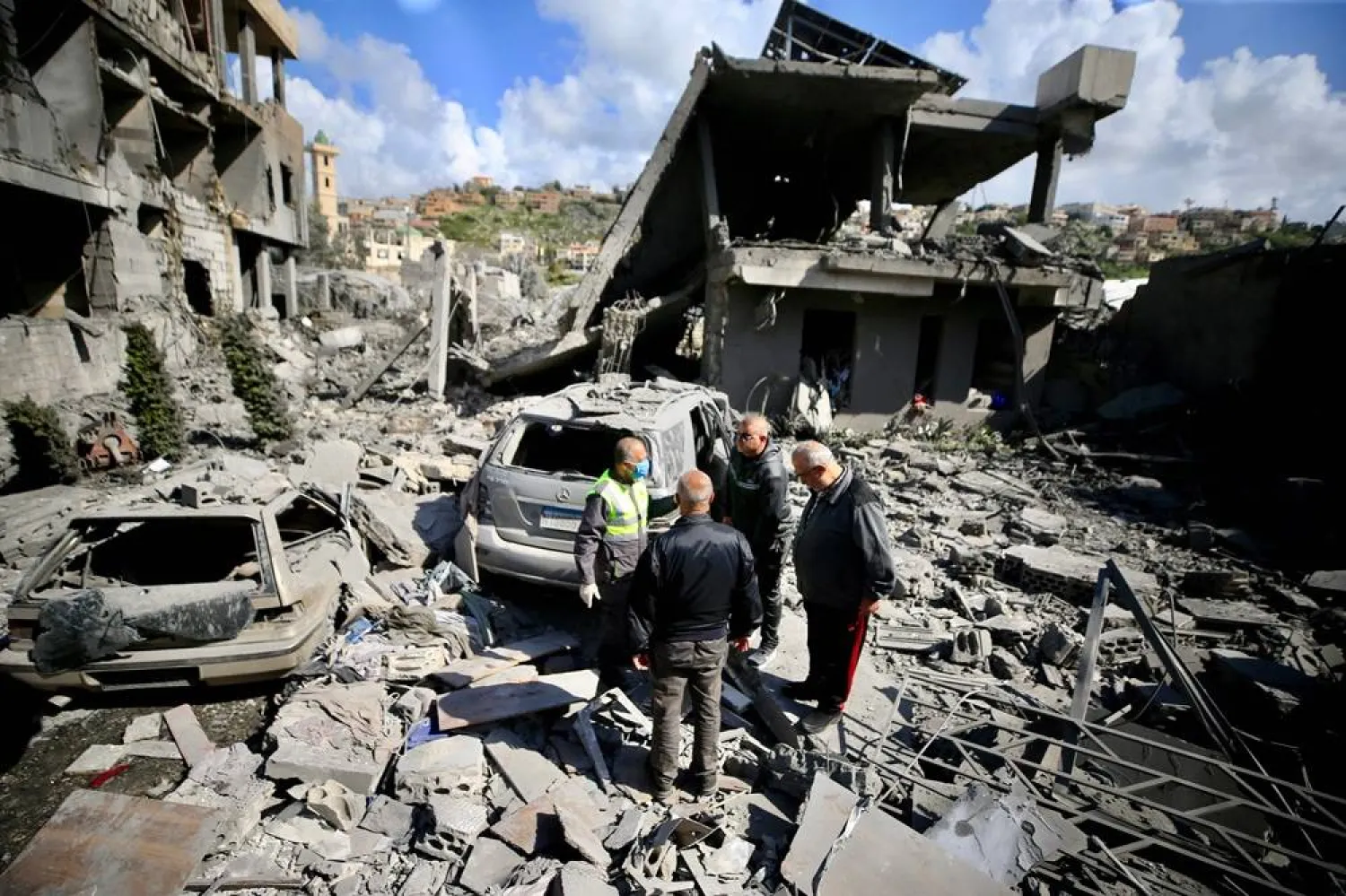
First aid responders inspect the site of an Israeli airstrike that targeted a building in the southern Lebanese town of Saksakiyeh on March 27, 2026. (AFP)
TT

G7 Ministers Urge End to Attacks Against Civilians in Middle East War

First aid responders inspect the site of an Israeli airstrike that targeted a building in the southern Lebanese town of Saksakiyeh on March 27, 2026. (AFP)

G7 allies on Friday urged a stop to attacks against civilians in the Middle East war, after a foreign ministers' meeting in France attended by US Secretary of State Marco Rubio almost one month into the US-Israeli assault against Iran. 

Having skipped the first day of the meeting at the historic monastery turned luxury hotel complex outside Paris, Rubio had a full day of talks with counterparts from leading industrialized democracies at the Vaux-de-Cernay Abbey outside Paris. 

A final communique on the war in the Middle East called for "an immediate cessation of attacks against civilians and civilian infrastructure. 

"There can be no justification for the deliberate targeting of civilians in situations of armed conflict as well as attacks on diplomatic facilities," it added. 

US President Donald Trump had threatened to strike Iranian energy facilities, but subsequently rowed back that warning to give Tehran more time for talks he said were taking place. 

This was Rubio's first trip abroad since the United States and Israel launched the war with air strikes on February 28 that killed supreme leader Ali Khamenei. 

Before leaving France, he told reporters the US expected to finish Iran operations in the "next couple of weeks". 

He said Iran had not yet responded to a plan to end the war. 

But "we've had an exchange of messages and indications from the Iranian system -- whatever's left of it -- about a willingness to talk about certain things". 

- 'Global economy hostage' - 

The G7 meeting was dominated by uncertainty over the current US strategy in the Middle East conflict. 

"The Iranian regime would be well advised to enter into serious negotiations with the United States now," German Foreign Minister Johann Wadephul said after the meeting. 

"There are initial indications that such talks should be taking place," he added, without elaborating. 

Wadephul said the international community needed to collaborate even more closely now it was dealing with two wars in which Russia and Iran were cooperating -- including the conflict sparked by Moscow's 2022 invasion of Ukraine. 

"We need to strengthen our unity," he told reporters. 

The UK's foreign minister Yvette Cooper urged a "swift resolution to this conflict that restores regional stability". 

She echoed concerns over the de facto blockade by Iran of the key Strait of Hormuz, which has driven up global oil prices and left vessels queueing up to enter the energy bottleneck. 

"Iran cannot be able to just hold the global economy hostage," she said. 

The final statement said ministers had "reiterated the absolute necessity to permanently restore safe and toll-free freedom of navigation in the Strait of Hormuz". 

Rubio said he had made progress with allies in opposing Iranian threats to start "tolling" vessels. 

"It's dangerous to the world, and it's important that the world have a plan to confront it," he said. 

The elite G7 club -- whose origins go back to the first G6 summit held in the nearby Chateau de Rambouillet in 1975 -- and now comprises Canada, Germany, France, Italy, Japan, UK and United States. 


Israeli Military Publishes Map of South Lebanon Territory Under Its Control

 Israeli military vehicles drive in southern Lebanon, near the Israel-Lebanon border, amid a 10-day ceasefire between Lebanon and Israel, as seen from Israel, April 19, 2026. (Reuters)
Israeli military vehicles drive in southern Lebanon, near the Israel-Lebanon border, amid a 10-day ceasefire between Lebanon and Israel, as seen from Israel, April 19, 2026. (Reuters)
TT

Israeli Military Publishes Map of South Lebanon Territory Under Its Control

 Israeli military vehicles drive in southern Lebanon, near the Israel-Lebanon border, amid a 10-day ceasefire between Lebanon and Israel, as seen from Israel, April 19, 2026. (Reuters)
Israeli military vehicles drive in southern Lebanon, near the Israel-Lebanon border, amid a 10-day ceasefire between Lebanon and Israel, as seen from Israel, April 19, 2026. (Reuters)

The Israeli military published ‌for the first time a map of its new deployment line inside Lebanon on Sunday, bringing dozens of mostly abandoned Lebanese villages under its control, days after a ceasefire with Hezbollah took effect.

There was no immediate comment from Lebanese officials or from Iran-backed Hezbollah.

Israel and Lebanon agreed on Thursday to a US-backed ceasefire in fighting between Israel and Hezbollah. The deal, which followed the first direct talks in decades between Israel and Lebanon on April 14, is meant to enable broader US-Iran negotiations but with Israeli forces maintaining positions deep inside southern Lebanon.

Stretching east to west, the deployment line on the ‌map runs 5-10 km ‌deep from the border into Lebanese territory, where Israel ‌has ⁠said that it ⁠plans to create a so-called buffer zone. Israeli forces have destroyed Lebanese villages in the area, saying their aim is to protect northern Israeli towns from Hezbollah attacks.

It has created buffer zones in Syria and in Gaza, where it controls more than half the enclave.

"Five divisions, alongside Israeli Navy forces, are operating simultaneously south of the forward defense line in southern Lebanon in ⁠order to dismantle Hezbollah terror infrastructure sites and to ‌prevent direct threats to communities in northern ‌Israel," the military said in a statement accompanying the map.

Asked whether people who fled ‌the Israeli strikes would be allowed to return to their homes, ‌the Israeli military declined to comment.

Lebanese civilians have been able to access some of the villages that fall on or beyond the Israeli-set line, but Israeli forces still prevent people from accessing most of those south of the line, a Lebanese security ‌source said.

Israeli Defense Minister Israel Katz said on Sunday that homes on the border exploited by Hezbollah would ⁠be demolished and ⁠that "any structure threatening our soldiers and any road suspected of (being planted with) explosives must be immediately destroyed".

Lebanon was dragged into the war on March 2, when Hezbollah opened fire in support of Tehran, prompting an Israeli offensive that has killed more than 2,100 people, including 177 children, and forced more than 1.2 million to flee, Lebanese authorities say.

Hezbollah has not disclosed its casualty figures. At least 400 of its fighters had been killed by the end of March, according to sources close to the group.

Hezbollah has fired hundreds of rockets and drones at Israel. Its attacks killed two civilians in Israel while 15 Israeli soldiers have died in Lebanon since March 2, Israel says.


Israel Re-Establishes Evacuated West Bank Settlement

Israeli Defense Minister Israel Katz, (3rd-L), Yossi Dagan, Head of the Shomron Regional Council (4th-L), and Israel's far-right Finance Minister Bezalel Smotrich (4th-R) stand for the national anthem as they attend the resettlement ceremony of Sa-Nur, south of Jenin, in the Israeli-occupied West Bank on April 19, 2026. (AFP)
TT

Israel Re-Establishes Evacuated West Bank Settlement

Israeli Defense Minister Israel Katz, (3rd-L), Yossi Dagan, Head of the Shomron Regional Council (4th-L), and Israel's far-right Finance Minister Bezalel Smotrich (4th-R) stand for the national anthem as they attend the resettlement ceremony of Sa-Nur, south of Jenin, in the Israeli-occupied West Bank on April 19, 2026. (AFP)

Israeli ministers on Sunday officially reopened Sa-Nur, a settlement in the occupied West Bank that was evacuated 20 years ago, marking the occasion with defiant declarations against Palestinian statehood and calls to resettle Gaza.

Several cabinet members and lawmakers attended the ceremony near a cluster of white prefabricated homes arranged in rows on a hilltop.

Excluding east Jerusalem, more than 500,000 Israelis now live in the West Bank in settlements that are illegal under international law, among some three million Palestinians.

"On this exciting day, we celebrate a historic correction to the criminal expulsion from Northern Samaria," Finance Minister Bezalel Smotrich said, using the Israeli biblical term for part of the West Bank.

Sa-Nur's settlers were evicted in 2005 as part of Israel's so-called disengagement policy that also saw the country withdraw troops and settlers from the Gaza Strip.

The policy promoted by then-prime minister Ariel Sharon was framed as a security measure intended to reduce Israel's civilian and military footprint in densely populated Palestinian areas.

Israel's current government, considered one of the most right-wing in the country's history, approved the reconstruction of all four northern West Bank settlements evacuated in 2005.

Authorities have approved 126 housing units in Sa-Nur alone.

"We are cancelling the shame of the disengagement, burying the idea of a Palestinian state and returning to the settlement of Sa-Nur," Smotrich said.

Smotrich, a far-right minister in the ruling coalition and a settler himself, also called for the resettlement of the Gaza Strip as a "security belt" for the State of Israel.

Israeli media reported that 16 families had moved into the re-established settlement in recent days, adding that the new residents included Yossi Dagan, head of the northern West Bank Settlements Council.

Dagan was among those evacuated from Sa-Nur in 2005.

"For me, this is both a national and a personal closing of a circle," Dagan said after cutting the ribbon at the ceremony.

"No more uprootings, no more retreats. We have returned to stay."

Israel has occupied the West Bank since 1967 and since then settlement expansion has been a policy under successive Israeli governments.

But it has accelerated significantly under the current coalition government of Prime Minister Benjamin Netanyahu.

More than 100 settlements have been approved since the government came to power in 2022, according to activists and authorities.


France’s Macron to Meet with Lebanon’s PM in Paris on Tuesday

16 February 2026, Lebanon, Beirut: Lebanese Prime Minister Nawaf Salam is pictured during a meeting at the Prime Minister's office. (dpa)
TT

France’s Macron to Meet with Lebanon’s PM in Paris on Tuesday

16 February 2026, Lebanon, Beirut: Lebanese Prime Minister Nawaf Salam is pictured during a meeting at the Prime Minister's office. (dpa)

French President Emmanuel Macron will on Tuesday meet with Lebanese Prime Minister Nawaf Salam in Paris, his office announced, amidst a fragile 10-day truce between Israel and Iran-backed Hezbollah.

The visit highlights Macron's commitment to seeing "full and complete respect for the ceasefire in Lebanon" as well as France's support for Lebanon's "territorial integrity", the president's office said on Sunday.

Israel and Lebanon on Thursday agreed to a 10-day ceasefire to give time to negotiate an end to six weeks of fighting between Israel and the group.

The visit was announced a day after France blamed Hezbollah for an ambush on UN peacekeepers which left one French soldier dead and three others wounded.

Macron is to urge Lebanese authorities to "shed full light on the incident" and "identify and prosecute those responsible without delay," his office added.

An initial assessment by the United Nations Interim Force in Lebanon (UNIFIL) found the attack was carried out by Hezbollah, according to UN Secretary-General Antonio Guterres.

"UNIFIL soldiers, who are carrying out their missions in difficult conditions and supporting the delivery of humanitarian aid to southern Lebanon, must under no circumstances be targeted," the Elysee said.

Hezbollah -- which strongly opposes to the planned Lebanon-Israel talks -- denied involvement in the attack that killed the French peacekeeper.

The fighting in Lebanon has seen UNIFIL positions repeatedly targeted by Israeli and Hezbollah forces.
