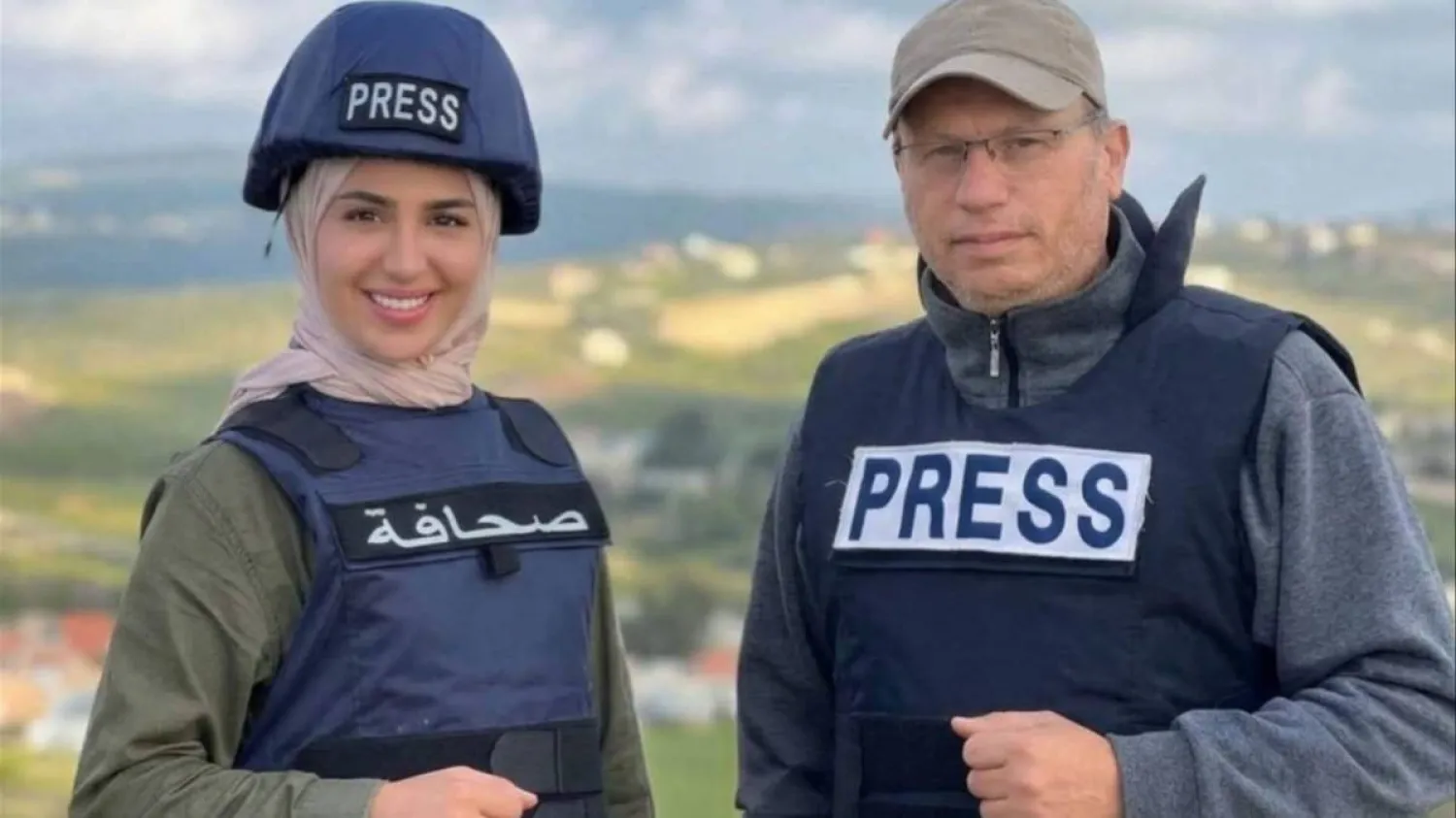
Israeli Strike Kills Three Lebanese Journalists

Journalists Ali Shaib and reporter Fatima Ftouni (National News Agency)
TT

Israeli Strike Kills Three Lebanese Journalists

Journalists Ali Shaib and reporter Fatima Ftouni (National News Agency)

An Israeli strike on a car in southern Lebanon has killed three Lebanese journalists, Reuters reported.

Al Manar reporter Ali Shaib and reporter Fatima Ftouni, from broadcaster Al Mayadeen, were killed when their vehicle was hit. Ftouni's brother, cameraman Mohammed Ftouni, had also been killed in the strike.

The Israeli military said in a statement it had "eliminated" Shaib, whom it described as a "terrorist" in a Hezbollah intelligence unit who had reported on the locations of Israeli soldiers in southern Lebanon. It accused him of "incitement" against Israeli soldiers and civilians.

The military's statement made no mention of any other deaths and provided no evidence to support the assertion that Shaib was a member of Hezbollah.

Lebanese President Joseph Aoun described them in a statement on X as "civilians doing their professional duty."

"It is a brazen crime that violates all treaties and norms through which journalists enjoy international protection in war," he said.

For his part, Prime Minister Nawaf Salam also stressed that “targeting journalists constitutes a flagrant violation of international humanitarian law and a clear breach of the rules that guarantee the protection of journalists in times of war.”

He said: “Lebanon, which holds press freedom and its role in high regard, affirms its commitment to protecting journalists and calls for respect for international law, the safeguarding of civilian lives, and an end to Israeli attacks targeting them.”

Also, Information Minister Paul Morcos said that “the targeting of journalists is repeated and deliberate,” and that what occurred “constitutes a documented war crime against the media and the journalistic mission.”

He added that the incident “adds to a growing record of attacks targeting media outlets and journalists,” noting that Lebanon has submitted to the UN Special Coordinator for Lebanon, Jeanine Hennis-Plasschaert, a detailed list of assaults against journalists as well as health and medical personnel.


Lebanon Kids Struggle to Keep Up Studies as War Slams School Doors Shut

UNICEF says the war has left almost half a million students out of school in Lebanon. Anwar AMRO / AFP
TT

Lebanon Kids Struggle to Keep Up Studies as War Slams School Doors Shut

UNICEF says the war has left almost half a million students out of school in Lebanon. Anwar AMRO / AFP

In a classroom turned shelter for displaced families, teenager Ahmad Melhem follows a recorded lesson on a tablet as the war between Hezbollah and Israel interrupts education for hundreds of thousands of students in Lebanon.

"I don't want to regret not finishing my studies despite the difficult circumstances," said Melhem, whose family was displaced from Beirut's southern suburbs, the site of repeated Israeli bombardment.

"We took a risk and went back to get schoolbooks," he told AFP.

"We're trying with everything we have to continue our education so we can achieve our goals," said the 17-year-old, who hopes to study engineering after finishing high school.

Crisis-hit Lebanon was pulled into the Middle East war on March 2 when militant group Hezbollah fired rockets towards Israel to avenge the US-Israeli killing of Iran's supreme leader Ali Khamenei.

Israel has responded with large-scale strikes on Lebanon and a ground offensive in the country's south, killing more than 1,100 people -- including 122 children -- and displacing more than one million people, according to authorities.

The United Nations children's agency UNICEF says the war has left almost half a million students out of school in Lebanon, after more than 350 public schools were turned into shelters and many in areas under Israeli bombardment were closed.

Melhem's family and others are sharing a classroom divided up by plastic curtains at a school in a central Beirut district, the room scattered with thin mattresses and blankets, a table and small stove serving as a shared kitchen.

- 'Digital divide' -

In the corner, Melhem has set up his books and a computer screen, but there is no internet in the room.

An NGO has provided internet access in the schoolyard, crowded with children playing and families socializing, but Melhem says he cannot concentrate because of the noise, so he watches the recorded classes later.

His private school resumed distance learning two weeks after the war began, after cancelling subjects and shortening lessons.

"In-person (class) is better and more engaging," he said. "I miss group work and the science projects we used to do."

According to a 2023 World Bank report, each day of public school closures costs the Lebanese economy three million dollars.

In the courtyard, Melhem's mother helps her other son, aged eight, to follow his online classes.

"If I leave him alone, his mind wanders and he can't keep up with the lesson," says Salameh, 41.

"The war has destroyed everything," she added.

"Education is the only thing left for my children."

UNICEF's head of education in Lebanon, Atif Rafique, expressed particular concern about the future of students who are preparing to enter university while the war continues.

He warned of the dangers of children dropping out of school, especially "girls and adolescent young women" who face additional risks, including early marriage.

'Not even pens'

In Dekwaneh, north of Beirut, at a vocational institute that is now a shelter, Aya Zahran said she spends her day "preparing food and working to make the place livable".

"We have only one phone that my siblings and I share," said Zahran, 17, who is also displaced from Beirut's southern suburbs.

But "the link the school sent us (for online classes) doesn't work", she said.

Rafique said hundreds of public schools lack the resources for distance learning, and noted a "big digital divide" when it comes to internet access, with teachers also affected.

UNICEF has helped launch an online platform with recorded lessons, and a hotline allowing students to access materials through a phone call, without needing internet access.

He said children in south Lebanon have been disproportionately affected by education interruptions since the last round of hostilities between Israel and Hezbollah broke out in October 2023.

Just a week before the latest war began, UNICEF reopened 30 schools in the south that had been damaged in the previous conflict, he said.

At the vocational institute's entrance, an education ministry employee was registering children to assess what educational services they need.

"The situation here is very difficult... there's no internet here, and not even pens," said Nasima Ismail, who has been displaced from the northeast Bekaa region, as she signed up her children.

"My children are top students. I don't want them to miss out on their education, as happened to us when we were kids," said Ismail, recalling Lebanon's devastating 1975-1990 civil war.

"I want them to complete their education, even if we are left with nothing," she said.

"I wish them days better than ours."


Israel and Hezbollah Shift to Multi-Dimensional Warfare

Israeli soldiers aboard a military vehicle at the Lebanese border (Reuters). 
TT

Israel and Hezbollah Shift to Multi-Dimensional Warfare

Israeli soldiers aboard a military vehicle at the Lebanese border (Reuters). 

The ongoing confrontation between Israel and Hezbollah is taking on a new character, with both sides moving beyond the largely conventional fighting seen in 2024 toward a more complex, multi-layered conflict shaped by technology, intelligence and flexible battlefield tactics.

Nearly a month into the conflict, neither side appears to be seeking a swift outcome. Instead, both are pursuing incremental gains, reflecting an understanding that victory is unlikely to come through a single blow but through sustained pressure over time.

Israel has maintained extensive use of drones, deploying them for surveillance as well as targeted strikes against Hezbollah commanders and key positions. This approach is backed by strong intelligence capabilities and technological superiority.

Hezbollah, meanwhile, has adjusted its approach, shifting toward a more decentralized and mobile style of warfare, an evolution from the more static defensive tactics that led to heavier losses during the 2024 conflict.

Military analyst Brigadier General Hassan Jouni says both sides have made clear strategic adjustments based on lessons learned from previous fighting.

“Geography remains a decisive factor in shaping military operations,” Jouni said, highlighting border areas such as the town of Khiam, which continues to serve as a key flashpoint due to its strategic location.

He said Hezbollah has moved away from a strategy of fixed defense toward a more dynamic and flexible model, allowing for greater mobility and adaptability on the battlefield.

Israel, for its part, appears to be probing Hezbollah’s defensive capabilities — testing coordination, morale and combat readiness — while avoiding immediate escalation into a full-scale ground assault.

According to military expert Brigadier General Said al-Qazah, Israel’s core tactics remain largely consistent with those used in the previous 66-day war.

Israel continues to focus on dismantling Hezbollah’s military infrastructure beyond the front lines, relying on intelligence superiority and precision strikes targeting leadership structures and logistical networks.

These operations have included strikes on missile stockpiles, launch platforms, command-and-control centers, as well as economic and financial entities linked to Hezbollah.

Qazah noted that a defining feature of the current campaign is Israel’s use of a “scorched earth” approach along the border, involving the systematic destruction of villages to create a buffer zone. This is intended to deny Hezbollah fighters the ability to use terrain and buildings for infiltration or anti-tank attacks against advancing troops and northern Israeli communities.

Hezbollah has sought to counter Israel’s air superiority by adapting its tactics. Taking advantage of the period following a ceasefire, the group has shifted toward decentralized defense, abandoning fixed lines in favor of small, semi-autonomous units.

These units operate with greater decision-making flexibility, drawing on guerrilla warfare principles. This approach complicates Israeli efforts to eliminate Hezbollah’s combat capability through a single strike.

So far, Israeli pre-emptive strikes have not fully degraded Hezbollah’s operational capacity, helping explain delays in launching a large-scale ground offensive.

Hezbollah is currently focusing on short-range rockets, aimed at maintaining sustained pressure on Israel’s northern front and disrupting stability rather than achieving a decisive military breakthrough.

Jouni said this strategy complements Iranian strikes, increasing strain on Israeli air defense systems while adding a psychological dimension to the conflict.

Hezbollah has also strengthened internal security measures to limit infiltration, particularly in response to drone strikes targeting its fighters. This has contributed to a relative reduction in casualties along the front lines.

The group appears intent on maintaining continuous engagement with Israeli forces — even in the absence of a major ground incursion — in an effort to wear them down over time.

A Fragile Balance

Israel’s current strategy centers on achieving fire control over areas south of the Litani River through sustained air and naval strikes, combined with psychological pressure aimed at prompting civilian displacement.

However, a broad ground advance has yet to materialize. Jouni said Israel appears to be weighing options between establishing a buffer zone extending 5 to 8 kilometers from the border or pushing deeper into southern Lebanon.

“The course of the fighting will determine the final decision,” he said, describing the current situation as a “careful balance” in which both sides seek to achieve their objectives without triggering a wider war.

Geopolitical Factor

A new factor shaping the conflict is the increased use of medium-range rockets by Hezbollah, often synchronized with Iranian ballistic missile strikes. Qazah said the aim is to overwhelm Israeli air defenses, allowing some missiles to penetrate while also attempting to prompt civilians in northern Israel to evacuate, an objective that has not yet been fully achieved.

He added that geography remains a key factor, with Israel relying on technological superiority and gradual advances to navigate complex terrain, while prioritizing its broader confrontation with Iran. Hezbollah, in turn, is using geography to prolong the conflict and stretch Israeli forces.

“The final outcome,” Qazah said, “will ultimately depend on developments on the ground.”


Syria Says Repelled Drone Attack From Iraq on US Base

In this file photo dated Feb 7, 2026, boys along a road wave to an approaching US military mine-resistant ambush protected (MRAP) armored fighting vehicle moving in a convoy transporting ISIS group detainees being transferred to Iraq from Syria, on the outskirts of Qahtaniyah in Syria's northeastern Hasakeh province. (AFP)
TT

Syria Says Repelled Drone Attack From Iraq on US Base

In this file photo dated Feb 7, 2026, boys along a road wave to an approaching US military mine-resistant ambush protected (MRAP) armored fighting vehicle moving in a convoy transporting ISIS group detainees being transferred to Iraq from Syria, on the outskirts of Qahtaniyah in Syria's northeastern Hasakeh province. (AFP)

Syria's assistant defense minister said Sunday that his country's forces had repelled a drone attack from neighboring Iraq targeting one of Syria's last US military bases.

"Earlier today, the US base in Qasrak, located on our territory, was attacked by four drones launched from Iraqi territory," Sipan Hamo said on X, adding that "the drones were shot down without casualties".

"We hold Iraq responsible and call upon it to prevent the recurrence of attacks that threaten our stability."

The attack came a day after Syria's army said it repelled another drone attack from Iraq aimed at al-Tanf, a base in the southeast which used to house US forces.

Earlier this week, the Syrian military said another base in the northeast was also targeted by a missile attack from Iraq, with an Iraqi official saying a local armed group was behind it.

Iraq has arrested four people in connection with that attack.

Iraq has been pulled into the war since it was sparked by US and Israeli strikes against Iran on February 28, with the conflict engulfing much of the Middle East.

Pro-Tehran Iraqi groups have claimed responsibility for attacks on US interests in Iraq and across the region, while strikes have also targeted these groups.

In recent months, American forces have withdrawn from the al-Tanf base, as well as Shadadi in the northeastern province of Hasakeh, and had begun withdrawing from the Qasrak base, also located in Hasakeh.