Easter in Jerusalem Disrupted by War and Restrictions at Holy Sepulchre

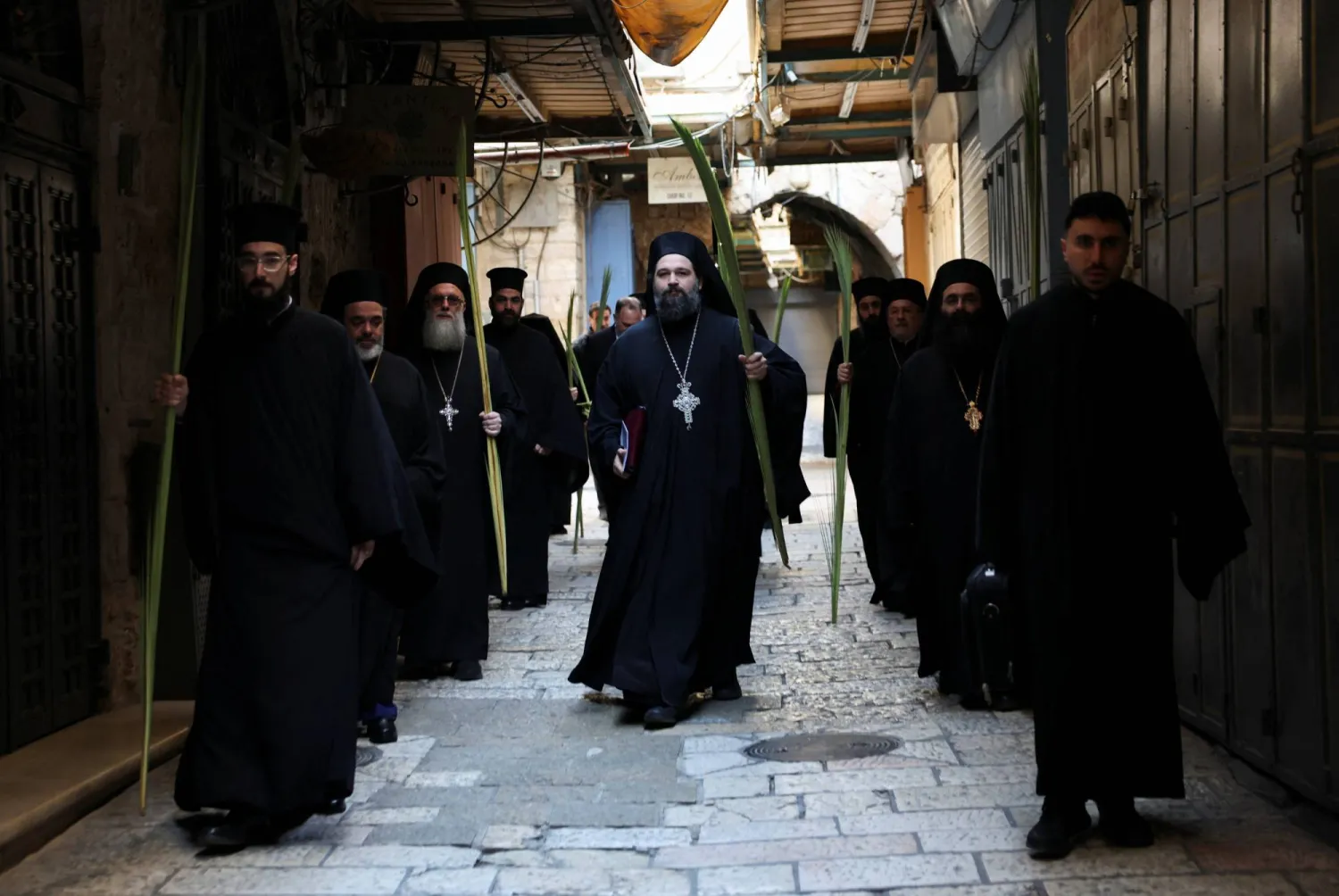
 Members of the clergy make their way to the Church of the Holy Sepulchre for prayers on Palm Sunday, following restrictions on gatherings in large groups, amid the US-Israel conflict with Iran, in Jerusalem's Old City April 5, 2026. (Reuters)
Members of the clergy make their way to the Church of the Holy Sepulchre for prayers on Palm Sunday, following restrictions on gatherings in large groups, amid the US-Israel conflict with Iran, in Jerusalem's Old City April 5, 2026. (Reuters)
TT

Easter in Jerusalem Disrupted by War and Restrictions at Holy Sepulchre

 Members of the clergy make their way to the Church of the Holy Sepulchre for prayers on Palm Sunday, following restrictions on gatherings in large groups, amid the US-Israel conflict with Iran, in Jerusalem's Old City April 5, 2026. (Reuters)
Members of the clergy make their way to the Church of the Holy Sepulchre for prayers on Palm Sunday, following restrictions on gatherings in large groups, amid the US-Israel conflict with Iran, in Jerusalem's Old City April 5, 2026. (Reuters)

In the usually lively alleyways of Jerusalem's Old City, silence reigned on Easter Sunday, with the holiday overshadowed by war and restrictions on access to the Holy Sepulchre, where the faithful commemorate Christ's crucifixion and resurrection.

On routes approaching the church, police at checkpoints screened a small number of worshippers allowed near the site.

All shops in the area were closed, heightening the sense of emptiness.

"Happy Easter," said the Latin Patriarch of Jerusalem, Cardinal Pierbattista Pizzaballa, shortly after dawn as he entered the church surrounded by a modest group of clergy, according to AFP journalists at the site.

Outside, a few Catholics and Orthodox Christians tried to reach the church but were kept at a distance by security forces.

"How can you tell me I cannot go to church, it is unacceptable," said one Catholic from Tel Aviv who had attended Easter worship at the site in previous years.

Security has been stepped up in the Old City, located in annexed east Jerusalem and home to sites sacred to Jews, Christians and Muslims.

Israel has also imposed restrictions on large gatherings as a security precaution due to the constant threat of strikes during the ongoing Middle East war.

On Palm Sunday, Cardinal Pizzaballa was prevented by Israeli police from entering the Holy Sepulchre for mass, provoking outrage, before Prime Minister Benjamin Netanyahu ordered he be allowed in.

Since the start of the war on February 28, debris from Iranian missiles or interceptors has fallen in the Old City, including near the Holy Sepulchre, Al-Aqsa Mosque, and in the Jewish Quarter.

Most Palestinian Christians belong to the Orthodox faith, which celebrates Easter on April 12.

But for many other Christians, the curbs on worship have stripped the Easter celebrations of substance.

"It's very hard for all of us because it's our holiday... It's really hard to want to pray but to come here and find nothing. Everything is closed," said Christina Toderas, 44, from Romania.

Like many other worshippers, she had resigned herself to watching the mass at the Holy Sepulchre on television.

Father Bernard Poggi, who was preparing to attend mass in another church near the holy site, said he understood the security measures but added that "it seems to be more and more that there's an unevenness in how the laws are put into practice".

Inside the Holy Sepulchre, the celebrations were being held behind closed doors in front of a very small congregation, far removed from the crowds that usually gather.

Around the Old City, where hymns and processions usually dominate at Easter, only whispers could be heard among the faithful moving discreetly through its passages.


Production Suspended at Iraq’s Khor Mor Gas Field After Drone Attack

The Khor Mor gas field in Sulaymaniyah province, Iraq, November 27, 2025. (Reuters)
TT

Production Suspended at Iraq’s Khor Mor Gas Field After Drone Attack

The Khor Mor gas field in Sulaymaniyah province, Iraq, November 27, 2025. (Reuters)

Production ‌was halted on Sunday at Iraq's Khor Mor gas field, one of the largest in the Kurdistan region, after a drone attack hit the field, sources said.

Two sources in the region's electricity ministry said production at the field was suspended after a single drone strike hit the LPG storage tank, causing a fire that was still raging. Two security sources said smoke was seen rising from the field.

Employees at the field were evacuated ‌to shelters ‌inside the facility following the attack, the ‌two ⁠ministry sources said.

Iraq's ⁠prime minister and commander-in-chief of the armed forces, Ali al-Zaidi, said the attack did not result in casualties, based on an initial assessment.

A joint statement by the region's natural resources and electricity ministries described the attack on the field as a "terrorist attack," saying they ⁠are working on minimizing its impact.

There was no ‌claim of responsibility for ‌the attack.

The gas field provides supplies for regional power generation.

Some ‌2.8 gigawatts of power generation in the Kurdistan region ‌was lost following the attack, the region's electricity ministry said in a statement.

Joint field operator Dana Gas had previously shut down the main production facilities at the field in July ‌due to credible security threats and regional tensions before restarting production later in the ⁠same month.

Iraq ⁠has been among the countries most affected by Iran’s effective closure of the Strait of Hormuz. Traffic in the strait remains disrupted as ships continue to face attacks in the area.

Baghdad has been striving to balance its ties with neighboring Iran and the US amid the military escalation between the two countries.

However, Tehran has launched attacks against Iranian Kurdish opposition groups in northern Iraq, while Iran-backed armed factions in Iraq launched attacks against Gulf neighbors earlier in the conflict.


US Asks Iraq to Shut Most Iran Border Crossings, Iraqi Foreign Minister Says

Iraqi Foreign Minister Fuad Hussein speaks as he attends a joint press conference with Syrian Foreign Minister Faisal Mekdad (not pictured), in Baghdad, Iraq June 4, 2023. (Reuters)
TT

US Asks Iraq to Shut Most Iran Border Crossings, Iraqi Foreign Minister Says

Iraqi Foreign Minister Fuad Hussein speaks as he attends a joint press conference with Syrian Foreign Minister Faisal Mekdad (not pictured), in Baghdad, Iraq June 4, 2023. (Reuters)

The US Treasury has asked Iraq to close all border crossings with Iran except for two as part of Washington's policy of ‌increasing economic ‌pressure on Tehran, Iraqi ‌Foreign ⁠Minister Fuad Hussein ⁠said in an interview with Al Jazeera.

One of the exceptions is in the Kurdistan region.

"There ⁠are many official ‌and ‌unofficial border crossings with Iran, ‌and closing all ‌of them would be difficult and would affect our economy. The Americans ‌are still demanding the closure of the crossings, ⁠and ⁠we are currently in discussions with them," Hussein said.

Last month, Iraq closed the busy Sheeb border crossing with Iran to review security and install detection equipment to stop smuggling.


Yemen Army Makes New Gains on Battlefronts

A Yemeni soldier in battle in Taiz. (AFP)
TT

Yemen Army Makes New Gains on Battlefronts

A Yemeni soldier in battle in Taiz. (AFP)

The Yemeni arena has witnessed a coordinated military escalation across multiple fronts over the past few hours, stretching from the southwestern governorates of Lahj and Taiz to Marib and Al-Jawf in the north.

The flare-up coincided with a wave of Houthi missile and drone strikes targeting Saudi Arabia, including the capital, Riyadh, alongside the Eastern and Southern Regions, as ongoing Yemeni government military operations point toward a broadening confrontation.

Yemeni military sources said that the air force executed a precision airstrike targeting a meeting of prominent Houthi field commanders in the Al-Maqatirah district of northern Lahj. The strike was launched after intelligence assets tracked the commanders' movements and pinpointed the meeting location.

The final toll of human casualties resulting from the strike, as well as the identities of the commanders present at the targeted site, remain unclear.

The strike took place amidst escalating military operations across the Lahj fronts, particularly in areas intersecting the Al-Maqatirah, Al-Mudharabah, and Tur Al-Baha districts.

Over recent days, these zones have witnessed intense clashes and retaliatory attacks, driven by Houthi attempts to advance toward strategic positions and supply routes linking the Lahj and Taiz governorates.

Government forces had previously announced the recapture of strategic positions on the Al-Mudharabah front following fierce clashes with the Houthis. The fighting involved intensive attacks launched by members of the militia against military sites before government forces managed to repel them and force the attackers to retreat.

On Saturday, the Yemeni army carried out 875 military operations against the Houthis, encompassing artillery strikes, ambushes, and targeted attacks on positions, gatherings, and reinforcements.

The campaign resulted in the neutralization of 130 Houthi members and the destruction or damage of some 50 military vehicles and equipment, including rocket launchers.

The attacks were executed across multiple fronts, focusing on the group's positions, reinforcements, and combat capabilities with the participation of ground units supported by air and artillery assets.

Meanwhile, government forces continued their maneuvers in Al-Jawf and other areas as part of ongoing confrontations to recapture military sites and secure liberated zones.

The escalation extended to the Marib fronts, where government forces announced the downing of a Houthi reconnaissance drone, coinciding with the thwarting of simultaneous ground attacks launched by the group against military positions in the Taiz and Lahj governorates.

Yemeni army artillery targeted Houthi military vehicles and barracks on the northern front of Marib following the downing of a drone on the Mas front. Military sources stated the operations are intended to curb the group's surveillance, reconnaissance, and troop-monitoring capabilities.