
Anger, Sorrow at Funeral of Lebanese Forces Official Killed by Israel

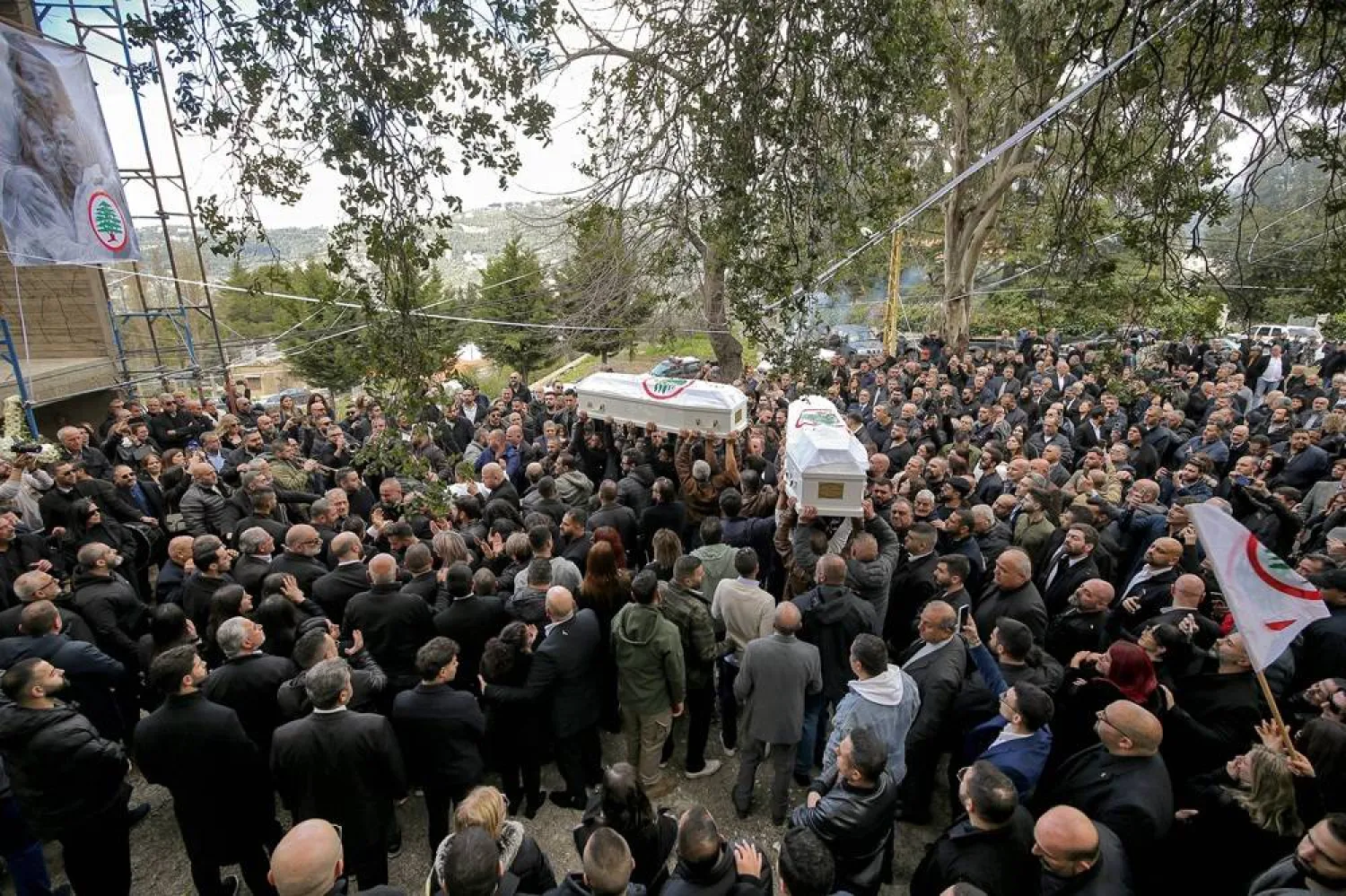
07 April 2026, Lebanon, Yahshoush: Mourners carry the coffins of Lebanese Forces official Pierre Mouawad and his wife during their funeral procession in the village of Yahshoush, northeast of Beirut. (dpa)
TT

Anger, Sorrow at Funeral of Lebanese Forces Official Killed by Israel

07 April 2026, Lebanon, Yahshoush: Mourners carry the coffins of Lebanese Forces official Pierre Mouawad and his wife during their funeral procession in the village of Yahshoush, northeast of Beirut. (dpa)

At a church in the mountains outside Beirut, Raymonda Mouawad raged as she buried her brother, killed by an Israeli strike in a war against Hezbollah that he had nothing to do with.

"We shouldn't be forced to bear the guilt of others' mistakes," she said, her voice filled with anger and sorrow.

"We're done with Israel and Hezbollah. That's all I want to say," she told AFP at the church, which was overflowing with hundreds of family members, friends and supporters.

Pierre Mouawad, a local official in the Lebanese Forces (LF) -- which is strongly opposed to Hezbollah -- was killed on Easter Sunday along with his wife Flavia and another woman.

The Israeli strike on a residential building in Ain Saadeh, east of Beirut, was the latest attack outside Hezbollah's traditional strongholds since the armed group drew Lebanon into the Middle East war on March 2 with rocket fire towards Israel in support of its backer Iran.

That attack sparked an Israeli invasion and air raids across Lebanon that have killed more than 1,500 people, according to authorities.

- Sectarian tensions -

The couple's coffins, draped in LF flags, arrived in Mouawad's hometown of Yahshoush in a packed procession to the deafening sound of automatic gunfire and fireworks as mourners threw rice and flower petals.

LF anthems blared in the church courtyard, where some men in military-style garb stood among the mourners.

Israel's strikes in majority-Christian and Sunni areas, including on hotels or apartments reportedly rented by people displaced by fighting, have stoked fear and division in a country where sectarian tensions have previously ended in bloodshed.

"We opened our homes to them... and in the end they came among us to harm us," said Raymonda, referring to people who have fled the majority-Shiite areas of Lebanon where Israeli strikes are most intense.

But Lebanon's army said Monday that its investigation showed there were "no new tenants" in the targeted building.

Investigations are ongoing "to uncover the circumstances of the Israeli attack", the army said, warning that speculation over "sensitive security matters... could lead to domestic tensions".

Israel's military has said it struck a "terrorist target" east of Beirut, and was reviewing the incident after "reports of casualties among Lebanese civilians".

President Joseph Aoun said in a statement on Tuesday that some were "exploiting fears of sectarian strife to serve their own interests", adding: "I will not allow strife."

LF leader Samir Geagea, who sent flowers to the funeral, said that "the Israelis were targeting a member of the Quds Force", the Iranian Revolutionary Guards' foreign operations arm, but he did not seem to have been killed.

- 'We don't want war' -

"Where is the state? There is no oversight, there's nothing, there are just lies," Raymonda said.

Nurse Fadia Mrad Atallah, 55, a friend of the couple's, said she was shocked by the news of their deaths.

"We've had enough bloodshed. We don't want war," she said.

"Whoever wants to wage war should go to Iran," she added.

Sam Hanna, 56, showed a series of missed calls from Pierre Mouawad on Sunday as he and his friend tried to arrange for a coffee meetup that would never happen.

"I told him, I can't, I have to pick my wife up from work, I'll come down and meet you at 7:00 pm. He told me he'd be waiting for me. I wish I had told him to come."

Scrolling through photos of them together, Hanna asked who his friend had died for.

"For Khamenei? No, his blood can't have been spilled for this," he said, referring to Iran's slain supreme leader.

Another friend, Marwan Khoury, 53, showed a video of his "last journey" with Mouawad -- accompanying his coffin inside the hearse.

"It wasn't Pierre's time," he said.

"Neither him nor anyone else should go like this."


Israeli Threats Shut Masnaa Crossing, Partly Isolate Lebanon from Syria

The Masnaa border crossing with Syria in the Bekaa Valley, eastern Lebanon, 05 April 2026, following an Israeli warning to target the M30 highway between Lebanon and Syria. (EPA)
TT

Israeli Threats Shut Masnaa Crossing, Partly Isolate Lebanon from Syria

The Masnaa border crossing with Syria in the Bekaa Valley, eastern Lebanon, 05 April 2026, following an Israeli warning to target the M30 highway between Lebanon and Syria. (EPA)

Israel has partially severed Beirut from Damascus after shutting the main border crossings between the two countries, following a warning that it would strike the Masnaa crossing.

The move has disrupted trade and travel, funneling movement through a single crossing in Lebanon’s far northeast, far from both capitals.

Syrian and Lebanese diplomatic contacts helped avert an Israeli strike on Masnaa, but failed to reopen it. The crossing remains fully closed. Major General Hassan Choucair, head of Lebanon’s General Security, said protecting personnel and equipment at the crossing was the top priority.

He stressed the crossing was legal and could not be used for arms smuggling, noting all trucks and vehicles undergo strict inspections, and dismissed reports of smuggling as false.

Security measures

A Lebanese security source flatly rejected Israeli claims that the crossings are used to smuggle weapons, saying traffic in both directions is subject to strict inspections by Lebanese and Syrian authorities, making any such operations impossible.

The source told Asharq Al-Awsat the allegations were baseless and carried political and security motives beyond counter-smuggling.

The Israeli escalation over the crossings forms part of broader pressure linked to the war on Lebanon, the source said, and may pave the way for a land blockade along the Lebanese-Syrian border to redraw the rules of engagement with Hezbollah.

The source warned the developments could signal a new security reality on the border ahead of any future confrontation.

Undeclared blockade

Border crossings are no longer mere transit points; they have become a focal point where economic strain meets security and political tensions. With movement paralyzed, losses mounting, and tensions rising, Lebanon appears to be entering a phase of compounded pressure, widely seen as an undeclared blockade.

MP Sajih Attieh, head of parliament’s public works committee, said conditions at the crossings are steadily deteriorating. Of five crossings with Syria, only one remains effectively open, Jousieh in the Qaa area.

He told Asharq Al-Awsat that three crossings in Akkar, Aboudieh, Arida, and Al-Buqiaa remain shut, while efforts to reopen Aboudieh are being hindered by Syrian hesitation due to limited security capacity.

Masnaa, the main artery between Lebanon and Syria in the Bekaa Valley, has been paralyzed since Sunday night after the Israeli warning. Activity has shifted to Jousieh, where trucks loaded with goods are backed up on both sides, along with civilian traffic.

Attieh said the closures have nearly halted land transit and cross-border trade, hitting key facilities, notably the port of Tripoli, which is losing about $100,000 a day due to the suspension of overland transit goods.

State revenues fall

The closures have also choked Lebanese exports, especially fruit, vegetables and local industries, which have lost their main overland route to Arab markets, adding pressure on productive sectors.

Attieh said the impact extends beyond exports. Maritime imports have dropped by up to 70%, affected by the closure of the Strait of Hormuz, triggering a sharp fall in state revenues.

Monthly revenues from customs, imports and value-added tax have fallen from about $450 million to roughly $125 million, he said, adding that the government has frozen implementation of the 2026 budget.

Public spending had been set based on revenues nearing $6 billion, making the freeze unavoidable amid a roughly 70% drop in imports, he said, warning that the risk of a deeper economic crisis will become clearer once the war ends.


Israel Urges All Vessels to Evacuate South Lebanon Maritime Area up to Tyre

Smoke rises following Israeli bombardment on the village of Qlaile as pictured from nearby Tyre in southern Lebanon on April 7, 2026. (AFP)
TT

Israel Urges All Vessels to Evacuate South Lebanon Maritime Area up to Tyre

Smoke rises following Israeli bombardment on the village of Qlaile as pictured from nearby Tyre in southern Lebanon on April 7, 2026. (AFP)

The Israeli military on Tuesday urged all vessels in the maritime zone off the coast of southern Lebanon to immediately head north of the city of Tyre, warning that it would operate in the area.

"Hezbollah's activities expose naval vessels in the maritime area between Tyre and Ras al-Naqoura to danger, which compels the Israeli army to take action against it in the maritime domain," the military's Arabic-language spokesman Avichay Adraee posted on X.

"To ensure your safety, all anchored or sailing naval vessels in the specified maritime area shown on the navigation map must immediately proceed north of the Tyre area," he added.


American Journalist Shelly Kittleson Has Been Released, Says Iraqi Official

US journalist Shelly Kittleson poses for a picture in Baghdad on March 31, 2026. (AFP)
TT

American Journalist Shelly Kittleson Has Been Released, Says Iraqi Official

US journalist Shelly Kittleson poses for a picture in Baghdad on March 31, 2026. (AFP)

American journalist Shelly Kittleson, who was kidnapped from a Baghdad streetcorner last week, has been released, an Iraqi official with direct knowledge of the situation said on Tuesday. 

Kittleson was freed in the afternoon, said the official, who spoke to The Associated Press on condition of anonymity because he was not authorized to comment publicly. He did not share her current whereabouts but said that prior to her release, she had been held in Baghdad. 

The Iran-backed Iraqi Kataib Hezbollah faction said in a statement earlier in the day it had decided to free Kittleson, who was abducted on March 31. 

The group said its decision came “in appreciation of the patriotic stances of the outgoing prime minister," Mohammed Shia al-Sudani, without giving more details. It added that “this initiative will not be repeated in the future.” 

The statement added a condition — that Kittleson must “leave the country immediately” upon her release. 

The US State Department did not immediately respond to a request for comment. 

Kataib Hezbollah had not previously acknowledged that it was the one responsible for Kittleson’s abduction, although both US and Iraqi officials had pointed fingers at the group. 

Two officials within the faction, who spoke on condition of anonymity because they were not authorized to comment publicly, told the AP that in exchange for freeing Kittleson, several members of the group who had previously been detained by Iraqi authorities would be released. 

Kittleson, 49, a freelance journalist, had lived abroad for years before the kidnapping, using Rome as her base for a time and building a respected journalism career across the Middle East, particularly in Iraq and Syria. Like many freelancers, she often worked on a shoestring budget and without the protections afforded by large news organizations to staff. 

She had entered Iraq again shortly before her abduction. US officials have said that they warned her multiple times of threats against her, but that she did not want to leave. 

Iraqi officials have said that two cars were involved in the kidnapping, one of which crashed while being pursued near the town of al-Haswa in Babil province, southwest of Baghdad. The journalist was then transferred to a second car that fled the scene. 

Three Iraqi officials said earlier Tuesday that attempts to negotiate her release had run into obstacles. 

The two Iraqi security officials and one official from the pro-Iran Coordination Framework political bloc spoke to the AP on condition of anonymity because they were not authorized to speak about the sensitive case publicly. 

One of the security officials said that an official with the Popular Mobilization Forces had been tasked with communicating with the abductors to secure Kittleson’s release but had run into difficulties in communicating with the Kataib Hezbollah leadership. 

“The primary challenge is that the leaders of the Kataib — specifically, the commanders of the battalions — are nowhere to be found. No one knows their whereabouts, and the process of establishing contact with them is extremely complex,” they said. “These leaders have gone underground, maintaining no active lines of communication, out of fear of being targeted.” 

The political official said a message had been sent to the Kataib leadership to determine their demands in exchange for releasing the kidnapped journalist. Iraqi authorities were willing to release six Kataib Hezbollah members who are currently detained, most of them in connection with attacks on a US base in Syria, they said. 

Kataib Hezbollah has previously been accused of kidnapping foreigners. 

Elizabeth Tsurkov, a Princeton graduate student with Israeli and Russian citizenship, disappeared in Baghdad in 2023. After she was freed and handed over to US authorities in September 2025, she said that she had been held by Kataib Hezbollah. 

The group never officially claimed responsibility for kidnapping her. 

Iran-backed factions in Iraq have also launched regular attacks on US facilities in the country since the beginning of the US-Israeli war on Iran.