
Scores Killed as Israel Strikes Central Beirut After Saying Iran Ceasefire Doesn’t Apply There

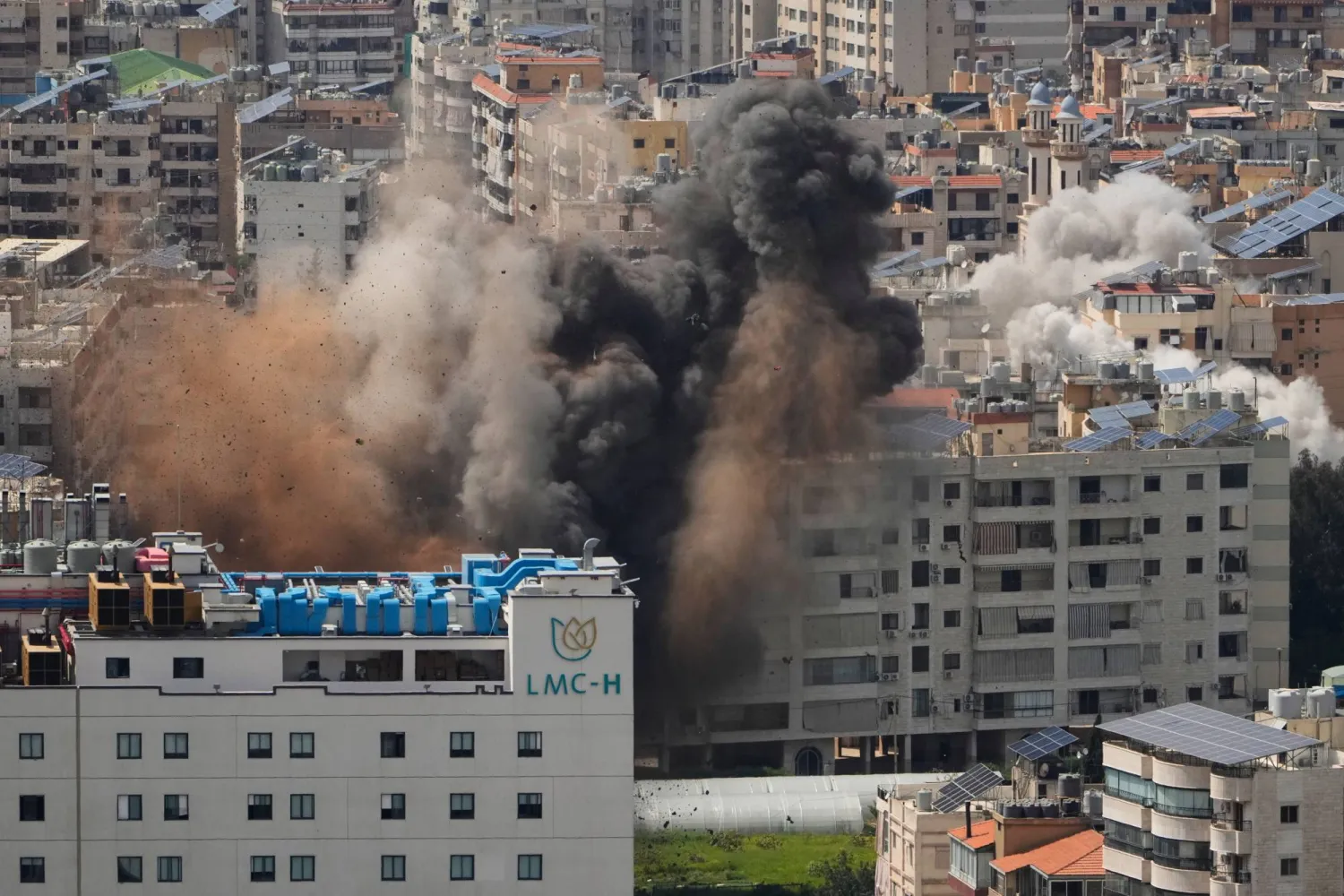
Smoke rises following several Israeli airstrikes in Beirut, Lebanon, Wednesday, April 8, 2026. (AP Photo/Hassan Ammar)
TT

Scores Killed as Israel Strikes Central Beirut After Saying Iran Ceasefire Doesn’t Apply There

Smoke rises following several Israeli airstrikes in Beirut, Lebanon, Wednesday, April 8, 2026. (AP Photo/Hassan Ammar)

Israeli strikes hit several dense commercial and residential areas in central Beirut without warning on Wednesday afternoon, hours after a ceasefire was announced in the US-Israeli war with Iran. Lebanon’s health ministry said at least 89 people were killed and 700 were wounded. 

US President Donald Trump told PBS News Hour that Lebanon was not included in the deal because of the Lebanese Hezbollah group. When asked about Israel’s latest strikes, he said, “That’s a separate skirmish.”  

Israel had said the agreement does not extend to its war with the Iran-backed Hezbollah, although mediator Pakistan said it does. 

The fleeting sense of relief among Lebanese after the ceasefire announcement turned into panic with what Israel’s military called its largest coordinated strike in the current war, hitting more than 100 Hezbollah targets within 10 minutes in Beirut, southern Lebanon and the eastern Bekaa Valley. 

Black smoke towered over several parts of the seaside capital, where a huge number of people displaced by war have taken shelter. Explosions interrupted the honking of traffic on what had been a bustling, blue-sky afternoon. Ambulances raced toward open flames. Apartment buildings were struck. 

Associated Press journalists saw charred bodies in vehicles and on the ground at one of Beirut’s busiest intersections in the central Corniche al Mazraa neighborhood, a mixed commercial and residential area. Using forklifts, rescue workers removed smoldering debris and sifted through ruins for survivors. 

There was no sign of Hezbollah launching strikes against Israel in the first couple of hours after the attacks. 

A deadly midday barrage  

Central Beirut has been targeted before, but not by so many strikes at once and in the middle of the day. Israel had rarely struck central Beirut since the outbreak of the latest Israel-Hezbollah war on March 2 but has regularly struck southern and eastern Lebanon and Beirut’s southern suburbs. 

Lebanon's Minister of Social Affairs, Haneed Sayed, in an interview with The Associated Press condemned Israel’s wide range of strikes, calling it a “very dangerous turning point.” 

“These hits are now at the heart of Beirut … Half of the sheltered (internally displaced people) are in Beirut in this area,” she said, adding that she had just driven by areas hit. 

She said Lebanon's government is ready to enter into negotiations with Israel for an end to hostilities, an offer that the Lebanese president previously made. Israel has not responded. “There are calls and efforts being made as we speak," Sayed said. 

Prime Minister Nawaf Salam in a statement accused Israel of escalating at a moment when Lebanese officials were seeking to negotiate a solution, and of hitting civilian areas in “utter disregard for the principles of international law and international humanitarian law — principles it has, in any case, never respected.” 

Lebanese President Joseph Aoun called the Israeli attacks “barbaric.” 

Israel's military said it had targeted missile launchers, command centers and intelligence infrastructure. It accused Hezbollah fighters of trying to “blend into” non-Shiite Muslim areas beyond their traditional strongholds. 

Residents and local officials denied that the buildings hit were military sites. 

“Look at these crimes,” said Mohammed Balouza, a member of Beirut’s municipal council, at the scene of a strike in Corniche al Mazraa. An apartment building behind a popular shop selling nuts and dried fruit had been hit. “This is a residential area. There is nothing (military) here.” 

An Israeli warning and a defiant Hezbollah  

As the smoke rose Wednesday, Israeli Defense Minister Israel Katz warned Hezbollah leader Naim Qassem that “his turn will come.” In 2024, Israel killed Hezbollah's previous leader, Hassan Nasrallah, with an airstrike. 

Katz called Wednesday's strikes the largest blow against Hezbollah since the attack that caused pagers used by hundreds of its members to explode almost simultaneously in September 2024. 

Before the new strikes, a Hezbollah official told the AP that the group was giving a chance for mediators to secure a ceasefire in Lebanon, but “we have not announced our adherence to the ceasefire since the Israelis are not adhering to it.” He spoke on condition of anonymity because he was not authorized to comment publicly. 

The Hezbollah official said the group will not accept a return to the pre-March 2 status quo, when Israel carried out near-daily strikes in Lebanon despite a ceasefire being nominally in place since the last full-blown Israel-Hezbollah war ended in November 2024. 

“We will not accept for the Israelis to continue behaving as they did before this war with regards to attacks,” he said. 

Hezbollah had fired missiles across the border days after the United States and Israel attacked Iran on Feb. 28, sparking a regional war. Israel responded with widespread bombardment of Lebanon and a ground invasion. 

The Israeli military chief of staff, Lt Gen. Eyal Zamir, said the attacks are to protect Israel’s northern residents, who have come under heavy fire. 

Since the war started and before Wednesday's attacks, Israeli airstrikes have killed more than 1,530 people in Lebanon, including more than 100 women and 130 children. The Israeli military has said it has killed hundreds of Hezbollah fighters. More than 1 million people have been displaced in Lebanon. 

Early Wednesday, after the Iran ceasefire was announced and before Israel struck, many displaced people sleeping in tents on the streets of Beirut and the coastal city of Sidon had begun packing their belongings in preparation to return home. 

Families at a sprawling displacement camp on Beirut’s waterfront later expressed confusion and despair. 

“We can’t take this anymore, sleeping in a tent, not showering, the uncertainty,” said Fadi Zaydan, 35. He and his parents had prepared to head back to the southern city of Nabatieh. Instead, they decided to wait things out in Sidon, a bit closer to home. 


Trump Says Israel and Lebanon Leaders to Hold Talks Thursday

TOPSHOT - US President Donald Trump speaks to the press outside the Oval Office at the White House in Washington, DC, on April 13, 2026. (Photo by Brendan SMIALOWSKI / AFP)
TT

Trump Says Israel and Lebanon Leaders to Hold Talks Thursday

TOPSHOT - US President Donald Trump speaks to the press outside the Oval Office at the White House in Washington, DC, on April 13, 2026. (Photo by Brendan SMIALOWSKI / AFP)

US President Donald Trump said Wednesday that leaders of Israel and Lebanon will speak Thursday, after they held a high-level face-to-face meeting in Washington Tuesday -- the first such negotiation since 1993.

"Trying to get a little breathing room between Israel and Lebanon. It has been a long time since the two leaders have spoken, like 34 years. It will happen tomorrow," Trump wrote without specifying who will be involved or offering further details.

Lebanon was pulled into the Middle East war on March 2 after Iran-backed Hezbollah attacked Israel, and more than 2,000 people have been killed by Israeli strikes since.


Damascus Foils Smuggling of 6,000 Detonators to Lebanon

Tunnel found in Homs countryside linking Qusayr to Lebanon (Syrian media)
TT

Damascus Foils Smuggling of 6,000 Detonators to Lebanon

Tunnel found in Homs countryside linking Qusayr to Lebanon (Syrian media)

Syrian authorities said they had thwarted an attempt to smuggle a large shipment of military-grade detonators from the Nabk area in the Qalamoun region of rural Damascus into Lebanon.

They also uncovered a cross-border tunnel and seized weapons depots prepared for smuggling, state media reported on Wednesday.

The Internal Security Directorate in Nabk said it dismantled a plan to move a large quantity of explosive detonators used in making improvised explosive devices, adding the shipment was bound for Lebanon.

In a statement, it said the operation was carried out with “high professionalism” after precise technical and field surveillance, preventing the materials from reaching their destination.

Authorities said about 6,000 detonators were seized, without identifying the smugglers or the intended recipients in Lebanon.

The announcement came as internal security forces in Homs reported discovering a tunnel linking Syrian and Lebanese territory in the border town of Housh al-Sayyed Ali, in the Qusayr area of southern Homs province.

Weapons and ammunition depots prepared for smuggling were also seized, according to the Syrian Al-Ikhbariya channel, which gave no details on who dug the tunnel.

Earlier this month, Syria’s defense ministry said it had uncovered a network of tunnels in the Qusayr area used to smuggle drugs and weapons, adding that Hezbollah had used them.

Qusayr has been one of Hezbollah’s main areas of influence in Syria since 2013, until the fall of its ally Bashar al-Assad. The area served as a key supply route from Albu Kamal on the Iraqi border in Deir al-Zor, through Palmyra and Homs, to the Lebanese border.

Media reports say tunnels are widespread along the Qusayr border, alongside informal crossings used by residents to move between the two countries. For many, smuggling has become a source of income amid worsening economic conditions, poverty, and security instability, complicating efforts to secure the border.

The developments come amid fears Syria could be drawn into a wider conflict through Lebanon and efforts to disarm Hezbollah, with backing from the United States and Israel.

On April 11, Syria’s interior ministry said its counterterrorism department, working with internal security in rural Damascus, arrested five people in a cell linked to Hezbollah after tracking suspicious activity in the capital.

Authorities said a woman in the cell was caught attempting to carry out an attack by planting an explosive device near the home of a religious figure in Bab Touma, close to the Mariamite Cathedral. Media reports identified the target as Rabbi Michael Houri.

Earlier this month, the defense ministry allowed a photographer from Agence France-Presse to document the army’s deployment along the border for the first time since reinforcements were sent about a month earlier, including several cross-border tunnels that had recently been uncovered.

Mohammad Hammoud, a Syrian-Lebanese border official, told AFP the army had discovered “a network of tunnels linking the two countries” used to smuggle weapons and drugs. A Syrian army field commander also said Hezbollah had used the tunnels.

Hezbollah fought alongside Assad’s forces in the conflict that began in 2011 as a peaceful uprising before escalating into war.

An AFP photographer saw at least five tunnels crossing the border, including one that started in a house basement and led via concrete steps into narrow, dark passageways used for transit.

On March 28, Syrian authorities said they found a tunnel near a village west of Homs linking Syria to Lebanon, adding that “Lebanese militias” had used it for smuggling before it was closed.

In February, the interior ministry said it dismantled a cell behind attacks in the Mezzeh district of Damascus, adding the weapons used had come from Hezbollah, which denied involvement.


Beirut MPs Meet to Back Weapons-Free City Declaration

Lebanese army soldiers deploy at the site of an Israeli airstrike in Beirut (AP)
TT

Beirut MPs Meet to Back Weapons-Free City Declaration

Lebanese army soldiers deploy at the site of an Israeli airstrike in Beirut (AP)

Beirut lawmakers and political parties in Lebanon’s parliament will hold a conference on Thursday backing a declaration of the capital as “safe and free of weapons,” after a government decision that followed deadly Israeli attacks on the city last week.

Organizers invited all Beirut MPs except those from Hezbollah and the Islamic Group, in a move targeting the party’s arms after the government banned its military activities.

The gathering also signals support for Prime Minister Nawaf Salam, who came under attack from Hezbollah after the decision.

Organizers told Asharq Al-Awsat that rejecting the targeting of Salam reflects that the move “expresses the decisions of the Council of Ministers collectively.”

Beirut MPs are expected to endorse government efforts to assert state sovereignty and cement the state’s exclusive authority over decisions of war and peace. This includes measures tied to Hezbollah, notably limiting arms to legitimate state forces.

They will also back the executive authority, represented by the president, prime minister, and cabinet, in declaring Beirut a weapons-free city, and call for a strong, comprehensive deployment of the Lebanese army and security forces to protect citizens and prevent any unauthorized arms or threats to stability.

MP Fouad Makhzoumi said the Israeli attack last Wednesday, while condemned, underscored the risks to the city’s security.

“There is no solution except to place all weapons under the control of the state, including Hezbollah’s arms. This is the gateway to strengthening stability and protecting all Lebanese,” he told Asharq Al-Awsat.

Makhzoumi said Beirut MPs fully support the decision and stressed the need for full, uncompromising implementation.

He called for a robust deployment of the army and security forces, warning against any leniency in enforcing measures he said would protect the city, its residents, and people displaced from southern Lebanon and other areas hit by Israeli attacks.

Last week, Beirut MPs, along with economic bodies and civil society groups, called for the conference to present a unified stance on developments, reaffirm the state’s role, and press for implementation of government decisions to protect the capital, its institutions, and residents.

In a statement, they condemned Israeli strikes on Lebanese territory, including Beirut, and rejected dragging Lebanon into a war “that has nothing to do with it,” while backing government steps to reinforce sovereignty and stability.

They also denounced incitement and unrest in Beirut, saying it endangers residents and threatens security, and reiterated their commitment to national unity and rejection of sectarian strife.