


US-Iran Truce Shows Cracks as War Flares in Lebanon

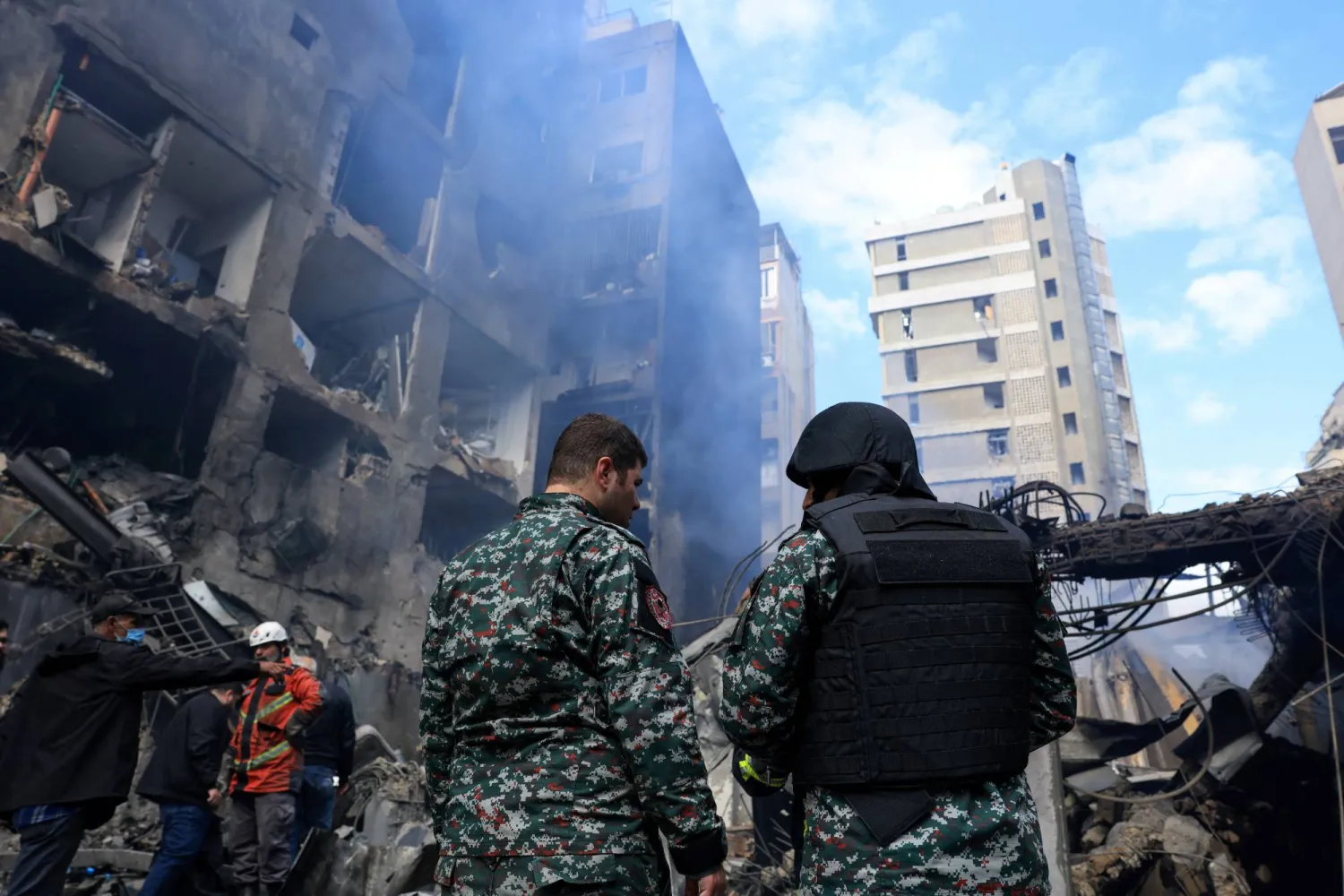
Rescuers stand at the site of an Israeli strike carried out on Wednesday, in Al-Mazraa in Beirut, Lebanon, April 9, 2026. REUTERS/Raghed Waked
TT

US-Iran Truce Shows Cracks as War Flares in Lebanon

Rescuers stand at the site of an Israeli strike carried out on Wednesday, in Al-Mazraa in Beirut, Lebanon, April 9, 2026. REUTERS/Raghed Waked

Lebanon declared a national day of mourning on Thursday after Israeli strikes pummeled the country, shaking a fragile truce less than 48 hours after it came into force.

Washington and Tehran both claimed victory after agreeing to a two-week ceasefire and negotiations aimed at ending a war that has killed thousands across the Middle East and sparked global economic upheaval, reported AFP.

But the deal's fractures emerged quickly on Wednesday as Israel carried out its heaviest strikes on neighboring Lebanon -- including in densely packed central Beirut -- since the Iran-backed militant group Hezbollah joined the war in early March.

At least 182 people were killed and nearly 900 wounded on Wednesday, the Lebanese health ministry said.

The Lebanese prime minister's office said Thursday will be "a national day of mourning for the martyrs and wounded of the Israeli attacks that targeted hundreds of innocent, defenseless civilians", ordering the closure of public administrations and the lowering of flags.

Hours later, Hezbollah said it had fired rockets towards Israel in response to its "violation" of the US-Iran truce, which was agreed to late Tuesday.

Israel has said its battle against the Lebanese group was not part of the ceasefire, an argument echoed by US Vice President JD Vance, days before he is due to lead talks with Tehran in Pakistan.

"If Iran wants to let this negotiation fall apart... over Lebanon, which has nothing to do with them, and which the United States never once said was part of the ceasefire, that's ultimately their choice," he said.

But Iran's parliament speaker Mohammad Bagher Ghalibaf appeared to threaten the ceasefire, posting on X that the "workable basis on which to negotiate" had already been violated, making further talks "unreasonable".

Ghalibaf listed three alleged US violations of the truce plan: the continued attacks in Lebanon, a drone entering Iranian airspace and a denial of the country's right to enrichment.

Adding to the fragility of the truce -- agreed hours before a deadline set by US President Donald Trump -- a senior US official said Iran's 10-point plan was not the same set of conditions the White House had agreed to in order to pause the war.

In Lebanon, where UN rights chief Volker Turk called the scale of killing "horrific", strikes across the capital Beirut without warning triggered scenes of horror and panic.

"People started running left and right, and smoke was billowing," said Ali Younes, who was waiting for his wife near Corniche al-Mazraa, one of the areas targeted.

More than 1,700 people have been killed in Lebanon since Israel launched airstrikes and a ground invasion last month, local officials said.

Iran's Revolutionary Guards warned they would "fulfil our duty and deliver a response" if Israel did not cease its strikes, while Hezbollah said it had a "right" to respond.

Israeli Prime Minister Benjamin Netanyahu said the country remained prepared to confront Iran if necessary, as it still had "objectives to complete", with the military saying it continued to pursue the goal of "disarming" Hezbollah in Lebanon.

Pentagon chief Pete Hegseth also vowed that American forces remained at the ready if the conflict flared up again.

- High-stakes talks -

The belligerent rhetoric came ahead of high-stakes talks in Pakistan expected on Friday or Saturday, after Iran temporarily agreed to reopen the Strait of Hormuz under threat of annihilation by Trump, with a small number of ships passing through the strategic waterway on Wednesday.

Iran announced alternative routes on Thursday for ships travelling through the strait -- a narrow waterway through which one-fifth of the world's oil passes -- citing the risk of sea mines in its main navigational zone.

But it was unclear if Tehran was allowing vessels to pass through the strait, following reports on Wednesday suggesting it was shut -- something the White House called "completely unacceptable".

Pakistani Prime Minister Shehbaz Sharif, whose country mediated the ceasefire, urged on X for all parties to "exercise restraint and respect the ceasefire for two weeks" to allow diplomacy to take hold.

Further casting doubt on the truce's durability, Iranian state media announced fresh missile and drone attacks against US-allied Gulf states in retaliation for airstrikes on its oil facilities, with Kuwait, the UAE, Saudi Arabia and Bahrain all reporting strikes since the ceasefire took effect.

There have been no reports of fresh attacks on other countries across the region in the past hours.

In Tehran, streets were quieter than usual on Wednesday, with many shops closed after a long and anxious night for residents fearing a massive US attack.

"Everyone is at ease now," said Sakineh Mohammadi, a 50-year-old housewife, adding she was "proud" of her country.

"We are more relaxed."

On Wednesday, the leaders of several European nations, Canada and the United Kingdom said "a swift and lasting end to the war" must be negotiated, as Pope Leo hailed a moment of "real hope".

But Tehran's demands over uranium enrichment, economic sanctions and future control of the Strait of Hormuz remain deeply at odds with those of the United States.



Egypt-Pakistan Military Drill Underscores Closer Ties

Launch of the joint Egyptian-Pakistani “Raad 2” exercise in Pakistan on Thursday (Egyptian military spokesman)
TT

Egypt-Pakistan Military Drill Underscores Closer Ties

Launch of the joint Egyptian-Pakistani “Raad 2” exercise in Pakistan on Thursday (Egyptian military spokesman)

A joint military exercise between Egypt and Pakistan has underscored growing ties between the two countries, which became increasingly evident during the recent Iran war.

The joint drill, dubbed “Raad 2,” began Thursday with the participation of Egyptian paratroopers and Pakistani special forces and is set to run for several days at special forces training grounds in Pakistan.

Egypt’s military spokesman said the exercise includes a range of joint training activities focused on special operations and counterterrorism, aimed at exchanging tactical expertise, aligning operational concepts and enhancing coordination and combat readiness among participating units.

Pakistan, Egypt and Türkiye emerged as key mediators in the Iran war, which began on Feb. 28.

Egyptian President Abdel Fattah al-Sisi on Wednesday welcomed the ceasefire announced this week between the US and Iran and urged all parties to engage seriously in talks “to achieve lasting peace and peaceful coexistence among the peoples of the region and the world.”

Cairo also reiterated its support for initiatives aimed at achieving peace and security, stressing its continued efforts with Pakistan and Türkiye to work with regional and international partners to enhance stability.

Pakistan, which maintains good relations with both the administration of US President Donald Trump and neighboring Iran, played a mediating role between Washington and Tehran.

Pakistani Prime Minister Shehbaz Sharif said Wednesday in a post on X that China, Saudi Arabia, Türkiye, Egypt and Qatar had all provided support to help secure a ceasefire and give diplomacy a chance.

A four-way meeting involving Saudi Arabia, Egypt, Türkiye and Pakistan held in Islamabad in late March discussed ways to enhance coordination in response to rapid developments and escalating military tensions in the region.

Participants also exchanged assessments of the severe economic repercussions of the escalation, including its impact on international shipping, supply chains, food security and energy security amid rising oil prices.

Rakha Ahmed Hassan, a member of the Egyptian Council for Foreign Affairs and a former assistant foreign minister, said Egyptian-Pakistani cooperation dates back many years and includes joint exercises and exchanges of expertise.

He told Asharq Al-Awsat the drill aims to strengthen ties and benefit from evolving military experience, particularly in light of new weapons and technologies introduced in both countries.

He added the exercise is not directly linked to the Iran war but comes within the broader context of addressing various challenges. “The training is military support and is not directed against anyone,” he stated.

In recent days, Egyptian Foreign Minister Badr Abdelatty held daily contacts with his Pakistani counterpart, Ishaq Dar, and Turkish Foreign Minister Hakan Fidan to discuss efforts to launch direct negotiations between the US and Iran and to promote diplomacy over military escalation.

Hassan said Egypt, Pakistan and Türkiye played a significant role in reaching a truce, noting that the three countries helped bridge differences between the sides thanks to their strong relations with all parties and their interest in ending a war that caused heavy damage to all sides, including the US and Israel.


Israel Targets Last Litani Bridges, Raising Fears of South Lebanon Isolation

Civil defense personnel inspect damage caused by an Israeli strike targeting the Qasmiyeh bridge over the Litani River in South Lebanon (AFP). 
TT

Israel Targets Last Litani Bridges, Raising Fears of South Lebanon Isolation

Civil defense personnel inspect damage caused by an Israeli strike targeting the Qasmiyeh bridge over the Litani River in South Lebanon (AFP). 

Israel is intensifying strikes on bridges over Lebanon’s Litani River, raising concerns it aims to isolate the entire area south of the river from the north, Lebanese officials and state media said.

The Israeli military struck the Qasmiyeh coastal bridge, the last functioning crossing linking areas south of the Litani with the north, damaging it and further restricting movement. A second strike later hit the same area, according to Lebanon’s National News Agency (NNA).

Civil defense teams worked to clear high-voltage cables severed in the attack, allowing limited traffic to resume on a single lane.

Over the past two weeks, Israel has targeted seven main bridges over the Litani, leaving Qasmiyeh as the final link before it was partially damaged in Wednesday night’s strike.

Lebanese authorities warn that continued attacks could effectively besiege around 50,000 civilians in the southern city of Tyre, its suburbs and nearby Palestinian refugee camps, as well as thousands of Lebanese troops and UN peacekeepers deployed in the area.

Several families south of the river have appealed for evacuation under international supervision, citing what they describe as a “complete siege” following the damage to the bridge.

Official sources told Asharq Al-Awsat that food stocks in the area would last no more than 15 days, warning of shortages of food and medicine if supply routes are not restored within two weeks.

The Lebanese Army said Thursday it had reopened the Qasmiyeh bridge with the help of civil defense and local groups, and deployed a unit nearby to secure it.

Authorities are studying contingency plans with the United Nations to supply the area if access routes are fully cut, in a bid to avert a humanitarian crisis.

“We are trying to address the repercussions by all means. We will not allow the area to be isolated from the rest of Lebanon,” the sources said, adding that practical proposals were under review.

The impact extends beyond civilians to military personnel. Around 7,700 Lebanese soldiers are deployed south of the Litani, alongside roughly 7,500 troops from the United Nations Interim Force in Lebanon (UNIFIL), according to sources familiar with the deployment.

Most UN peacekeepers are stationed south of the river, though troop numbers have declined in recent months due to financial constraints at the United Nations, the sources said.

They added that UNIFIL, a military peacekeeping force, is adapting its operations to evolving conditions, as it has done since fighting escalated on March 2.

UNIFIL troops are currently positioned in areas where clashes are taking place between Israeli forces and Hezbollah.


US Summons Iraqi Ambassador Over Drone Strike on Diplomatic Facility in Baghdad

A man waves the flags of Iraq and Iran from the sunroof of a vehicle during celebrations welcoming the two-week ceasefire between the United States and Iran in Baghdad's central Tahrir Square on April 8, 2026. (AFP)
TT

US Summons Iraqi Ambassador Over Drone Strike on Diplomatic Facility in Baghdad

A man waves the flags of Iraq and Iran from the sunroof of a vehicle during celebrations welcoming the two-week ceasefire between the United States and Iran in Baghdad's central Tahrir Square on April 8, 2026. (AFP)

US Deputy Secretary of State Christopher Landau summoned Iraqi Ambassador Nizar Khirullahon Thursday after a drone struck a major US diplomatic facility in Baghdad, the State Department said in a statement.

The US Embassy in Baghdad said earlier that Iraqi "terrorist militias," who Washington accused of being aligned with ‌Iran, had ‌conducted multiple drone attacks near ‌the ⁠Baghdad Diplomatic Support Center ⁠and Baghdad International Airport on Wednesday.

The State Department said Landau acknowledged the Iraqi security forces' efforts to respond while emphasizing "the Iraqi government's failure to prevent these attacks."

The State Department said Washington expects the Iraqi government to take measures to dismantle ⁠Iran-aligned factions in Iraq.

It also ‌said that "some elements associated ‌with the Iraqi government continue to actively provide political, ‌financial, and operational cover for the militias."

Dozens of ‌people have been killed in Iraq since the start of the Iran war, according to Iraqi health authorities. Those include civilians, members of the Iran-affiliated Popular ‌Mobilization Forces, US-allied Kurdish Peshmerga fighters, police and army.

The Iran war began ⁠when the ⁠US and Israel attacked Iran on February 28. Iran responded with its own strikes on Israel and Gulf states with US bases. US-Israeli strikes on Iran and Israeli attacks on Lebanon have killed thousands and displaced millions.

US President Donald Trump announced a two-week ceasefire with Iran on Tuesday, which has remained fragile. The US president had previously threatened to destroy Iran's entire civilization in remarks that were widely condemned.