
US Report: Ethiopia Army Base Used to Support Sudan’s RSF

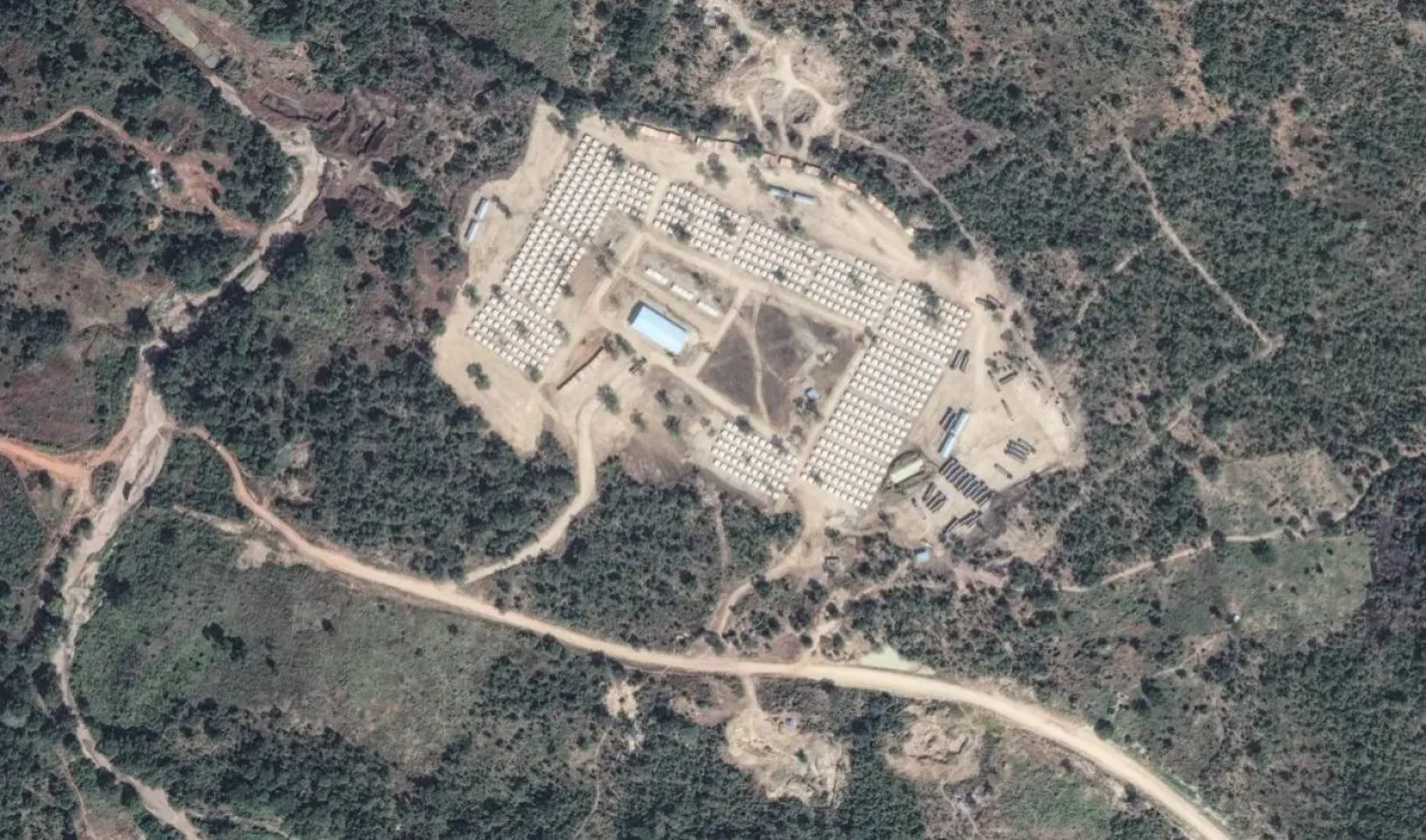
Satellite imagery taken on January 22, 2026 shows a camp with hundreds of tents and an area to the north where trucks come and go in Benishangul-Gumuz, Ethiopia. Source: Vantor
TT

US Report: Ethiopia Army Base Used to Support Sudan’s RSF

Satellite imagery taken on January 22, 2026 shows a camp with hundreds of tents and an area to the north where trucks come and go in Benishangul-Gumuz, Ethiopia. Source: Vantor

An Ethiopian military base close to the Sudanese border is lending support to the Rapid Support Forces, according to a report by a research unit at Yale University released Wednesday.

The Yale School of Public Health's Humanitarian Research Lab (HRL) said analysis of satellite imagery and open-source data shows activity "consistent with military assistance to the RSF" at an Ethiopian base in Asosa, in the Benishangul-Gumuz region, between late December 2025 and late March 2026.

The paramilitary group, which has been at war with Sudan's army since April 2023, was accused last month by the Sudanese military of launching drone attacks "from inside Ethiopian territory", the first public allegation of Ethiopian involvement in the conflict.

Ethiopia has denied the claim and has also rejected allegations that it is hosting RSF camps.
Yale's HRL has used remote sensing data and satellite imagery to monitor the war since it began.

Its researchers said their findings "represent clear visual evidence over a five-month period" that RSF attacks on Sudan's southeastern Blue Nile State were being launched from within Ethiopia.

The researchers identified repeated arrivals of commercial car carriers at the base unloading vehicles known as "technicals", light pickup trucks commonly used by armed groups.

HRL said these vehicles do not match those normally used by the Ethiopian military and have been observed supplying RSF units operating in Sudan's Blue Nile state.

According to the report, some of the vehicles were later fitted with gun mounts "capable of holding heavy machine guns".

Objects consistent with 50-calibre weapons were also observed nearby, the report said.

HRL added that similar vehicles later appeared in open-source images from fighting around Al-Kurmuk, a strategic Sudanese border town roughly 100 kilometers (62 miles) by road from Asosa.

Recent fighting has intensified around Al-Kurmuk, a key army position.

This year, an estimated 28,000 people were displaced by fighting in Blue Nile, including more than 10,000 from Al-Kurmuk alone.

Control of the state is divided between Sudan's army and RSF allies from the Sudan People's Liberation Movement-North (SPLM-N), led by Abdelaziz al-Hilu.

The paramilitaries have recently claimed victories in the area.

The Yale lab also documented increased logistical activity at the Asosa base, including the arrival of shipping containers, fuel tanks and tents capable of housing up to 150 people.

White armored vehicles inconsistent with Ethiopian military markings were also seen, alongside frequent movements of non-military transport trucks.

Separately, satellite imagery showed significant expansion at Asosa airport, including "a new hangar and concrete pad" and defensive fighting positions.

Imagery previously analyzed by AFP has shown significant development at the airport, which previously served as a drone base.

The RSF last year brought thousands of fighters into Ethiopia, an RSF source and an army source told AFP.

Separately, two UN agencies said on Thursday that more than a million Sudanese refugees face drastic cuts in life-saving aid such as food and water unless donors fill a funding shortfall of over $400 million.

Over 1.3 million Sudanese refugees are living in neighboring Chad, with most of them arriving since the start of the conflict in Sudan between the army and the RSF in April 2023. Among them are survivors of mass ⁠killings and famine from ⁠Darfur.

The World Food Programme and the UN refugee agency do not have enough funds to help them all and envisage further cuts in the coming months unless a $428 million shortfall can be met, they said in a joint statement.

"...With less than half the resources we require, we ⁠cannot deliver sufficient food to the people who need it most,” said WFP Chad Country Director Sarah Gordon-Gibson. "This will force them into devastating coping strategies and put lives at risk.”

Lebanon Says Israeli Attack Killed 13 State Security Personnel in Nabatieh

Flames and smoke engulf part of the site of an Israeli airstrike that targeted the Lebanese State Security Center, in the Southern Lebanese city of Nabatieh on April 10 2026. (AFP)
TT

Lebanon Says Israeli Attack Killed 13 State Security Personnel in Nabatieh

Flames and smoke engulf part of the site of an Israeli airstrike that targeted the Lebanese State Security Center, in the Southern Lebanese city of Nabatieh on April 10 2026. (AFP)

Lebanon's President Joseph Aoun said on Friday that 13 state security ‌personnel ‌were killed ‌in an ⁠Israeli strike on ⁠a governmental building in the southern city ⁠of ‌Nabatieh.

In a ‌statement, Aoun ‌condemned ‌continued Israeli attacks and said targeting ‌state institutions would not ⁠deter ⁠Lebanon from defending its sovereignty.

Naim Qassem, head of Iran-backed armed group Hezbollah, called on the Lebanese state to stop giving "free concessions" to Israel, with the two governments due to begin negotiations next week to end the war that has left nearly 1,900 people in Lebanon dead.

The government banned Hezbollah's military activities at the beginning of the latest war with Israel in March and is moving towards bilateral negotiations with Israel despite the opposition of Hezbollah, which is represented in the cabinet and parliament.

The state-run National News Agency (NNA) said "enemy warplanes launched a series of heavy strikes" on Nabatiyeh, including one in the vicinity of the government complex hitting the State Security office.

An AFP photographer saw extensive damage at the site, where a fire was still raging.

- Diplomatic scramble -

As the government prepared for talks with Israel in Washington, outside the auspices of the US-Iran talks in Islamabad, Qassem called on officials "to stop offering free concessions" and described Israel's military campaign as a failure.

"The Israeli enemy has failed on the battlefield... It has been unable to carry out the ground invasion it repeatedly announced," he said, adding that "the resistance will continue until the last breath".

More than 300 people, mostly civilians according to a Lebanese military source, were killed in a wave of simultaneous Israeli strikes on Lebanon on Wednesday despite the announcement hours earlier of a truce between the United States and Iran, with Israel and the US saying it did not apply to Lebanon.

Iran has insisted on including Lebanon in its ceasefire negotiations with the US.

- Quiet in Beirut -

On Thursday afternoon, the Israeli military issued a warning of incoming strikes for large, densely populated areas of southern Beirut, but had not carried out the threat as of Friday, with a Western diplomat telling AFP Friday that European and Arab states are pressuring Israel to stop targeting Beirut.

The Western diplomat, who asked to remain anonymous in order to discuss sensitive matters, said on Friday that "there is ongoing diplomatic pressure from European states, Gulf states and Egypt on Israel to prevent renewed Israeli airstrikes on Beirut after 'Black Wednesday'".

Thursday's Israeli warning included areas home to major hospitals and the road to the country's only international airport.

Public Works and Transport Minister Fayez Rasamny said, in a statement carried by the state-run National News Agency (NNA) on Thursday, that he had "received assurances" from foreign diplomats that the airport and the road leading to it would be spared.

Meanwhile, Mohammad Zaatari, director of the country's largest public medical facility, Rafic Hariri Hospital, told AFP: "We have received assurances, including from the International Committee of the Red Cross that the hospital would not be targeted."

The World Health Organization on Thursday called on Israel to cancel its evacuation warning for the Jnah district of Beirut because around 450 patients were in the Rafic Hariri and Al-Zahraa hospitals in the district, including 40 in intensive care.

The Israeli military said on Friday it had "dismantled" more than 4,300 Hezbollah sites in Lebanon and killed "more than 1,400" Hezbollah fighters.

Hezbollah, for its part, claimed several rocket launches on northern Israel, as well as attacks on Israeli troops advancing in the border area.

Hezbollah also said it targeted a naval base in the southern Israeli city of Ashdod on Friday, far from the border, with missiles.


Israel’s Zamir: Lebanon is the Main Combat Arena

First responders gather at the site of an Israeli airstrike in the village of Habbouch, southern Lebanon on April 10, 2026. (Photo by Abbas FAKIH / AFP)
TT

Israel’s Zamir: Lebanon is the Main Combat Arena

First responders gather at the site of an Israeli airstrike in the village of Habbouch, southern Lebanon on April 10, 2026. (Photo by Abbas FAKIH / AFP)

The head of Israel’s military, Lt. Gen. Eyal Zamir, has said that the “main combat arena is in Lebanon.”

The mission is to keep weakening Hezbollah, Zamir said.

He was speaking on Thursday to Israeli troops inside Lebanon, on the outskirts of the town of Bint Jbeil.

“Our main combat arena is here in Lebanon,” he stated.

Zamir said the army’s mission is to “continue deepening the damage and to continue weakening Hezbollah.”

He added that the objective is to remove the direct threat to residents of northern Israel.

Israeli Prime Minister Benjamin Netanyahu has offered a potential boost to ceasefire efforts in the region when saying he had approved direct talks with Lebanon.

The announcement came after Israel’s pounding of Beirut Wednesday killed more than 300 people. The negotiations are expected next week in Washington.


Macron Meets Pope Leo to Talk Lebanon, Middle East War

 French President Emmanuel Macron and his wife Brigitte Macron are welcomed as they arrive at the San Damaso courtyard to meet Pope Leo XIV at the Vatican, April 10, 2026. (Reuters)
French President Emmanuel Macron and his wife Brigitte Macron are welcomed as they arrive at the San Damaso courtyard to meet Pope Leo XIV at the Vatican, April 10, 2026. (Reuters)
TT

Macron Meets Pope Leo to Talk Lebanon, Middle East War

 French President Emmanuel Macron and his wife Brigitte Macron are welcomed as they arrive at the San Damaso courtyard to meet Pope Leo XIV at the Vatican, April 10, 2026. (Reuters)
French President Emmanuel Macron and his wife Brigitte Macron are welcomed as they arrive at the San Damaso courtyard to meet Pope Leo XIV at the Vatican, April 10, 2026. (Reuters)

French President Emmanuel Macron arrived Friday at the Vatican for his first meeting with Pope Leo XIV, a private audience expected to be dominated by the Iran war.

The French leader, who arrived with his wife Brigitte after flying to Rome on Thursday, will meet the US pontiff and the Vatican's secretary of state, Pietro Parolin.

Macron and the leader of the world's 1.4 billion Catholics were due above all to discuss "the resolution of the crisis in the Middle East", a spokesman for Macron's office told reporters.

They are particularly focused on Lebanon, where deadly Israeli strikes threatened this week's temporary truce between the US and Iran.

Leo XIV visited Lebanon late last year as part of his first trip abroad, which also included Türkiye, and has repeatedly prayed for the victims of conflict there.

Macron has also made numerous appeals for Lebanon to be included in the ceasefire.

He discussed the conflict on Thursday evening with representatives of the Catholic community of Sant'Egidio, an informal diplomatic channel of the Holy See that is very active on Middle Eastern and humanitarian issues.

"Macron is a man of peace," and "can do a lot" to "support" the Lebanese authorities, the community's founder, Andrea Riccardi, told reporters, adding that Lebanon "must not be left alone".

In recent days, both Macron and the Chicago-born pontiff have spoken out against US President Donald Trump over the war, which began with Israel-US attacks on Iran.

Leo condemned as "unacceptable" threats to civilian targets -- while not citing Trump by name -- while Macron said there was "too much talk, and it's all over the place".

Both welcomed the truce and have urged a diplomatic solution to the war, which has expanded across the Middle East and roiled the global economy.

The US government on Thursday denied a report that the Vatican's US envoy was summoned in January for a "bitter" dressing down over a speech by the pope condemning "diplomacy based on force", in remarks widely viewed as aimed at the Trump administration.

Macron is expected to invite Leo, a more reserved character than his predecessor, to visit France soon.

Friday's meeting at the Vatican comes three days before the pope's visit to the former French colony of Algeria, the first ever by a pontiff.