


For First Time in Two Months, 323 Trucks Enter Gaza in One Day

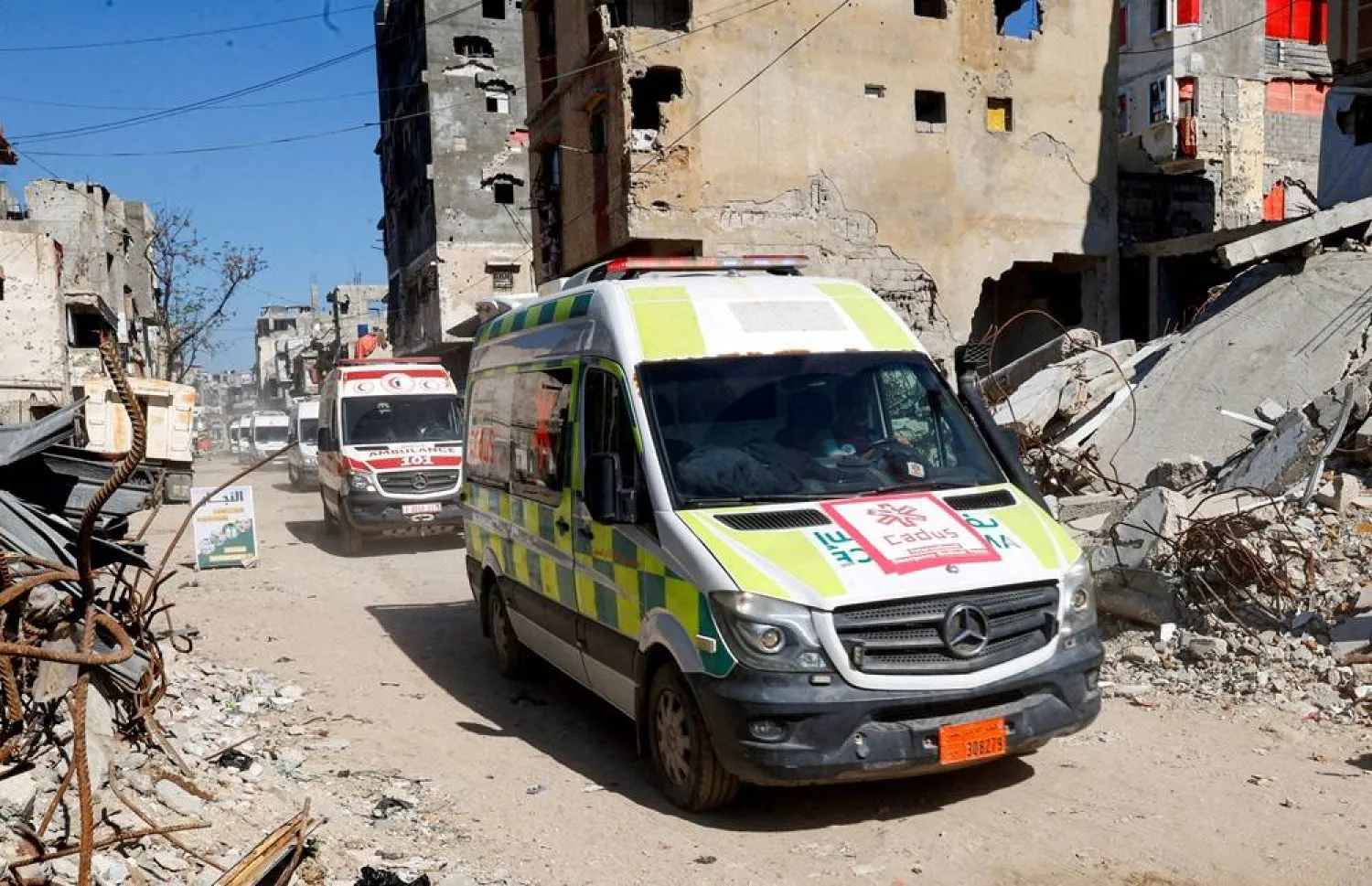
A convoy carrying wounded Palestinians from Gaza for treatment through the Rafah border crossing between Gaza and Egypt, after it was reopened by Israel on Sunday for a limited number of people, rides through Khan Younis in the southern Gaza Strip, April 12, 2026. (Reuters)
TT

For First Time in Two Months, 323 Trucks Enter Gaza in One Day

A convoy carrying wounded Palestinians from Gaza for treatment through the Rafah border crossing between Gaza and Egypt, after it was reopened by Israel on Sunday for a limited number of people, rides through Khan Younis in the southern Gaza Strip, April 12, 2026. (Reuters)

For the first time in two months, the Gaza Strip has seen a sharp increase in trucks carrying aid and commercial goods, alongside a rise in travelers crossing through the Rafah land crossing in both directions.

A total of 323 trucks entered Gaza on Monday, including 220 commercial shipments for the private sector and 103 aid trucks from international organizations.

Of these, 234 trucks came through the Kerem Shalom crossing in the far south, and 89 through the Zikim crossing in northern Gaza, which reopened on Sunday after 44 days.

Workers in Gaza’s civil and charitable sectors expect the Kissufim crossing, between northern Khan Younis and southern Deir al-Balah, to open on Sunday to further increase the flow of trucks.

A source in Gaza’s economy ministry said most of the incoming shipments were commercial goods, including food supplies carried on more than 270 trucks, along with shelter materials, relief items, consumer goods, household supplies, fuel, and telecommunications equipment.

“For the first time in about two months, this number of trucks has been allowed in,” the source told Asharq Al-Awsat, adding that fewer trucks had entered since the ceasefire took effect on October 10.

The ceasefire deal stipulates the entry of 600 trucks per day, but Hamas and UN bodies have accused Israel of allowing only limited numbers.

The source said most trucks entering since the ceasefire have carried commercial goods, while aid shipments from Arab, Islamic, and international donors, including UN agencies, have been more limited.

Gaza officials have been told that more trucks and goods could be allowed in to help ease prices.

Israel on Tuesday allowed 126 Palestinians, including 41 patients and 85 companions, to travel after coordination by the World Health Organization. About 18 foreign passport holders also left through the crossing in coordination with their countries.

Israel partially reopened the Rafah crossing under the ceasefire at the start of February, shut it again when the war with Iran began later that month, and reopened it on March 19.

Since the ceasefire, the number of people allowed to pass through Rafah has remained limited, occasionally reaching 100, with expectations that it could rise to 150 a day.

A Palestinian source in Gaza said the recent easing in truck entries and movement through Rafah followed an agreement reached by Gaza’s representative at the Board of Peace, Nickolay Mladenov, with Israel to push compliance with the ceasefire terms.

For now, only patients are allowed to travel through Rafah, but other categories, including students and stranded civilians, could be permitted within about two weeks.

Palestinian factions, led by Hamas, have called on Mladenov and mediators to press Israel to fully implement the first phase of the ceasefire before moving to the second. Contacts and meetings on the issue are ongoing in Cairo.



16 Dead in Bus Crash in Egypt's Sinai

Ambulance vehicles in Egypt (Egyptian Ambulance Authority)
TT

16 Dead in Bus Crash in Egypt's Sinai

Ambulance vehicles in Egypt (Egyptian Ambulance Authority)

A bus crash in Egypt's eastern Sinai Peninsula on Wednesday killed 16 people and injured 28 others, the health ministry reported.

Twenty ambulances rushed to the scene of the accident, which occurred on the road between the popular tourist towns of Dahab and Nuweiba on South Sinai's eastern coast, the ministry said.

Authorities said the injured were receiving medical care but did not say what caused the crash, according to AFP.

The area is a popular tourist destination, known for its marine biodiversity, natural beauty and mountain hiking trails.

Car crashes are common in Egypt, and often blamed on reckless driving, poor maintenance and uneven law enforcement.

Last year, nearly 6,000 people died in road accidents across the country, according to Egypt's state statistics agency.


Yemen Announces Killing of ISIS Spokesman

Terrorist organizations in Yemen previously controlled vast areas before being mostly defeated. (Local media)
TT

Yemen Announces Killing of ISIS Spokesman

Terrorist organizations in Yemen previously controlled vast areas before being mostly defeated. (Local media)

Yemen announced on Tuesday the killing of the spokesman of the ISIS terrorist group Abou Huzayfah al-Ansari during an operation carried out by the Arab coalition special forces, with the support of Yemen's counter-terrorism force, "Force 22" in Seiyun city.

Informed Yemeni sources told Asharq Al-Awsat said the spokesman’s original name is Mithaq Thabet Haitham al-Hujaili, a Yemeni who hails from the Hajjah province.

Speaking on condition of anonymity, the sources said he was the spokesman of the entire terrorist organization, underlining the significance of the operation and his position in the group.

State security media in Yemen said the operation was carried out on Tuesday as part of the cooperation and exchange of intelligence between the State Security Service and Arab coalition joint command.

The forces were able to eliminate the target while he was hiding in a home in Seiyun, it added in a statement.

It said he was with eight civilians at the time, including a man, two women and five children. The forces managed to escort the women and children to a safe place. They were not harmed in the operation.

The other man was arrested. He was injured while resisting arrest.

The statement said that no one else was harmed and no property was damaged in the operation.

The forces discovered an explosives belt, which was detonated to avoid harming civilians, at the house. Also discovered were a laptop and five mobile phones.

The operation was declared a success. The statement did not provide more information about Abou Huzayfah or the details about how the forces were able to locate his whereabouts.

The operation took place as ISIS has lost its ability to maintain control over areas in Yemen following years of security and military operations against it.

The terrorist group had first emerged in the country in 2014, exploiting the collapse of state institutions in wake of the Houthi coup and the expansion of the war.

It managed to establish a presence in several regions, including al-Bayda, Hadramawt and Shabwa, before being dealt successive defeats that diminished its power.

The group then resorted to operating through limited cells and hiding in remote or residential areas and carrying out sporadic attacks using explosives.

The State Security Service vowed that the Yemeni government will continue to crack down on wanted terrorists and bring them to justice in cooperation with the Saudi-led Arab coalition and international partners.


Iraqi Factions Set Conditions for Laying Down Arms

A member of an Iraqi armed faction. (X)
TT

Iraqi Factions Set Conditions for Laying Down Arms

A member of an Iraqi armed faction. (X)

Hadi al-Ameri, head of Iraq’s Badr organization, which is allied with Iran, laid “impossible” conditions for Iraqi armed factions to lay down their weapons.

Once appearing as a moderate to avoid incurring Washington’s anger, he has adopted a hard line over the disarmament of the factions. His previous positions allowed him to avoid the US imposing sanctions against him.

In a televised address, Ameri dismissed the possibility that Prime Minister Ali al-Zaidi would take a “radical” decision over the weapons of the “resistance” factions.

He echoed official statements that September 30 should be a day of celebration after the withdrawal of anti-ISIS coalition forces from the country.

He added, however, that full sovereignty can be achieved over land, sea and air with the pullout of all foreign troops, including the Americans and Turks, and with a pledge that they will not violate Iraqi sovereignty.

September 30 is the deadline for the withdrawal of anti-ISIS coalition forces and for the Iraqi armed factions to lay down their weapons.

Ameri spoke of the Iranian and Turkish armed groups deployed on Iraqi territory, demanding that they all lay down their weapons and saying that they are a threat to regional countries.

Their deployment violates the constitution, he remarked.

He also called on the parliament to ratify the law on the Popular Mobilization Forces (PMF) that the US had objected to and that led to the legislature abandoning the vote.

The law “grants the factions operating under the PMF legal guarantees”, sparking the American objections.

Ameri also praised the role of the “resistance” that have stood by Iraq whenever it was needed.

It was the “resistance that protected Iraq from the October strife,” he stressed, in reference to the October 2019 anti-government protests.

His remarks were the first implicit acknowledgement that the armed factions were responsible for the killing and torture of over 700 youths involved in the protests.

Activists and politicians close to Iran had at the time blamed a “third party” for the crimes.

Political activist Nizar Haidar said the previous conditions set by the factions and other political figures for the handover of weapons are aimed at “buying time” as the September deadline approaches.

In remarks to Asharq Al-Awsat, he said Ameri is implicating himself and the Iran-aligned Coordination Framework, which are in control of the country, its security and decision-making.

Haidar said September 30 will be a turning point that will test Iraq and its ability to implement its laws and constitution or whether the militias will come out on top by ignoring the government’s order for them to lay down their weapons.

Political science professor at the University of Mosul Firas Elias said Iraq is now being embroiled in a debate about defining the meaning of limiting of possession of weapons to the state, its timing and who should take the first step.

He said Ameri is aiming to set a very high ceiling for negotiations.

Other conditions that have been floated in Iraq include halting dealings with American companies, exporting oil in another currency, tackling the presence of the Kurdistan Workers’ Party and Kurdish Iranian opposition groups, and expanding the authority of the Iraqi federal forces to the Kurdistan Region.