

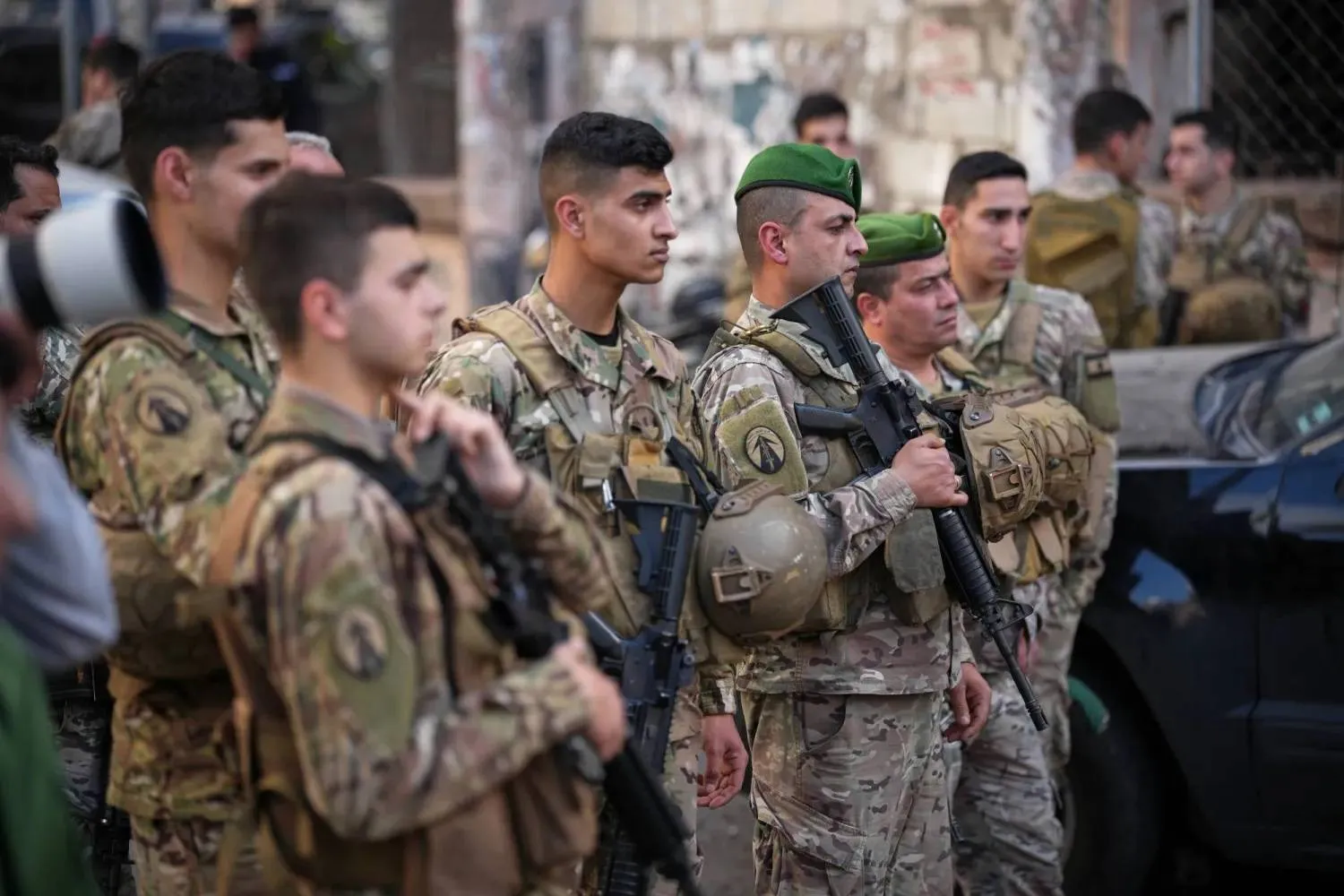

Beirut MPs Meet to Back Weapons-Free City Declaration

Lebanese army soldiers deploy at the site of an Israeli airstrike in Beirut (AP)
TT

Beirut MPs Meet to Back Weapons-Free City Declaration

Lebanese army soldiers deploy at the site of an Israeli airstrike in Beirut (AP)

Beirut lawmakers and political parties in Lebanon’s parliament will hold a conference on Thursday backing a declaration of the capital as “safe and free of weapons,” after a government decision that followed deadly Israeli attacks on the city last week.

Organizers invited all Beirut MPs except those from Hezbollah and the Islamic Group, in a move targeting the party’s arms after the government banned its military activities.

The gathering also signals support for Prime Minister Nawaf Salam, who came under attack from Hezbollah after the decision.

Organizers told Asharq Al-Awsat that rejecting the targeting of Salam reflects that the move “expresses the decisions of the Council of Ministers collectively.”

Beirut MPs are expected to endorse government efforts to assert state sovereignty and cement the state’s exclusive authority over decisions of war and peace. This includes measures tied to Hezbollah, notably limiting arms to legitimate state forces.

They will also back the executive authority, represented by the president, prime minister, and cabinet, in declaring Beirut a weapons-free city, and call for a strong, comprehensive deployment of the Lebanese army and security forces to protect citizens and prevent any unauthorized arms or threats to stability.

MP Fouad Makhzoumi said the Israeli attack last Wednesday, while condemned, underscored the risks to the city’s security.

“There is no solution except to place all weapons under the control of the state, including Hezbollah’s arms. This is the gateway to strengthening stability and protecting all Lebanese,” he told Asharq Al-Awsat.

Makhzoumi said Beirut MPs fully support the decision and stressed the need for full, uncompromising implementation.

He called for a robust deployment of the army and security forces, warning against any leniency in enforcing measures he said would protect the city, its residents, and people displaced from southern Lebanon and other areas hit by Israeli attacks.

Last week, Beirut MPs, along with economic bodies and civil society groups, called for the conference to present a unified stance on developments, reaffirm the state’s role, and press for implementation of government decisions to protect the capital, its institutions, and residents.

In a statement, they condemned Israeli strikes on Lebanese territory, including Beirut, and rejected dragging Lebanon into a war “that has nothing to do with it,” while backing government steps to reinforce sovereignty and stability.

They also denounced incitement and unrest in Beirut, saying it endangers residents and threatens security, and reiterated their commitment to national unity and rejection of sectarian strife.



Lebanon President Thanks Rubio During Phone Call for US Efforts to Reach Ceasefire

FILED - 16 February 2026, Lebanon, Beirut: Lebanese President Joseph Aoun speaks during a joint press conference with German President Steinmeier (not pictured) at the presidential palace. Photo: Markus Lenhardt/dpa
TT

Lebanon President Thanks Rubio During Phone Call for US Efforts to Reach Ceasefire

FILED - 16 February 2026, Lebanon, Beirut: Lebanese President Joseph Aoun speaks during a joint press conference with German President Steinmeier (not pictured) at the presidential palace. Photo: Markus Lenhardt/dpa

Lebanese President Joseph Aoun on Thursday thanked US Secretary of State Marco Rubio for Washington's efforts to reach a ceasefire in Lebanon.

Aoun received a telephone call from Rubio and "thanked him for the efforts Washington has been making to reach a ceasefire", a statement from the Lebanese president's office said.

It did not mention any possible call with Israeli Prime Minister Benjamin Netanyahu, after US President Donald Trump said the Lebanese and Israeli "leaders" would speak on Thursday, with an Israeli minister saying Netanyahu and Aoun would talk.


Israeli Strike Severs Last Bridge Linking Southern Lebanon to Rest of Country

Smoke rises following an Israeli strike in Nabatieh, Lebanon, April 16, 2026.  REUTERS/Stringer
Smoke rises following an Israeli strike in Nabatieh, Lebanon, April 16, 2026. REUTERS/Stringer
TT

Israeli Strike Severs Last Bridge Linking Southern Lebanon to Rest of Country

Smoke rises following an Israeli strike in Nabatieh, Lebanon, April 16, 2026.  REUTERS/Stringer
Smoke rises following an Israeli strike in Nabatieh, Lebanon, April 16, 2026. REUTERS/Stringer

An Israeli strike has severed the last bridge linking southern Lebanon to the rest of the country, a senior Lebanese security official told Reuters on Thursday, adding that the strike “shattered” the bridge and left no possibility of repairing it.

The state-run National News Agency (NNA) reported that “enemy warplanes carried out two consecutive strikes targeting the Qasmieh bridge, the remaining crossing linking the Tyre area to the city of Sidon, completely destroying it.”

The agency also said that Lebanon’s main highway linking Beirut and Damascus was closed on Thursday after an air strike targeted a car, killing one person.

Since March 2, the Israeli army has successively destroyed four main bridges over the Litani River, which divides southern Lebanon into two parts.

Two days ago, the ambassadors of Lebanon and Israel in Washington met at the US State Department to discuss announcing a ceasefire and setting a date to begin negotiations between Lebanon and Israel under US auspices.

Lebanon’s president had launched an initiative on March 9 based on a full truce, a halt to all Israeli attacks, support for the Lebanese army, the army’s control over areas of tension and confiscation of all weapons there, and the start of negotiations with Israel.

Israeli Prime Minister Benjamin Netanyahu said the talks would focus on disarming Hezbollah and establishing peaceful relations between the two neighboring countries.


In Lebanon Shelters, Women Care for Tiny Babies, Face Pregnancy

Mariam Zein (R) brings her son to a mobile health clinic run by charity Caritas Lebanon. Joseph EID / AFP
TT

In Lebanon Shelters, Women Care for Tiny Babies, Face Pregnancy

Mariam Zein (R) brings her son to a mobile health clinic run by charity Caritas Lebanon. Joseph EID / AFP

Mariam Zein cradled her 11-week-old son on a mattress on the floor where she and her family have sheltered near Beirut since the Israel-Hezbollah war upended her young family's life.

"I was really excited when I was in my ninth month of pregnancy... I never thought he'd be born and there'd be war," said Zein, 26, clutching baby Hussein.

"I haven't been able to enjoy my son -- my first child... to see him getting bigger in his own bed, in his own home."

"I was very sad, and I'm still sad," she told AFP, nappies and baby formula wedged near a photocopier, clothes hanging on an improvised line.

Zein fled with her husband, their baby and other relatives when war erupted between Israel and Hezbollah on March 2, drawing Lebanon into the Middle East conflict, said AFP.

She does not know if her home in south Lebanon is still standing.

Israel has kept up strikes despite a fragile US-Iran ceasefire, a landmark meeting this week between Israeli and Lebanese officials in Washington, and reports that leaders from both countries would talk for the first time in decades.

Lebanese authorities say the war has killed more than 2,100 people and displaced more than one million others.

Some 140,000 people are in overcrowded shelters like the center in Beirut's suburbs housing Zein's family and around 500 other people, among them five pregnant women and others with young babies.

Zein said she stopped breastfeeding because there was no privacy, and now struggles to buy baby formula, while Hussein is outgrowing his clothes.

"Whatever happens I just want my son near me," she said.

- Pregnancy -

According to the United Nations Population Fund (UNFPA), an estimated 620,000 women and girls are displaced, including some 13,500 pregnant women, of whom "1,500 are expected to give birth within the next 30 days".

The agency and other organizations have sought to support women as the authorities struggled to cope.

In a small tent containing a portable ultrasound, obstetrician and gynecologist Theresia Nassar has checked on women including Zein as part of a mobile health clinic run by charity Caritas Lebanon with support from UNFPA.

Displaced pregnant women risk missing important tests and scans, she said, and they are trying to fill the gaps.

"We're not just worried about physical health but also their mental health," she said.

"They don't know if they can go home, they don't have their medication, they're not being properly followed."

Elsewhere, at a school-turned-shelter in central Beirut, heavily pregnant Ghada Issa, 36, is due to deliver a baby girl in a few weeks.

But "this place, this environment, is not for pregnant women", said Issa, who was displaced from south Lebanon with her husband, their daughter Siham, five, and son Ali, four.

They live in a cramped tent, and she said even the basics are a problem, like having to make frequent trips to crowded, far-away communal toilets.

- Twins -

Her husband set up an improvised bed so she doesn't have to sleep on the floor.

Underneath are precious donated items like tiny socks and little blankets. A worker from charity Amel Association International brought them a "baby kit" including nappies and baby powder.

Without donations and other support, "there wouldn't be anything" for the baby, Issa said, as people playing football yelled, children squealed and washing hung on improvised lines.

The shelter's administration said some 20 pregnant women and two who had recently given birth were among more than 2,600 people staying there.

"I haven't got my head around the idea of having a baby here," Issa said.

"I'm still hoping that one day they'll tell me, let's go to the village, and I'll have the baby at home."

In a university classroom in south Lebanon's city of Sidon, Ghada Fadel, 36, cares for her tiny twin sons. Mohammed and Mehdi are just over one month old, and in blue jumpsuits and matching beanies.

The family has been there since she was eight months' pregnant, after fleeing their border village.

"After we left the house, they (Israel) bombed it. The house is gone" along with everything they had prepared for the twins, Fadel said.

"I was hoping to give birth and come home," she said sadly.

"Every mum hopes to take her kids home... no matter the circumstances."