UN: Average of 47 Women and Girls Killed Daily During Gaza War

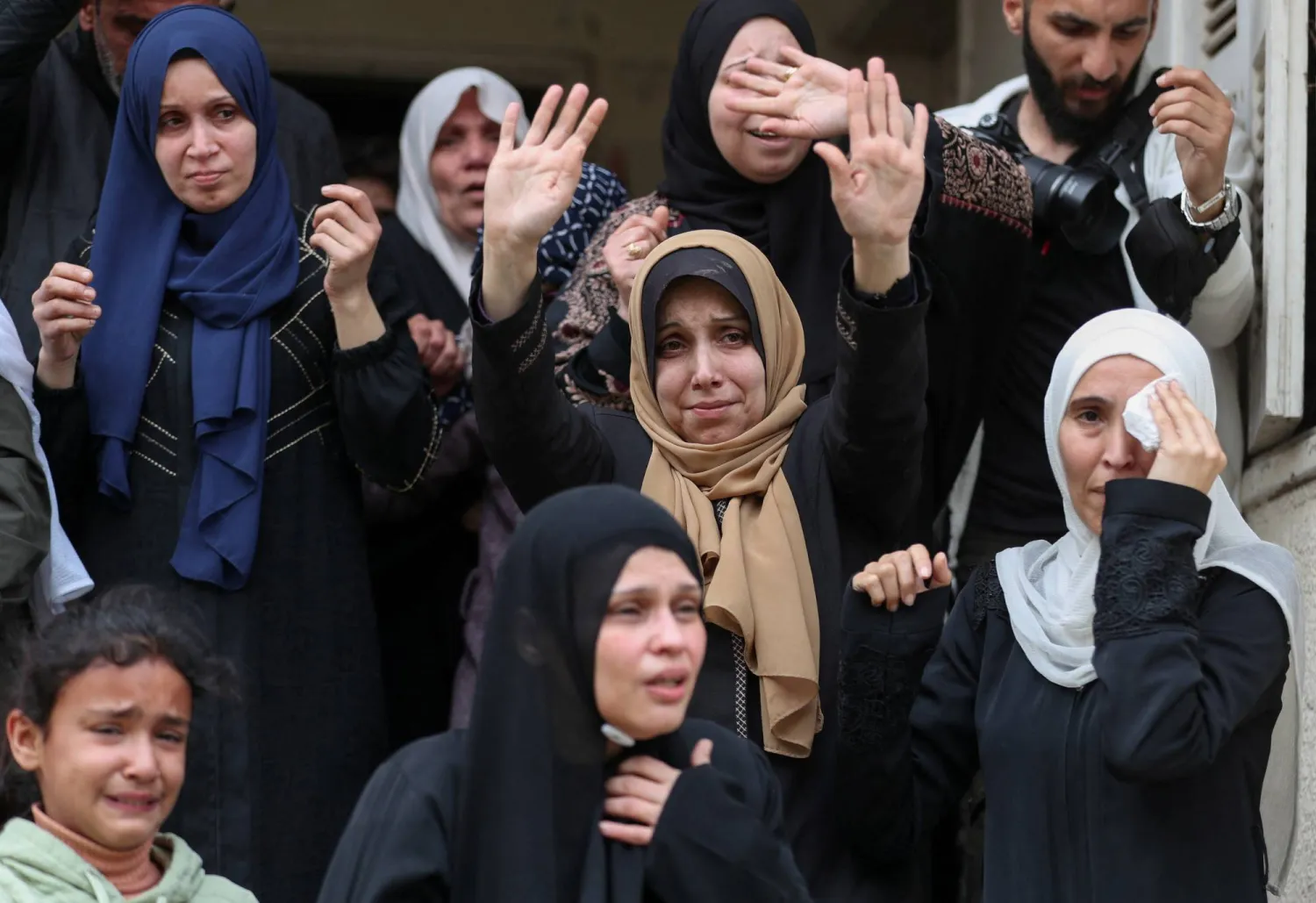
Mourners react during the funeral of Palestinians who were killed in an Israeli strike that took place on Tuesday, according to medics, at Al-Shati camp in Gaza City, April 15, 2026. REUTERS/Dawoud Abu Alkas
TT

UN: Average of 47 Women and Girls Killed Daily During Gaza War

Mourners react during the funeral of Palestinians who were killed in an Israeli strike that took place on Tuesday, according to medics, at Al-Shati camp in Gaza City, April 15, 2026. REUTERS/Dawoud Abu Alkas

An average of at least 47 women and girls were killed each day during the war in Gaza, according to figures published by UN Women on Friday, and the agency warned that deaths have continued six months into a fragile ceasefire.

More than 38,000 women and girls were killed in Gaza between October 2023 and December 2025, according to the report by UN Women, an agency that focuses on gender equality.

"Women and girls accounted for a proportion of deaths far higher than those observed in previous ⁠conflicts in Gaza," ⁠Sofia Calltorp, the agency's humanitarian action head, told reporters in Geneva.

"They were individuals with lives and with dreams," she added, according to AFP.

The agency expressed concern that the killing of women and girls has continued since an October ceasefire, though it does not know exactly how many have died due to ⁠a lack of gender-aggregated data.

October's ceasefire halted two years of full-scale war but left Israeli troops in control of a depopulated zone that makes up well over half of Gaza, with Hamas in power in the remaining, narrow, coastal strip.

More than 750 Palestinians have been killed since then, according to local medics, while militants have killed four Israeli soldiers. Israel and Hamas have traded blame for ceasefire violations.

Israel says it aims to thwart attacks by Hamas and ⁠other militant factions.

UN ⁠children's agency UNICEF said on Friday that children continued to be killed and injured at an alarming rate in Gaza, with at least 214 reported dead in the last six months.

Around one million women and girls are displaced in Gaza, UN Women said.

"Extensive damage to infrastructure has made it almost impossible for women and girls in Gaza to access their basic needs like healthcare," said Calltorp.

World Health Organization figures show more than 500,000 women lack access to essential services including antenatal and postnatal care and management of sexually transmitted infections.


Aoun Says Future Deal Will Not Cede Lebanese Territory, Country No Longer ‘Arena for Anyone’s Wars’

A photograph released by the Lebanese Presidency on April 17, 2026, shows Lebanon's President Joseph Aoun delivering a televised address to the Lebanese people from the Baabda Presidential Palace, east of the capital Beirut. (Lebanese Presidency)
TT

Aoun Says Future Deal Will Not Cede Lebanese Territory, Country No Longer ‘Arena for Anyone’s Wars’

A photograph released by the Lebanese Presidency on April 17, 2026, shows Lebanon's President Joseph Aoun delivering a televised address to the Lebanese people from the Baabda Presidential Palace, east of the capital Beirut. (Lebanese Presidency)

Lebanese President Joseph Aoun said on Friday that any future deal reached by the government would not cede any ‌territory or ‌undermine Lebanon's national ‌rights, ⁠without saying whether ⁠he was referring to prospective talks with Israel.

The televised address was ⁠his first speech ‌since ‌the US brokered a ‌ceasefire to ‌end fighting between Israel and Iran-backed Hezbollah on Thursday. ‌

The text of the deal ⁠says ⁠Israel and Lebanon would hold direct talks to produce a "peace between the two countries".

Aoun said Lebanon was on the verge of a "new phase" of "permanent agreements."

"Now, we all stand before a new phase," he added, stressing "it is the phase of transition from working on a ceasefire to working on permanent agreements that preserve the rights of our people, the unity of our land, and the sovereignty of our nation."

He added that direct talks with Israel were "not a sign of weakness nor a concession... negotiations do not mean, and will never mean, giving up any right, conceding any principle, or compromising the sovereignty of this nation."

Moreover, Aoun stressed that Lebanon was no longer an "arena" for anyone's wars.

"We are confident that we will save Lebanon... we have reclaimed Lebanon and Lebanon's decision-making power for the first time in nearly half a century," he declared, adding that "today, we negotiate for ourselves... we are no longer a pawn in anyone's game, nor an arena for anyone's wars, and we never will be again."

"I hereby affirm... that there will be no agreement that infringes upon our national rights, diminishes the dignity of our steadfast people, or relinquishes an iota of this nation's soil."


Hezbollah Tallies Its Dead from Israel War, Estimates Exceed 1,000

A woman walks next to an ambulance at the site of an Israeli strike carried out before a 10-day ceasefire between Lebanon and Israel went into effect, in Tyre, Lebanon, April 17, 2026. (Reuters)
TT

Hezbollah Tallies Its Dead from Israel War, Estimates Exceed 1,000

A woman walks next to an ambulance at the site of an Israeli strike carried out before a 10-day ceasefire between Lebanon and Israel went into effect, in Tyre, Lebanon, April 17, 2026. (Reuters)

Hezbollah said its fighters would “keep their fingers on the trigger” hours after a ceasefire took effect between Lebanon and Israel, warning it would not stay silent over any Israeli violations and would not repeat its past restraint under the October 2024 ceasefire, when Israel continued attacks and assassinations against its members and commanders.

In recent hours, the Iran-backed party focused on helping large numbers of displaced people return to their homes, while tracking Israeli movements in occupied areas and preparing for a possible new confrontation at any moment.

Death toll unclear

People closely following Hezbollah said it was still counting its dead, with no final toll yet, as many fighters remain under rubble in villages and towns that saw fierce clashes, including the southern towns of Khiam and Bint Jbeil, where Israeli forces are deployed, complicating search efforts.

Some bodies are difficult to identify, while others have been taken captive.

Sources said Hezbollah would not, for now or in the near future, announce casualty figures, as it did in the previous war.

It stopped issuing official death notices after the toll passed 500 and is maintaining that approach, they said, with estimates suggesting the number is high and may exceed 1,000, particularly after heavy fighting in Khiam and Bint Jbeil.

Hezbollah statement

In a statement after the ceasefire, Hezbollah said it carried out 2,184 military operations during the 45-day battle from March 2 to April 16.

It said its drones and rocket fire struck Israeli settlements and cities from the Lebanese border to beyond Tel Aviv, up to 160 km deep.

It said its fighters conducted about 49 operations a day, adding: “The hands of these fighters will remain on the trigger, on guard against the enemy’s treachery and any violation of its commitments.”

Hezbollah lawmakers on Friday accompanied displaced residents returning to their towns and villages in the south, Bekaa Valley, and Beirut’s southern suburbs.

Hezbollah lawmaker Hassan Fadlallah said the group would accept no surrender or submission.

“This issue is settled for us. If the Americans want to give the Israeli enemy freedom of movement, and if some Lebanese officials submit and make concessions, that will have no application on the ground,” he said, warning that the ceasefire “must not become a tool for the enemy to blackmail the authorities.”

He added: “The Lebanese authorities must withdraw from direct negotiations that will only lead to submission to Israeli dictates. This threatens Lebanon’s future and fate.”

People check destruction behind posters of Hezbollah leader Naim Qassem (bottom) and a killed Hezbollah member in Beirut's southern suburbs after a 10-day ceasefire with Israel came into effect on April 17, 2026. (AFP)

‘A major defeat’

While Hezbollah and its supporters frame the outcome as a victory, security and defense analyst Riad Kahwaji told Asharq al Awsat the battlefield suggests otherwise.

“When the war began, the Israelis were in five points, while Hezbollah fighters were active along axes such as Naqoura, Kfar Kila, and Aita al-Shaab. Today, Israeli forces are deeper inside Lebanese territory,” he said.

“Israeli control has reached 10 km, compared with around 2 or 3 km before. Hezbollah lost territory, was forced to retreat, its death toll is in the hundreds, its number of captives has risen, and the scale of destruction in the south, the southern suburbs and the Bekaa is many times greater,” Kahwaji added.

He said tens of thousands have been displaced after their homes were destroyed. “This is defeat, in every sense of the word.”

Kahwaji said that even if Israeli soldiers were killed, their numbers were not comparable to Hezbollah’s losses, and that the scale of damage in Lebanon versus Israel underscored the imbalance.

“Hezbollah considers its survival and ability to fire rockets a victory, even though it has again shown it acts as an Iranian tool and entered the war in support of Iran,” he stressed.

Ready for another round

Political writer Qassem Kassir, who is closely familiar with Hezbollah’s position, offered a sharply different view, saying the group had emerged stronger than after the 2024 war.

“If we do not say it won, what is certain is that Israel failed to achieve its military and security goals. Tel Aviv was unable to target Hezbollah’s leadership. Although some commanders were killed, the number is very small compared with the previous war,” he said.

Kassir said Hezbollah had “managed the battle with precision and success” and was preparing for a possible new confrontation, unless comprehensive solutions are reached, including a full Israeli withdrawal, the return of captives, an end to attacks and launch of reconstruction.


Secret Israeli Ministerial Talks under US Pressure Discuss Vision of ‘New Gaza’

A satellite image of Gaza port. (Reuters  file)
A satellite image of Gaza port. (Reuters file)
TT

Secret Israeli Ministerial Talks under US Pressure Discuss Vision of ‘New Gaza’

A satellite image of Gaza port. (Reuters  file)
A satellite image of Gaza port. (Reuters file)

Israeli media sources said Prime Minister Benjamin Netanyahu ordered two secret meetings of senior officials across several ministries, under US pressure, to discuss the future of Gaza, including a possible commercial port and reconstruction plans.

Observers linked the meetings to a military escalation in which Israeli forces struck multiple areas on the margins of operations in Lebanon, in what they said was meant to divert attention from the talks, opposed by far-right ministers.

Israel’s Channel 12 reported on Thursday that a meeting this week was chaired by acting director general of the prime minister’s office, Drorit Steinmetz, with participation from the finance ministry, the National Security Council, the Coordinator of Government Activities in the Territories, and the energy, transport and environmental protection ministries.

Citing five unnamed sources, the channel said the meeting followed US pressure and requests from American officials at the Civil-Military Coordination Center (CMCC) in Kiryat Gat. It said this was the second government meeting on the issue held in complete secrecy.

Talks focused on managing US forces inside Gaza, as well as control of border crossings and the near-term flow of goods.

Ministries were asked to present positions on establishing a civilian port in Gaza. Israel’s vision was also reviewed alongside proposals from the CMCC, involving foreign representatives and aid groups.

These proposals fall under what US envoys Steve Witkoff and Jared Kushner have called a “new Gaza,” including high-rise buildings, industrial zones, desalination plants, a gas platform, and an airport, the report said.

Representatives from the electricity and water authorities and the transport ministry were asked to provide professional assessments.

The report said Israel’s leadership had issued clear guidance that no reconstruction would move forward unless Gaza is fully demilitarized and the Palestinian Hamas group is disarmed. Israel also said it would not fund any reconstruction.

Despite official statements, Channel 12 said Israel appears to be compelled to engage with external initiatives that contradict its stated position.

Netanyahu’s office said policy remains unchanged, no reconstruction before Hamas is disarmed and Gaza fully demilitarized, a condition it has not been met despite commitments to the US administration and mediators.

It added that professional-level discussions are not meant to advance reconstruction, but to assess international proposals and prevent the establishment of a status quo on the ground that could harm Israel’s interests.