Israeli Fire Kills Five in Gaza and the West Bank, Medics Say

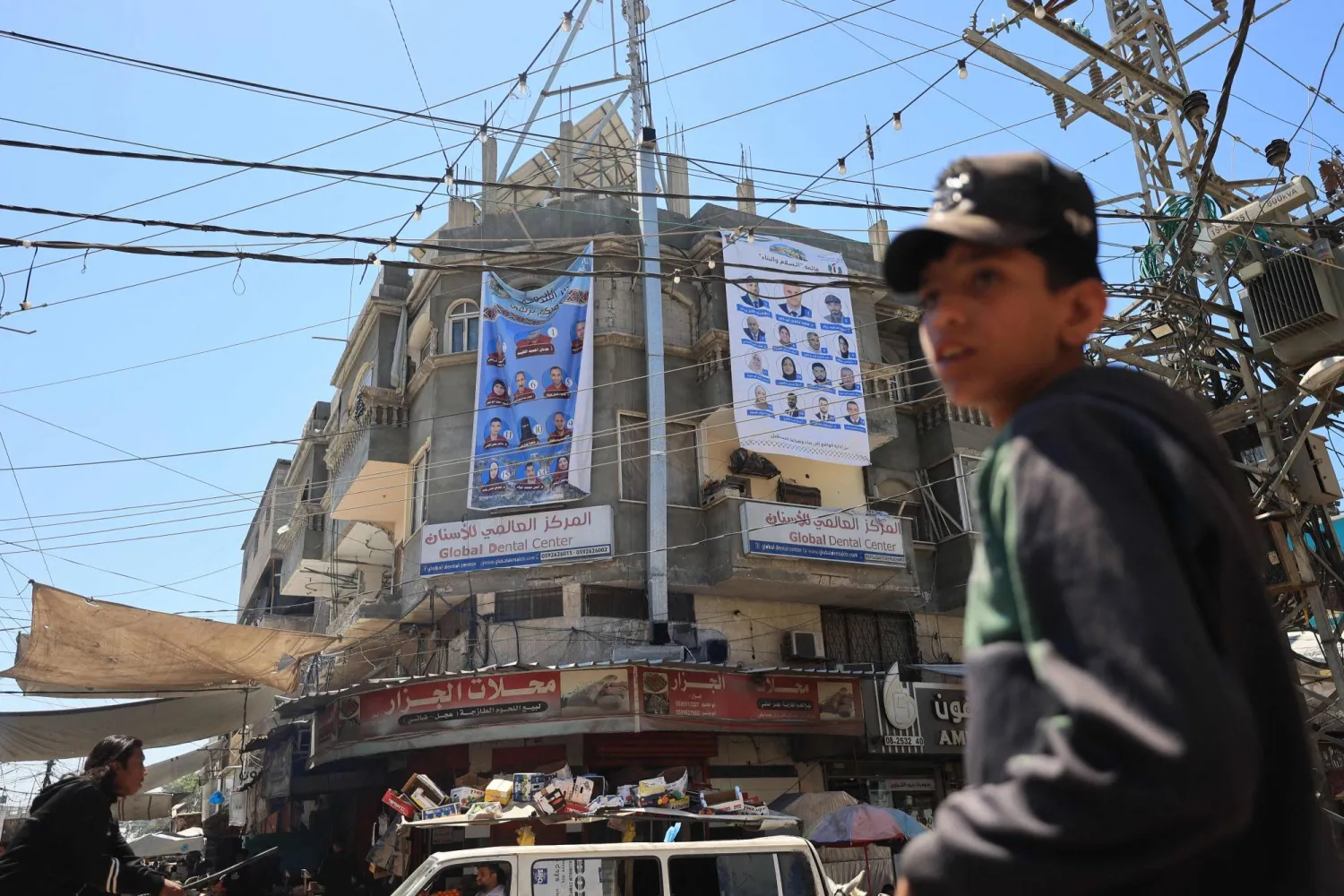
 Election campaign banners showing candidates for the upcoming municipal elections hang on a building in Deir el-Balah in the central Gaza Strip on April 21, 2026.  (Photo by Eyad Baba / AFP)
Election campaign banners showing candidates for the upcoming municipal elections hang on a building in Deir el-Balah in the central Gaza Strip on April 21, 2026. (Photo by Eyad Baba / AFP)
TT

Israeli Fire Kills Five in Gaza and the West Bank, Medics Say

 Election campaign banners showing candidates for the upcoming municipal elections hang on a building in Deir el-Balah in the central Gaza Strip on April 21, 2026.  (Photo by Eyad Baba / AFP)
Election campaign banners showing candidates for the upcoming municipal elections hang on a building in Deir el-Balah in the central Gaza Strip on April 21, 2026. (Photo by Eyad Baba / AFP)

Israeli airstrikes killed at least four Palestinians in Gaza on Thursday, while soldiers shot and killed a 15-year-old child during an army raid in the Israeli-occupied West Bank, Palestinian health officials said.

One person was killed in a strike in southern Gaza's Khan Younis in which several others were wounded, local medics said. Israel's military said it had targeted militants transporting munitions, who it said had posed a threat to Israeli soldiers, Reuters reported.

Three others, including a rescue worker, were killed in a separate strike in Maghazi, a Palestinian refugee camp in the Deir al Balah area in central Gaza, health officials said. Israel's military had no immediate comment on that strike.

Israel has carried out repeated strikes on Gaza since a US-brokered ceasefire came into effect in October. Both Israel and Hamas have accused each other of ceasefire violations.

There is no mechanism for enforcing the ceasefire. Four Israeli soldiers and more than 780 Palestinians have been killed in Gaza since the ceasefire started.

At Gaza City's Al Shifa Hospital, the territory's largest medical facility, relatives stood among mourners gathered to bury five people, including three children, who were killed on Wednesday in an Israeli airstrike on a northern Gaza town.

"There is no ceasefire, no truce, nothing at all," said Mohammed Baalousha, a relative of one of the victims. "There is no safety in any area."

Israel's military has not commented on the strike.

WEST BANK VIOLENCE

In the West Bank city of Nablus, health officials said Israeli forces shot and killed a teenager during an ongoing raid in the city.

The health ministry said Israeli settlers shot and killed a 25-year-old Palestinian man in Deir Dibwan town near Ramallah a day ago, in the latest in what human rights groups have described as a surge in violence against Palestinians waged by Israeli settlers and soldiers.

The Israeli military did not immediately comment on either incident. The Palestinian health ministry said at least 15 people had been killed by Israeli settlers' attacks so far this year.


Sisi Visits Uganda as Egypt Increases Coordination on Water Security

Ugandan President Yoweri Museveni welcomes Egyptian President Abdel Fattah al-Sisi in Entebbe on Wednesday. (Egyptian Presidency)
TT

Sisi Visits Uganda as Egypt Increases Coordination on Water Security

Ugandan President Yoweri Museveni welcomes Egyptian President Abdel Fattah al-Sisi in Entebbe on Wednesday. (Egyptian Presidency)

Egyptian President Abdel Fattah al-Sisi and Ugandan President Yoweri Museveni discussed Nile water issues and regional security during talks in Entebbe on Wednesday, as Cairo steps up coordination with Nile Basin countries amid ongoing tensions with Ethiopia over the Grand Ethiopian Renaissance Dam (GERD).

The visit, which followed a trip by Museveni to Cairo several months ago, comes as Egypt seeks to strengthen political and economic ties with Nile Basin states in support of its water security strategy.

According to a statement from the Egyptian presidency, Sisi praised the growing momentum in relations with Uganda and called for broader cooperation in agriculture, irrigation, healthcare and training programs for Ugandan personnel.

He also stressed the importance of increasing trade and establishing sustainable investment partnerships.

Museveni described cooperation between the two countries as “a model for the desired integration among African states,” according to the statement. He also outlined Uganda’s Vision 2040 development plan and highlighted sectors where Kampala hopes to deepen cooperation with Cairo.

The two leaders exchanged views on regional crises, including conflicts in Sudan, Libya and the Palestinian territories, and emphasized the need for closer coordination on Nile and water-related issues.

Sisi called for neighboring countries to play a constructive role in restoring stability and achieving lasting peace across Africa, while Museveni stressed the importance of African-led solutions that take into account the continent’s particular circumstances and delicate balances.

Former Egyptian assistant foreign minister for African affairs Mona Omar said Egypt now viewed relations with Nile Basin countries as “an absolute priority,” including through investment, joint development projects and capacity-building initiatives.

Speaking to Asharq Al-Awsat, Omar said Uganda held particular importance for Egypt because of historical ties and Cairo’s support for Uganda’s independence movement.

She said water cooperation was a central element of the visit, citing the long-standing presence of an Egyptian technical mission affiliated with Egypt’s irrigation ministry in Uganda.

The mission participates in Nile measurements and water-related projects, including efforts to clear invasive weeds from Lake Victoria to facilitate trade and navigation, she said.

Omar added that discussions also addressed the GERD dispute. She said Uganda does not oppose the construction of the dam but rejects causing harm to downstream countries, a stance Egypt appreciates.

Cairo is seeking broader consensus among Nile Basin countries on reaching a legally binding agreement governing the operation of the dam, which Ethiopia considers essential for development but Egypt and Sudan fear could reduce their water supplies.

The talks also touched on the Entebbe Agreement, a framework accord launched by Ethiopia in 2010 that would revise historical Nile water-sharing arrangements involving Egypt and Sudan.

Ethiopia announced in October 2024 that the agreement had entered into force after ratification by six countries — Ethiopia, Uganda, Kenya, Tanzania, Rwanda and South Sudan — despite continued rejection by Egypt and Sudan.

Relations between Cairo and Kampala have gained momentum since Museveni’s visit to Egypt in August last year, during which several cooperation agreements were signed, Omar said.

She added that 65 Egyptian companies currently operate in Uganda in sectors including energy, infrastructure and food security, alongside cooperation in police and military training programs.

During his visit, Sisi renewed an invitation for Museveni to attend the African Union coordination summit to be hosted by Egypt in June 2026, as Uganda currently chairs the East African Community.


Iraqi Parliament Set to Vote on Al-Zaidi's Government

An Iraqi parliament session in Baghdad, March 2026. (INA)
TT

Iraqi Parliament Set to Vote on Al-Zaidi's Government

An Iraqi parliament session in Baghdad, March 2026. (INA)

Iraq’s parliament is scheduled to vote on Thursday on the cabinet lineup proposed by Prime Minister-designate Ali Falih Al-Zaidi, amid ongoing political disputes over key ministries and newly proposed posts.

Parliament’s media office said the agenda for session No. 24 includes a single item: a vote on “the government program and cabinet of Prime Minister-designate Ali Falih Al-Zaidi,” signaling efforts by political blocs to move forward with approving the new government despite lingering divisions, particularly within the Shiite Coordination Framework alliance.

Political and parliamentary sources said negotiations were continuing over several sovereign ministries, four deputy prime minister posts and two proposed new ministries, as pressure mounted to finalize the government before the Eid holiday to avoid a political vacuum or possible security escalation.

A source familiar with the talks told Asharq Al-Awsat that most lawmakers had not yet reviewed the résumés of ministerial nominees, despite constitutional requirements that they be distributed to parliament members before the confidence vote.

“Most lawmakers are not part of the negotiations taking place among bloc leaders, which are focused mainly on dividing ministerial quotas under the points system, while disagreements continue over some sensitive positions,” the source said.

Despite a relatively calm political atmosphere ahead of the session, political sources spoke of possible “last-minute surprises,” citing disputes within some parties over government priorities, particularly the issue of restricting weapons to state control.

A politician familiar with the negotiations noted that some leaders within the Coordination Framework had become less enthusiastic about backing Al-Zaidi than they were at the start of his nomination process, partly because of his pledge to place all weapons under state authority and concerns over his future relationship with armed factions allied to the coalition.

Some factions believe Al-Zaidi enjoys “clear international and American support,” the source said, referring to statements by Western officials in recent weeks that have fueled fears among some political groups that the next government could adopt a tougher stance on weapons outside state control.

Local media reports said resistance by some armed factions to disarm was one of the main reasons for delays in finalizing the cabinet, while political analysts also pointed to disputes among parties over the allocation of ministries.

A committee formed by the Coordination Framework has discussed the issue of weapons control with Al-Zaidi, while some armed groups continue to reject disarmament because of uncertainty over the future of their arsenals, the source added.

On the Sunni side, political factions appeared close to finalizing their ministerial share. Media linked to the Taqaddum party led by Mohammed Al-Halbousi circulated names of nominees and details of the distribution of ministries among Sunni blocs.

According to the reports, Taqaddum would receive the education and industry ministries, in addition to a deputy prime minister post, while the commerce ministry would go to the Al-Siyada party led by Khamis Al-Khanjar. The defense ministry would be assigned to the Hasm alliance headed by Thabit Al-Abbasi, and the planning ministry to the party of Muthanna Al-Samarrai.

Among Kurdish parties, there are signs that the Kurdistan Democratic Party would receive the foreign ministry and a deputy prime minister position, while the Patriotic Union of Kurdistan would take the construction and justice ministries.

In his first public comments on the government formation process, Al-Zaidi said he would “not respond to any personal demands” while selecting ministers, adding that he had secured Kurdish backing following meetings in Erbil.

Al-Zaidi said he aimed to form “a strong and solid economic government,” signaling that economic and development issues would be prioritized by his cabinet.


The Veteran Envoys Leading Lebanon-Israel Direct Talks

US Secretary of State Marco Rubio (C) speaks during a meeting with Lebanon's Ambassador to the US Nada Hamadeh Moawad (2R) and Israeli Ambassador to the US Yechiel Leiter (2L) at the State Department in Washington, DC, on April 14, 2026. AFP, Oliver Contreras
TT

The Veteran Envoys Leading Lebanon-Israel Direct Talks

US Secretary of State Marco Rubio (C) speaks during a meeting with Lebanon's Ambassador to the US Nada Hamadeh Moawad (2R) and Israeli Ambassador to the US Yechiel Leiter (2L) at the State Department in Washington, DC, on April 14, 2026. AFP, Oliver Contreras

Lebanon's Simon Karam and Israel's Yechiel Leiter, both political veterans with entrenched views, will come face to face in Washington for talks Thursday after decades in a state of war.

Lebanon and Israel have no formal ties, but US President Donald Trump is hoping for a historic breakthrough even as Israeli forces remain deployed in south Lebanon to fight Iran-backed Hezbollah.

While Lebanon is seeking to consolidate a ceasefire in the latest war and to obtain the withdrawal of Israeli troops, Israel wants to ensure Hezbollah is disarmed, said AFP.

Here are profiles of the envoys leading their countries' third round of negotiations:

- Karam: the quiet negotiator -

Simon Karam, a lawyer known for his decades in politics and fierce defense of Lebanon's sovereignty, was appointed by President Joseph Aoun last month for the thorny task of helming the direct talks with Israel.

Beirut insists Israel must end its attacks before starting negotiations, while Hezbollah rejects outright any direct engagement between the two countries.

A former ambassador to Washington and independent politician, 76-year-old Karam is known for his defense of Lebanese unity in a country riven by sectarian divisions.

He is also known for his support for extending state sovereignty across all of Lebanon, where Hezbollah has long kept a huge arsenal and thrown the country into war after war.

Late last year, Karam was appointed as Lebanon's civilian representative to a committee comprising Lebanon, Israel, the United States, France and UN peacekeepers that was tasked with monitoring a 2024 ceasefire.

Karam is known for his calm demeanor and makes few media appearances, but those who know him say he has remained uncompromising in his convictions on a sovereign, stable Lebanon.

During his participation in two previous ceasefire monitoring committee meetings, Karam "was a decisive and rational negotiator", a source familiar with the talks told AFP on condition of anonymity.

"He was particularly insistent on the demand that southern residents return to their towns, and spoke at length about the emotional ties linking villagers to their lands," the source added.

Political analyst Ali al-Amin, who has known Karam for decades, praised his upstanding character.

"He doesn't make deals under the table," Amin said, noting Karam had not sought high office despite his connections.

Karam entered public life in 1990, first being appointed governor of east Lebanon's Bekaa region and then Beirut.

He was named ambassador to Washington in 1992 but stepped down the following year, in a move observers said was linked to his diverging views from authorities who at the time were under the influence of Syria, whose occupation Karam opposed.

Karam, who is fluent in Arabic, French and English, hails from south Lebanon's Jezzine district and is married with three children.

- Leiter: the Netanyahu ally -

Israel's ambassador to the United States, Yechiel Leiter, is a longtime ally of Prime Minister Benjamin Netanyahu.

Well-versed in Israeli settler politics, conservative activism and hard-edged diplomacy, Leiter, 67, took up his post as Israel's top envoy to Washington in January 2025.

Born in the United States, he emigrated to Israel at 18 and later served as a combat medic in the military in 1982, when Israel invaded Lebanon.

Leiter first gained prominence in the 1990s as a leading figure in the Yesha Council, the umbrella organization representing Israeli settlers in the occupied West Bank.

During some of the most divisive years of the Israeli-Palestinian peace process, Leiter became a forceful advocate for the settlement movement and a prominent nationalist.

His influence later extended into government, holding several senior positions in the ministries of education, finance and transportation.

Leiter served as chief of staff to Netanyahu when the latter served as finance minister in the early 2000s, helping cement a longstanding political alliance.

A member of Netanyahu's Likud party, he also worked as a strategist and adviser to several right-wing Israeli think tanks.

The war in Gaza struck him personally.

In November 2023, his son, Moshe Leiter, was killed in combat in the Gaza Strip, a month after Hamas's October 7 attack on Israel.

Leiter was also an outspoken critic of President Joe Biden, before Trump returned to the White House.

In a 2024 interview with Israel's Channel Tov, he denounced what he described as "American pressure" on Israel under Biden during the war in Gaza.

After being appointed ambassador, Leiter renounced his US citizenship as Israelis with dual citizenship are not permitted to serve as diplomats in countries where they hold a citizen status.

In May 2025, he was summoned by the foreign ministry after accusing Netanyahu's opponents of spreading "blood libels" against the prime minister -- breaching norms against Israeli diplomats making political statements, according to media reports.

Leiter has positioned himself as an advocate for a broader regional realignment, and following talks in Washington with his Lebanese counterpart in April, he praised what he called a "wonderful exchange".

His portfolio also includes normalization talks with Syria, according to the Israeli embassy in Washington.