

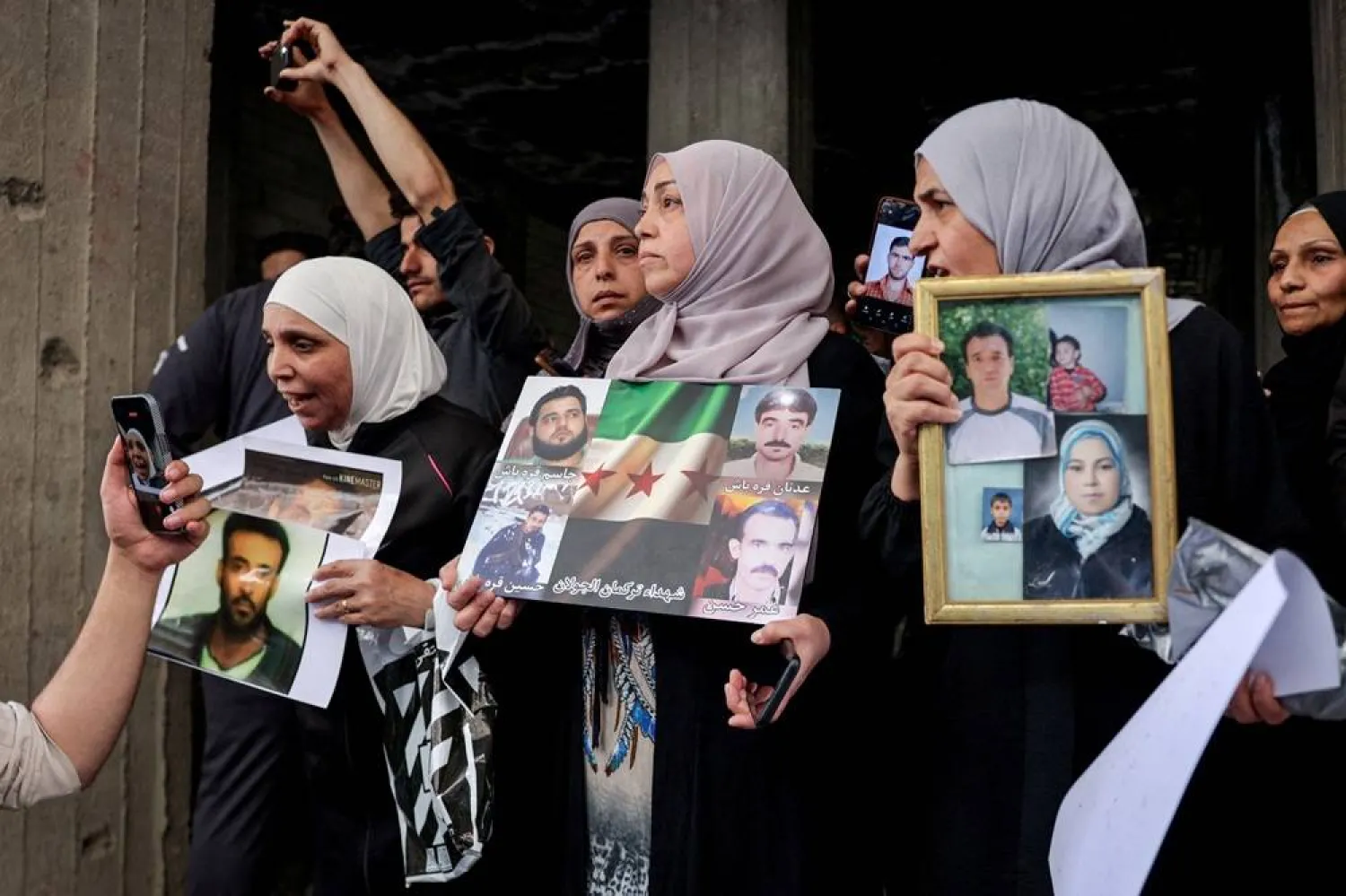

Syria to Begin Trying Assad-Era Figures on Sunday, Says Justice Official

Residents gather in a street after Friday prayers to celebrate the arrest of Amjad Yousef, a key suspect in the 2013 Tadamon massacre, in Tadamon, Syria, April 24, 2026. (Reuters)
TT

Syria to Begin Trying Assad-Era Figures on Sunday, Says Justice Official

Residents gather in a street after Friday prayers to celebrate the arrest of Amjad Yousef, a key suspect in the 2013 Tadamon massacre, in Tadamon, Syria, April 24, 2026. (Reuters)

Trials of prominent figures from the rule of ousted Syrian leader Bashar al-Assad are set to begin this weekend, a justice ministry official told AFP on Saturday, starting with a former security official.

"The first trial sessions for symbolic former Syrian regime figures will begin on Sunday" with Atif Najib, who was arrested in January of last year, the official told AFP on condition of anonymity.

Najib is the former head of political security in south Syria's Daraa province, the cradle of the country's 2011 uprising, and is accused of orchestrating a crackdown there. He is also a cousin of the ousted leader.

The ministry official said trials would follow for Wassim al-Assad -- another of the former president's cousins -- and Amjad Youssef, the main suspect in a 2013 massacre who was arrested this week, as well as "pilots who took part in bombing Syrian cities and towns".

Syria's civil war began with a brutal crackdown on pro-democracy protests and spiraled into a 13-year conflict that killed more than half a million people.

Assad's forces pounded opposition-held areas, including with airstrikes and crude barrel bomb attacks, while tens of thousands of people disappeared, some into the country's brutal prison system.

Since seizing power in December 2024, Syria's new authorities have repeatedly announced the arrests of former officials, vowing to provide justice and accountability for Assad-era atrocities.

Assad fled to Russia with only a handful of confidants, abandoning senior officials and security officers, some of whom reportedly went abroad or took refuge in the coastal heartland of Assad's Alawite minority.

Syrian Justice Minister Mazhar al-Wais said Friday on X that the Damascus criminal court was ready "for the moment that victims have long waited for: the start of public trials", calling them "part of the transitional justice process".

Rights groups, activists and the international community have repeatedly emphasized the importance of transitional justice in the war-ravaged country.

The protest movement against Assad began in Daraa on March 15, 2011, after 15 students were arrested for allegedly writing anti-government slogans on the city's walls.

Residents said the students were tortured, leading to a protest to demand their release that ended in bloodshed.

Najib, blamed for the crackdown, was dismissed soon after. He was on a US Treasury sanctions list alongside other Syrian officials.

Wassim al-Assad was arrested last June. The US Treasury sanctioned him in 2023, saying he had led a paramilitary unit and was "a key figure in the regional drug trafficking network".



Four Killed in Israeli Strikes on Southern Lebanon

Israeli tanks drive in Lebanon, as seen from the Israeli side of the Israel-Lebanon border, in northern Israel, April 25, 2026. (Reuters)
TT

Four Killed in Israeli Strikes on Southern Lebanon

Israeli tanks drive in Lebanon, as seen from the Israeli side of the Israel-Lebanon border, in northern Israel, April 25, 2026. (Reuters)

Four people were killed on Saturday in Israeli strikes on southern Lebanon, Lebanon's state news agency reported, while the Israeli military said Hezbollah had fired rockets at Israel, the latest challenges to a tenuous, recently extended ceasefire.

The ceasefire agreed between Israel and Lebanon has led to a significant reduction in hostilities, ‌but Israel ‌and Iran-backed Hezbollah ‌have ⁠continued to clash ⁠in southern Lebanon, where Israel has kept soldiers in the self-declared buffer zone.

The Israeli military said on Saturday that it had struck loaded rocket launchers belonging to Hezbollah in three locations in southern Lebanon overnight ⁠and targeted several Hezbollah fighters in ‌separate strikes.

It was ‌unclear whether the deaths reported by the ‌state news agency were linked to those ‌Israeli strikes.

The Israeli military restated its warning for Lebanese residents not to approach the Litani River area in southern Lebanon while it battles ‌Hezbollah.

It said it had intercepted a "suspicious aerial target" within the area its ⁠forces ⁠are presently occupying, and that two rockets were fired by Hezbollah into northern Israel, one of which was intercepted. There were no reports of casualties.

A Hezbollah lawmaker said on Friday that a US-mediated ceasefire in the war with Israel was meaningless, a day after it was extended for three weeks. The truce had been due to expire on Sunday.


Palestinian Local Elections Give Some Gazans First Chance to Vote in Years

Palestinian electoral officials set up a polling station in a tent for municipal elections in Deir al-Balah, Gaza Strip, on April 25, 2026. (AFP)
TT

Palestinian Local Elections Give Some Gazans First Chance to Vote in Years

Palestinian electoral officials set up a polling station in a tent for municipal elections in Deir al-Balah, Gaza Strip, on April 25, 2026. (AFP)

Palestinians voted in local elections on Saturday that for the first time in two decades include Gaza and are a gauge of the political mood as Israel's government seeks to destroy any future for a Palestinian state. 

The West Bank-based Palestinian Authority has said it hopes the inclusion of the Gazan city of Deir al-Balah will reinforce its claim to authority over the territory from which it was ousted by Hamas in 2007. 

Some Gazans, who are struggling to meet their basic needs in the devastated enclave, welcomed the opportunity to vote. 

"As a Palestinian and a son of the Gaza Strip, I feel proud that after this war the democratic process is returning," said voter Mamdouh al-Bhaisi, 52, at the Deir al-Balah polling station.  

Turnout, however, was low at 13.8% in Deir al-Balah by 1 p.m. (1000 GMT) and at 25.3% in the West Bank, according to official figures.  

Voting will continue in the West Bank until 7 p.m., while in Deir Al-Balah it ends ‌an hour earlier ‌due to electricity constraints. 

Casting his ballot in a polling station in the Al-Bireh area, near Ramallah, Palestinian ‌President ⁠Mahmoud Abbas said eventually ⁠elections will be held across the Gaza Strip. 

"Gaza is an inseparable part of the state of Palestine. Therefore, we have worked by all means to ensure that elections take place in Deir al-Balah to affirm the unity of the two parts of the country together," he said. 

A Palestinian woman casts her ballot in a polling station during municipal elections in the Israeli-occupied West Bank city of Hebron on April 25, 2026. (AFP)


ISRAEL HAS EXTENDED CONTROL OVER GAZA AND WEST BANK  

Since a US-brokered ceasefire in Gaza between Hamas and Israel took effect in October, intermittent talks led by the United States have made little progress towards a settlement that envisages international supervision of Gaza. 

European and Arab governments broadly support an eventual return of Palestinian Authority governance in Gaza, together with the establishment of an independent Palestinian state. It would comprise Gaza, East Jerusalem and the ⁠West Bank, where the Palestinian Authority exercises limited self-rule under Israeli occupation. 

Western diplomats say local elections ‌could be a step towards the first national elections in nearly two decades and advance ‌reforms to increase transparency and accountability that the PA says are under way. 

"We hope that the procedure carried out today will be crowned with legislative ‌and presidential elections," said Munif Treish, one of the candidates in the West Bank. 

Saturday's vote is the first of any ‌kind in Gaza since 2006 and the first Palestinian elections to be held since the Gaza war started more than two years ago with a cross-border Hamas assault on southern Israeli communities.  

Municipal elections were last held in the West Bank four years ago. 


A Palestinian man shows his marked finger after casting his ballot at a polling station during municipal elections in the Israeli-occupied West Bank city of Al-Bireh on April 25, 2026. (AFP)

STRUGGLE TO PAY WAGES AS ISRAEL WITHHOLDS FUNDS 

The Palestinian Authority has struggled to pay wages as Israel withholds tax revenues it collects on its behalf, raising fears of economic collapse. 

Israel justifies withholding ‌the funds in protest at welfare payments to prisoners and families of those killed by its forces, which it says incentivize attacks. The Israeli government has also taken steps to help settlers acquire ⁠West Bank land.  

Finance Minister Bezalel ⁠Smotrich has repeatedly said: "We will continue to kill the idea of a Palestinian state." 

In Deir al-Balah, which has suffered less damage from Israel's assault since 2023 than other Gazan cities, banners bearing candidate lists hang from buildings. 

The Palestinian election committee cited widespread destruction among the reasons voting could not be held across the rest of Gaza, more than half of which is controlled by Israel, with the rest under Hamas rule. 

HAMAS BOYCOTTS VOTE BUT SOME CANDIDATES ARE ALIGNED 

Some Palestinian factions are boycotting the elections in protest at the PA's request that candidates back its agreements, which include recognition of the state of Israel. 

Hamas, which has ruled Gaza for nearly two decades, has not formally nominated any candidates but one list in the Deir al-Balah election is widely viewed by residents and analysts as aligned with it. 

Analysts say the performance of candidates linked to the group could gauge its popularity. Most candidates, including in the West Bank, are running under Fatah, the main political movement behind the PA, or as independents. 

Hamas has said it would respect the results. Palestinian sources told Reuters ahead of the vote that the group's civil policemen would be deployed to safeguard polling stations in Gaza. 

The Palestinian Central Elections Committee said more than one million Palestinians, including 70,000 in Gaza, are eligible to vote, with results expected late on Saturday or on Sunday. 


Houthis Rename Schools in Yemen’s Sanaa After their Fallen Fighters

A Yemeni child visits a cemetery for Houthi fallen fighters in Sana'a (EPA)
TT

Houthis Rename Schools in Yemen’s Sanaa After their Fallen Fighters

A Yemeni child visits a cemetery for Houthi fallen fighters in Sana'a (EPA)

Yemen’s Houthi-run capital, Sanaa, is witnessing a new wave of changes in the education sector, as the group renames a number of public and private schools in what education sources say is part of a broader effort to reshape public awareness along ideological lines with a sectarian dimension.

The measures go beyond renaming schools and extend to reshaping the learning environment, including cultural activities and educational content, the sources said, describing a push to entrench a single ideological narrative within schools.

They warned that the moves are fueling growing concern about the future of education in areas under Houthi control.

The changes have affected schools long known by their historical names, replacing them with names of figures linked to the group or fighters killed in its ranks.

Among the most prominent examples, the “Azal al-Wadi” school in al-Wahda district has been renamed after a Houthi fighter known as “Abu Zaabal,” while the “Moussa bin Nusseir” school in the Maeen district has been renamed “Hani Toumar.”

The move has sparked widespread discontent among educators and students. Teachers and parents described it as an attempt to erase educational and national identity, noting that school names form part of cultural memory.

They said the changes reflect a drive to impose Houthi symbols carrying sectarian connotations.

Education sector workers said the renaming decisions were accompanied by changes to school and cultural activities, reinforcing an ideological narrative within schools.

Specialists said the shifts could narrow intellectual diversity and turn educational institutions into tools for promoting specific ideological agendas.

Students in the affected schools also voiced frustration, saying education should remain free from political or sectarian influence.

Some parents expressed concern, with some considering transferring their children to other schools, despite limited alternatives.

The developments come as Yemen faces a deepening education crisis, with deteriorating infrastructure, unpaid teacher salaries, and severe resource shortages.

The United Nations Children’s Fund, UNICEF, said about 3.2 million children in Yemen are out of school, highlighting the scale of the challenges facing the education system.

UNICEF said it plans in 2026 to return more than 172,000 children to classrooms, distribute educational supplies to over 316,000 students, and support around 1,200 teachers through training and professional development programs.

However, these efforts face a complex reality shaped by ongoing conflict and economic and social pressures.

Observers warned that continued interference in education, whether through school renaming or curricular changes, could deepen social divisions and undermine prospects for recovery, stressing that keeping education neutral is essential to safeguarding future generations.