
Four Dead in Lebanon as Israel Says Action Needed on Hezbollah Arsenal

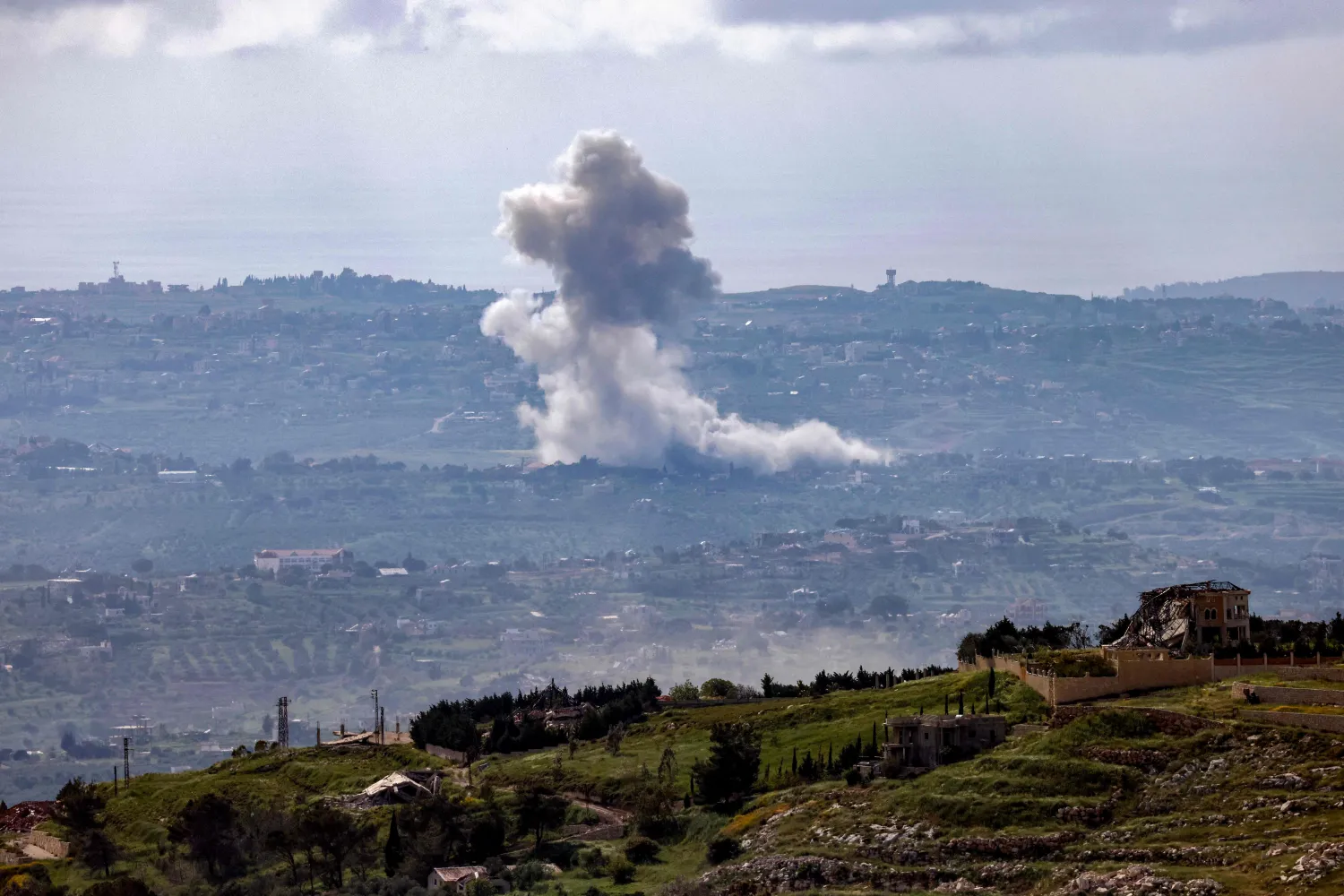
This picture taken from a position in Upper Galilee in northern Israel, near the border with Lebanon, shows smoke rising during Israeli strikes in southern Lebanon on April 27, 2026. (AFP)
TT

Four Dead in Lebanon as Israel Says Action Needed on Hezbollah Arsenal

This picture taken from a position in Upper Galilee in northern Israel, near the border with Lebanon, shows smoke rising during Israeli strikes in southern Lebanon on April 27, 2026. (AFP)

Israeli Prime Minister Benjamin Netanyahu said Hezbollah's rockets and drones were a key threat demanding military action, as Israel's army expanded strikes on Lebanon where authorities reported four dead on Monday despite a ceasefire. 

Lebanese President Joseph Aoun said direct talks with Israel sought to end the Israel-Hezbollah war and that those who dragged Lebanon into it were the ones committing "treason" -- a jab at the Iran-backed group, which claimed several attacks on Israeli targets in south Lebanon on Monday. 

Hezbollah chief Naim Qassem called direct talks between the two countries a "sin", while Israeli Defense Minister Israel Katz warned the group's rejection of negotiations would bring catastrophic consequences for Lebanon. 

Israeli and Lebanese representatives met twice in Washington this month, the first such meetings in decades, for discussions that Hezbollah has categorically rejected. 

After the first talks, US President Donald Trump announced a 10-day ceasefire that began on April 17, and a three-week extension after the second round. 

Netanyahu said in a statement that "there are still two central threats from Hezbollah: the 122mm rockets and the drones. This demands a combination of operational and technological activity." 

Israel's army said it struck more than 20 Hezbollah "infrastructure sites" in eastern Lebanon's Bekaa Valley and the country's south on Monday, including weapons storage facilities and rocket launch sites. 

Under the ceasefire, Israel reserves the right to act against "planned, imminent or ongoing attacks". 

- 'Grave sin' - 

Lebanese state media reported Israeli airstrikes in multiple locations in south Lebanon, including around a dozen sites in the evening. 

The health ministry said Israeli strikes on the south killed four people on Monday, including a woman, and wounded 51 others. 

Israeli strikes have killed at least 40 people in Lebanon since the truce began, according to an AFP tally of health ministry figures. 

Hezbollah said its fighters launched several attacks on Israeli troops, including on an army bulldozer that it said was demolishing homes in the border town of Bint Jbeil. 

Aoun said in a statement that "my goal is to reach an end to the state of war with Israel, similar to the armistice agreement" of 1949, signed after the 1948 Arab-Israeli war. 

"I assure you that I will not accept reaching a humiliating agreement," said Aoun. 

Earlier, Hezbollah's chief sharply criticized the government, branding direct negotiations with Israel a "grave sin". 

"We categorically reject direct negotiations with Israel, and those in power should know that their actions will not benefit Lebanon or themselves," Qassem said in a statement. 

He urged authorities to "back down from their grave sin that is putting Lebanon in a spiral of instability". 

The government "cannot continue while it is neglecting Lebanon's rights, giving up land, and confronting" those resisting Israel, he said. 

"We will not give up our weapons... and the Israeli enemy will not remain on a single inch of our occupied land." 

Israeli troops who invaded south Lebanon after the war erupted on March 2 are operating inside an Israeli-announced "yellow line" -- a ribbon of Lebanese territory around 10 kilometers (six miles) deep along the border, where Lebanese have been warned not to return. 

- 'Consensus' - 

Aoun said that "what we are doing is not treason. Rather, treason is committed by those who take their country to war to achieve foreign interests". 

Aoun has faced intense criticism from Hezbollah and its supporters. 

They say his push for direct talks with Israel lacks consensus among Lebanon's communities -- the latest point of contention after the government decided to disarm the group last year and outlawed its military activities in March. 

"Some want to hold us accountable over the decision to go to negotiations on the grounds that there is no national consensus" over the talks, Aoun said. 

"My question to them is: when you went to war, did you first obtain national consensus?" 

Hezbollah drew Lebanon into the Middle East war by firing rockets towards Israel to avenge the killing of Iranian supreme leader Ali Khamenei in US-Israeli strikes. 

Katz said Qassem was "playing with fire, and the fire will burn Hezbollah and all of Lebanon". 


Israel Military Issues Evacuation Warning for Area of South Lebanon

 Smoke rises following an explosion in southern Lebanon, near the Israel-Lebanon border, as seen from northern Israel, April 28, 2026. (Reuters)
Smoke rises following an explosion in southern Lebanon, near the Israel-Lebanon border, as seen from northern Israel, April 28, 2026. (Reuters)
TT

Israel Military Issues Evacuation Warning for Area of South Lebanon

 Smoke rises following an explosion in southern Lebanon, near the Israel-Lebanon border, as seen from northern Israel, April 28, 2026. (Reuters)
Smoke rises following an explosion in southern Lebanon, near the Israel-Lebanon border, as seen from northern Israel, April 28, 2026. (Reuters)

Israel's military on Tuesday warned residents of more than a dozen villages and towns in southern Lebanon to immediately evacuate and head northwards, saying it would respond to Hezbollah's "violation of the ceasefire" there.

The military "does not intend to harm you, and out of concern for your safety, you are required to evacuate your homes immediately and move away from the specified area towards the Sidon District", Arabic-language spokesman Avichay Adraee posted on X.

"Anyone present near Hezbollah elements, their facilities or their weapons is endangering their life," he added.

All the areas listed in the post appear to be outside or on the border of the so-called "Yellow Line" -- a strip of Lebanese territory around 10 kilometers (six miles) deep along the border within which Israeli troops are operating.

Israel and Iran-backed Hezbollah have traded blame over violations of the fragile ceasefire in Lebanon agreed earlier this month, and attacks by both sides have continued.

In two incidents on Tuesday morning, the Israeli military said an interceptor was launched "toward a suspicious aerial target that was identified in an area where Israeli forces are operating in southern Lebanon".

On both occasions, it said the target did not cross into Israeli territory.

The military also announced on Tuesday morning that one soldier had been severely injured and another lightly injured a day earlier "as a result of an explosive drone impact during operational activity in southern Lebanon".

"This incident constitutes a violation of the ceasefire understandings by the Hezbollah terrorist organization," it said.

Israeli Prime Minister Benjamin Netanyahu said Monday that Hezbollah's rockets and drones remained a key threat requiring action by the Israeli military, adding that Israel was continuing to carry out strikes.

Hezbollah drew Lebanon into the Middle East war on March 2 by firing rockets towards Israel to avenge the killing of Iranian supreme leader Ali Khamenei.


Dozens of Gaza Children Arrive in Jordan for Medical Care

A wounded Palestinian girl, evacuated from Gaza for medical treatment, arrives in an ambulance at the King Hussein Bridge in Jordan, April 27, 2026. (Reuters)
TT

Dozens of Gaza Children Arrive in Jordan for Medical Care

A wounded Palestinian girl, evacuated from Gaza for medical treatment, arrives in an ambulance at the King Hussein Bridge in Jordan, April 27, 2026. (Reuters)

A new group of wounded or ill Palestinian children from Gaza have arrived in Jordan to receive medical care, the kingdom's army said on Tuesday.

They are the 26th group of children transported to Jordan since the start of the war in Gaza in October 2023.

The 81 children, accompanied by 108 family members, arrived through the King Hussein, or Allenby, border crossing between the occupied West Bank and Jordan, the army said in a statement.

It is part of the "Jordanian medical corridor" initiative that King Abdullah II agreed to following a meeting with US President Donald Trump in February 2025.

Under the initiative, around 2,000 children will be transported to Jordan to receive medical care.

Since March last year, more than 716 children have been transferred in cooperation with the World Health Organization, the majority of them suffering from fractures, major wounds or cancer.

"The children will be treated in a number of Jordanian hospitals, as part of the kingdom's ongoing medical and humanitarian efforts to provide healthcare and medical support to our brothers and sisters in the Gaza Strip," the army said.

A ceasefire has largely held in Gaza since last October, but some violence has persisted.


Iraqi Leaders to Begin Thorny Talks on Forming Cabinet

 Iraqi Prime Minister Mohammed Shia al-Sudani meets with Ali al-Zaidi, the Coordination Framework’s nominee for prime minister, in Baghdad, Iraq, April 28, 2026. (Iraqi Prime Minister’s Media Office/Handout via Reuters)
Iraqi Prime Minister Mohammed Shia al-Sudani meets with Ali al-Zaidi, the Coordination Framework’s nominee for prime minister, in Baghdad, Iraq, April 28, 2026. (Iraqi Prime Minister’s Media Office/Handout via Reuters)
TT

Iraqi Leaders to Begin Thorny Talks on Forming Cabinet

 Iraqi Prime Minister Mohammed Shia al-Sudani meets with Ali al-Zaidi, the Coordination Framework’s nominee for prime minister, in Baghdad, Iraq, April 28, 2026. (Iraqi Prime Minister’s Media Office/Handout via Reuters)
Iraqi Prime Minister Mohammed Shia al-Sudani meets with Ali al-Zaidi, the Coordination Framework’s nominee for prime minister, in Baghdad, Iraq, April 28, 2026. (Iraqi Prime Minister’s Media Office/Handout via Reuters)

Iraqi leaders are expected to begin complex talks on Tuesday over forming a government and allocating cabinet portfolios under new prime minister-designate Ali al-Zaidi.

Five months on from elections, Iraq remains deadlocked in negotiations over a new administration, after US pressure scuppered the choice for prime minister of the majority bloc in parliament.

Two-time ex-premier Nouri al-Maliki, who has close ties to Iran, had been endorsed by the bloc but was forced to step back after an ultimatum from US President Donald Trump.

Since the 2003 invasion of Iraq led by the United States, the country has walked a tightrope between the competing influences of Washington and Tehran.

On Monday, Iraq's new President Nizar Amedi nominated businessman Zaidi as prime minister-designate, giving him the daunting task of putting a cabinet together in the next 30 days amid fierce political wrangling.

The Coordination Framework -- the majority bloc in parliament and an alliance of Shiite groups with varying ties to Iran, had backed Maliki but appears to have yielded to the US pressure.

The framework has now endorsed Zaidi and thanked Maliki, a key member of their alliance, for dropping out.

Iraq's state-run INA news agency quoted a framework official late Monday as saying the alliance would meet on Tuesday with Zaidi to discuss the cabinet.

Zaidi said he is determined to work "with all political forces", INA reported.

Seen as a compromise figure, Zaidi, 40, is little known in political circles, and has never held a government post.

A businessman and owner of a television channel, he once headed one of the many Iraqi banks that are banned from conducting dollar transactions under US anti-money laundering regulations.

If Zaidi succeeds in forming a government, he will replace Mohammed Shia al-Sudani, who until recently enjoyed smooth relations with the US.

Sudani's hopes for a second term as prime minister faded after he failed to stop Iran-backed groups from targeting US interests during the Middle East war.

A political source told AFP that the Coordination Framework endorsed Zaidi "after checking" with US representatives.

Victoria J. Taylor, director of the Iraq Initiative at the Atlantic Council think tank, said on X that "the framework would not have nominated him without some sense that the US would accept his nomination".

Trump's "public opposition to Maliki was deeply embarrassing and the framework doesn't want to go down that road again," added Taylor, who is a former US deputy assistant secretary for Iraq.

Zaidi's nomination also emerged 10 days after an Iranian commander visited Iraq and met with political leaders.