


Hamas Angered by Continued Violations, Prepares Amendments to New Mediator Plan

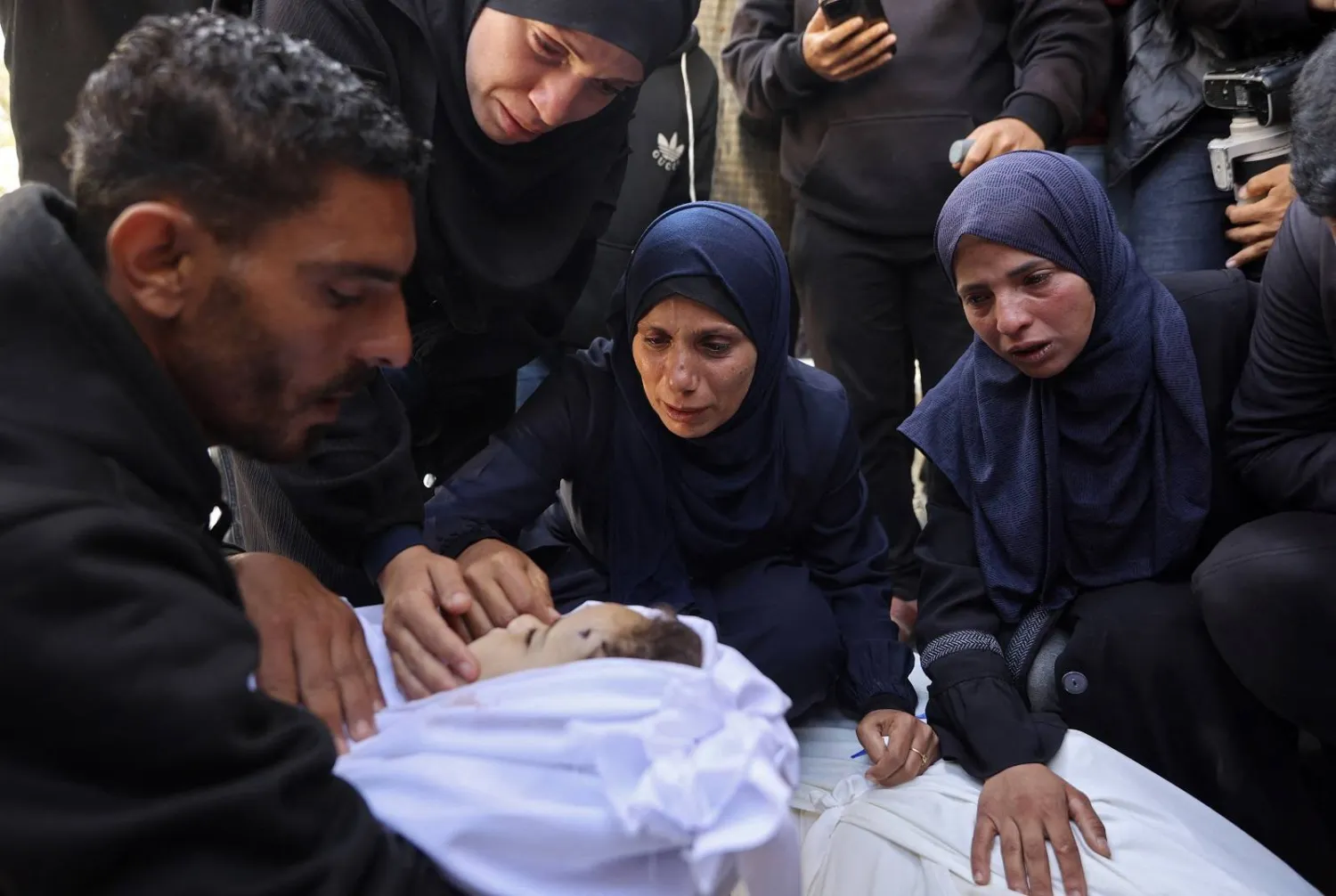
Mourners weep beside the body of a child at a hospital in Gaza City (AFP)
TT

Hamas Angered by Continued Violations, Prepares Amendments to New Mediator Plan

Mourners weep beside the body of a child at a hospital in Gaza City (AFP)

Three Hamas sources said the movement has expressed anger to mediators over the continued Israeli violations in the Gaza Strip, most recently the assassination of Iyad al-Shanbari, a senior commander in the Qassam Brigades, the movement’s armed wing.

The three sources, speaking to Asharq Al-Awsat, said Hamas considers these violations, particularly the assassination of security leaders, a blow to mediation efforts aimed at establishing a clear agreement that obliges Israel to carry out its commitments.

It called on mediators to intervene in a “serious and firm” manner to halt these operations, which have led to the killing of about 1,000 Palestinians since the ceasefire entered into force on October 10, 2025. The sources said mediators confirmed they are continuing their efforts to put an end to the Israeli violations.

A Palestinian source in contact with the Gaza Administration Committee told Asharq Al-Awsat that Nickolay Mladenov, the highest representative for Gaza in the Peace Council, “requested on Monday that Israel halt airstrikes in the Gaza Strip for 48 hours to give the Cairo negotiations a chance to succeed, but received no response.” Hamas sources said they had no knowledge of this request.

A day after a new proposal was presented by mediators and the Peace Council regarding Gaza and advancing the implementation of the ceasefire agreement, Hamas sources said the movement is preparing a response containing remarks and requested amendments to be submitted by its negotiating delegation to Mladenov and the mediators.
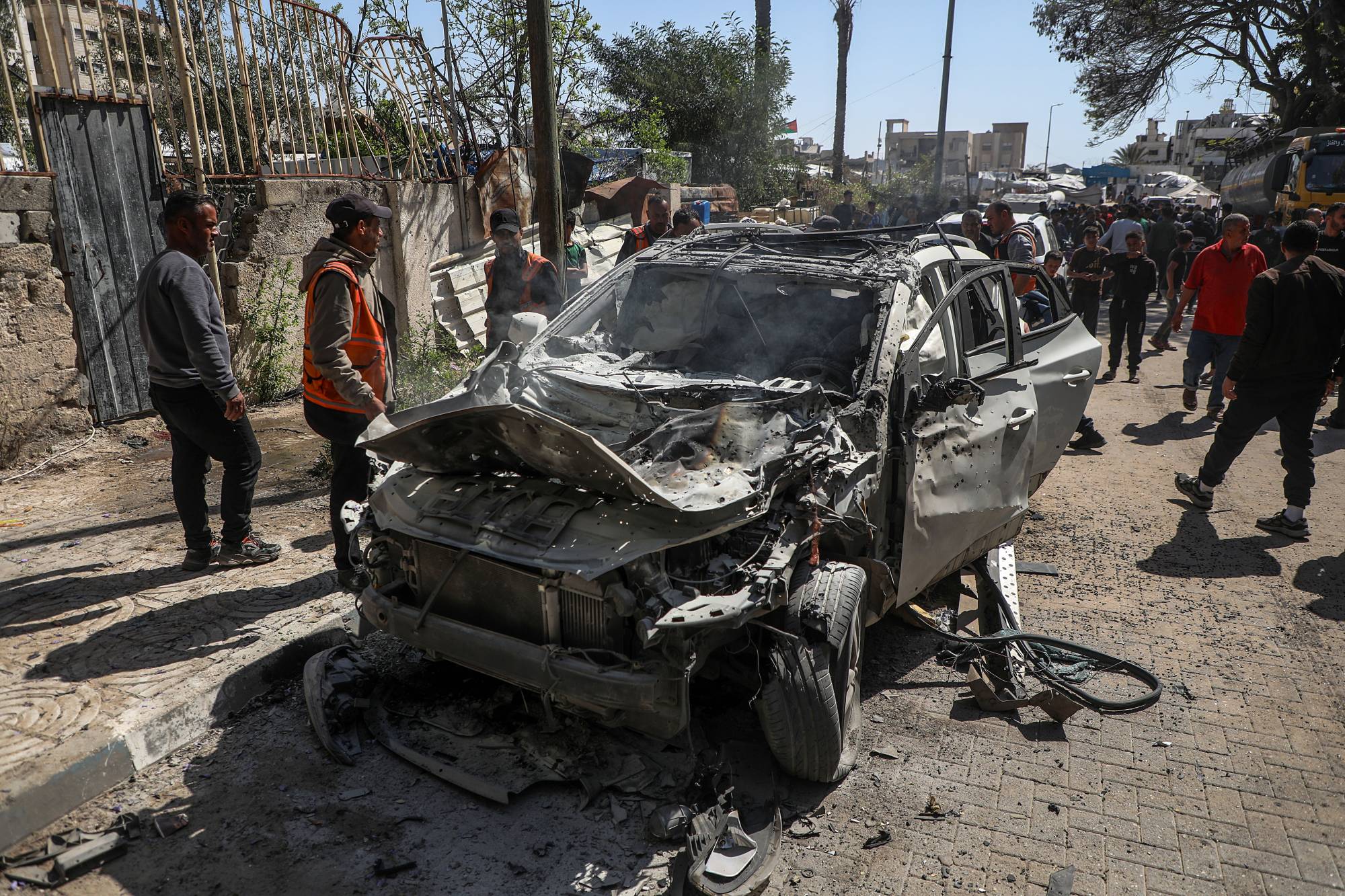
Members of the Palestinian Civil Defense and local residents inspect a damaged vehicle following an Israeli airstrike in the west of Gaza City, Gaza Strip, 28 April 2026. EPA/MOHAMMED SABER

Asharq Al-Awsat had obtained details of the proposal drafted by representatives of the Peace Council and mediators from Egypt, Qatar and Türkiye, along with the United States, concerning the Gaza Strip, particularly its disarmament.

The document, titled “Roadmap” to complete implementation of US President Donald Trump’s comprehensive Gaza peace plan, outlines 15 provisions addressing the implementation of the second phase of the ceasefire agreement between Israel and Hamas.

The response will focus, according to the sources, on demands for a clear timetable for Israeli withdrawal, the establishment of clear international mechanisms and guarantees to oblige Israel, rejecting any linkage between reconstruction and the confinement and disarmament issue, and affirming the right of factions to fully exercise their political role without restrictions.

The new paper indicates the formation of a body named the “Implementation Verification Committee,” to be established by the highest representative for Gaza, comprising guarantor states, an international stabilization force and the Peace Council, to ensure that the parties fulfill their obligations, supported by an enhanced monitoring mechanism.

In its first provisions, the document stresses the importance of full commitment by all parties to implement UN Security Council Resolution 2803 and Trump’s comprehensive plan, as an agreed international framework that will guide the implementation of this process, in a way that ensures achieving the primary objective of restoring civilian life, enabling Palestinian governance, reconstruction, security and economic recovery, and creating the conditions for a credible path toward self-determination and a Palestinian state in line with the Security Council resolution.



Beirut Transfers 128 Syrian Convicts Home

Lebanese army soldiers secure the area at the entrance of Zawtar al-Gharbiyah village, southern Lebanon, 23 June 2026, amid a ceasefire between Israel and Hezbollah. EPA/WAEL HAMZEH
TT

Beirut Transfers 128 Syrian Convicts Home

Lebanese army soldiers secure the area at the entrance of Zawtar al-Gharbiyah village, southern Lebanon, 23 June 2026, amid a ceasefire between Israel and Hezbollah. EPA/WAEL HAMZEH

Lebanon has transferred 128 Syrian convicts to their home country, a Lebanese security source told AFP on Wednesday, the second batch of handovers under an agreement the two sides signed earlier this year.

Overcrowded Lebanese prisons host around 2,000 Syrian nationals held on various charges.

Many are still awaiting trial, while hundreds have been brought before military courts on charges of "terrorism" or related offences, including attacks on Lebanese forces.

Others are in custody for alleged membership in militant or armed groups that were opposed to now-ousted Syrian president Bashar al-Assad, who was supported by Lebanon's Hezbollah during the Syrian civil war.

The security source, who requested anonymity, said that Beirut "handed over the second batch of Syrian convicts in Lebanon to Damascus, numbering 128 convicts" on Wednesday.

The transfer follows the handover of more than 130 Syrian detainees in March, under an agreement signed between the two countries the previous month, which will cover almost 300 convicts who have served 10 years or more in Lebanese prisons.

Under the agreement, they will be required to complete the remainder of their sentences in Syria.

At least 260 convicts have now been sent to Syria's Adra prison out of 356 in Lebanon's Roumieh, the source added.

The issue of the detainees had been a sticking point in Beirut-Damascus relations following Assad's overthrow in December 2024.

It was discussed by Lebanese Prime Minister Nawaf Salam during his visit to Damascus in May, where he met Syrian President Ahmed al-Sharaa.

Over the past year, both sides have repeatedly expressed their determination to open a new chapter in their relations.


Syrian Troop Killings Expose Repeated Attacks, Security Lapses

Syrian army personnel on a military vehicle in Deir Hafer, rural Aleppo, in January 2026. (Reuters)
TT

Syrian Troop Killings Expose Repeated Attacks, Security Lapses

Syrian army personnel on a military vehicle in Deir Hafer, rural Aleppo, in January 2026. (Reuters)

The recent killing of two Syrian army members near Manbij, east of Aleppo, was not an isolated attack. It was part of a recurring pattern of strikes on government forces, exposing serious administrative and security gaps that groups opposed to Syria’s new administration are using to target its personnel.

Syria’s Ministry of Defense media and communications department said on June 20 that two soldiers from the 76th Division were killed after unknown gunmen attacked them near Manbij.

The soldiers were riding a motorcycle on a road near the city when they came under direct fire.

Since the fall of the Assad regime, Asharq Al-Awsat has tracked many similar attacks on Syrian security and army personnel. Most have occurred as members were heading to or leaving their posts, often on motorcycles or via irregular transport.

Many see the pattern as evidence of weak protection measures and poor organization of personnel rotations.

Rural Aleppo has witnessed several assassinations this year. Among the most prominent were the killing of two Syrian army members in March and another member of the Interior Ministry in April near the town of al-Rai.

Similar incidents have also been reported across most Syrian provinces, including Daraa, Latakia, rural Hama and Homs.

Embarrassing the Syrian state

Demands have grown for personnel to avoid moving alone, wearing military uniforms or using motorcycles in remote areas where the risk is high and support is hard to reach.

Major Khaled al-Abdullah, director of the Syrian interior minister’s office, said the defense and interior ministries had repeatedly issued circulars banning personnel from wearing official uniforms outside working hours and requiring them to follow safety measures suited to Syria’s current conditions.

He said the immediate aim of attacks by groups opposed to the new administration, including Islamic State and remnants of the ousted regime, was to “try to embarrass the Syrian state.”

Abdullah stressed that authorities were working hard to impose security, eliminate armed groups and organizations, and had made significant progress on what he called a difficult path.

But in remarks to Asharq Al-Awsat, he also pointed to “continued internal and external challenges that the Syrian state is working to overcome and whose danger it seeks to end.”

Manbij, the most dangerous route

Abu Mohammed al-Hussein, who oversees a cluster of checkpoints in eastern rural Aleppo, said the movement of personnel had become a problem. He said he had repeatedly asked for buses to transport rotating shift members, especially in rural areas far from the city center.

Hussein said one member of his checkpoint group survived an assassination attempt on the Manbij-al-Bab road in eastern rural Aleppo at the end of March. The incident pushed him to issue special orders regulating how his personnel move.

“A civilian car offered to take one of my men to Aleppo city,” he said. “After they had driven several miles, they claimed there was an emergency and said they had to return. As soon as he got out, the driver’s companion fired several shots at him with a pistol. Two hit his magazine pouch and one pierced his foot. He survived by a miracle.”

He said shift rotations are “decided centrally by sector commanders” and are often carried out at night because service areas are far from where personnel live. He said a ban on carrying weapons and moving through residential areas had also made personnel easier targets.

“With repeated assassination attempts, I issued a decision banning nighttime shift rotations, prohibiting movement in civilian cars or on motorcycles, which have also become easy targets, and limiting transport to road security vehicles,” he added.

Hussein said they were still waiting for approval of a request to allocate a bus to transport security and military checkpoint personnel deployed along the Aleppo-Manbij road.

He described it as “one of the most dangerous land routes,” linking Aleppo to outlying areas and Raqqa province, and passing through an area that remained for years under the control of the ousted regime and the Syrian Democratic Forces.

Ban on keeping weapons

Haider al-Mohammed, a special tasks member, disagreed. He said “transport buses are, in practice, the easy target” and are often attacked, meaning the problem of securing personnel goes beyond transport.

He said decisions that stripped personnel of the means to protect their safety and identity were the direct reason behind the rise in assassinations, alongside the exceptional conditions in the country and the process of “clearing out groups that believe they can create chaos and fear.”

He said among the most important of these decisions were “the ban on wearing face coverings, the ban on keeping registered weapons, and the strict instruction not to carry personal weapons, along with leniency over wearing official uniforms.”

As a result, he said, personnel are exposed, easy targets for these groups, and left without weapons to defend themselves.

On this point, Major Khaled al-Abdullah said Syria’s security and military institutions were working to “implement solutions to facilitate and reduce regular movement in a way that helps end the threat and strengthen the safety of their personnel.”

He said the pattern of attacks “confirms their randomness.” The failure to select specific targets or have prior knowledge of the personnel being targeted, he said, was “an attempt to create chaos and confuse the Syrian state.”


Arab Parliament Speaker Stresses Need for Solidarity to Confront Regional Challenges

Arab Parliament Speaker Stresses Need for Solidarity to Confront Regional Challenges
TT

Arab Parliament Speaker Stresses Need for Solidarity to Confront Regional Challenges

Arab Parliament Speaker Stresses Need for Solidarity to Confront Regional Challenges

Speaker of the Arab Parliament Mohammed Al-Yamahi stressed the importance of solidarity, unity of ranks, positions, and voices, and strengthening consensus among Arab countries in addressing the growing challenges and risks facing the region, which require greater solidarity, cohesion, and joint Arab action now more than ever.

He made the remarks today during the preparatory committee meeting for the Eighth Conference of the Arab Parliament and Speakers of Arab Councils and Parliaments, which is being held in partnership with the Arab Inter-Parliamentary Union, SPA reported.

Al-Yamahi explained that this year's conference is being convened at a critical and exceptional stage for the Arab nation, requiring the highest levels of coordination, consultation, and unified positions on issues and challenges affecting the Arab world's present and future.

He noted that the conference will address several strategic issues, foremost among them the serious developments surrounding the Palestinian cause, the Arab world's primary concern.

It will also discuss recent highly dangerous security developments in the region and Iranian attacks against Arab states, as well as the topic of enhancing Arab digital sovereignty, which has emerged as a strategic issue driven by rapid digital transformation.

He said the issue calls for the development of a unified Arab parliamentary vision that protects Arab interests, strengthens digital security, and supports sustainable development efforts.