


Iran-Linked Cells Accused of Exploiting Chaos in Syria

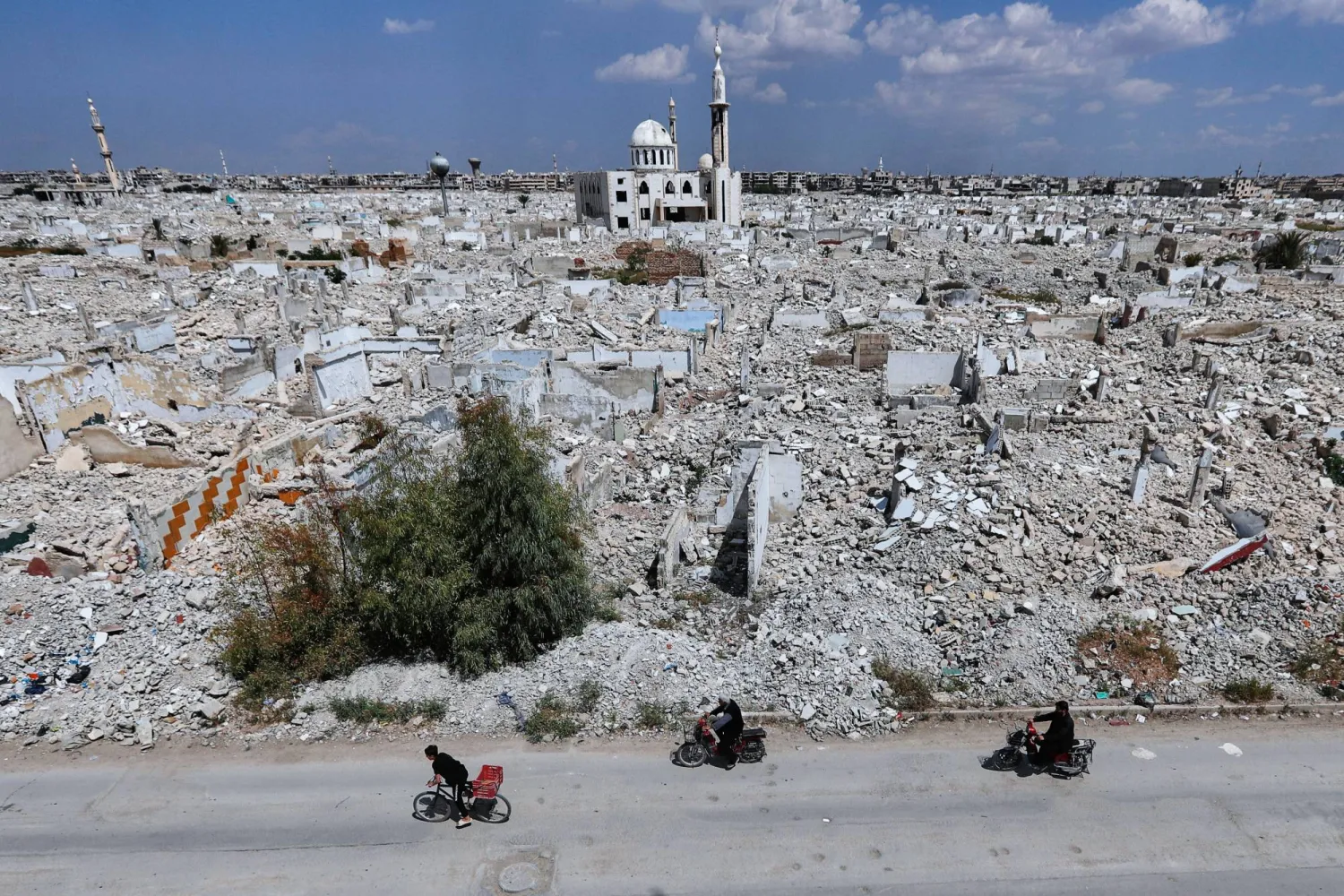
Motorcyclists pass destruction in the al-Qadam area on the outskirts of Damascus, Syria, Wednesday, April 29, 2026 in a area that was heavily bombed by forces loyal to former Syrian president Bashar Assad during the Syrian war. (AP Photo/Omar Sanadiki)
TT

Iran-Linked Cells Accused of Exploiting Chaos in Syria

Motorcyclists pass destruction in the al-Qadam area on the outskirts of Damascus, Syria, Wednesday, April 29, 2026 in a area that was heavily bombed by forces loyal to former Syrian president Bashar Assad during the Syrian war. (AP Photo/Omar Sanadiki)

The Syrian Interior Ministry has said the assassination of a Shiite cleric, seen as close to the government, marks a “dangerous escalation,” adding it is following with “great concern” what it described as “systematic” attempts in recent days to create instability, spread chaos, and undermine civil peace.

A source in Damascus said the cleric killed on Friday was considered a partner of the government in reshaping “the landscape of stability within the Shiite community” in Syria.

That role could have made him a target for cells linked to the “Iran axis,” which, according to circles close to the Syrian government, seek to exploit instability by recruiting local agents.

However, no official Syrian statement has confirmed this scenario, and the attack could also have been carried out by ISIS cells or other parties.

Farhan al-Mansour, imam at the Sayyida Zainab shrine south of Damascus, was killed in a car bomb on Friday, Syrian state television reported.

The Interior Ministry said the assassination fits into a “dangerous escalation” targeting religious and social figures in an attempt to incite sectarian strife.

In a statement issued late Friday, the Ministry said the “crime will not go unpunished,” adding that authorities have launched investigations to uncover the circumstances, identify those responsible, and take the necessary legal measures.

It reaffirmed its commitment to protecting citizens, preserving public security, and confronting any attempts to undermine stability.

A Damascus-based source said the Ministry’s statement appears to link the attack to recent operations dismantling “terrorist” cells.

Wael Alwan, executive director of the Jusoor for Studies in Damascus, told Asharq Al-Awsat that most cells dismantled in recent months are linked to an axis connected to Iran, which “seeks to exploit chaos and recruit local agents, whether from former regime elements or newly recruited individuals.”

Alwan said many of these cells are tied to Hezbollah or Iraqi groups with local members, most of whom had links to the former regime. “They are trying to exploit chaos, because stability in Syria runs counter to Iran’s interests,” he said.

According to Alwan, al-Mansour was “fully aligned with the process of stability and social peace pursued by the Syrian government,” and had played a role in reshaping a “highly sensitive” aspect of stability concerning the Shiite community.

For that reason, he could have been targeted by cells linked to Iran or Hezbollah, although there is no confirmed information.

He added that the Interior Ministry’s framing of the incident may point to an axis in which Hezbollah remains the most influential actor in Syria.

Sheikh Hassan al-Mansour, from the village of al-Kubar in Deir Ezzor, had recently met Syrian President Ahmad al-Sharaa and played a prominent role in promoting civil peace in the Sayyida Zainab area.

He had also rejected any Iranian or Iran-backed militia influence over the shrine or the Shiite religious establishment in Syria.

Iran’s Foreign Ministry spokesman Esmaeil Baghaei strongly condemned the assassination.

Baghaei said on Saturday that such “terrorist acts” are part of “malicious conspiracies by the Zionist entity and the United States to fuel divisions and sow discord in regional countries,” according to Iran’s IRNA news agency.

He called on all parties to remain vigilant and act responsibly in confronting terrorism and extremism, while urging efforts to identify those responsible and strengthen regional cooperation to eradicate the roots of terrorism.

Since the fall of the Iran-backed government of Bashar al-Assad in December 2024, Syria’s Shiite minority, estimated at around 300,000 people and mainly concentrated in Damascus and parts of Homs, Aleppo, and Idlib provinces, has been living in a state of concern.

While the community has not faced retaliatory attacks like those targeting some Alawites on the Syrian coast or Druze in Sweida, a cleric, Rasoul Shahoud, was shot dead near Homs in July 2025.

The Sayyida Zainab area was also targeted by ISIS cells on Jan. 11, 2025, according to the Interior Ministry, which said at the time it had foiled a bombing attempt at the shrine and arrested those involved.

In April, the Ministry said it had dismantled several cells linked to Hezbollah in Damascus and Quneitra that were planning “sabotage” operations and rocket attacks.

It also announced it had thwarted an attempt to assassinate Syrian Jewish rabbi Michael Houri through an explosive device planted outside his home near the Mariamite Cathedral in Bab Touma, Damascus. It said it arrested five suspects, including a woman.

On April 27, Syrian authorities said they had dismantled a “terrorist cell” in Homs province and foiled a plot aimed at “targeting security and stability in the region.”

Two members of the cell were killed and a cache of weapons was seized.


UN Demands Israel Prevent 'Genocide' in Gaza

Hundreds of thousands of people are still living in tents in the Gaza Strip, pictured in January, and conditions remain dire despite the ceasefire. Bashar Taleb / AFP/File
TT

UN Demands Israel Prevent 'Genocide' in Gaza

Hundreds of thousands of people are still living in tents in the Gaza Strip, pictured in January, and conditions remain dire despite the ceasefire. Bashar Taleb / AFP/File

The United Nations demanded Monday that Israel take measures to prevent acts of "genocide" in Gaza, and decried indications of "ethnic cleansing" in the Palestinian territory and in the occupied West Bank.

In a fresh report, the UN rights office said Israel's actions in Gaza since the start of the war in October 2023 involved "gross violations" of international law, amounting in many cases to "war crimes and other atrocity crimes".

UN rights chief Volker Turk called in the report on Israel to ensure compliance with a 2024 International Court of Justice order that it take measures to prevent acts of genocide in Gaza, AFP reported.

Israel, he said, should ensure "with immediate effect that its military does not engage in acts of genocide, (and take) all measures to prevent and punish incitement to commit genocide".

Israel has repeatedly and forcefully denied allegations of genocide, which have previously been brought by rights groups like Amnesty International and Human Rights Watch, as well as independent UN experts, but never by the United Nations directly.

- 'Unlawful killings' -

Monday's report, which covered the period from October 7, 2023, when Hamas's unprecedented attack inside Israel sparked the Gaza war, up to May 2025, also condemned "serious violations" including some amounting to war crimes, by Palestinian armed groups during the initial attack and after.

The Hamas attack resulted in the deaths of 1,221 people on the Israeli side, most of them civilians, according to an AFP tally based on official data.

Monday's report highlighted the abuse suffered by the hostages seized by the Palestinian armed groups, many of whom reported torture and sexual abuse as they were held "in inhumane conditions" for months on end.

"Most hostages who died in Gaza died while held in secret detention, either killed by their captors or impacts of the conflict occurring around them," it said.

Most of the focus however was on Israel's actions in Gaza, where its retaliatory military campaign has killed more than 72,000 people, according to the health ministry in the Hamas-run territory, whose figures are considered reliable by the UN.

Hundreds of thousands of people are still living in tents and conditions remain dire despite a ceasefire that took effect in October last year.

"The ceasefire diminished the immense scale of violence up to that point, and opened some modest humanitarian space," Ajith Sunghay, head of the UN rights office in the occupied Palestinian territories, told reporters in Geneva.

"But killings and the destruction of infrastructure have continued on an almost daily basis, and the overall humanitarian situation remains dire," he warned.

A large proportion of the killings since the start of the war "appear unlawful", the report said.

It also highlighted how Israel had "directed attacks on civilian or protected objects, including healthcare and medical facilities and attacks on civilians, including journalists, civil defenders, health workers, humanitarian actors and police in a routine and repeated fashion".

Israel's conduct in Gaza had rendered living conditions in much of the territory "incompatible with Palestinians continued existence as a group", it warned.

The report also looked at the situation in the West Bank, where violence has spiralled since the start of the war in Gaza, pointing out that "the use of unnecessary and disproportionate force (there had) led to hundreds of unlawful killings".

- 'Collective punishment' -

"Force displacement on a mass scale" had been seen in both Gaza and the West Bank, it said.

It charged that "the deliberate and unlawful destruction of wide swathes of Gaza", coupled with "the emptying and destruction of large parts of refugee camps in northern West Bank", had contributed to forcing Palestinians from their homes, "with strong indications that Israel intends their displacement to be permanent".

Taken together, Israel's repeated violations across the occupied Palestinian territories indicated a pattern aimed at doling out "collective punishment of Palestinians", and "forced displacement, emptying and ethnic cleansing of large parts of the Occupied Palestinian Territory", said the report.

"Incitement and derogatory and dehumanising language targeted at Palestinians as a group from Israeli officials was also observed with no accountability," it warned.

The rights office stressed that it was "essential that there is due reckoning" for all violations listed in the report through "credible and impartial judicial bodies".

Sunghay warned that "in a context like this, lack of action is not passivity. It is a license".


Syria to Join G7 Finance Talks in Paris in Sign of Growing Status

Syrian Finance Minister Yisr Barnieh - Reuters
TT

Syria to Join G7 Finance Talks in Paris in Sign of Growing Status

Syrian Finance Minister Yisr Barnieh - Reuters

Syria will take part in a closed-door session with G7 finance ministers and central bank governors in Paris on Monday, a person familiar with the matter said, in a sign of its growing status less than two years after the ousting of Bashar al-Assad.

Syrian Finance Minister Yisr Barnieh is expected to attend the meeting, the person said, adding that the discussions will focus on Syria's sustainable recovery and reintegration into the global financial system, according to Reuters.

The two-day G7 finance chiefs' meeting is dominated by global economic imbalances, trade tensions and the fallout from conflicts in the Middle East and Ukraine.

Syria's economy remains deeply damaged by years of war and isolation. While most sanctions have been eased or lifted since former president Assad's removal, recovery has been slow, with investors and banks still wary of compliance risks and the practical difficulty of reconnecting Syria to the global financial system.

Syria and Ukraine are expected to be present in parts of the discussions, underscoring the G7's emphasis on stabilizing countries seen as central to regional and global security.

The person familiar with the matter said Syria's participation was part of preparations for the G7 leaders' summit in June and reflected a push to bring the administration of President Ahmed al-Sharaa closer to leading economies.

For Damascus, participation in the G7 finance track marks another step in efforts to return to the international system, attract support for reconstruction and show that it has become a pivotal state in the changes reshaping the region.


EU Renews Restrictions on People Involved in former Syria Administration under Assad

FILE PHOTO: Guard standing near an image of Syria's Bashar al-Assad at the fourth division headquarters in Damascus, Syria, January 23, 2025 REUTERS/Yamam Al Shaar/File Photo
TT

EU Renews Restrictions on People Involved in former Syria Administration under Assad

FILE PHOTO: Guard standing near an image of Syria's Bashar al-Assad at the fourth division headquarters in Damascus, Syria, January 23, 2025 REUTERS/Yamam Al Shaar/File Photo

The European Union has decided to renew restrictions on individuals and entities linked to the former Syrian administration run by Bashar al-Assad, who was toppled in December 2024.

"The EU considers that networks linked to the former al-Assad regime continue to retain influence and pose a risk of undermining the transition process and hindering efforts towards national reconciliation and accountability," said a statement from the Council of the European Union on Monday, Reuters reported.

"Those designated are subject to an asset freeze and EU citizens and companies are prohibited from making funds available to them. Individuals are additionally subject to a travel ban, which prevents them from entering or transiting through EU member states," it added.

The EU has, at the same time, increased ties with the new Syrian government, led by President Ahmed al-Sharaa, which replaced Assad's administration.

Earlier this month, EU foreign ministers agreed to restore trade ties with Syria, reinstating a cooperation agreement that had been suspended in 2011.
