


Syria: Pending Issues, Including Arrests Delay SDF Integration

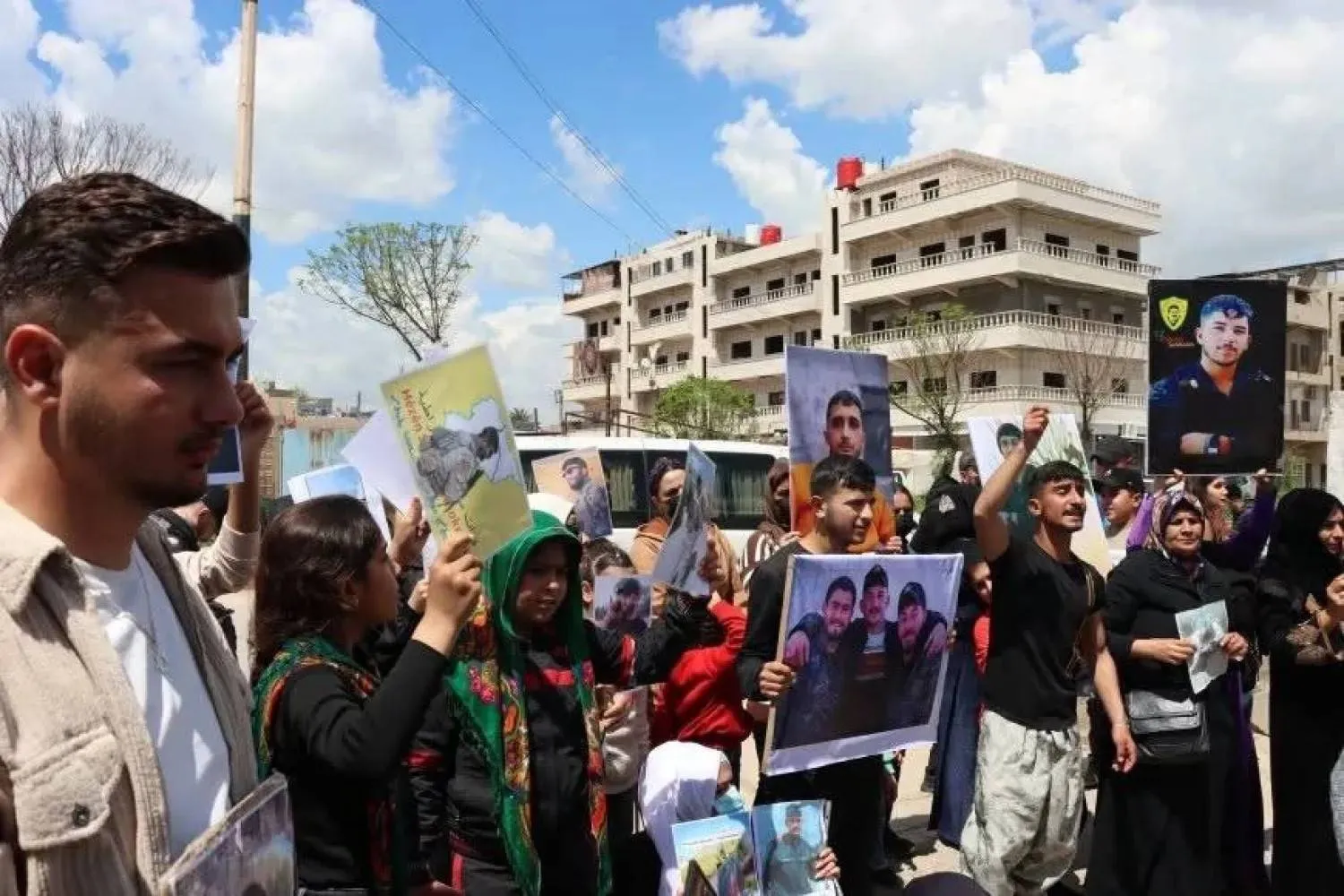
Protest by families of SDF detainees held by the Syrian government outside the Democratic Union Party building in Qamishli (Ronahi)
TT

Syria: Pending Issues, Including Arrests Delay SDF Integration

Protest by families of SDF detainees held by the Syrian government outside the Democratic Union Party building in Qamishli (Ronahi)

The exchange of prisoners and detainees between the Syrian government and the Syrian Democratic Forces (SDF) has stalled since mid-April after becoming tied to political issues, hampering efforts to integrate the SDF and implement an agreement reached last January.

Abdulkarim Omar, a senior official in the Kurdish Autonomous Administration, told Asharq Al-Awsat that several issues still require “further discussion and consensus.”

He said the top priority remains the detainees file and the return of displaced people, stressing that both the Autonomous Administration and the SDF are fully committed to the agreement.

The remarks came as families of SDF detainees held by the Syrian government staged a protest demanding the release of their sons, according to Kurdish media, amid reports of reciprocal arrest campaigns in Hasakah and Raqqa provinces.

Omar said the detainees and prisoners file was still receiving “careful attention and follow-up” from the SDF and the Autonomous Administration.

“This reflects our commitment to fully implementing the provisions of the Jan. 29 agreement, which represents an important framework for cooperation and understanding between the Autonomous Administration and the transitional government,” he said.

He said the Autonomous Administration and the SDF were committed to implementing all provisions of the agreement, including the integration of military, security and administrative institutions, while taking into account the particularity of Kurdish areas.

He said there was “full awareness that the integration process requires building trust and a genuine will from all parties, in addition to overcoming any rhetoric that could obstruct this path.”

According to the Kurdish news agency Hawar, families of SDF detainees held by the Syrian government complained that they had been prevented from seeing their sons in detention centers in Aleppo.

Families of detainees also staged protests in Hasakah city to demand their release. Video clips aired by Kurdish media showed a group of families demonstrating outside the Hasakah governorate building on Tuesday.

“We are seeking urgent solutions that ensure the release of all detainees in order to ease the suffering of their families,” Omar said.

He added that the return of displaced people to their original areas remained a top priority. About 1,400 families have so far returned to Afrin, while around 7,000 families in Jazira and Kobani are still waiting to return to their hometowns.

Work is also continuing to allow other families displaced from Ras al-Ain, Tal Abyad and other areas to return “with dignity and safety,” he said.

Outstanding Issues

Omar said several issues require further discussion and agreement. These include integrating the Women’s Protection Units into the Syrian Defense Ministry and developing mother-tongue education in Kurdish areas.

He added that other issues include accrediting certificates issued by Autonomous Administration institutions on par with other areas, as well as matters related to courthouses and other technical and administrative issues.

“We are confident that through shared will, continued and transparent dialogue and trust-building, tangible progress can be achieved on these files in a way that serves the interests of all Syrians and strengthens national stability,” he said.

He said progress on these files represented “a real opportunity to strengthen trust among all parties,” adding that commitment to agreements was the best path toward “solid national unity, lasting stability and a shared future marked by security and dignity for all Syrians.”

The prisoner and detainee exchange file had made notable progress in March and April under understandings aimed at “emptying prisons” and building confidence as part of the implementation of the agreement.

In the latest batch, around 400 SDF detainees were released in exchange for 91 detainees held by the Syrian government.

That followed earlier batches in March that saw 300 detainees released in exchange for 300 others, and before that, 159 detainees were released in exchange for 100.

Sipan Hamo, also known as Samir Oso, assistant defense minister in Syria’s interim government for eastern region affairs, described linking the detainees issues to political pressure as “immoral.”

In an interview with Hawar, he said the mechanism used in recent exchanges was “wrong,” adding that all prisoners should have been released on the day integration was announced, without batches.

Ahmed al-Hilali, spokesman for the presidential team tasked with overseeing the implementation of the Jan. 29 agreement, said in press remarks that the delay in taking over courthouses, especially in Qamishli, had negatively affected other files, most notably detainees.

He said the issue had shifted from an exchange approach to release procedures after the Syrian government took over prisons in Hasakah, but that the process was still facing delays.

Hilali said the integration track was linked to several overlapping issues, including the detainees, whom he described as “non-negotiable.”

But he said it was still affected by progress in implementing the agreement, while expressing optimism that a breakthrough could be achieved in the coming days.

Reciprocal arrests

In a parallel development, local media said SDF forces carried out an arrest campaign on Monday in Hasakah city and its surroundings.

The Hasakah Media Center said the campaign took place in the city’s Salihiya neighborhood and in the village of al-Fahd near Panorama roundabout, leading to the arrest of a young man in Hasakah and several residents of the village.

Syrian security forces had earlier arrested a number of people affiliated with the SDF in Raqqa. Asharq Al-Awsat sought details from government and Kurdish sources on the nature of those arrests but received no response.



Israeli Strikes Kill Five People in Gaza

Mourners carry a body during the funeral of Palestinians who were killed in an Israeli strike, according to medics, in Gaza City, May 17, 2026. REUTERS/Dawoud Abu Alkas
TT

Israeli Strikes Kill Five People in Gaza

Mourners carry a body during the funeral of Palestinians who were killed in an Israeli strike, according to medics, in Gaza City, May 17, 2026. REUTERS/Dawoud Abu Alkas

Israeli strikes killed at least five Palestinians in the Gaza Strip on Sunday, health officials said, as ceasefire efforts meant to end fighting between Israel and Hamas falter.

In the weeks since halting its joint bombing with the US in Iran, Israel has stepped up its attacks in Gaza, where Hamas has been tightening its grip, even as Israeli troops remain in control of more than half the territory.

Medics said an Israeli strike killed one Palestinian near a police ⁠post and another ⁠at a tent encampment in Khan Younis in the southern Gaza Strip. The Israeli military said it killed a militant who posed an immediate threat to forces in the area.

Separately, Gaza medics said another Israeli airstrike killed at least three people at a community kitchen near Al-Aqsa Hospital in Deir Al-Balah, in the central Gaza area. The Israeli military did not immediately ⁠comment on that incident.

On Saturday, the Israeli military said that Izz al-Din al-Haddad, the head of Hamas' armed wing in Gaza, was killed in what it described as a precise strike on Gaza City on Friday.

Hamas confirmed Haddad's death but stopped short of threatening revenge.

The Israeli military said it had also killed Bahaa Baroud, a Hamas Operations Headquarters commander, in an airstrike on Saturday, accusing him of planning multiple imminent attacks against troops and Israeli civilians in recent weeks.

According to Reuters, the military said Baroud posed an immediate threat and was targeted in a precise strike, adding ⁠that measures ⁠were taken beforehand to reduce civilian harm, including the use of precision munitions and aerial surveillance.

Gaza health officials said Baroud, along with another person, was killed in the airstrike, which targeted their car in Gaza City.

Israel and Hamas remain deadlocked in indirect talks to advance US President Donald Trump's post-war plan for Gaza that is meant to end more than two years of fighting with Hamas disarming as Israeli troops withdraw from Gaza.


Israel Strikes Lebanon as Hezbollah Calls Talks 'Dead End'

Smoke rises from the site of an Israeli airstrike that targeted the southern Lebanese village of Choukine on May 17, 2026. Photo by Abbas FAKIH / AFP
TT

Israel Strikes Lebanon as Hezbollah Calls Talks 'Dead End'

Smoke rises from the site of an Israeli airstrike that targeted the southern Lebanese village of Choukine on May 17, 2026. Photo by Abbas FAKIH / AFP

Israel struck eastern and southern Lebanon on Sunday, state media reported, despite a fragile ceasefire as Hezbollah called US-brokered talks between the two countries a "dead end".

Two Israeli strikes hit the town of Sohmor in eastern Lebanon's Bekaa valley, the state-run National News Agency (NNA) said, adding that others took place across southern Lebanon.

The Israeli army later issued an evacuation warning to four villages near the southern coastal city of Sidon, dozens of kilometres from the border area, which were also subject to an evacuation warning on Saturday, AFP reported.

Israeli airstrikes hit three of the four villages following the warning, the NNA said.

Despite the ceasefire, Israel continues to strike widely in southern Lebanon and issues frequent evacuation warnings to towns and villages across the south.

Speaking at the start of a cabinet meeting on Sunday, Israeli Prime Minister Benjamin Netanyahu said Israel was "holding territory, clearing territory, protecting Israel's communities, but also fighting an enemy that is trying to outsmart us".

"We are facing the challenge of neutralizing FPV (First-Person view) drones," he said, as Hezbollah has increasingly made use of the drones to strike Israeli forces.

The latest exchanges of fire came after envoys from Israel and Lebanon held a third round of negotiations in Washington and agreed to extend the ceasefire, talks that Iran-backed Hezbollah has repeatedly denounced.

"The direct negotiations that the authorities in Lebanon have conducted with the Israeli enemy have... led them down a dead-end path that will result in nothing but one concession after another," Hezbollah lawmaker Hussein Hajj Hassan said on Sunday.

"Neither they nor anyone else will be able to carry out what the enemy wants, especially when it comes to the issue of disarming the resistance," he said, adding that authorities were creating "very big predicaments" for the country.

In a statement on Saturday, the group called the proposed establishment of a US-facilitated security track a fresh addition "to the series of free concessions" the Lebanese government "offers the enemy".

On Saturday the group also said it had struck a military target in northern Israel, having earlier announced several operations against Israeli forces in southern Lebanon.

Israel sent ground forces into southern Lebanon during the latest war and they continue to occupy territory near the border between the two countries.

Israeli attacks since the start of the war have killed more than 2,900 people in Lebanon, including more than 400 since the truce began on April 17, according to Lebanese authorities.


Palestinian President's Son Elected to Top Fatah Leadership Body

Palestinian President Mahmoud Abbas with his son Yasser in Ramallah, West Bank, on May 28, 2018 (Reuters file photo)
TT

Palestinian President's Son Elected to Top Fatah Leadership Body

Palestinian President Mahmoud Abbas with his son Yasser in Ramallah, West Bank, on May 28, 2018 (Reuters file photo)

The son of Palestinian President Mahmoud Abbas won a seat on Fatah's top decision-making body on Sunday, as initial results emerged from the Palestinian movement's first congress in years.

Yasser Abbas, 64, a businessman who spends most of his time in Canada, secured a place on the central committee after being appointed around five years ago as his father's "special representative" - a role that marked his gradual emergence on the political scene.

Jailed Fatah leader Marwan Barghouti topped the preliminary results, retaining his seat on the committee with the highest number of votes, according to figures seen by AFP.

Jibril Rajoub was reelected as the secretary-general of the committee, retaining the seat he has held since 2017.

Palestinian vice president Hussein Al-Sheikh, Fatah deputy leader Mahmoud Al-Aloul and ex-Palestinian intelligence chief Tawfiq Tirawi also held their seats on the body.

Among the newcomers was Zakaria Zubeidi, 50, a former commander of the Al-Aqsa Martyrs Brigades -- Fatah's armed wing in the Jenin refugee camp -- who was freed from Israeli prison last year under a prisoner exchange deal with Hamas.

Two women also won seats, including Ramallah governor Laila Ghannam.

The three-day congress, held simultaneously across Ramallah, Gaza, Cairo and Beirut, drew 2,507 voters -- a turnout of 94.64 percent, organisers said.

Fifty-nine candidates competed for 18 seats on the central committee, while 450 vied for 80 seats on the revolutionary council, the party's parliament.

Counting for the council was still under way.

The congress opened Thursday, with Abbas being reelected as head of the movement.
In his opening address, he vowed to pursue reforms and hold long-delayed presidential and parliamentary elections.