

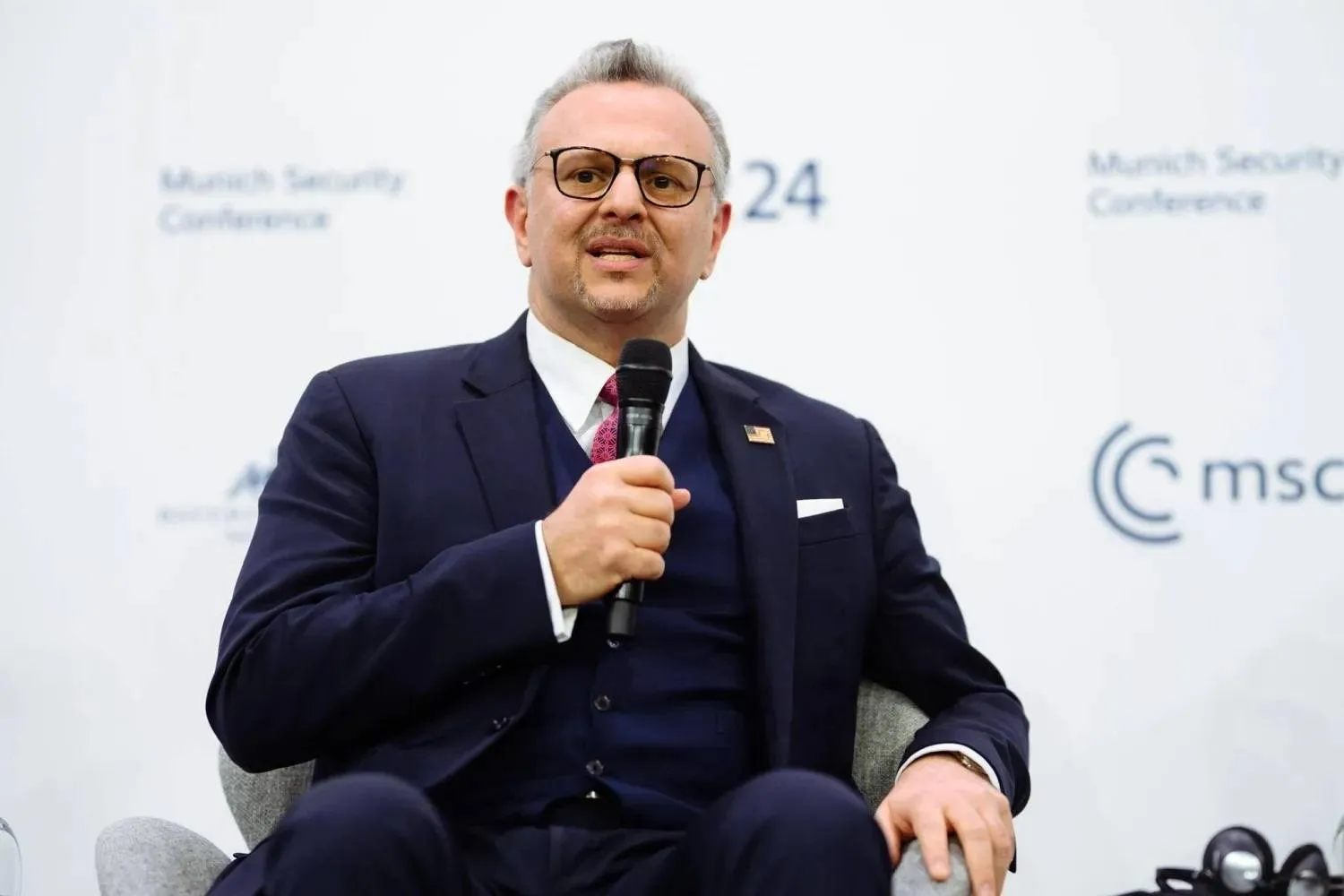

Trump Senior Adviser to Asharq Al-Awsat: No Military Solution in Sudan

Massad Boulos during his participation in the Munich Security Conference in mid-February, from his account on X
TT

Trump Senior Adviser to Asharq Al-Awsat: No Military Solution in Sudan

Massad Boulos during his participation in the Munich Security Conference in mid-February, from his account on X

Despite the complexity of the situation on the ground in Sudan, Washington still believes the de-escalation effort has a chance of succeeding.

Massad Boulos, senior adviser to President Donald Trump for Arab and African affairs, believes there is no military solution to the conflict that has raged there for years, and stressed the need to end external financial and military support to the warring parties.

In remarks to Asharq Al-Awsat that also covered regional developments and the dispute between Egypt and Ethiopia over the Grand Ethiopian Renaissance Dam, Boulos said a credible path remains available for de-escalation and a lasting settlement. He said that the path should begin with both sides accepting the proposed humanitarian truce without preconditions.

Boulos said all parties in Sudan must meet their obligations, halt hostilities, and allow full, safe, and unhindered humanitarian access. He also said humanitarian aid should not be subject to preconditions or politicized.

Asked about the failure to achieve a breakthrough on a truce, Trump’s senior adviser said responsibility lies with the Rapid Support Forces and the Sudanese Armed Forces to reach and abide by a humanitarian truce that ends atrocities and eases the immense suffering of the Sudanese people.

He said members of the Quad group (Saudi Arabia, Egypt, the United States, and the United Arab Emirates) agree on the need to pursue a negotiated settlement and a steady, and implementable path forward.

He said all parties want to end the atrocities and bring stability to Sudan, especially since there is no viable military solution.

Boulos stressed the need to end external financial and military support to the warring parties.

He said the Rapid Support Forces and the Sudanese Armed Forces must also halt hostilities, allow unhindered humanitarian access across the country, protect civilians, and take steps toward a negotiated, lasting peace that includes inclusive dialogue.

Grand Ethiopian Renaissance Dam

On April 20, Boulos visited Cairo, where he met Egyptian President Abdel Fattah al-Sisi and discussed several regional issues, including the dispute over Ethiopia’s Grand Ethiopian Renaissance Dam.

Boulos told Asharq Al-Awsat that, in January 2026, Trump had expressed the United States’ readiness to resume mediation between Egypt and Ethiopia to reach a responsible and final settlement of the dam issue.

He said Washington has supported a diplomatic solution on the Nile River that takes into account the needs of all parties. He added that the United States believes a comprehensive agreement is possible and is ready to support its negotiation and completion.

Egypt announced in 2024 that negotiations with Ethiopia over the dam had stopped after years of talks, citing the absence of political will on the Ethiopian side, according to statements by the Ministry of Irrigation. Addis Ababa says the dam is intended for development and not to harm the two downstream countries.

Eastern Congo crisis

From Sudan and Ethiopia, Boulos turned to eastern Congo, where tensions have escalated for a third year and where Washington is playing a major role in de-escalation. He said there remains a possibility of ending the violent conflict.

Boulos referred to Trump’s comments on the signing of a historic peace agreement between the Democratic Republic of the Congo and Rwanda, saying it provided, for the first time, a path toward peace to end an extremely violent conflict that has lasted 30 years. He said the effort was not easy.

He expressed deep gratitude for Qatar’s role, in partnership with the United States and other parties, in helping to end the conflict. He also praised close cooperation with other countries working with Washington and Doha, including the recent roles played by the African Union, Togo and Switzerland in supporting the talks.

Boulos said the United States remains deeply concerned about continued violence in eastern Democratic Republic of the Congo and is working closely with regional partners to strengthen the ceasefire.

He said Rwanda must end its support for the M23 movement and withdraw from the eastern Democratic Republic of the Congo, in line with the Washington Agreements.

Speaking about ongoing efforts to resolve the conflict in eastern Congo, Boulos said Washington would continue to use all available tools to ensure both sides meet their obligations. He declined to comment further on the ongoing diplomatic discussions.

Iran war

Trump’s senior adviser for Arab and African affairs criticized Iran, saying there had been no retreat in the US position toward Tehran, particularly on rejecting its possession of a nuclear weapon.

Boulos described Iran as the world’s leading state sponsor of terrorism, saying it supports Hezbollah, Hamas, the Houthis, the Taliban, al-Qaeda and other terrorist networks.

He said the Iranian Revolutionary Guard Corps is designated by the United States and many other countries, including the European Union, as a foreign terrorist organization, and that several regime leaders have also been designated as terrorists.

Boulos said the US position on Tehran remains clear and unchanged, namely that Iran cannot be allowed to possess a nuclear weapon.

In late February, Israel and the United States launched a war on Iran before Washington announced a truce that began on April 8, with Pakistani mediation aimed at a final halt to the conflict, whose repercussions affected economies around the world.



Hamas Considers Temporarily Suspending Ceasefire Negotiations

Mourners attend the funeral of Azzam Al-Hayya, the son of Khalil Al-Hayya, Hamas' chief negotiator in US-mediated talks over Gaza's future, in Gaza City May 7, 2026. REUTERS/Dawoud Abu Alkas
TT

Hamas Considers Temporarily Suspending Ceasefire Negotiations

Mourners attend the funeral of Azzam Al-Hayya, the son of Khalil Al-Hayya, Hamas' chief negotiator in US-mediated talks over Gaza's future, in Gaza City May 7, 2026. REUTERS/Dawoud Abu Alkas

Two Hamas sources told Asharq Al-Awsat the group’s leadership is weighing a temporary suspension of negotiations, citing what one source called “Israel’s lack of seriousness” in taking any steps to stop “its crimes and daily killings in Gaza.”

Talks on the Gaza ceasefire agreement, which took effect last October, are facing fresh complications.

Israel and Hamas remain at odds over how to implement the first-phase terms demanded by Hamas, including humanitarian commitments, and the second phase, which Israel is pressing to activate, especially the clause on “disarming” Gaza.

Israel has stepped up assassinations in Gaza after three days of relative calm requested by mediators, the Board of Peace’s high representative for Gaza, Nickolay Mladenov, and a US official from envoy Jared Kushner’s team.

People scramble to receive a warm meal at the Nuseirat camp for Palestinian refugees in the central Gaza Strip on May 7, 2026. (Photo by Eyad Baba / AFP)

Hamas said Thursday that Azzam al-Hayya, son of its chief negotiator Khalil al-Hayya, had died of wounds sustained in an Israeli attack that targeted him and others in Gaza City on Wednesday evening.

The attack also killed Hamza al-Sharbasi, a field commander in the elite unit of the Qassam Brigades, Hamas’ military wing, in the Shujaiya neighborhood.

Israeli strikes after noon Thursday killed three members of Hamas’ Internal Security Service at the entrance to its headquarters west of Gaza City.

Hamas said in a statement that the killing of Azzam al-Hayya was a failed attempt by Israel to influence the negotiating team and win political concessions.

Azzam’s death means Khalil al-Hayya has lost four sons in separate incidents. Among them was Hammam, Azzam’s twin, who was killed in a strike that targeted his father and several Hamas leaders while they were in Doha in September 2025.

‘The option is on the table, but it is not a response’

The two Hamas sources, both based outside the Palestinian territories, said the group had not made a final decision to suspend talks.

But one said “the option is now strongly on the table,” citing what he described as the mediators’ clear inability, including Mladenov and the US, to force Israel to stop daily violations that he said had killed about 1,000 Palestinians since the ceasefire began last October.

In separate comments, the sources rejected the idea that the possible suspension was a response to the killing of Khalil al-Hayya’s son.

They said the proposal had already been under discussion by the delegation, but had been delayed at the request of mediators and following consultations with factions.

“With the return of intensive assassinations and killings in this manner, it is back on the table again,” one source said.

Children sift through rubbish at the Nuseirat camp for Palestinian refugees in the central Gaza Strip on May 7, 2026. (Photo by Eyad Baba / AFP)

Sources from Palestinian factions said the killing of al-Hayya’s son would, in any case, automatically pause negotiation contacts because of a mourning period expected to last at least three days.

Despite earlier “positive” signals about progress, Palestinian factions have not received a response following Mladenov’s visit to Israel and his meeting with Israeli Prime Minister Benjamin Netanyahu last Tuesday.

Mladenov left Cairo last Friday for Israel to seek a response to understandings reached in Egypt’s negotiations with Hamas.

He met Netanyahu and described the meeting as “a positive and substantive discussion on the way forward to ensure the implementation of US President Donald Trump’s 20-point plan.”

Mladenov’s delayed response

Asharq Al-Awsat learned that Mladenov left Israel on Wednesday evening for his office in Dubai, although he had been expected in Egypt last Tuesday.

A Hamas source inside Gaza accused the Board of Peace representative of “aligning with Israeli conditions instead of being neutral.”

“What the negotiating delegation hears about ‘positivity’ from Mladenov or some US officials who took part in the meetings was expected to be followed by them compelling Israel or bringing positive responses from it,” the source said. But that did not happen, according to the source.

In an interview with Israel’s i24NEWS, Mladenov reiterated the Board of Peace’s position that Gaza’s reconstruction and Israel’s withdrawal from the strip are essentially tied to full disarmament.

He warned against linking Gaza to geopolitical developments in Iran or Lebanon, calling such voices “irresponsible” toward two million people living in tragic conditions.

Trump’s Gaza plan, accepted by Israel and Hamas, calls for Israeli forces to withdraw from Gaza, reconstruction to begin and Hamas to give up its weapons. But “disarmament” remains a major sticking point in talks to implement the plan and cement the ceasefire.

Senior Hamas sources say the group has told Mladenov it will not enter serious talks on implementing the second phase before Israel meets its first-phase obligations, including a complete halt to attacks.


Israel Strikes across Southern Lebanon despite Truce

A bulldozer clears the rubble of a partially damaged building targeted by an Israeli strike in the Haret Hreik neighborhood, a southern suburb of Beirut, Lebanon, 07 May 2026. EPA/STRINGER
TT

Israel Strikes across Southern Lebanon despite Truce

A bulldozer clears the rubble of a partially damaged building targeted by an Israeli strike in the Haret Hreik neighborhood, a southern suburb of Beirut, Lebanon, 07 May 2026. EPA/STRINGER

Israel pummeled southern Lebanon on Thursday, state media and AFP correspondents said, a day after it targeted a Hezbollah commander in its first strike on Beirut's southern suburbs since a truce sought to end weeks of fighting.

The Israeli army said Thursday that the strike on the southern suburbs killed "the Commander of Hezbollah's 'Radwan Force' Unit", an elite unit within the Iran-backed armed group Hezbollah.

A ceasefire in the war between Hezbollah and Israel began on April 17, but combat has largely not stopped in southern Lebanon.

Wednesday's strike near the capital, however, came as a shock in Lebanon.

AFP photographs taken in the southern suburbs showed the top floors of a residential building totally destroyed, and rescuers searching through the rubble on Thursday morning.

Hezbollah has not retaliated for the attack.

Lebanese state media reported Israeli strikes across a number of southern towns and villages, and the Israeli army issued fresh evacuation warnings to three villages north of the Litani River, and outside the area occupied by Israeli troops following their ground invasion of the border area.

Some of the Israeli strikes, on the southern city of Nabatieh, targeted a shopping center and residential buildings, state media and an AFP correspondent said.

In the nearby village of Toul, two rescuers from the Hezbollah-affiliated Islamic Health Committee were wounded in an Israeli strike as they were dispatched following a previous attack, spokesperson Mahmoud Karaki told AFP.

The team's ambulance was heavily damaged, he added.

The Israeli military said in a statement Thursday that an "explosive drone impact" wounded four soldiers -- one severely -- in southern Lebanon the previous day.

Despite the ceasefire, Hezbollah regularly claims attacks against Israeli forces occupying parts of southern Lebanon.

Since the war began on March 2, Israeli strikes have killed more than 2,700 people in Lebanon.

The Israeli military says it has lost 17 soldiers and a contractor in south Lebanon.


Israeli Attack Kills Son of Hamas’ Khalil Al-Hayya

FILE PHOTO: Hamas officials, Khalil Al-Hayya and Osama Hamdan, attend a press conference in Beirut, Lebanon, November 21, 2023. REUTERS/Esa Alexander/File Photo
TT

Israeli Attack Kills Son of Hamas’ Khalil Al-Hayya

FILE PHOTO: Hamas officials, Khalil Al-Hayya and Osama Hamdan, attend a press conference in Beirut, Lebanon, November 21, 2023. REUTERS/Esa Alexander/File Photo

Azzam Al-Hayya, the son of Khalil Al-Hayya, Hamas' exiled Gaza chief who had been leading indirect talks with Israel over the Palestinian enclave's future, died on Thursday, a day after he was wounded in a strike in Gaza City, medical sources and others from the Hamas movement told Asharq Al-Awsat.

One source at Al-Ahli Arab Hospital said that Azzam Al-Hayya’s injuries were “severe and critical,” while a Hamas source indicated that the Israeli attacks on Wednesday were large-scale and extensive, resulting in the deaths of at least five people across the Gaza Strip, in addition to the son of the senior Hamas leader.

Khalil Al-Hayya had already lost three sons in previous Israeli attempts on his life - two in Gaza in the 2008 and 2014 rounds of fighting, while the third was killed in an Israeli attempt to kill Hamas leadership in Doha last year.

Several of Al-Hayya’s daughters and grandchildren have also been killed in a series of attacks during the war in the Gaza Strip.

Al-Hayya is in Cairo as part of a Hamas delegation and is holding talks with regional mediators and the Board of Peace’s lead envoy, Nickolay Mladenov.

Al-Hayya on Wednesday accused Israel of trying to undermine mediators' efforts to ⁠push ahead with US President Donald Trump's Gaza plan, overseen by his Board of Peace.