

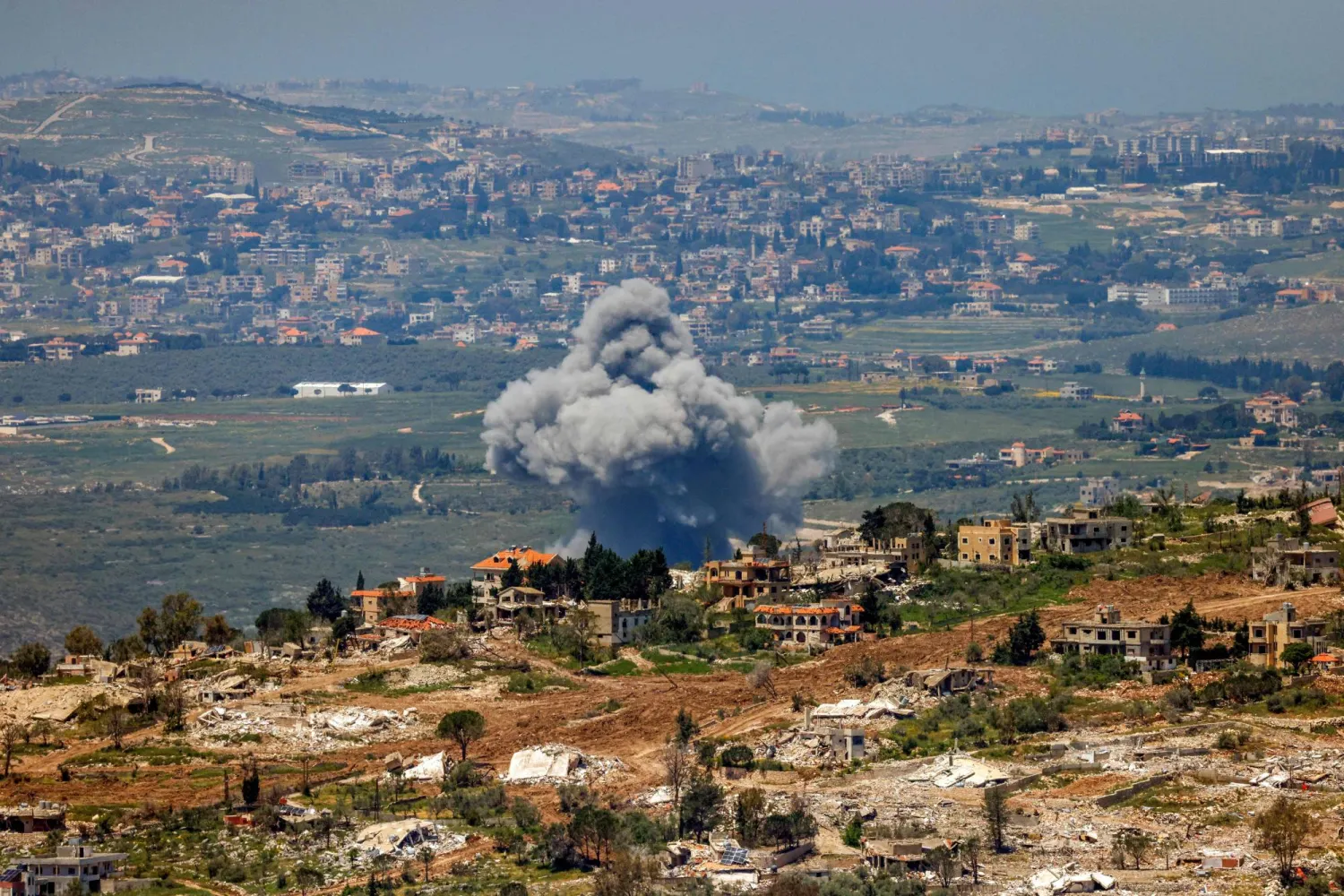

Hezbollah Says Launched Missiles at Military Base in North Israel

Smoke rises following Israeli bombardment in southern Lebanon as seen from a position across the border in the Upper Galilee in northern Israel on May 7, 2026. (Photo by Jalaa MAREY / AFP)
TT

Hezbollah Says Launched Missiles at Military Base in North Israel

Smoke rises following Israeli bombardment in southern Lebanon as seen from a position across the border in the Upper Galilee in northern Israel on May 7, 2026. (Photo by Jalaa MAREY / AFP)

Hezbollah launched missiles at a military base in Israel on Friday in response to Israeli attacks that killed a top commander, while Lebanese authorities reported five people including a rescuer killed in fresh Israeli strikes. 

In a statement, the group said the missiles targeted a base south of the Israeli city of Nahariya "in response to the Israeli enemy's violation of the ceasefire, the targeting of Beirut's southern suburbs and the attacks that affected villages and civilians in southern Lebanon". 

Air raid sirens had sounded earlier in several cities in northern Israel, according to the Israeli military. 

The military said it "intercepted one launch, and the additional launches fell in open areas", adding that no injuries were reported. 

The Lebanese health ministry meanwhile said in a statement that "the Israeli enemy's raid on the town of Toura" in the southern Tyre district killed four people, including two women, and wounded eight others in a preliminary toll. 

Lebanon's civil defense said earlier that one of its members was killed in an Israeli attack on the south. 

Despite a truce in the war between Israel and Hezbollah in place since April 17, fighting has not stopped in south Lebanon. 

The terms of the ceasefire announced by the US state department on April 16 allow Israel to act against "planned, imminent or ongoing attacks" by Hezbollah. 

The Israeli military had issued evacuation warnings for seven southern Lebanese towns, including Toura. 

Lebanon's state-run National News Agency reported a series of strikes across the south on Friday. 

Hezbollah also claimed responsibility for several attacks on Israeli troops in southern Lebanon. 

- Upcoming talks - 

Israel struck Beirut's southern suburbs on Wednesday, the first attack on the Hezbollah stronghold in a month. 

The Israeli military said it targeted the commander of Hezbollah's elite Radwan Force. 

Hezbollah has not yet announced a commander's death, but a source close to the group confirmed the killing to AFP the killing of Malek Ballout 

The latest attacks came as Lebanon and Israel, officially at war since 1948, were set to hold direct negotiations in Washington next week. 

Lebanese President Joseph Aoun met with delegation chief Simon Karam on Friday ahead of his departure to the US, giving him "directives outlining Lebanon's firm positions regarding the negotiations". 

Lebanon and Israel's US ambassadors had previously met twice in Washington over the past weeks, in an attempt to end the war that started when Hezbollah drew Lebanon into the Middle East conflict on March 2. 

Hezbollah is strongly opposed to the direct talks, calling them a "sin" and urging Beirut to withdraw from them. 

Israeli strikes have killed more than 2,750 people in Lebanon since March 2, including dozens since the ceasefire was announced. 

EU crisis management chief Hadja Lahbib told reporters in Beirut that since the start of the war on March 2, the 27-member bloc has provided 100 million euros in aid and sent six planes carrying humanitarian aid, with a seventh expected on Saturday. 



Israel Strikes South Lebanon despite Framework Agreement to End Hostilities

Billboards reading 'Lebanon First' are displayed alongside the airport highway in Beirut, Lebanon, 27 June 2026, amid a ceasefire between Israel and Lebanon.  EPA/WAEL HAMZEH
Billboards reading 'Lebanon First' are displayed alongside the airport highway in Beirut, Lebanon, 27 June 2026, amid a ceasefire between Israel and Lebanon. EPA/WAEL HAMZEH
TT

Israel Strikes South Lebanon despite Framework Agreement to End Hostilities

Billboards reading 'Lebanon First' are displayed alongside the airport highway in Beirut, Lebanon, 27 June 2026, amid a ceasefire between Israel and Lebanon.  EPA/WAEL HAMZEH
Billboards reading 'Lebanon First' are displayed alongside the airport highway in Beirut, Lebanon, 27 June 2026, amid a ceasefire between Israel and Lebanon. EPA/WAEL HAMZEH

Israel renewed its strikes on Lebanon on Sunday, Lebanese state media reported, two days after an agreement was signed by the two countries, which a Hezbollah lawmaker warned would lead to "internal conflict".

The strikes come a day after one person was killed in an Israeli strike on the south, according to Lebanon's health ministry, with the Israeli military saying it targeted Hezbollah members near its self-proclaimed "security zone", which reaches 10 kilometres (6 miles) into Lebanon.

Lebanon's state-run National News Agency (NNA) reported several strikes on Sunday.

The Israeli army said a soldier "fell in combat" in southern Lebanon.

In a later statement, Israeli military chief Eyal Zamir approved plans for "continued operations in the security zone, in accordance with the ceasefire agreement".

Lebanese President Joseph Aoun told his US counterpart Donald Trump on Saturday that his country "would assume its responsibilities" in implementing the framework agreement, which was signed in Washington on Friday after five rounds of talks.

The deal aims to pave the way for peace between Israel and Lebanon, who have officially been at war for decades, though Israel's many conflicts across its northern border have largely been with non-state actors.

The agreement makes any Israeli withdrawal from occupied Lebanese land conditional on Beirut disarming Hezbollah, which is backed by Iran.

Israeli Prime Minister Benjamin Netanyahu called the deal "historic" for his country.

- 'Internal conflict' -

Hezbollah strongly opposed the talks with Israel from the start and rejects the agreement, with leader Naim Qassem saying on Saturday that the group would treat the deal as "null and void" and describing it as "a surrender of sovereignty".

His supporters took to the streets on Friday evening to protest the framework.

An AFP correspondent saw signs on Sunday morning that read "Lebanon first" being burned along Beirut's airport road, which borders the city's southern suburbs, a Hezbollah stronghold, after previous billboards saying "thank you Iran" were removed.

Hezbollah lawmaker Hassan Fadlallah said on Sunday that "the agreement of humiliation and disgrace signed by the authorities will never see the light of day".

He added that what "the authorities have done amounts to sedition aimed at pushing the country into chaos and shifting the conflict from one with the enemy to an internal conflict".

Hezbollah repeatedly asked Lebanese authorities to link themselves to Iran's negotiations to end its war with the US, while Tehran has insisted any ceasefire for the Middle East war should include Lebanon.

In a phone conversation with his Lebanese counterpart Nabih Berri, Iranian parliament speaker and head of Tehran's negotiating delegation Mohammad Bagher Ghalibaf said that "our goal is to end the war in Lebanon, return the refugees to their homes and remove the occupation and the withdrawal of the Zionist regime from the Lebanese territory, and we are seriously pursuing this issue".

According to the text of the deal shared by the US State Department, Lebanon and Israel expressed their intent to "conclusively end the conflict, address its underlying causes and... formally conclude any state of war between them".

Under the agreement, Lebanon's military will "restore effective sovereign authority over all Lebanese territory, pending the verified disarmament of non-state armed groups".

Israel's Defense Minister Israel Katz, however, has insisted troops will stay in Lebanon so long as Hezbollah remains armed.


Iraq Arrests Dozens of Politicians and Government Officials in Green Zone Raids

A circulating image shows Iraqi Humvees at an entrance to the Green Zone at dawn Sunday
TT

Iraq Arrests Dozens of Politicians and Government Officials in Green Zone Raids

A circulating image shows Iraqi Humvees at an entrance to the Green Zone at dawn Sunday

Iraqi security forces arrested dozens of politicians, lawmakers and senior government officials early on Sunday after Elite Counter Terrorism Service (CTS) units raided their homes inside Baghdad's heavily fortified Green Zone, security sources told Asharq Al-Awsat.

The state news agency later reported that 47 people had been arrested in the corruption probe, but it was not clear if all of them were detained Sunday or if some of them had been arrested earlier.

The security sources said that the heaquarters of Midland Oil Company south of Baghdad were raided too.

A senior source quoted by ⁠state news ⁠agency INA said that some of the latest arrests were based on testimony provided by Adnan al-Jumaili, deputy oil minister for refining affairs, after his detention on corruption charges.

The source told INA that al-Jumaili's statements implicated a wider network of officials in alleged corruption schemes.


Iraqi security personnel are seen near a house in the Green Zone at dawn Sunday (X)

Sunday's operation was launched on direct orders from Prime Minister Ali al-Zaidi, a government official told Asharq Al-Awsat.

Iraq's anti-graft body, the Commission of Integrity, said that authorities are implementing judicial arrest warrants against suspects "accused of misappropriating public funds."

In a move to demonstrate commitment to fighting corruption, authorities seized more than $85 million earlier this month in the graft case against Jumaili.


Iraq’s PM Sends Positive Signals Ahead of Trump Meeting

Iraqi Prime Minister Ali Al-Zaidi during his meeting with Iranian Ambassador Mohammad Kazem Al-Sadeq in Baghdad (Government media)
TT

Iraq’s PM Sends Positive Signals Ahead of Trump Meeting

Iraqi Prime Minister Ali Al-Zaidi during his meeting with Iranian Ambassador Mohammad Kazem Al-Sadeq in Baghdad (Government media)

Iraqi Prime Minister Ali al-Zaidi has been sending positive signals to Washington ahead of a planned mid-July visit, as analysts say his government is trying to reorganize ties with the United States based on an economic and security partnership while preserving relations with Iran.

US Secretary of State Marco Rubio said Washington had recently received good and constructive signals from the Iraqi government on armed factions, in a reference to efforts to place weapons under state control and disarm armed groups.

In his latest remarks carried by state media, al-Zaidi urged armed factions to “preserve their history after contributing to the fight against terrorism, and to work through the state,” renewing his government’s rejection of “weapons outside official institutions.”

Al-Zaidi said his government sought a “strong economic partnership” with the US, while stressing that Baghdad’s ties with Tehran were “based on good neighborliness, respect and common interests, as is our relationship with all countries of the region.”

“Iraq does not accept dictates from any party, and the decision will always be made according to the interests of Iraqis first,” he said, adding that his government’s strategic direction was built on “a strong partnership with the US, starting from Iraq’s interest, and not at the expense of any other party.”

He said Iraq “does not follow a policy of blocs or hostility, and wants to be a space for communication and stability, not an arena for conflict,” in a reference to US-Iranian competition in Iraq.

On Iraq’s regional ties, al-Zaidi said the “Gulf Arab states represent a historical, cultural and social depth and a source of strength for Iraq.”

Balancing Iran

Al-Zaidi’s expected visit to Washington comes as Baghdad seeks to reshape its relationship with the US while maintaining balanced ties with Iran, amid regional shifts that followed this year’s Israel-Iran war.

Iraqi researcher Muhanad Seloom said al-Zaidi “is clearly seeking a strong partnership with the US at all levels,” calling the approach “good.”

Seloom said there was popular support for fighting corruption and restricting weapons to the state, giving the government the basic tools to move ahead despite the complexity of the issue of militias.

Speaking to Asharq Al-Awsat, Seloom described Iranian as “negative.” He added that it was not in Iraq’s interest to enter into hostility with Iran, and that the US understood the special nature of Baghdad’s relationship with Tehran.

The ‘project to eliminate militias’

Political science professor Talib Muhammed Karim said al-Zaidi “is not going to Washington carrying a project to eliminate militias in the military sense, but rather a project to strengthen the state and restore its legitimate monopoly over the use of force.”

Karim told Asharq Al-Awsat that the wager was to build an internal consensus, backed by regional and international support, that would allow weapons to be gradually restricted to the state under the law.

He said Iranian influence was not confined to the security sphere, but extended to political, economic and social ties built up over more than two decades.

Reducing that influence, he said, would not come through a political decision or external pressure alone, but through stronger Iraqi state institutions, a more diversified economy and broader Arab and international partnerships. That, he said, would automatically reduce the impact of any outside influence.

Karim said the success of the Washington visit “will not be measured by whether there is a confrontation with armed factions,” but by Iraq’s ability to secure US and international backing for the state project, attract investment, strengthen the economy and expand security cooperation in ways that reinforce state sovereignty.

A shifting US view

Political science professor Abbas Abboud Salem offered a different reading, saying Iraq’s political system “cannot be reduced to the will of one person.” The post-2003 political scene, he said, is built on multiple competing political forces.

Salem told Asharq Al-Awsat that the silence of these forces does not mean they have given al-Zaidi a mandate to radically change Iraq’s policy.

What has changed most, he said, is the US view of Iraq. According to Salem, Washington moved from direct occupation to managing Iraq after the withdrawal as a zone of influence balanced with Iran, and then to seeking a return through direct influence amid regional geopolitical shifts.

Salem said these shifts were pushing Iraq to rebuild its alliance with the US in response to regional challenges and to reduce losses as the regional order is being reshaped.