


Three-Member Committee Negotiates With Washington on Disarming Iraqi Factions

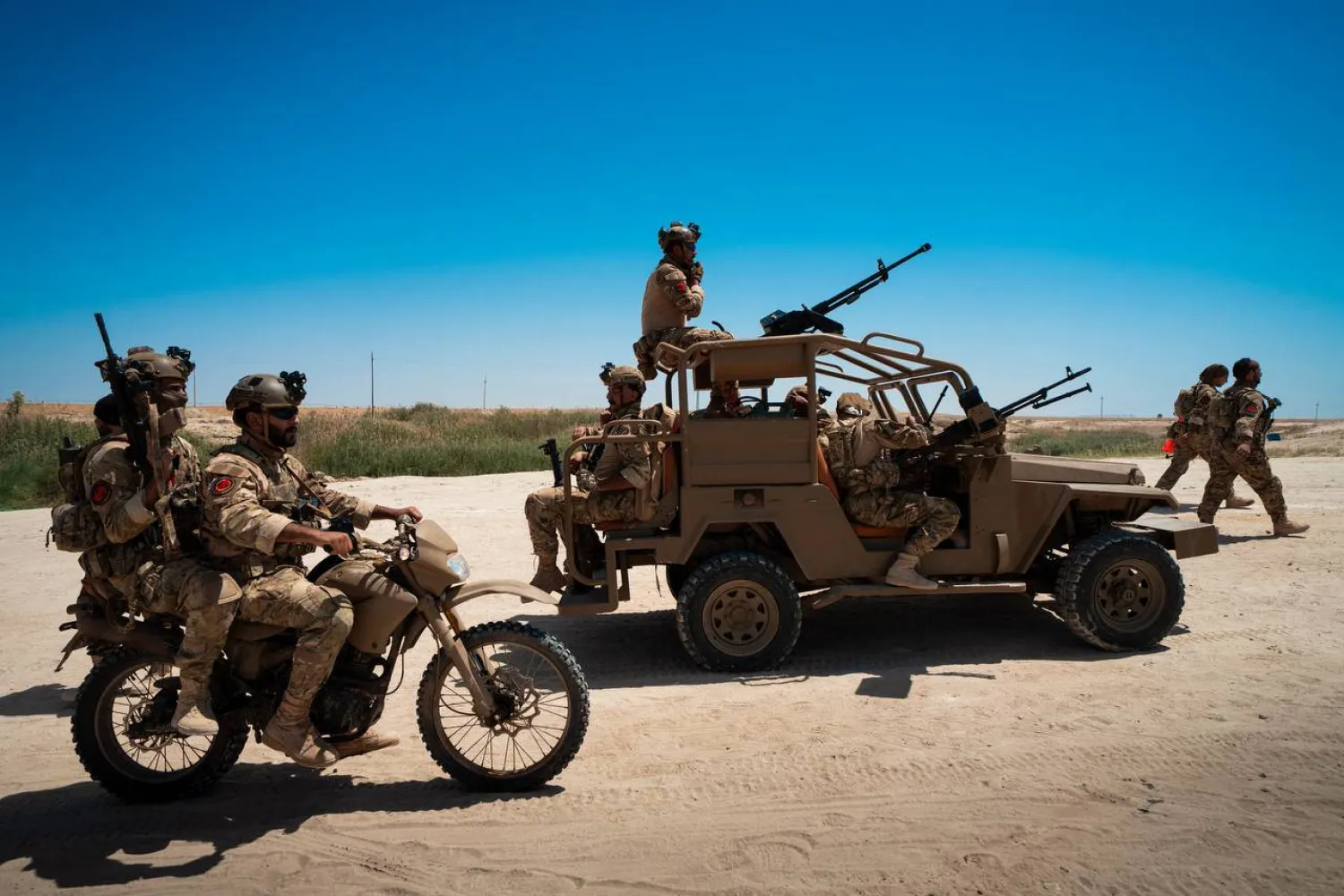
Popular Mobilization Forces brigades patrol. (PMF media office)
TT

Three-Member Committee Negotiates With Washington on Disarming Iraqi Factions

Popular Mobilization Forces brigades patrol. (PMF media office)

Asharq Al-Awsat has learned that an Iraqi committee comprising three senior figures is close to finalizing an “executive plan” to disarm armed factions, ahead of presenting it to US officials in the coming days.

As the process coincides with expected changes in the leadership of key security agencies under the incoming government, political and government officials ruled out the possibility that the plan would go beyond “buying time,” while representatives of three factions insisted they “will not surrender their weapons.”

Washington has intensified pressure on the ruling Shiite parties to disarm armed factions and prevent their representatives from participating in the new government. These pressures are expected to translate into practical measures as the formation of the next government in Baghdad approaches.
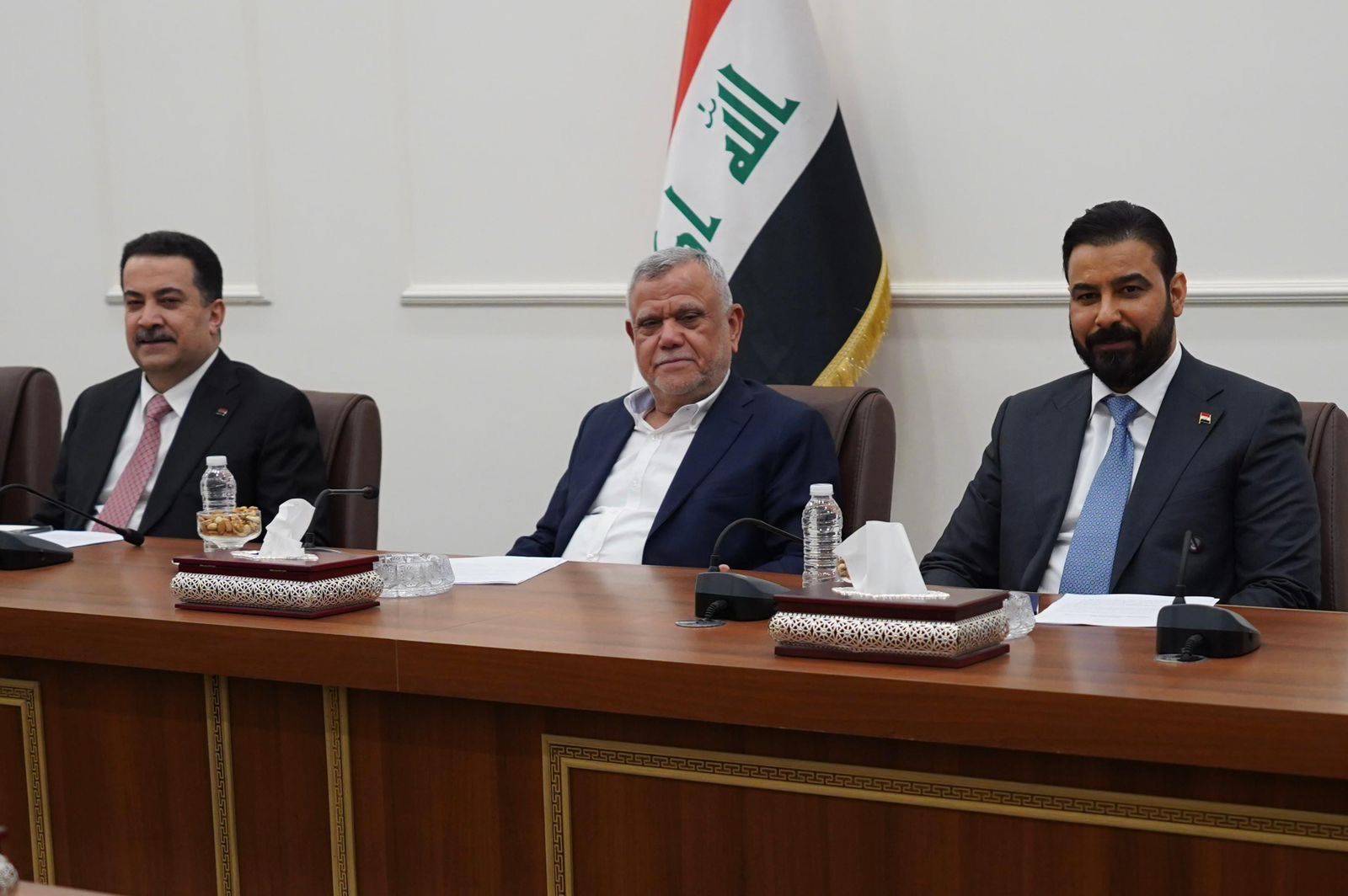
A photo released by the Coordination Framework shows, from left, Prime Minister-designate Ali al-Zaidi, Hadi al-Amiri, and Mohammed Shia al-Sudani.

Negotiations on Disarmament

The committee, whose existence is being disclosed for the first time, includes Prime Minister-designate Ali al-Zaidi, outgoing Prime Minister Mohammed Shia al-Sudani, and Badr Organization leader Hadi al-Amiri. According to sources, the committee has held secret negotiations with militia leaders, presenting them with “ideas on how to disarm and integrate fighters,” although some meetings “did not proceed calmly.”

Sources told Asharq Al-Awsat that al-Amiri’s presence, given his longstanding ties to Iran, “was supposed to help build trust with the factions and persuade them to engage with the state,” adding that the committee had been fully authorized by the Coordination Framework.

A climate of mistrust and mutual accusations prevails between Shiite party leaders and armed factions, the sources said, predicting that Zaidi’s government could face serious obstacles preventing it from implementing fundamental reforms related to weapons and financial resources that Washington says are deliberately being funneled to Iran through various channels.

Zaidi has enjoyed unprecedented support from the US administration since being formally tasked with forming a government. However, many believe the American “honeymoon” could end if no meaningful progress is made in reducing Iranian influence and severing militia ties to the Iraqi state.

A phone call last Wednesday between US Defense Secretary Pete Hegseth and Prime Minister-designate Ali al-Zaidi reportedly signaled that Washington wants militia elements removed not only from senior ministerial posts, but also from positions at the level of director-general.

Sources said people close to Zaidi understood from the call with Hegseth that, from Washington’s perspective, the legitimacy of the new Baghdad government would depend on its ability to distance militias from the machinery of the state.

A senior political official told Asharq Al-Awsat that the committee had accelerated its work under mounting US pressure, noting that security advisers had been working for months on various options for disarmament or integration, but that the pace had intensified in recent weeks.

The official said the executive plan includes disarming factions of heavy and medium weapons and restructuring the Popular Mobilization Forces, without specifying how the process would be carried out.

Uncertainty continues to surround the future of the PMF in Iraq, particularly whether it will ultimately submit to US pressure and become part of the disarmament project.
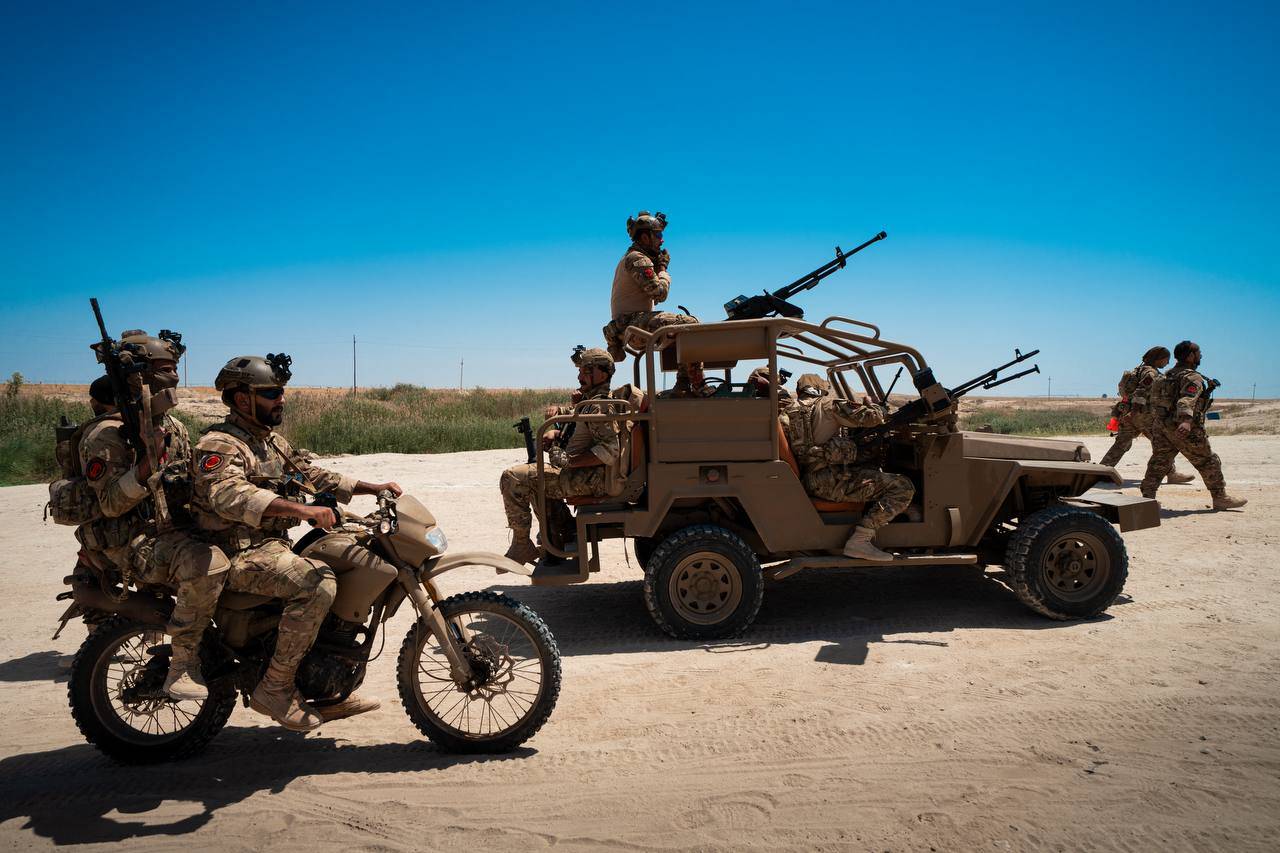
Popular Mobilization Forces brigades patrol. (PMF media office)

A Plan to “Buy Time”

Iraqi politicians say General David Petraeus may visit Baghdad this week to ensure that “the new government fully severs its ties with militias.” It has not been possible to verify the official capacity Petraeus would hold during the expected visit to Baghdad.

Petraeus is considered one of the leading US commanders associated with the Iraq war after 2003. He gained extensive field and strategic experience, most notably as commander of the 101st Airborne Division during the invasion that toppled Saddam Hussein.

His later experience also positions him to play a role in the factions’ weapons matter. In 2004, he was tasked with training local security forces amid escalating sectarian violence and worked closely with political leaders, some of whom headed militias at the time, including Hadi al-Amiri.

Iraqi sources suggested that the “executive plan” being prepared by the committee “may offer promising ideas to convince the Americans of Zaidi’s seriousness regarding disarmament, but there are doubts over whether it will actually be implemented, and it may amount to little more than an attempt to buy time, enough to secure passage of Zaidi’s government while waiting for the Iran-US war to end.”

A prominent Shiite adviser said: “Stalling on the issue of factional weapons will end with the ruling alliance being classified as a political group supporting terrorism. For Iraq, this would mean awaiting severe economic sanctions as a rogue state.”

Zaidi’s government program consists of 14 points, headed by “restricting weapons to the hands of the state and enforcing the rule of law.” However, it also includes a clause on “developing the combat capabilities of the Popular Mobilization Forces and defining its responsibilities and role within the military structure.”

An Iraqi official told Asharq Al-Awsat that “Washington does not want to loosen its grip on Baghdad to prevent armed faction leaders and members from infiltrating the new government.”

‘We Will Not Surrender Our Weapons’

In response to the tougher US position, some armed factions are adopting a more hardline stance. A spokesperson for one faction said that Kataib Hezbollah, Kataib Sayyid al-Shuhada, and Harakat al-Nujaba reject handing over their weapons to any party whatsoever.

The spokesperson, who requested anonymity, said the three factions were “prepared to pay any price resulting from their refusal to disarm.”

Sources said the armed factions do not believe they are compelled to relinquish their weapons. Instead, they view potential US consequences as unlikely to be harsher than what occurred during the previous war, including assassinations and the destruction of infrastructure.

“The war showed us how more power can be gained,” the faction spokesperson said.

Within the Coordination Framework, questions are being raised about whether Washington seeks to isolate all militias from state institutions, including those that have begun adopting rhetoric less centered on weapons and already hold seats in the Iraqi parliament.

These groups, led by Asaib Ahl al-Haq, are exploring alternative formulas for participating in the new government by reviving a model previously used during Mustafa al-Kadhimi’s administration: backing figures described as independent for ministerial positions while maintaining indirect influence over those posts.

US Treasury sanctions announced Thursday targeted figures involved in oil smuggling, including Laith al-Khazali, brother of Asaib Ahl al-Haq leader Qais al-Khazali, who has reportedly at times been considered for the Interior Ministry and at others for a service ministry.

The sanctions also included Ali Muaredh al-Bahadli. Informed sources said “a political faction had nominated him for the position of Iraqi oil minister.”

Politicians from the Coordination Framework said the sanctions may have been intended to “block undesirable nominations and steer the process toward other candidates.”

Although the disarmament negotiations appear in essence to be discussions about repositioning armed groups in a way that does not provoke American anger, according to one Iraqi official, that does not mean changes will not occur.

The official said the new government would witness security appointments aimed at reducing factional influence over sensitive institutions, including the intelligence service, which is likely to be headed by a Sunni figure.


Sudanese Army Welcomes RSF Defectors

Sudanese Army commander Abdel Fattah al-Burhan receives Major General Al-Nour Qubba, who defected from the Rapid Support Forces. (Sovereignty Council)
TT

Sudanese Army Welcomes RSF Defectors

Sudanese Army commander Abdel Fattah al-Burhan receives Major General Al-Nour Qubba, who defected from the Rapid Support Forces. (Sovereignty Council)

Sudan’s army is increasingly absorbing defectors from the Rapid Support Forces (RSF), betting that growing divisions within the paramilitary group can help consolidate military gains in a civil war that has become one of the world’s worst humanitarian crises.

The latest sign of that strategy came last month when authorities in Khartoum granted a military rank to Ali Rizqallah, a former RSF commander who defected alongside several other senior figures. The army-backed government welcomed the move as evidence of widening cracks within the RSF.

The conflict erupted on April 15, 2023, after a power struggle between the army and RSF spiraled into open warfare. Since then, the war is believed to have killed hundreds of thousands of people, displaced millions, and fueled famine and disease across large parts of the country.

Some of the worst violence has unfolded in Darfur, an RSF stronghold where the force has been accused of committing atrocities. Alleged abuses during the group’s assault on al-Fashir last October were documented in a Reuters investigation.

Halima, a resident of Darfur now living in the town of Tawila, said she was forced to flee repeatedly as RSF fighters raided villages surrounding al-Fashir. She recounted that she witnessed women being raped and was herself whipped by RSF personnel.

Sudanese refugees from Darfur walk amidst a sandstorm at the Touloum refugee camp, amid ongoing conflict in their country, on the outskirts of the town of Iriba in Wadi Fira province, eastern Chad, November 30, 2025. (Reuters)

“My arm is covered in scars all the way down to here,” she said, pointing toward her leg as she described the marks left on her body.

Anger toward the RSF is also widespread in neighboring Kordofan. A merchant in the town of Al-Nuhud revealed that he plans to file a lawsuit over the looting of warehouses and food stores.

Speaking on condition of anonymity for fear of retaliation, he blamed the RSF for the losses. But Mohamed Salah al-Din, a member of the executive council of the Emergency Lawyers group, said such individual cases are unlikely to gain broad traction amid the turmoil of war.

“This issue cannot be addressed piecemeal,” he stated. “It requires transitional justice.”

His comments contrast with efforts already underway to prosecute alleged collaborators. Emergency Lawyers said it has documented 243 cases referred to the courts involving accusations ranging from supplying intelligence to the RSF to cooking for its fighters.

The army is also seeking to exploit tribal tensions within the RSF’s support base. Several of the group’s senior commanders come from the Arab Rizeigat tribe, where rival clans have become increasingly divided, particularly after an RSF raid earlier this year on the hometown of Musa Hilal, a powerful tribal leader aligned with the military.

Hilal belongs to the Mahamid clan, while critics accuse the RSF of operating through a tribal and ethnic hierarchy that disproportionately benefits the family of its commander, Mohamed Hamdan Dagalo, better known as Hemedti.

“The RSF has become the preserve of a specific group and a single family,” critics said. “The project that builds a state must be a Sudanese national project, not one based on tribal loyalties.”

The Sudanese military is hoping those divisions will trigger further defections, replicating the success it achieved in Al Jazirah State, where the 2024 defection of militia commander Abu Aqla Keikal helped shift momentum decisively in the army’s favor.


Hamas Inclined Toward ‘Positive’ Response to Mladenov Amendments Despite Internal Objections

Mourners grieve for Palestinian woman Shahd Ashour, who was killed in an Israeli airstrike on Monday in Gaza City (AP). 
TT

Hamas Inclined Toward ‘Positive’ Response to Mladenov Amendments Despite Internal Objections

Mourners grieve for Palestinian woman Shahd Ashour, who was killed in an Israeli airstrike on Monday in Gaza City (AP). 

Expectations are growing that Hamas and other Palestinian factions will respond positively to revised proposals put forward by Nikolay Mladenov, the senior international mediator for Gaza within the Peace Council framework, despite emerging opposition to the latest amendments he has made to a roadmap first presented to the movement in April.

Hamas and participating factions are reviewing the newest version of Mladenov’s proposals, which are intended to advance a fragile Gaza ceasefire announced in October as part of a plan introduced by US President Donald Trump. Palestinian officials accuse Israel of repeatedly violating the agreement, saying more than 1,000 Palestinians have been killed in Gaza since the truce took effect.

Two Hamas sources and a third source from another Palestinian faction involved in the negotiations criticized the amendments, arguing that they depart from key provisions of the original agreement. Their objections focus on issues including an Israeli withdrawal from Gaza, implementation of the first phase of the deal, the rights of employees affiliated with the Gaza administration, reconstruction guarantees across the enclave, and the broader political framework.

The disagreements have complicated indirect talks between Israel and Palestinian factions over advancing to subsequent stages of the ceasefire agreement. Palestinian negotiators insist that Israel must fulfill first-phase commitments, including withdrawing troops from occupied areas and allowing the entry of aid and commercial goods. Israel, meanwhile, continues to press for the disarmament of Palestinian factions as a central element of the next phase.

A Hamas source based outside Gaza noted that some implementation mechanisms in the roadmap remain unclear. The movement and other factions, he said, will seek additional clarification to ensure Israel fulfills its obligations.

A factional source inside Gaza echoed those concerns, arguing that certain revisions and the removal of previously agreed provisions effectively undermine earlier understandings. “There are attempts to impose a new reality that serves Israel’s interests at the expense of Palestinian rights,” he stated.

Despite the criticism, all three sources said Hamas and the factions are generally inclined to engage constructively with the revised proposal. They are expected to submit comments and additional amendments aimed at strengthening implementation of the original agreement signed in Egypt’s Sharm el-Sheikh in October 2025. A formal response is expected within days.

According to Hamas officials, the movement’s leadership seeks to build on recent understandings reached in Cairo in order to secure a permanent end to the war and alleviate humanitarian suffering in Gaza.

A Hamas source outside the enclave said negotiators are working toward an agreement that would prevent Israel from maintaining long-term security control or creating a security vacuum by limiting weapons while continuing military operations, either directly or through armed groups that Hamas and other factions insist must be dismantled.

Meanwhile, Israeli military operations continued across Gaza. On Monday, Israeli forces killed a paramedic after targeting a vehicle in the al-Mawasi area of Khan Younis in southern Gaza. Six others were wounded.

Earlier, an Israeli strike in Gaza City’s al-Rimal neighborhood targeted a vehicle with four missiles during the busy morning rush hour. The attack killed an 11th-grade student and wounded at least eight others. A local field source said the intended target escaped after abandoning the vehicle following the first missile strike.

According to Gaza’s Health Ministry, the death toll since the ceasefire began has surpassed 1,026, with more than 3,260 people injured. The ministry says more than 73,000 people have been killed in Gaza since October 7, 2023.


New Lebanon-Israel Talks to Begin, in Shadow of US-Iran Deal

This picture taken from a position in northern Israel, near the border with Lebanon shows an Israeli military vehicle driving along a road in southern Lebanon on June 22, 2026. (AFP)
TT

New Lebanon-Israel Talks to Begin, in Shadow of US-Iran Deal

This picture taken from a position in northern Israel, near the border with Lebanon shows an Israeli military vehicle driving along a road in southern Lebanon on June 22, 2026. (AFP)

Lebanon heads into a new round of talks with Israel on Tuesday in Washington, with Beirut determined to press ahead with direct negotiations even as they appear to be overshadowed by Iran's decision to make Lebanon part of its negotiations with the United States.

Lebanese officials have insisted that face-to-face negotiations with Israel are the only way to secure an end to the war raging since March 2, when armed group Hezbollah fired at Israel in support of Iran and triggered Israeli air and ground attacks that have killed more than 4,000 people in Lebanon.

But four rounds of Lebanese-Israeli talks since April failed to produce a durable ceasefire. Instead, the longest lull in fighting came this week after Iran and the US agreed a memorandum of understanding that stipulated fighting would halt across all fronts, including Lebanon.

That deal buoyed Iran-backed ‌Hezbollah and dealt ‌a blow to the Lebanese state, whose leaders including President Joseph Aoun had repeatedly warned ‌that ⁠Tehran cannot negotiate ⁠on Lebanon's behalf.

A Lebanese official and two foreign officials working on Lebanon told Reuters the Iran-US deal had pulled the rug out from the Lebanese state, leaving it in its weakest position yet and throwing into question the utility of its talks with Israel this week.

The Lebanese official was skeptical that any tangible progress would come out of the negotiations, which are set to last for three days.

"There remains a fundamental problem of trust between us and the Israelis in these talks. We cannot fulfill their demands, and they reject all of ours," the official said.

LEBANON TO SEEK ISRAELI WITHDRAWAL TIMELINE

Lebanon has ⁠said that one of its key goals in the talks would be securing an ‌Israeli military withdrawal, but top Israeli officials have said that troops would ‌remain in southern Lebanon indefinitely.

The Lebanese official said that Beirut would demand Israel present a "reasonable" timetable for its withdrawal at the talks.

"This ‌is the only chance we have to generate momentum in these talks, and in this tug-of-war with Iran," ‌the official said.

Israel, meanwhile, sees the purpose of the upcoming talks as "disarming Hezbollah and achieving a genuine peace agreement" with Lebanon, according to a briefing by Israeli government spokesperson David Mencer on the eve of the new negotiations.

Mencer said the only impediment to a deal with Lebanon was Hezbollah, "which is why we believe that they should be disarmed and dismantled."

The Lebanese government has moved ‌carefully since 2025 to disarm Hezbollah without confronting the group directly, fearing it would spark a civil conflict.

Hezbollah has rejected disarming in full and has called on the ⁠government to withdraw from its ⁠direct talks with Israel.

HEZBOLLAH BETS ON IRAN AS NEGOTIATOR

Karim Safieddine, a fellow at the Washington-based Tahrir Institute for Middle East Policy, told Reuters there was a risk that Israel could assume an even more hardline position in the Washington talks given its officials' anger over the US-Iran deal.

While that deal had brought relative calm to Lebanon, there was "no structural change" in the Lebanese and Israeli positions that indicated progress could be made at the negotiating table, Safieddine said.

Aoun first proposed direct talks in March, but they only began in mid-April, after the US announced a ceasefire to enable a diplomatic process that Washington said would ultimately lead to a peace deal.

Israeli air strikes on Beirut's southern suburbs then largely stopped, but fierce fighting continued in southern Lebanon as Israeli troops pushed deeper into Lebanese villages.

The US announced a new ceasefire initiative in early June again as part of the Lebanese-Israeli talks, but it was contingent on Hezbollah halting fire and was rejected by the group.

Hezbollah expects Iran to demand an Israeli withdrawal as it pursues talks with the US on a final deal, and says the Lebanese government should bet on that track instead of its direct negotiations.
